
Summer of 2002.
Junior at the University of Hawaii-Manoa.
Quarterfinals of the World Cup.
The games were on at odd hours but you bet we woke up to cheer on the team.
Spain vs. Korea (co-host nation).
Full 120 minutes played, score is 0-0. Penalty kicks (PKs).
Korea goes first.
Both Korea and Spain make their first 3 PKs.
Ahn Jung Hwan makes the 4th.
Joaquin of Spain walks up to take their 4th PK. Except this time, Lee Woon Jae blocks it. 4-3. If Korea makes it, they move on to the semifinals.
Hong Myung Bo, the team captain, walks up and nails the PK.
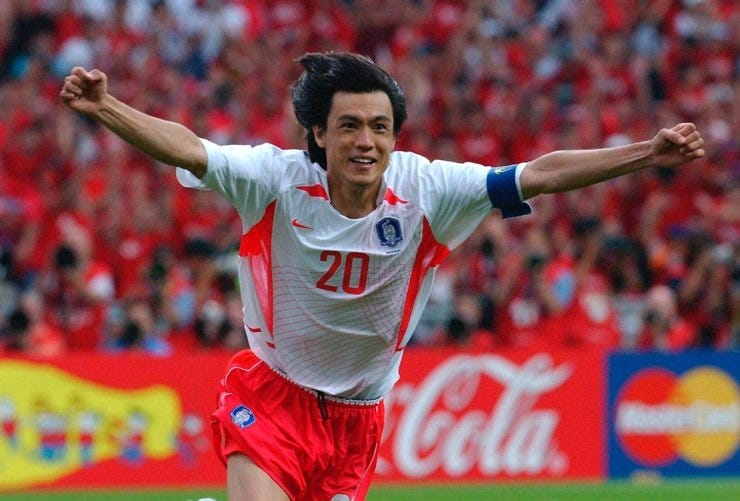
Korea becomes the first Asian team to make it to the semifinals in the World Cup.
Team Captain Hong was awarded the Bronze Ball of the 2002 World Cup which signified he was the 3rd best player of the entire tournament.
He’s the only Asian to this day ever to finish in the top 3 World Cup’s Golden Ball voting.
We lost to Germany 1-0 in the semifinals and ended up losing to Turkey to finish 4th overall in the 2002 World Cup.
That’s when I really started taking interest in soccer.
This was a great source of pride for us Koreans.
In fact, 3 to 4 years later, when I meet my father in-law for the first time, one of the first things he’ll say to me is, “You do know that our country finished 4th in the World Cup, right?”
I mean, obviously. Are you really a Korean if you don’t??? And no, I didn’t respond like that to my future father in-law.
But, I do wonder if it heavily hampered the growth of Korean football.
Instead of developing talent and growth, we’ve been chasing the high of 2002.
And it crashed spectacularly in this year’s World Cup.
So much so that the tournament ended with both KFA (Korean Football Association) president Chung Mong-gyu and Hong Myung-bo resigning.
My wife has asked me enough times what Hong was doing to pique my curiosity and do a mini dive into Korean football. Along with the people asking “Why is the Korean government getting involved in Korean soccer?”
And, the level of corruption can be described in only one word: Korean.
One of the successes of the 2002 squad was that they hired a non-Korean to coach the team, Guus Hiddink.
Guus had the autonomy to select his own players; drop established veterans; ignore politics — basically build the team to fit his tactical vision.
And right now you’re thinking, is that what a manager should do to begin with? Select the best players available?
Well, you see, KFA (and I’ll just focus on the KFA for this piece and not other organizations run by Koreans) operates like a good old boys club. The Korean manager would select the best players from the schools he went to/affiliated with. Not the best players available in the country, but the best players available that are within his affiliation. Okay, to be fair, there’s no public evidence to support this claim, but things have happened for this perception to have existed for decades.
For many Korean fans, that’s only the final chapter of a story that has been building for years. The frustration is directed less at one coach and more at the KFA.
The accusations are generally not of criminal corruption, but of cronyism, favoritism, lack of transparency, and resistance to outside voices.
Hong’s first tenure was in 2014.
Why not hire Hong, one of Korea’s greatest players?
But his first World Cup ended disastrously. Korea finished last in its group and Hong resigned afterward. But instead of moving on from KFA, he remained in senior roles.
Then, in 2022, the KFA hired the German Klinsmann, which was also a controversial hire because many questioned his commitment to living in Korea and developing the national program.
Results were disappointing.
Klinsmann was fired.
The KFA launched a worldwide search for the next skipper of the Korean National Football Team.
Jesse Marsch was one of the leading candidates. He ended up leading Canada to the Round of 16. He might’ve been a great fit for Korea but we’ll never know.
Hong did not participate in the interview process. Instead, the KFA Technical Director allegedly met Hong privately near his home to persuade him to accept the job.
Former national team player Park Joo-ho, who served on the coaching selection committee, later publicly criticized the process and suggested committee members were largely bypassed.
You know how in the NFL they have the “Rooney Rule,” where NFL teams must interview candidates of color during its hiring process of their head coach? Except, teams already know who they’re gonna hire and they’ll just interview a minority candidate whom they have no intentions of hiring to play the game. Well, it kinda seems like this was what happened. KFA had no plans to hire anyone else but Hong. So, already, this year’s World Cup had a rocky start because Hong’s last World Cup stint ended in last place.
But.
BUT.
This year’s squad is the best team on paper in our history.
You have Son Heung-Min, the GOAT Asian Footballer. Yes, he’s nearing the end of his prime, but he still can ball.
Then you have Kim Min-Jae of Bayern Munich, a solid defender that can defend with the best in Europe.
We have Lee Kang-In of Paris Saint-Germain — a Champions League winner, albeit spent most of the run on the bench. But being on that squad is a vote of confidence for his skills.
Then there’s Hwang Hee-Chan, of the Wolverhampton Wanderers, an established attacker in the Premier League.
This team had 20 of its 26 players playing abroad, the highest percentage of overseas-based players on the national team.
So, as always, there’s hope.
Would we go deep in the Cup? Mmmmm… maybe.
But with Mexico, Czechia, and South Africa as our group, the hope of advancing out of the group play was high. Expected, even. Mexico was really the sole big threat of this group.
But Hong didn’t use this team to the best of its abilities.
He committed to a 3-4-3 formation. There’s nothing inherently wrong with a 3-4-3. In fact, when you have the right personnel, it can be devastating.
The problem was that Korea didn’t.
That system depends heavily on attacking wingbacks, players who can defend one minute, bomb down the sidelines the next, and still have enough energy to track back. They’re arguably the most important players in the formation.
Korea’s squad wasn’t built that way.
Our wingbacks were natural fullbacks. Solid defenders, but not the type of players who thrive in those advanced roles.
The result was predictable. Korea struggled to create width, the midfield became isolated, and possession often turned into long stretches of passing with very little threat. We usually finished with more of the ball. Which sounds impressive until you remember that possession isn’t the objective. Goals are.
The system also put tremendous pressure on central midfielders Hwang In-beom and Baek Seung-ho, asking them to cover enormous amounts of ground while trying to connect the defense and attack. Too often, they were outnumbered, and Korea lost control of the middle of the pitch.
Even Son Heung-min never looked quite like himself.
When your tactics force your best players to play outside their strengths, the problem usually isn’t the players.
It’s the tactics.
Son Heung-min wasn’t used properly.
Sonny is one of the most dangerous players in the world when he’s running into space. Give him room to attack a back line and he’ll punish you. That’s been his game for nearly a decade in the Premier League.
But Korea rarely played that way. We dominated possession, slowly worked the ball around packed defenses, and asked Son to create magic against ten defenders already behind the ball. That’s simply not where he’s at his best.
When your greatest player suddenly looks ordinary, maybe the problem isn’t the player.
And then came the benching of Son in the first half of a must-win game vs South Africa. Remember, at this point Korea was fully in control of their destiny. They had to win to get in. And South Africa was a beatable team.
Hong later said that he was hoping that Son would be fresh while the defense would have tired legs in the second half.
It’s easy (well, easier, if you’re a rational, sane sports fan) to excuse mistakes, as boneheaded as they may be, during the game.
You know, like how JR Smith ruined the best game LeBron James ever played. All he had to do was call a timeout but he thought they were in the lead (they were not, the game was tied) and let the clock run out. The game went to overtime, where Cleveland lost and would go on to lose the championship to the Warriors.
This generation of NBA fans saw their version of the JR Smith boneheaded mistake when De’Aaron Fox tried to go for a lay up with the lead and less than 20 seconds to play. All he had to do was hold on to the ball. He would’ve been fouled and more time would have run off the clock. IInstead, he tried to be the hero, went for a layup, got blocked, and it led to the go-ahead bucket for the Knicks and the Spurs would eventually concede the championship to the New York Knickerbockers.
Just today (at the time of writing this), I witnessed Norway basically give away the game because someone else wanted to be Haaland.
You have one of the most elite strikers in the world on your squad.
He’s just a physical specimen. a Viking if you will.
He’s in the race for the most goals this World Cup.
So the question is:
How the hell do you not f#!%ing pass the ball to Haaland?
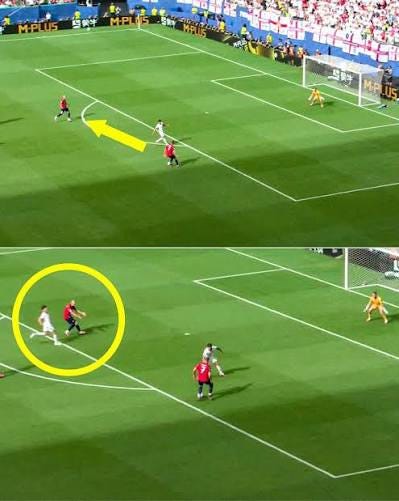
Anyway, I make bigger boneheaded mistakes with less on the line, you know?
But this wasn’t a middle-of-the-game decision.
This was a strategy. And a horrible one at that.
If I’m a coach and I have a player like Sonny on my team — a once-in-a-generation player for Korea — I’m going to ride him until he has no legs. Fair? To Sonny, absolutely not.
But you play to win the game.
And players like Sonny would rather be run to the ground than sit on the bench.
After the defeat, Hong admitted that if he had known the result, he would have made a different decision. (in the words of my 8th grade self, no shit Sherlock.)
But also, head scratching-ly… in the second half, Hong subbed out Kim Min-Jae.
Sonny might be the heart of the team and the captain.
Kim is the heart of the defense and he carries the team when Sonny’s not on the pitch. Taking Kim out made as much sense as leaving Sonny on the bench in the first half. But, we should’ve seen this coming, no?
Korea lost to Austria and Ivory Coast leading up to the Games, games Korea should’ve won, easily. (they lost 0-4 to Ivory Coast).
This was absolutely a failure for the coaching staff and the governing body of KFA. The tactics didn’t fit the players.
He didn’t utilize the best players to the best of their abilities.
With the most talented squad to date, he created a system that neutralized them.
Where do we even begin to talk about the shortcoming of the KFA?
I ain’t got the time nor the patience. But, Hong isn’t the whole story.
The bigger question is why he was there in the first place. If Hong had gone through a transparent hiring process and simply failed, that would be one thing.
Coaches fail. It’s the nature of the game.
Even the best managers in the world get tactics wrong.
But that’s not why so many Korean fans are angry. They’re angry because they watched the KFA announce a worldwide search.
They watched qualified candidates emerge. Only to be bypassed.
Then they watched the job go to someone who was already part of the establishment — someone who was not successful in his first stint as the coach.
Guus Hiddink can be an example of what Korean football could look like when managers and players are chosen out of merit instead of relationships.
When tactics came before politics.
When the goal is simply to build the best team possible.
But this kinda shortcoming isn’t just reserved for national football teams.
It happens in the local church.
The local church: where creativity and innovation go to die (unless you do them the way we’ve always done them).
One of the most innovative seasons of the Church in my lifetime was the pandemic shut down. We all had to scramble. There was no longer a box of: “we’ve never done it that way before” because everyone was on the same playing field: we were all forced into a situation none of us had been in before. We had no idea how to react (or act… and I don’t think we Americans really recovered).
So churches innovated.
Churches that treated modern technology like the Devil’s tools now had to embrace Satan’s screens, powerpoint, cameras, microphones.
We all became influencers of sorts, except most of us didn’t end our liturgy with “smash the like button and don’t forget to subscribe.”
But once the shutdown was lifted, most of the churches that were innovative for the first time in decades reverted to their pre-COVID selves really quick.
Almost like, “Oh thank God this is over. We can go back to how everything used to be.” Which… for many churches was picking up right where we left off in our decline.
That’s the dirty, not-so-well-kept secret of institutions: Institutions exist to keep themselves alive.
Not intentionally. Not maliciously. But over time, the mission slowly gets replaced by maintenance.
When we stop asking, “Why do we exist?” and start asking, “How do we preserve what we already have?” That’s when creativity becomes risky.
Innovation becomes threatening.
Familiarity becomes a virtue.
Outside voices become problems to solve (or ignore) instead of people to hear.
And eventually, protecting the institution becomes more important than fulfilling the purpose for which it was created.
I think we’ve all belonged to institutions like that.
Which is why questions matter. Especially uncomfortable ones.
“Why do we do this?”
“Why do we do it this way?”
“Is this still helping us accomplish our mission?”
Institutions rarely die all at once.
They die one “We’ve always done it this way” at a time.
Maybe the healthiest institutions aren’t the ones with all the answers.
They’re the ones that never stop asking why.
No posts
Comments
Nothing yet. Say the first thing.
Sign in to join the conversation.