
My work in addiction taught me something I now use constantly with couples: relapse is rarely the first event in a person’s collapse. It is usually the last one.
By the time someone picks up, a chain of smaller departures may already have happened. They stopped calling friends. They dropped whatever spiritual life they had. They stopped exercising, eating on a schedule, or asking anyone for anything. Withdrawal first, then the drug.
The dropped things were not decorative. They connected the person to the world and to themselves. Remove them one at a time and eventually you have someone isolated and neglected. The drug can treat isolation and neglect on short notice.
A marriage can come apart the same way, though the final event varies. Some people have an affair. Some drink. Some disappear into work, a screen, or a hobby they can pursue alone in the same room as their spouse. Some never leave and simply go quiet for a decade.
The visible rupture is often downstream of a connection that stopped being tended. Nothing necessarily happens on a Tuesday that either person can point to. Two people who love each other get comfortable, and comfortable neglect does not hurt at first.
For example, a man who takes a promotion that will add distance. The wife even tells him to take it. He is gone four nights a week, and on the nights he is home he is recovering from being gone. They mostly still like each other. They simply stop having anything between them that isn’t logistics. Five years later, she says she feels like a roommate. The man is blindsided because, from where he was sitting, he did all of it for them.
Or two people become good parents and stop being a couple. The children’s schedule becomes the final project they share. It is a real project, and it takes everything they have. When the youngest leaves, they discover there is almost nothing in the room that was not the children. They did not drift apart in any particular year. They stopped spending anything on each other that the children did not require.
A coworker asks how his day went and waits for the answer (as opposed to it just being a greeting without any expectation of response). Nobody has ever genuinely asked him in years, including his wife. The attention does not force him to betray his wife, and it does not absolve him if he does. It reveals how hungry he has become for something ordinary enough that he stopped noticing its absence.
Later, the “she asked about my day” sounds too small to explain anything. It is small. That is why it could disappear from his marriage without anyone sounding an alarm.
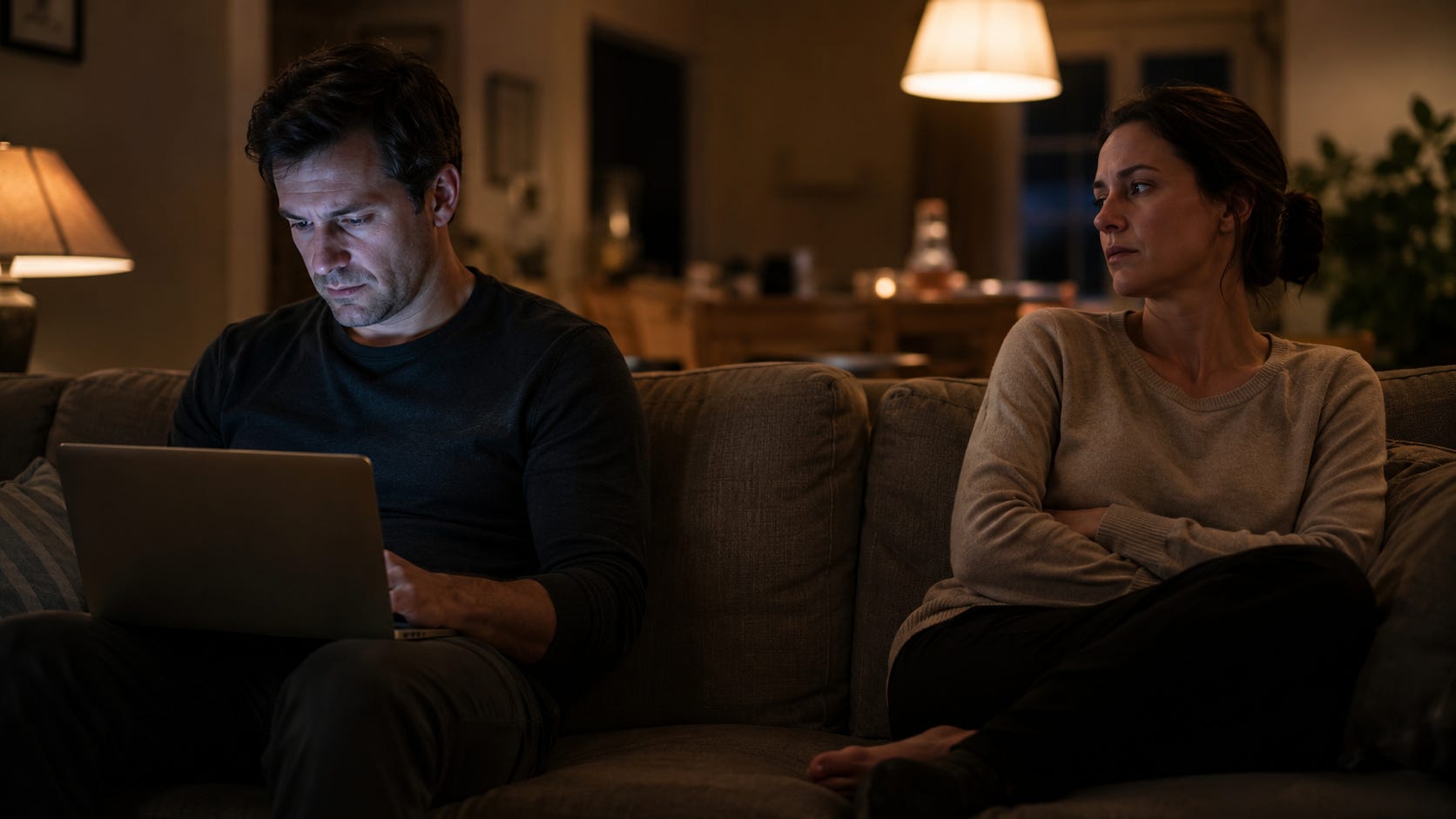
Mine was a laptop.
I had become consumed by a theory I had been building toward for years. Laptop on the couch, dawn to dusk, weekends included. It felt fantastic, and because it felt fantastic I assumed it was fine. That was the reasoning in full.
It ran for months. I found out what it cost through my wife’s tears, though what I was doing wrong was not dramatic. I was not lying to her. I was not gone.
I was in the room.
I was in the room building a theory about how people stay connected while my wife sat a few feet away feeling alone in her marriage. Had I held that pattern long enough, it might have ended in separation without producing a single decisive scene. No explosion. Just a long subtraction neither of us understood while it was happening.
We are told that love is a feeling and that the right person makes a relationship work. Neither idea mentions that connection is something people spend portions of their lives creating, or that it can disappear while they are sitting beside each other.
Proximity is not attention.
Attention means repeatedly noticing, knowing, and responding to another person. That requires actual portions of your life. Time is not the connection itself.
Time is what connection costs.
The price is not equal for every couple. Some people want many of the same things. Their interests overlap. Much of their connection occurs inside choices they would have made anyway.
Other couples have strong independent interests, punishing work schedules, children with high needs, illness, financial strain, or little practical support. For them, the same amount of connection may require much more deliberate sacrifice. Two couples can love each other comparably and still pay very different prices for maintaining access to one another. Different prices do not erase the bill.
A neglected marriage may help explain why attention from someone else felt powerful. It does not excuse deception. Stress may explain withdrawal. It does not make indefinite abandonment harmless. Explaining how a pattern formed is not the same as saying nobody chose to continue it.
Nor can one person pay the entire cost. This is not an argument for surrendering every independent interest while a spouse remains untouched. A marriage cannot be maintained by one person repeatedly sacrificing while the other treats that sacrifice as the natural order of things. I see this all the time in my practice.
Attention has to move in both directions.
The early flames of romance are real, but it is a poor measure of whether a relationship will hold. Its force tells you little about what two people will build after novelty stops doing the work for them.
What follows is less dramatic and more expensive. It is hours, but more precisely, it is what happens inside those hours. A thousand hours in which you continue encountering your spouse does something different from a thousand hours spent playing Stardew Valley. I am not being cute. That is an actual comparison, made one night at a time whether or not you experience it as a decision.
Here is the part nobody wants printed: maintaining connection is frequently not fun. Choosing the other person over the thing you would rather be doing is not always accompanied by warmth. Sometimes it is a cost paid on a night you do not want to pay it, close the laptop, and sit through the first fifteen minutes in which neither of you has much to say.
That repetition is the structure. There is no version in which connection survives without somewhere in time to live. And this can be further illustrated by showing the impact of attention over time.
Two people can begin with extraordinary chemistry and spend the next decade slowly becoming inaccessible to each other. Two others can begin with something quieter and use the years to become more known, more responsive, and in turn, closeness.
Where a couple starts is not the decisive variable.
I say this to couples who have begun to suspect they picked wrong. Sometimes they did. But sometimes they are treating the present distance as evidence about the original choice, when the distance was built later, gradually, through thousands of evenings that did not seem important enough to count.
Often, the flame did not fail them. They stopped giving it somewhere to live.
I’m a licensed professional counselor in practice, published researcher, and the developer of Nodal Psychology.
No posts
Comments
Nothing yet. Say the first thing.
Sign in to join the conversation.