
Let me start by saying that I am not formally educated in philosophy, metaphysics, or any humanities for that matter. In fact, I’m not formally educated in anything beyond a high school degree (a certificate, by the way, that would not elicit a particularly impressed reaction). But I am insatiably curious about the world, being, and the structures of reality, and I wholeheartedly feel that the ability to wonder about the nature of the universe is one of the greatest pleasures in life.
For some time now, I’ve been reflecting on the elements that make up our current sense of reality, and in particular, how that defines our role as humans in society. I was inspired to write this essay after spending a weekend, sick from a cold and keen to escape the unbearable New York City summer heat, largely glued to my reading chair with Alan Watts. Maybe it was the cold, but the new paradigm suddenly came to me and then that was all I could think about. This essay is the result of this sick madness.
I will also say that much of this text was developed in conversation with my better half, Dr. Bruno Lloret, who is a scholar of classical reception and one of the sharpest and wisest minds I know.
Like many philosophical undertakings, this one also has its roots with the Ancient Greeks. The Greeks formalized certain aspects of language and thought in three parts: 1) grammar, the structure and rules of learning, and more broadly speaking understanding the fundamental elements of any subject, 2) logic (or dialectic), reasoning and the process of valid argumentation, and 3) rhetoric, the art of effective communication and persuasion. These three elements were later adopted by the Romans as the foundation of their own educational practices and spread throughout the empire. Centuries later, as the obsession with the Greeks as an ideal model for civilization grew, manuals of this educational model were rescued from the times of the Roman Empire. The Middle Ages and the Renaissance copied these standards to what was then coined as the “trivium” — an integrated system of education, with each part complementing the others to help students think, learn, and communicate effectively.
As modernity accelerated the rise of rationalism and the scientific method, philosophers turned their focus toward constructing comprehensive frameworks that explained reality in its totality. In the Critique of Pure Reason, Kant developed a doctrine called transcendental idealism where he argues that knowledge transcends mere consideration of sensory evidence and requires an understanding of the mind’s innate modes of processing that sensory evidence. Building on this work, Hegel’s dialectics aimed to capture all of human history and thought within a grand, teleological narrative. Perhaps most shocking in this series, Friedrich Schelling had proposed three distinct models of reality, each with a complete worldview, all before he turned 26 years old. While impressive, it’s also hilariously illustrative of this era’s need to explain the universe to exhaustion.
This period also changed how thinkers viewed the classical trivium. While Kant, Hegel, and Schelling created theories of everything to explain all of reality, they simultaneously and paradoxically contributed to a fragmentation of knowledge. Marshall McLuhan, a philosopher who became one of the most influential media theorists of the 20th century, saw the trivium not just as an educational model, but as a full framework for understanding how humans process and communicate information. He argued that the three elements of grammar, logic, and rhetoric were originally seen as deeply interconnected, not separate disciplines. Just how much each weighed in relation to one other and in connection with broader cultural and technological changes changed over time. McLuhan argued that modern thought had fragmented the trivium and therefore led to a loss in holistic understanding.
This leads us to ask, what is the role of philosophy in society? Karl Marx, successor to the aforementioned 18th century thinkers, critiqued his predecessors by arguing that their approach, as philosophers, was too abstract and passive: "The philosophers have only interpreted the world in various ways; the point, however, is to change it,” he noted. In other words, creating models is cool, but ultimately unrelated with the effects of truth. During the epistemological wave of the 20th century, thinkers moved from questions of pure rationality to more nuanced discussions about the nature of knowledge itself. This brought with it the importance of paradigms as a starting point.
To illustrate: imagine you're watching a sunrise. For most of human history, people believed they were seeing the sun move across a stationary Earth. Today, we know we're observing the Earth's rotation. This change in our understanding creates a fundamental transformation in how we perceive our place in the universe. This framework that shapes our understanding of reality is called a paradigm, a concept popularized by Thomas Kuhn in the 1960s in the context of science and intellectual history. A paradigm goes beyond theory or a set of facts. You can conceive of it as an entire system of thinking that defines how we interpret the world around us.
According to Kuhn, ruling paradigms are dominant frameworks of thought and understanding that shape a society’s or a field’s perception of reality at a given time. They’re fundamental structures that govern how we interpret the world, approach problems, and define what is possible or impossible, true or false. We can think of a ruling paradigm as the lens through which an entire culture or community views the world. This lens determines what questions we ask, what methods we use to look for answers, and finally, how we interpret the results.
For example, in medieval Europe, the ruling paradigm embodied the idea of an Earth-centered universe. The paradigm went beyond astronomy to influencing (and being influenced by) religion, philosophy, and social structures. It shaped how people understood their place in the cosmos and, by extension, their role in society. Ruling paradigms are often so deeply ingrained that they become invisible to those operating within them. They're the 'common sense' or 'obvious truths' that everyone 'knows' without questioning. This is what makes them so powerful, and also what makes them so resistant to change.
That said, perhaps the most important aspect of paradigms is that they can change. When this happens, it’s called a paradigm shift. These shifts don’t just add new information to our knowledge, but fundamentally alter how we perceive and interact with the world.
What is our current ruling paradigm? There are many, of course, and the answer depends largely on how abstract or granular one would get. But I’ll stick to a fairly generalized scale that currently rules most aspects of society: positivism. Positivism, is a philosophical system that says that every rationally justifiable assertion can be scientifically verified or is capable of logical or mathematical proof. It emphasizes empirical data and scientific methods as the source of all authoritative knowledge. Positivism has profoundly shaped modern society, and in most ways for the better. Science as the backbone of society has allowed us to make incredible leaps in technology, medicine, and our understanding of the natural world, while enabling wide-scale, global collaboration on complex issues through a shared language of data.
If the neo-positivism of the late 20th century onwards is thought to generally promote verificationism, the unity of science, and a rejection of metaphysics, then, to get a little more granular, we could call the current, more technology and data focused positivism techno-positivism. Thanks to techno-positivism, we’ve been able to increase productivity in basically every aspect of industry and our lives. We have created tools to automate, optimize, and delegate menial tasks to, at least theoretically, create capacity for higher-order missions. However, I believe we’ve gone too far in our obsession with productivity and quantifiable, immediate or near-immediate outputs. We’re running on treadmills, each time a little faster than last, constantly setting new targets as soon as the previous goals are achieved. The endpoint is always just a little out of reach, and we’re always almost there.
One of the side-effects of techno-positivism has been a deep sense of disconnection and a desperate search for new meaning. In a reality increasingly driven by data, empirical evidence, and highly complex systems, many individuals find themselves struggling to understand they fit into the equation. Living with these levels of complexity can be so taxing. The volume of information available to us, paradoxically, often leaves people feeling just more confused and powerless. The positivist emphasis on measurable outcomes and quantifiable data has created an environment where people feel a profound lack of control over their lives. It’s no longer enough to simply work hard — the path to success seems obscured by a fog of data points, algorithms, and ever-changing metrics and benchmarks.
Many of us are asking the question, where do I put myself in all of this? This sense of powerlessness has generated an intense need for control — a desire to find some way to navigate the complexity of modern life. People are looking for new ways to make sense of reality, one of which seems to be what we might call "simplistic complex models”. These are frameworks that offer an illusion of understanding the world’s complexities while actually providing oversimplified explanations. Astrology is a great example here. Horoscopes feel attractive not because of how scientific it is, but because it provides a sense of order and meaning in a seemingly chaotic universe. These models appear sophisticated and interpretive by using complex-sounding terminology and intricate systems of symbols, giving their users the feeling that they’ve gained special insight into the workings of the world. On top of that, the effect grows in power when people build connections with others by sharing beliefs and interpretations, creating a sense of community and belonging.
Interestingly, while these models are fundamentally unscientific, they often mimic the language and structure of scientific theories. This pseudo-scientific front makes them even more attractive under a positivist paradigm. People feel they are engaging with something precise and data-driven, even when the underlying premise lacks any empirical foundation.
So where do we go from here? The short answer: philosophy, and more specifically gooey philosophy.
Bertrand Russel defines philosophy as the No Man’s Land between theology and science. All definite knowledge belongs to science and all dogma as to what surpasses definite knowledge belongs to theology, or so he contends. More than this specific definition, I prefer Russel’s elaborated take: nearly all questions of most interest to speculative minds are ones that science cannot answer, and theologians are no longer able to convince us of. Questions such as:
Is the world divided into mind and matter, and, if so, what is mind and what is matter? Is mind subject to matter, or is it possessed of independent powers? Has the universe any unity or purpose? Is it evolving towards some goal? Are there really laws of nature, or do we believe in them only because of our innate love of order? Is man what he seems to the astronomer, a tiny lump of impure carbon and water impotently crawling on a small and unimportant planet? Or is he what he appears to Hamlet? Is he perhaps both at once? Is there a way of living that is noble and another that is base, or are all ways of living merely futile? If there is a way of living that is noble, in what does it consist, and how shall we achieve it? Must the good be eternal in order to deserve to be valued, or is it worth seeking even if the universe is inexorably moving towards death? Is there such a thing as wisdom, or is what seems such merely the ultimate refinement of folly?
In other words, according to Russel, philosophy takes the space that science can’t yet reach.
In another perspective, Alan Watts, the writer and philosopher known for interpreting Eastern philosophy for Western audiences, sometimes thinks it’s possible to reduce philosophical disputes between the partisans of “prickle” and the partisans of “goo”. “The prickly people are tough-minded, rigorous, and precise, and like to stress differences and divisions between things. They prefer particles to waves, and discontinuity to continuity. The gooey people are tender-minded romanticists who love wide generalizations and grand syntheses. They stress the underlying unities, and are inclined to pantheism and mysticism”, he says. In essence, the prickly people have aligned philosophy with the ‘mystique of science’, using linguistic analysis, mathematical logic, and scientific empiricism as their weapons of choice. Watts argues that the prickly philosophers ‘have begun to transform the philosopher’s library or mountain retreat into something nearer to a laboratory’.
This overwhelming victory over the gooey ones has almost abolished philosophy as a discipline. And if we again take a look at Russel’s definition of philosophy, I would argue it leans much closer to goo than to prickle. So what are we to do when even our philosophers would be, as William Earle said, coming to work in white coats if they thought they could get away with it?
The paradigm shift we need is one that is comfortable with uncertainty. If we are to live in a world that plans to only grow in complexity (which it will) and where our roles in society are subjected to never-ending transformation, then we must find ways to cope with uncertainty in order to flourish. It’s a tall order, particularly in a positivist paradigm where we have been conditioned to rely on such specific methodology to do our sense-making of the world. And it’s exactly for this reason that simply a new perspective won’t do and why a full paradigm shift is the necessary prerequisite for change and adaption. Luckily, we have many tools to tap into for guidance. Philosophy, and in particular the more ignored, gooey metaphysical bits, can offer a wonderful starting point when it comes to relating with uncertainty, starting with mysticism.
Mysticism, in my mind, is a largely misunderstood frame of mind. If you turn to a dictionary for guidance, you will see that the term is diversely interpreted. For me, mysticism is not about the supernatural, but rather an open disposition to direct experiences of reality’s true nature. Alan Watts’ works explore notions of mysticism and the interconnectedness of all things. He challenges the conventional, Western notion of a separate self, arguing instead that individuals are inseparable from their environment. In his book, ‘The Book: On the Taboo Against Knowing Who You Are’, Watts introduces the concept of “it” as the fundamental essence of reality. He suggests that humans are not separate entities observing the universe, but are the universe experiencing itself.
Watts argues that many things we feel to be basic realities of nature are social fictions, arising from commonly accepted or traditional ways of thinking about the world. These fictions have included:
The notion that the world is made up or composed of separate bits or things.
That things are differing forms of some basic stuff.
That individual organisms are such things, and that they are inhabited and partially controlled by independent egos.
That the opposite poles of relationships, such as light/darkness and solid/space, are in actual conflict which may result in the permanent victory of one of the poles.
That death is evil, and that life must be a constant war against it.
That man, individually and collectively, should aspire to be top species and put himself in control of nature.
To think of oneself as a part of everything else may at first arouse some feelings of discomfort and a loss of purpose. But the idea that, for several thousand years, we’ve been obsessed with what Watts calls a false humility — ‘on the one hand, putting ourselves down as mere “creatures” who came into this world by the whim of God or the fluke of blind forces, and on the other, conceiving ourselves as separate personal egos fighting to control the physical world’, doesn’t personally comfort me at all. We are all a part of one biosphere in which we cannot exist without the cooperation of all other things and beings.
He continues to say that, ‘in the same measure we have lacked the proper self-respect of recognizing that I, the individual organism, am a structure of such fabulous ingenuity that it calls the whole universe into being. In the act of putting everything at a distance so as to describe and control it, we have orphaned ourselves both from the surrounding world and from our own bodies—leaving “I” as a discontented and alienated spook, anxious, guilty, unrelated, and alone’. In other words, we either think we are nothing or that we must conquer everything. I would hope we can strive for some serious middle ground here.
Creating space for mysticism in philosophy is a way to combat this belief system. If we are to open ourselves to the idea that there could be more to understand and to experience beyond our current scientific methods, we might unlock entirely new dimensions of understanding, progress, and sense of belonging. There are, of course, many people already working on this. In the field of neurosciences, many researchers are increasingly engaging with areas that border on philosophical territory, such as the hard problem of consciousness. The comeback of psychedelic research is helping us understand altered states of consciousness and our own perception of reality. And the growing popularity of meditation in the West has opened new doors for neuroscientific studies that help bridge the gap between subjective experience and objective measurement.
The new paradigm I am proposing builds on this work. It’s a synthesis of techno-positivism and an openness to the metaphysical. I’ll call it Cosmic optimism.
Cosmic optimism takes a step back from pure techno-positivism where humans are seen as conquerors of nature, rather than integral and connected beings within the vast cosmos. It maintains a strong belief in scientific and technological progress, but fundamentally alters the lens through which we view this progress. Rather than seeing technology as a means to control and subdue our environment, it becomes a tool for deepening our connection and understanding of the world around.
The term cosmic originates from the Greek root kosmos, meaning order, universe. In this context, I use the term cosmic to transcend its common definition as vast or celestial to an idea of the fundamental unity of existence. Cosmic optimism encourages us to approach the universe with a sense of wonder, curiosity, and creativity. It recognizes that human consciousness and the cosmos are inextricably linked, while still very much leaning on science and empirical observation. The new paradigm helps us expand our idea of what constitutes valid knowledge and experience, while creating space for intuitive insight and non-ordinary states of consciousness.
Going back to the trivium: the new paradigm would again place importance on the holistic nature of thought and education, as McLuhan observed as lacking. When it comes to public discourse, we live in times where there is seemingly no inherent truth or commonly understood fact. Since there is no one way to access truth, rhetoric ends up overpowering dialectics. In highly rhetorical times, to convince is not to portray truth, but to execute power to be seen as truth. Cosmic optimism changes this by encouraging truly interdisciplinary approaches that blend hard sciences with philosophy, arts, and contemplative practices. It grows its deeply felt optimism about human potential and technological progress, but redefines the current understanding of what is ‘progress’. Rather than limiting progress to mean the accumulation of knowledge and the development of new technologies, we can think of it as a means toward deepening our understanding and harmonious integration with the cosmic whole.
It also could not be a better time for a paradigm shift. AGI and likely soon after superintelligence will force us to rethink human role in society. In the new world, the value of the human brain is increasingly defined on how creative it can be. Cosmic optimism helps us navigate this transformation by emphasizing focus on the very human qualities that will remain invaluable: creativity, intuition, and spiritual insight. We can allow the machines to take over our part in the productivity hamster wheel, and make space for our unique capacity to innovate and think non-linearly. The new paradigm helps us nurture our most precious assets and enables humanity to thrive alongside advanced AI.
By making clear our connection to the cosmos and each other, Cosmic optimism can also help alleviate feelings of alienation and anxiety. Unlike the strict techno-positivist paradigm that leaves individuals feeling overwhelmed by data and empirical complexity, our new paradigm provides a more holistic way to understand one’s place in the universe. It allows us to recognize that ‘self and other, subject and object, organism and environment are not separate entities but poles of a single process’, as Watts says. This helps dissolve the artificial boundaries that have been so prevalent in the current ruling paradigm, and that so often lead to feelings of alienation in our hyper ego-centric society.
And finally, Cosmic optimism does not shy away from uncertainty, in fact it is built on it. Instead of frantically seeking to control or predict every aspect of life, individuals, due to a higher cosmic connection, have better tools to approach uncertainty with curiosity and openness. By placing higher importance on our interconnectedness and sense of universal wonder (including all of those wonderful questions that Bertrand Russel poses in his definition of philosophy), we can fill even mundane experiences with a sense of magic and significance.
This piece I have just written only scratches the surface of many ideas I look forward to exploring more. We live in times that call for unusually high levels of tolerance when it comes to change and uncertainty. This means we need to look for new (or bring back old) tools to help guide us.
When Bruno and I were discussing the ideas of this essay after I’d written my first draft, he brought up a text Carl Jung published in 1958 called “Flying Saucers”. In this piece, Jung explores UFOs from a psychological and symbolic perspective. He argues that these mysterious flying objects might represent a collective psychological need for unity in a world fragmented by the Cold War. The sliding discs in the sky, he suggested, were projections of our desire for wholeness amidst division.
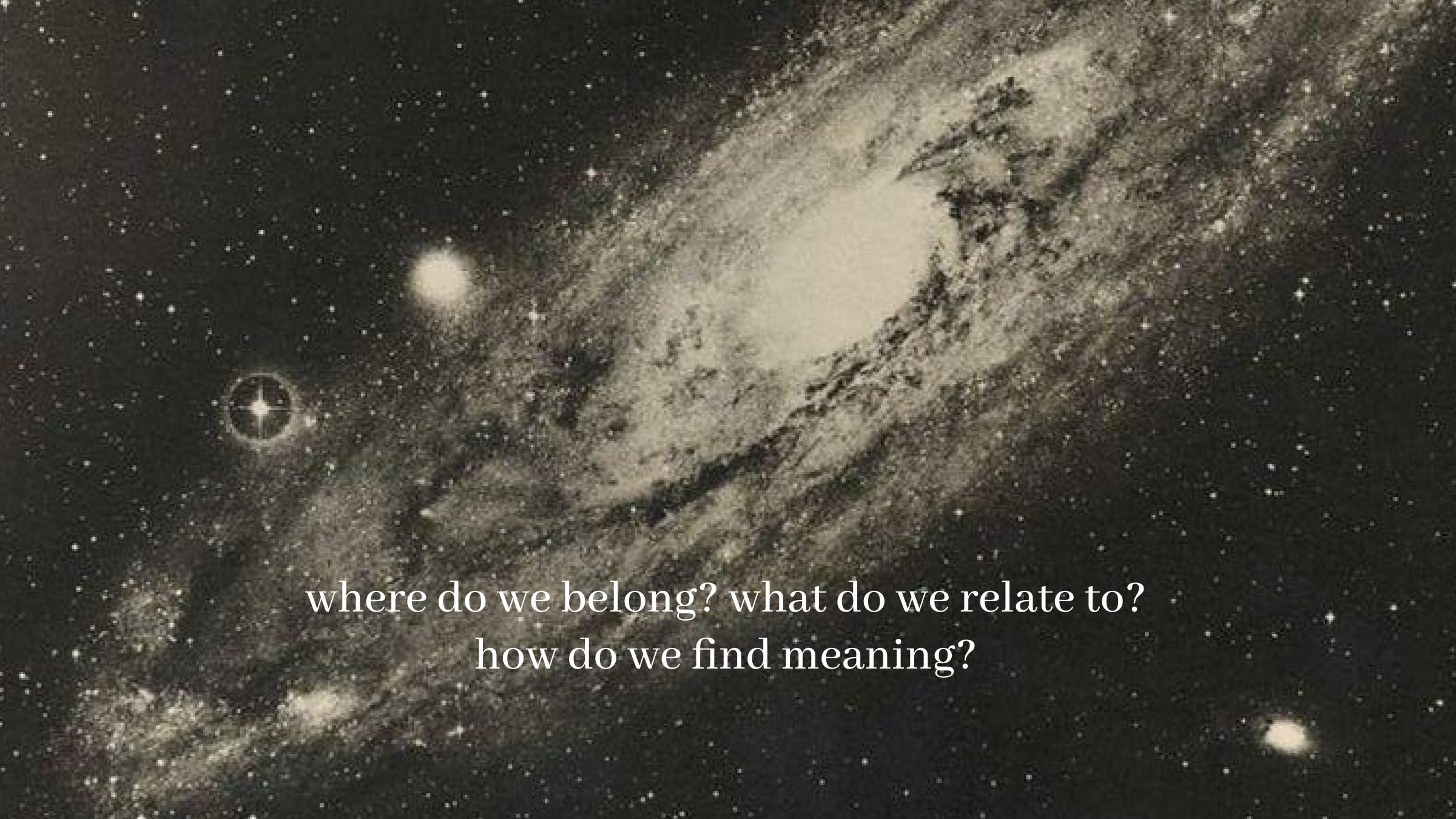
Today we exist, again, in a similarly fractured world — although with different issues. Every part of society is facing increasingly complex challenges and technology is advancing at exponential rates. This leaves many of us asking: Where do we belong? What do we relate to? And how do we find meaning?
Cosmic optimism is the beginning of an attempt to address these questions by providing a new lens for sense-making and unity in a highly complex world. The intention is not to simplify the complexity, but rather embrace it as a part of a greater cosmic dance. My hope is that this can prepare us not just for adapting to the new world, but for ultimately evolving into higher frequency beings. Ones that are more creative, conscious, and connected to each other and the world around.
No posts
Comments
Nothing yet. Say the first thing.
Sign in to join the conversation.