
This article is a note to myself.
“We’ll do it live, fuck it! … Fucken thing sucks!”
-Bill O’Reilly
“Such as are thy habitual thoughts, such also will be the character of thy mind; for the soul is dyed by the thoughts.”
-Marcus Aurelius
Your eyes dart around, frantically scanning the room.
There’s not much to scan.
The four thick plexiglass walls surrounding you have holes big enough to get your arm through, but they’re too small for your body. There are no doors.
You are trapped in a brightly lit prison.
They didn’t even give you a chair.
Your life is too mundane to have a villain. There is no story line to this. This is not a plot point in your character’s development. Your heroic partner is not somewhere hatching a plan to break you out.
Your predicament gets you thinking about just how much freedom you really had. You had been living in a mental prison of your own making. Constantly striving for indicators of success fed to you by monkeys be behind why you constantly feel frustrated. You don’t totally know what your goal is, but you just know that you haven’t achieved it and it’s taking way too long.
You are a capuchin monkey being studied by Dutch-American primatologist Frans de Waal.
A human wearing a blue gown comes up to your cage and hands you a rock. She gestures for you to give it back. You hand it back. She rewards you with a piece of cucumber. You calmly enjoy your tasty treat.
Across from you is another monkey in a plexiglass cage. The human hands your fellow prisoner a rock. He hands it back. In return, the human gives her a big, juicy grape.
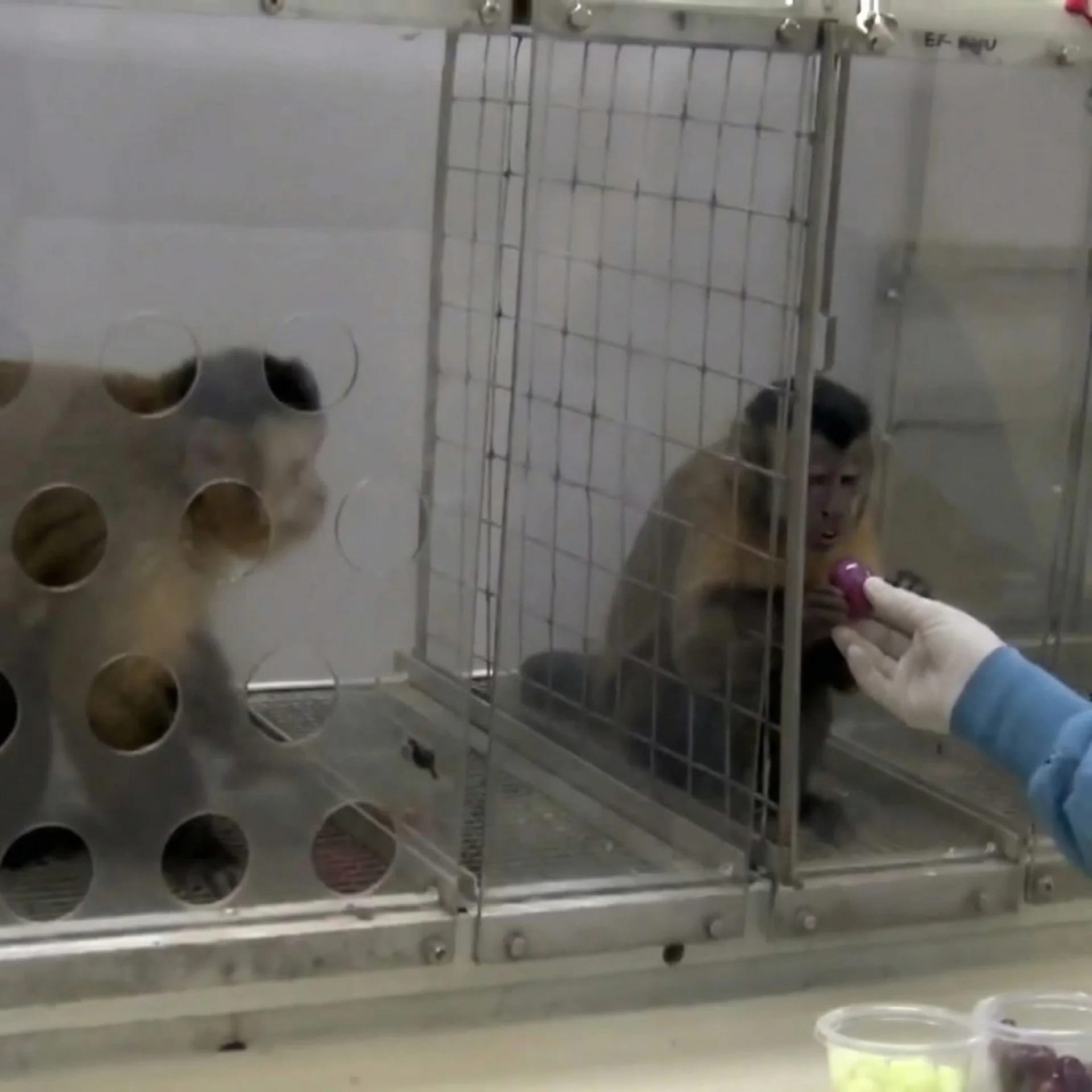
A scene from Hell’s Kitchen comes to mind: “finally, some good fucking food.”

The human turns to you and hands you another rock. You hand it back. You get another fucking cucumber.
You throw that piece of garbage back at the human.

All this is a video from Frans de Waal’s TED talk Moral behavior in animals.
After throwing the post-grape cucumber back at the researcher, the monkey bangs on the floor with her palm and violently shakes the plexiglass walls. Extremely frustrated, she watches the other monkey get yet another grape for passing the rock.
It’s her turn again. This time she checks the rock before passing it back to the human. Maybe something’s wrong with it? She passes it back. The researcher gives her another cucumber. She takes it, reaches her arm back out the plexiglass wall and throws it again.
What the poor, shafted monkey is experiencing is frustrative nonreward. The unfairness is clearly pissing her off. As Rapini et al. explains:
Frustrative nonreward is an integral mediator of irritability/aggression, motivation (substance use disorders, depression), anxiety/fear/threat, learning/conditioning, and social behavior.
In their paper, they explain that the increased drug and alcohol use, social conflict, irritability and suicide experienced during the COVID-19’s pandemics dramatic social restrictions were potential consequences of frustrative nonreward.
You completed your to-do list, you grinded away on zoom calls and excel sheets like a good remote-worker for the week, but come Friday, there’s no parties to go to because of social distancing. No grape for you, monkey boy. You gave reality a perfectly good rock but you just got fucking cucumbers.
Might as well pour yourself another glass of fermented grapes.


So, here’s the big question: Does briefly expressing your frustration at a minor inconvenience lead to becoming more easily frustrated in general?
Could briefly gripping your hands into a fist or letting out a quiet “damn!” or “shit!” when you accidentally hit select all instead of undo …or saying “fuck off stupid Zoom” to a small invisible mouse when a notification saying Zoom has lost its internet connection keeps interrupting your writing …make you more likely to be irritated by other minor inconveniences?
You’ve surely seen a scene in a movie where the director wants to illustrate just how pissed one of the characters is by having him punch a punching bag.
This idea that we need to “blow off steam” to get rid of anger (a kind of adaptation of Freud’s catharsis) was popularized by Konrad Lorenz. Lorenz, based on observations of animals, posited that the aggressive drive builds up internally over time and then gets “released” when the right trigger appears—this is his famous ‘pressure-release’ model.


This entire process is condensed into three minutes in this video of a Shiba dog being relentlessly teased with a hotdog. The owner has prepared a kind of whack-a-mole board with holes in it where it can put a tempting hot dog through one of the holes, only to pull it away right when the dog tries to bite it. As he keeps trying to get the hot dog, you can see the Shiba go from neutral to annoyed to pissed to taking his anger out on a nearby dog, snapping and howling at it.
Lorenz said that “present-day civilized man suffers from insufficient discharge of his aggressive drive.”
That is, we’re suffering because we’re not letting our steam off enough.
Apparently nowadays, Gen Z is taking up “scream therapy” - screaming into their pillows as an emotional outlet for stress and anxiety.
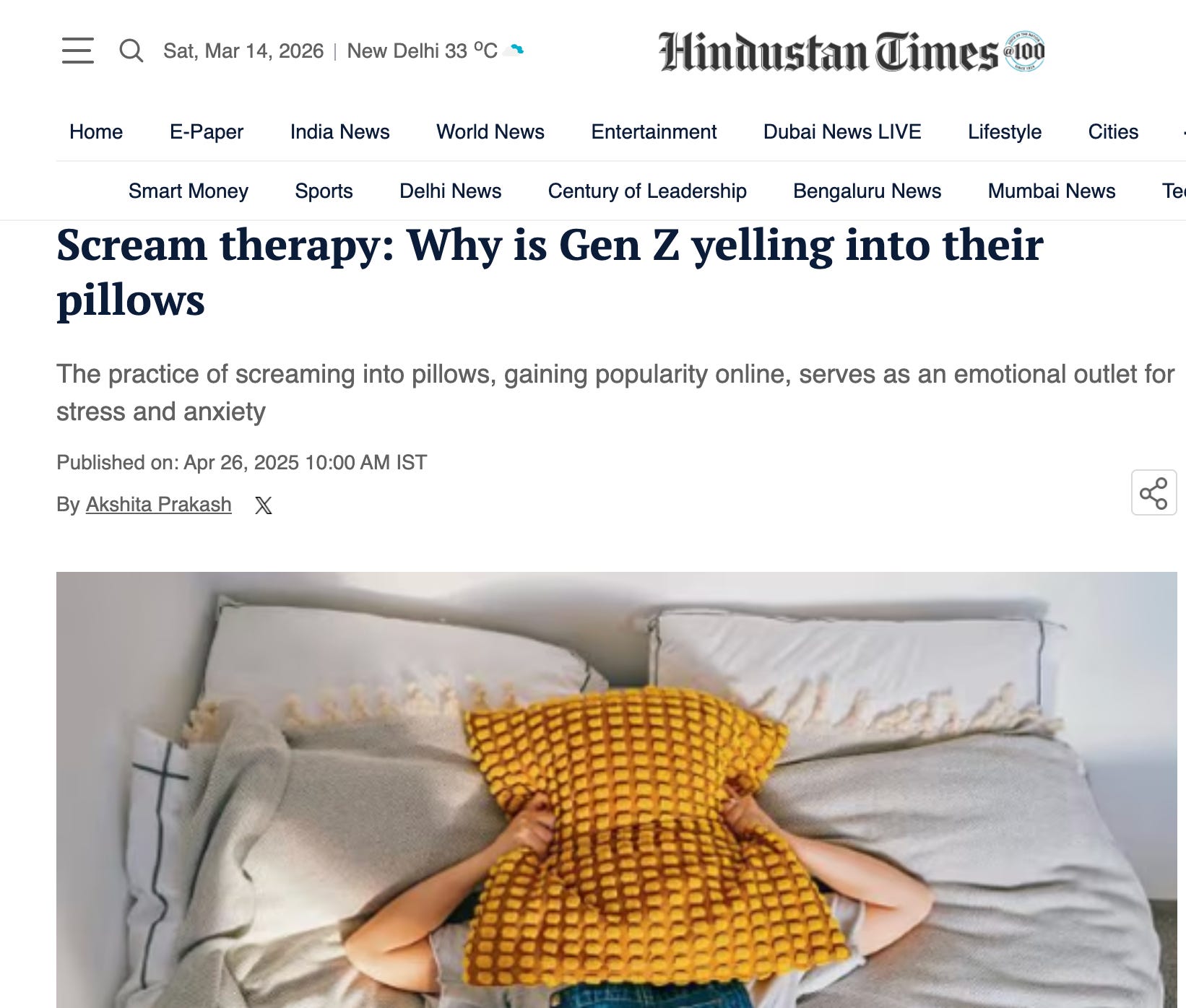
Except, does this actually reduce instances or frustration or does it make frustration more likely?
Peter Attia talked on a podcast with Andrew Huberman about how angry of a person he was, saying:
all my life so as a teenager if I go more than two weeks without punching a hole in the wall of our house it’s a miracle. I mean I am so good at drywall you can’t can’t believe … all the stuff I have to repair around our house like I’m breaking Windows I’m breaking…
Punching a hole in the wall of your house seems like a pretty big catharsis. Why didn’t it make Peter a less angry person?
“If, therefore, you wish not to be hot-tempered, do not feed your habit, set before it nothing on which it can grow.”
-Greek stoic philosopher, Epictetus
A study from Iowa State University deliberately tried to piss off 300 male and 300 female college students. They had them write an essay and then their essay was graded by an unseen person. Their essay was returned with all sorts of excessively harsh marks and criticism, even including a note saying “This is one of the worst essays I have read!” The authors noted that, as established by two other studies, this specific procedure “makes people quite angry.”
Then, they were given the opportunity to hit a punching bag. One group was told to hit the punching bag and think about the person who had angered them (the person who graded their essay). They were also given the chance to press a button to deliver a loud blast of noise through headphones that essay grader was wearing.
There was another group that was told to think about becoming physically fit while they hit the bag. The control group didn’t hit a punching bag.
The people in the “rumination” group who specifically thought about retaliating against the essay grader while releasing their anger on the punching bag* had “increased rather than decreased anger and aggression.” The people who hit the bag while thinking about fitness were less angry, but the people who did nothing were the the least angry.
*I’ll add that I think if someone were to punch a punching bag for fifteen rounds until they are just completely physically exhausted, that may actually put them in a much more calm state.
At some point I learned that I simply could not do voiceovers if I reacted each time I messed up. A tongue click, a small exhale, a ‘dangit’ would amplify my irritation, worsen my focus and actually make me mess up more and more, furthering my irritation, lengthening the voiceover and the time it takes to edit it.
There also was a no punching bag control group. People in the rumination group felt angrier than did people in the distraction or control groups. People in the rumination group were also most aggressive, followed respectively by people in the distraction and control groups. Rumination increased rather than decreased anger and aggression. Doing nothing at all was more effective than venting anger. These results directly contradict the concept of ‘letting off steam.’
Another study in the Journal of Personality and Social Psychology showed that when people in an angry mood ruminated, their anger increased. Distracting themselves from that emotional state did not increase anger.
More importantly, in a later longitudinal study, angry rumination predicted reactive aggression six months later. The reverse was true too suggesting a self-reinforcing loop. Reactive aggression also predicted later angry rumination. Rumination lead to aggression, aggression lead to rumination. Angry thoughts led to aggression and aggression led to angry thoughts.
“A tendency to act only becomes effectively ingrained in us in proportion to the uninterrupted frequency with which the actions actually occur”
-William James, The Principles of Psychology
“Whatever a bhikkhu frequently thinks and ponders upon, that will become the inclination of his mind.”
-The Buddha, MN 19
No posts
Comments
Nothing yet. Say the first thing.
Sign in to join the conversation.