
![[Game Soundscape] Streets of Rage 4 - Level Selection Screen : Y Island - 4 Hours](https://substackcdn.com/image/fetch/$s_!M7p2!,f_auto,q_auto:good,fl_progressive:steep/https%3A%2F%2Fsubstack-post-media.s3.amazonaws.com%2Fpublic%2Fimages%2Fcd4927a7-0070-4585-98f7-dbce3efaa4e0_686x386.jpeg "[Game Soundscape] Streets of Rage 4 - Level Selection Screen : Y Island - 4 Hours")
The other day, I was hanging around talking with a friend while lazily playing Streets of Rage 4. After we beat a level, the map display showed that we were heading to an Island. I said something like “looks like we’re off to Epstein’s island” which earned a chuckle.
A gross joke in hindsight.
In the midst of a sardine fast I was doing with my friend, he showed me pictures of the delicious carb-y food his wife and mother-in-law were eating. He could only watch them consume all these delicious foods while he was relegated to just eating sardines alone like a house cat. I said he’s like Hugo in the Simpsons- Bart’s evil twin who was separated from him at birth and banished to the attic given only a bucket of fish heads once a week.
Later, I wondered if if that episode were going to come out today, would the writers modify the episode’s story in light of the recent revolting news about Epstein?
It seems since the advent of Seinfeld, practically everything on our screens is ironic.* Everything’s a funny joke.
*I’m using irony in a colloquial way, not strictly ‘saying one thing but meaning the opposite.’
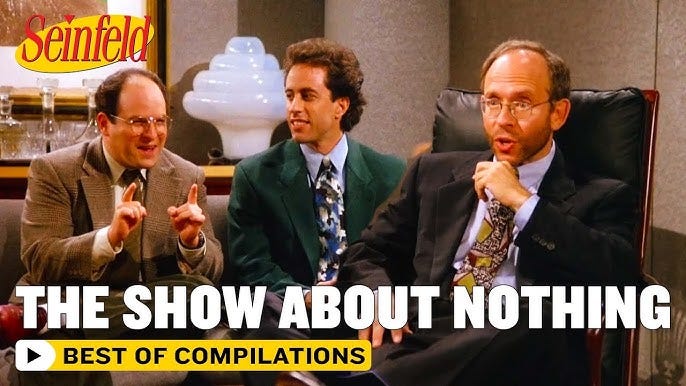
In response to the “teach viewers a lesson” format of 80’s and 90’s sitcoms, Seinfeld was “the show about nothing” with a strict rule of “no learning, no hugging.”
Not that I’m trying to say I am or was above any of this. I loved Seinfeld.
I’ve watched so much Simpsons that my mind often automatically spits out Simpsons references for almost any situation. Relevant scenes that came to mind while writing this particular paragraph:
-When Burns had 1000 monkeys working at a 1000 typewriters.
-When one of the writers for Itchy and Scratchy was writing in a joke making fun of Marge Simpson and said to himself “I’m so funny.”
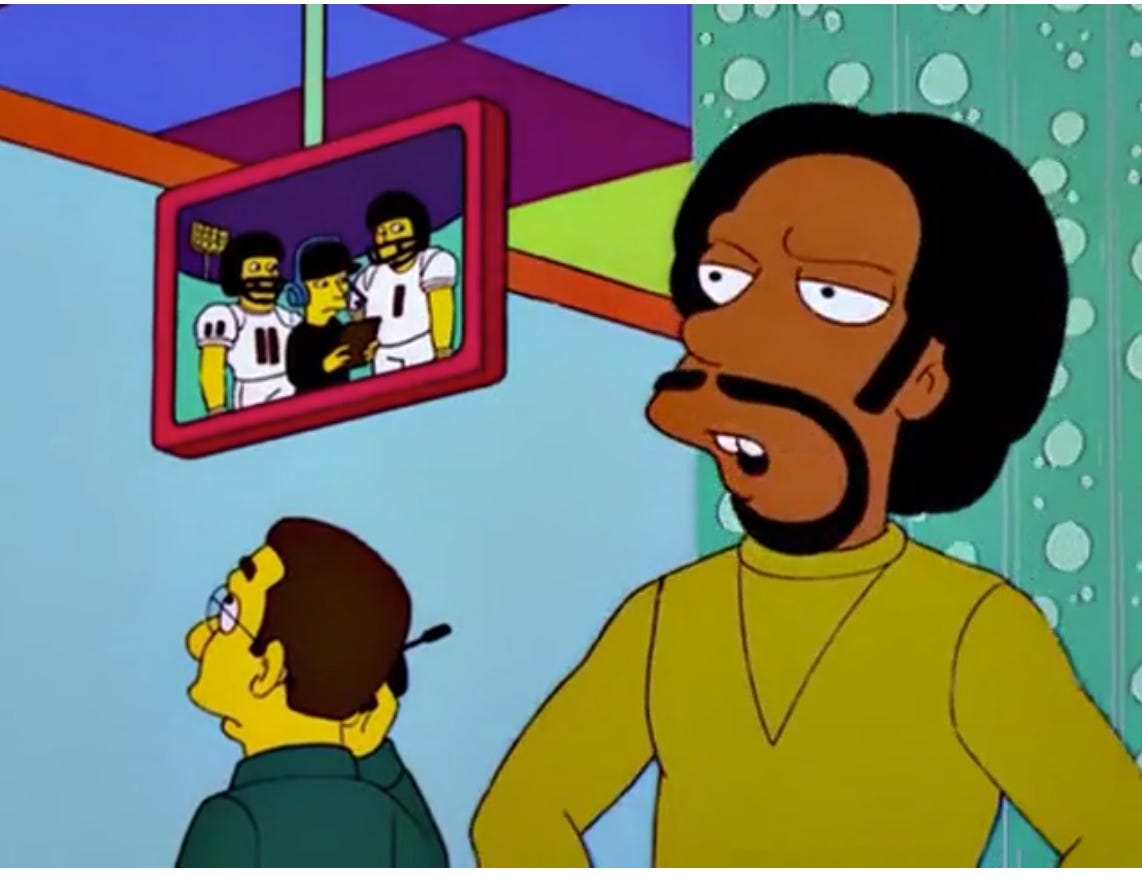
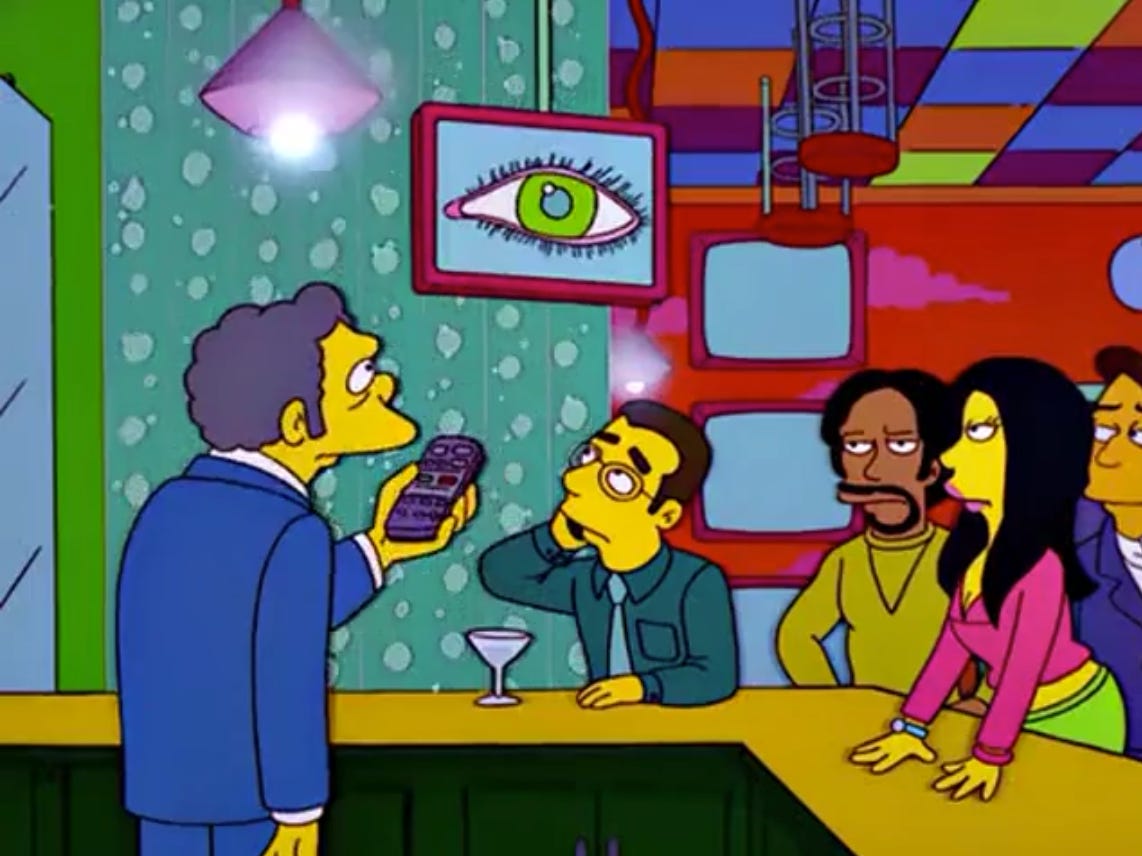
-In the episode where Moe starts a hip new bar appealing to metrosexual types, he changed the TV from a screensaver of a blinking eye to the football game and one of the customers said “unless you’re being ironic, turn that off now.”
Halfway through my first year in Japan as a study abroad student, I was dating a Japanese girl and asked her what her favorite movie was. Unexpectedly, she said Lord of the Rings. Suspicious this might be a ploy to impress me, I asked her why exactly she liked it. She said it was so touching that Sam would sacrifice so much for his friend Frodo.
John 15:13 says “greater love hath no man than this, that a man lay down his life for his friends.”
Indeed, self-sacrificing scenes in movies (done right) are very touching. 2024’s Deadpool & Wolverine was too cleverly self aware for this, though. When going to sacrifice himself to save the timeline (and the Universe), Deadpool says to a protesting Wolverine “I can’t hear you over all the noble sacrifice” in his goofy Deadpool voice.
Wolverine: “Why are you fucking doing this?”
Deadpool: “Cause I’m Marvel Jesus.”
The scene eventually does get more serious, but only after making yet another homoerotic joke.
Deadpool seems like a Marvel movie for people who are tired of liking Marvel movies. It’s like a never ending clip show of Marvel’s trademark cut-to-Jim-looking-at-Camera after any serious moment.
In the Summer of 1993, when people were still watching shows on bulky CRT Televisions, David Foster Wallace wrote this:
“It would be one thing if everyone was absolutely delighted watching TV 24/7 but we have as a culture not only a tremendous daily watching rate, but we have a tremendous cultural contempt for TV … now TV that makes fun of TV is itself popular TV. There’s this way in which that we who are watching a whole lot are also aware that we’re missing something- that there’s something else, that there’s something more…”
This essay came out four years after the first episode of Seinfeld aired. The Simpsons came out the same year as Seinfeld. And Maggie Makes Three came out January 1995, though episodes that had a soul mixed in with the jokes together became fewer and farther between as the series went on.
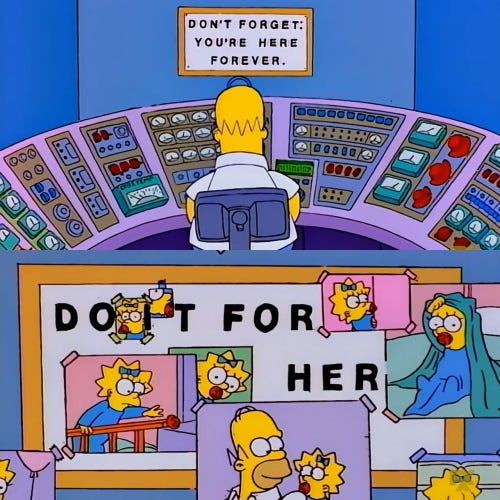
Spoiler for And Maggie Makes Three: After Homer’s dream of working at a bowling alley falls apart, he has to (literally) come crawling back to his job at the nuclear power plant under Mr. Burns. After he is lead back to his office, Mr. Burns give Homer the plague. I mean, he gives Homer a demotivational plaque that reads “don’t forget, you’re here forever.” Cutting back to the Simspons’ house where Homer is telling this story to Bart and Lisa, Bart asks why there are no pictures of Maggie in the family photo album. Homer says he keeps the pictures where he needs them the most (see picture).

“Crippling depression” has been a meme for a while now.
In 2016, Youtuber iDubbbz published a video titled I have crippling depression where he leaps into a wheelchair and says with a smile “I have crippling depression.” It has 7.5M views.
If you type “crippling depression meme” into Google image search, you’ll get tons of memes with depression as the punchline.
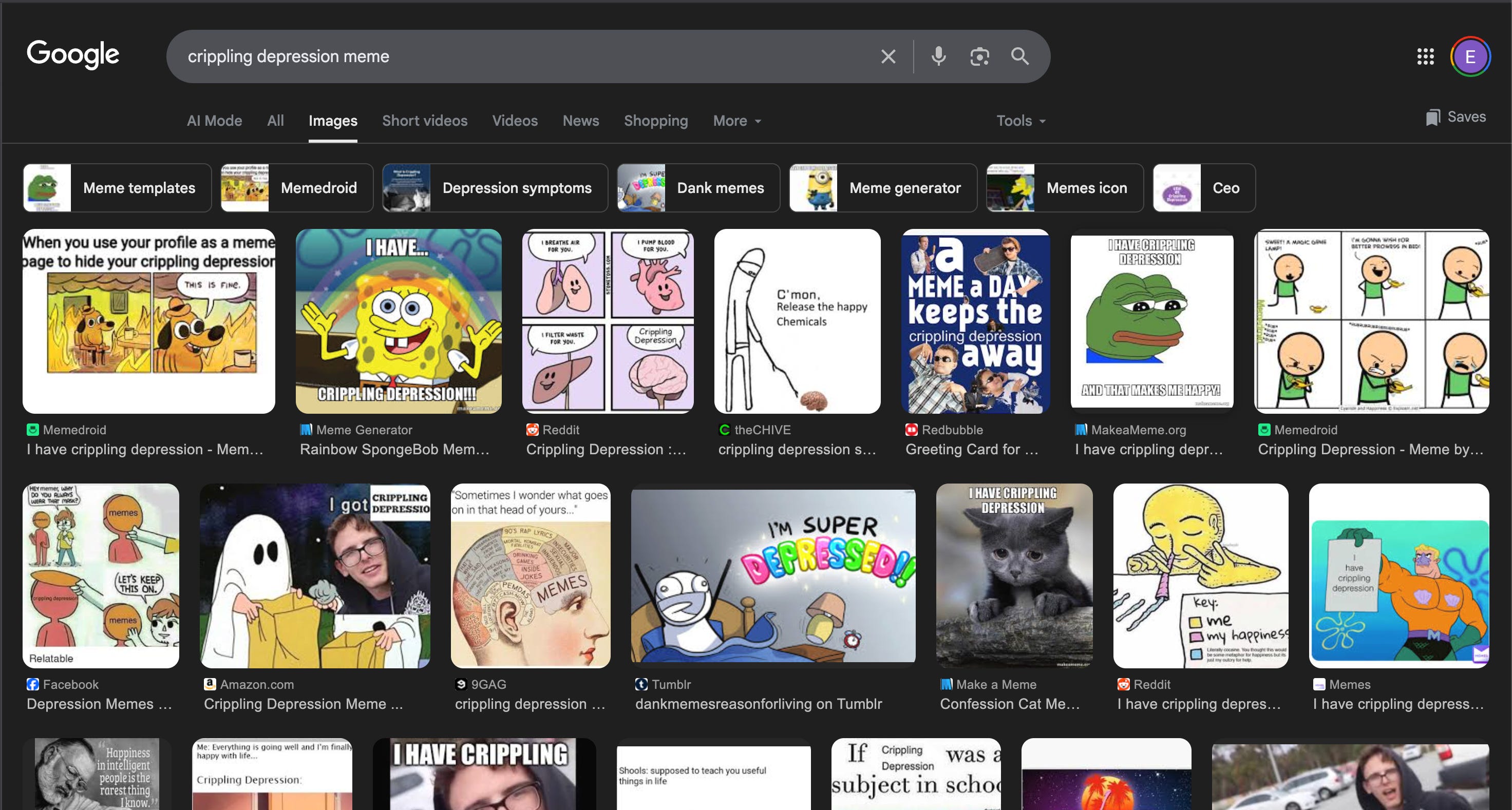
This self-aware meme with a dog sitting in a burning room saying “I’m fine” has the caption When you use your profile as a meme page to hide your crippling depression.
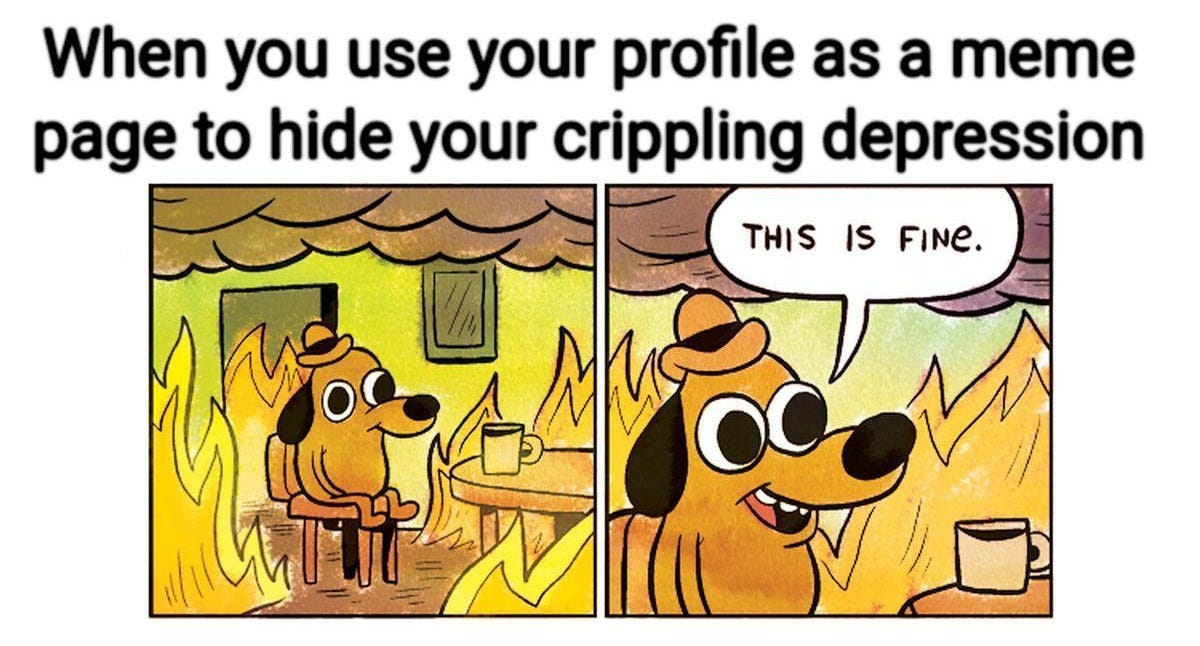
It’s like these people are (depending on who they send it to) are saying “I’m depressed, but whoa, I’m not like those lame depressed people who are actually serious about it.”
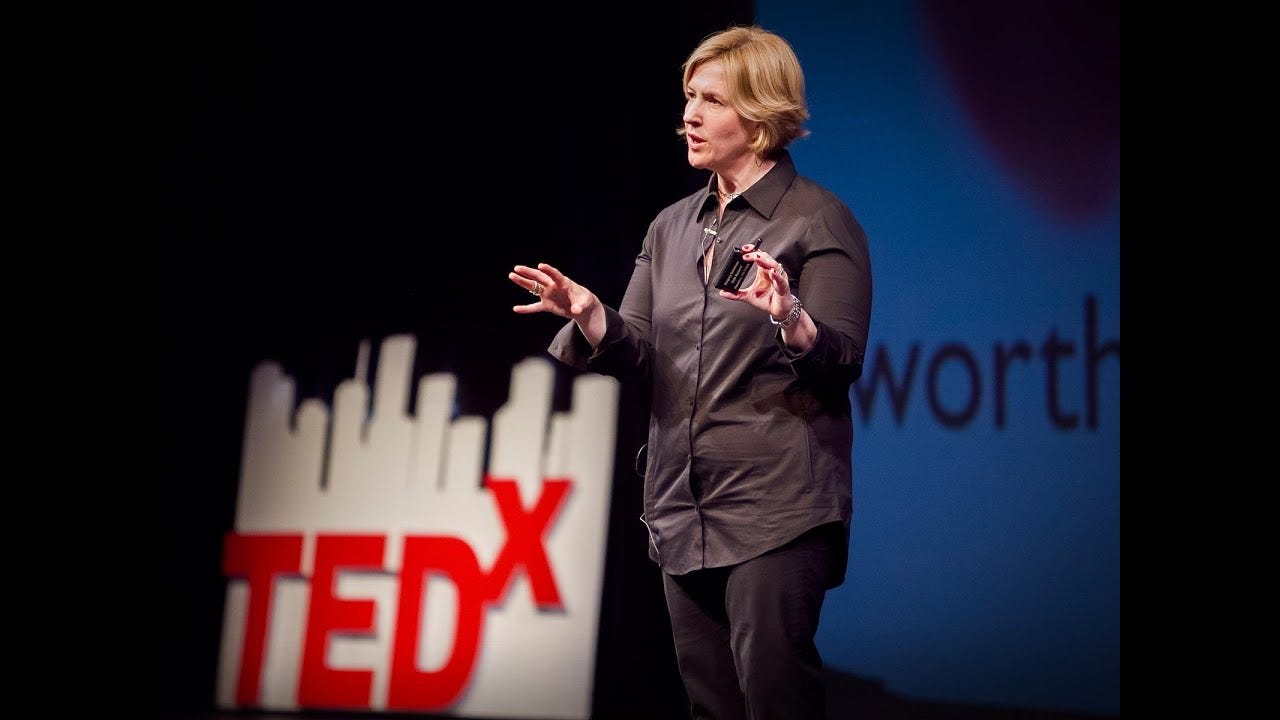
This TED talk by Brené Brown about vulnerability blew up in 2011. It has 24 million views today. Her point was that we need to be vulnerable to be fully connected to each other.
I thought “be weak” or “divulge your weaknesses” was stupid advice. I still think it is stupid advice (phrased in that way), at least for men.
Brené Brown is basically saying “be a woman.”
As laid out in Dr. Joyce Benenson’s book Worriers and Warriors, sharing personal secrets, weaknesses, vulnerabilities, and worries is a distinctly female bonding strategy.
“There are two primary types of information that a woman must collect before she becomes friends with another woman: (1) basic demographic information (name, rank, age) and (2) information about personal vulnerabilities and relationships.”
-Warriors and Worriers
On the other hand, Joyce Benenson explains that in the case of males, they bond in almost the opposite way: usually over strengths. Similar interests or goals is the starting point and usually recognizing competence in those shared activities enhances the desire to become friends with the other boy or man.
What’s funny is that men often bond over a shared sense of humor - they enjoy making fun of the same things. A man’s competence here is often very much appreciated.
With this in mind, I may have been less critical of Brené Brown’s talk if she replaced the word “vulnerable” with “sincere.”
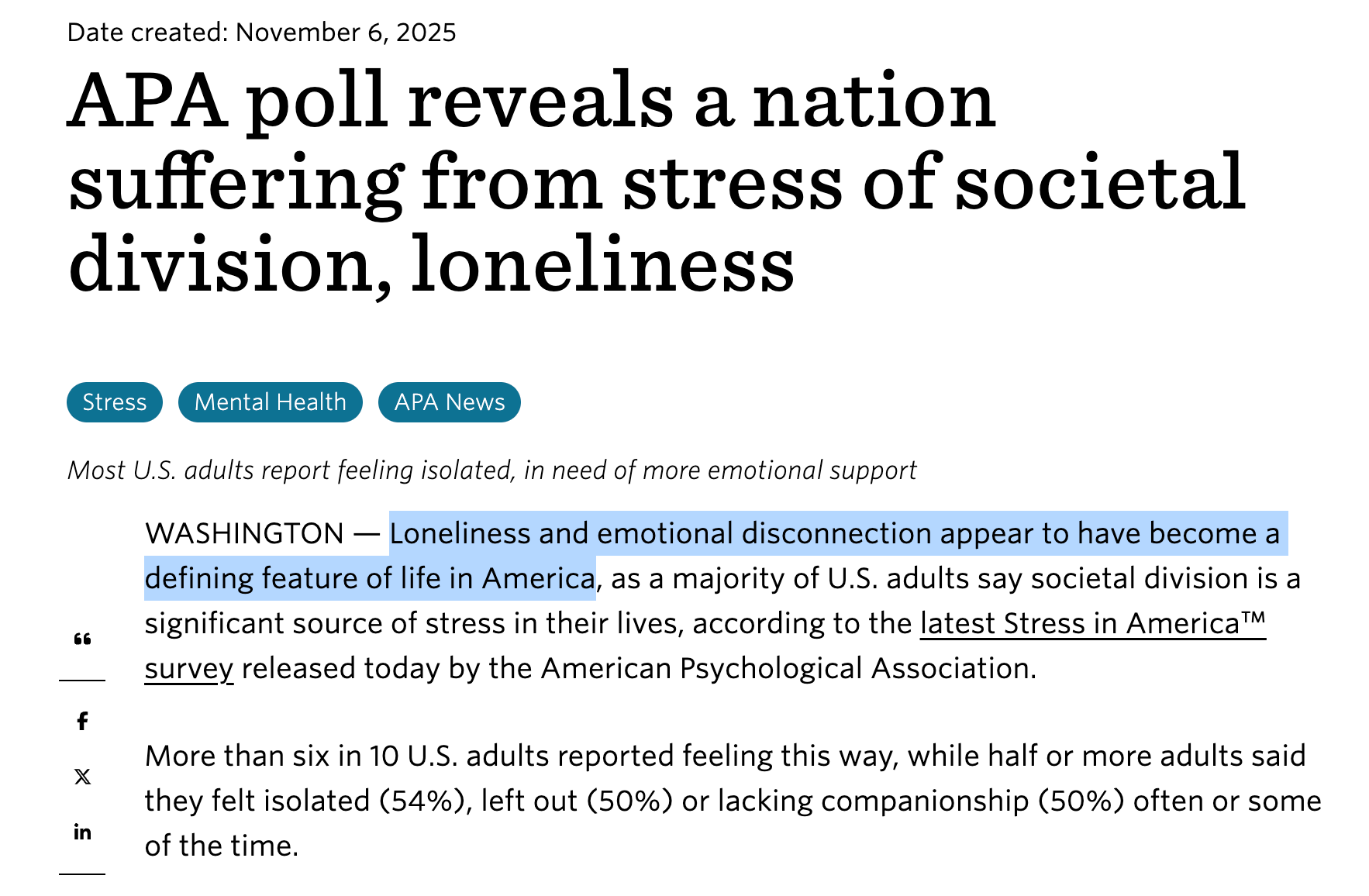
An APA poll revealed that more than 60% of U.S. adults reported feeling lonely and emotionally disconnected. “Half or more adults said they felt isolated (54%), left out (50%) or lacking companionship (50%) often or some of the time.”
There’s no shortage of loneliness memes either.
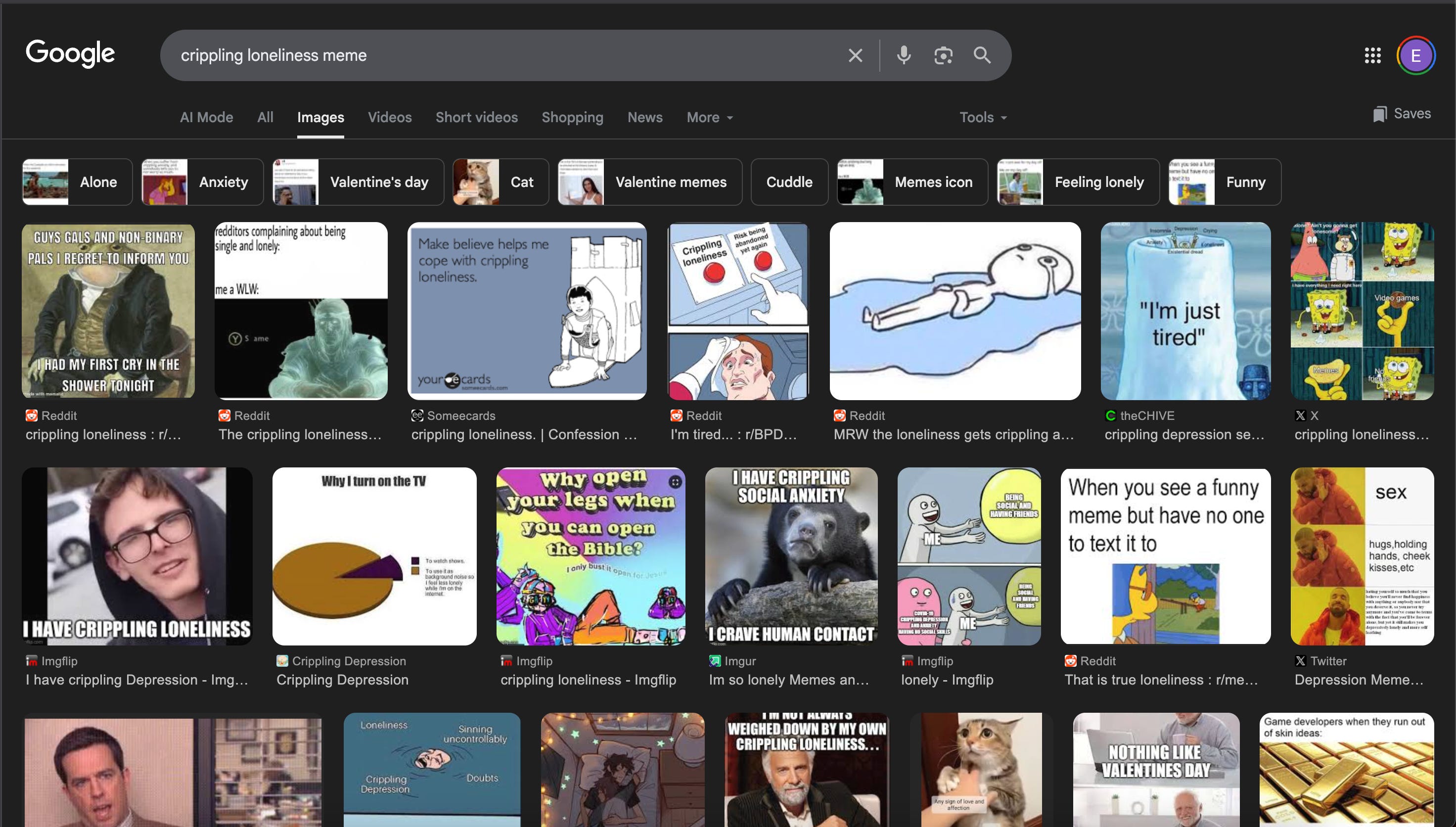

The more things frequently become the target of irony in the culture, the more it becomes risky to be completely sincere. Everyone’s got so much on their plate, no one has time for your sincerity.
The more risky it becomes to be sincere, the more sincerity is cloaked with irony and the number of things that become the target of irony increases.
The thing with irony like this is that it frees you from the consequences of actually meaning something but does not free you to do anything.
In the example of depression memes, because it’s ‘just a joke,’ there’s no commitment to the claim. The risk of social awkwardness is low and there’s no reputational risk of being labeled as needy or dramatic.
It’s a low-risk probe for connection.
Kierkegaard would called this being “negatively free” you are free from commitment. By joking you can tell the truth without having to pay the price for being truthful.
As far as being “free to” something: if someone acknowledged sincerely that they’re depressed this may free them to ask a friend if they could help them find a solution or finally set aside time to sincerely take behavioral steps to address it.
“in irony, the subject is negatively free, since the actuality that is supposed to give the subject content is not there.”
Kierkegaard
According to Kierkegaard, irony only negates. It does not add or construct, it only deconstructs.
Which brings us of course to the inferiority complex- a concept created by Alfred Adler (not Freud).
A core part of Adler’s psychology is “social interest” or “community feeling” (in German: gemeinschaftsgefühl). Adler says a core human issue is that of feeling inferior. We are constantly aware of what aspects of ourselves are inferior to others.
If you feel inferior, how do you resolve this feeling?
People often try to resolve this feeling of inferiority by compensating with an attempt to feel superior.
Adler says this is the wrong approach.
Adler says we should be striving to enhance the “community feeling” by aiming to cooperate with and contribute to the community, not try to rise above it.
He emphasizes that the trait most necessary for developing community feeling is courage.
That’s where David Foster Wallace comes back in:
“One of the big reasons why irony has been the kind of mode of discourse in the culture for the last 30 years has really ceased to be palliative or helpful is that irony is this marvelous carapace that I can use to shield myself from seeming to you to be naive or sentimental ... If I show you that I believe that we’re both bastards and there’s no point to anything and that I was last naive at about age six, then I protect myself from your judgement of the worst possible flaw in me- sentimentality and naivete.”
-David Foster Wallace
So what’s the solution?
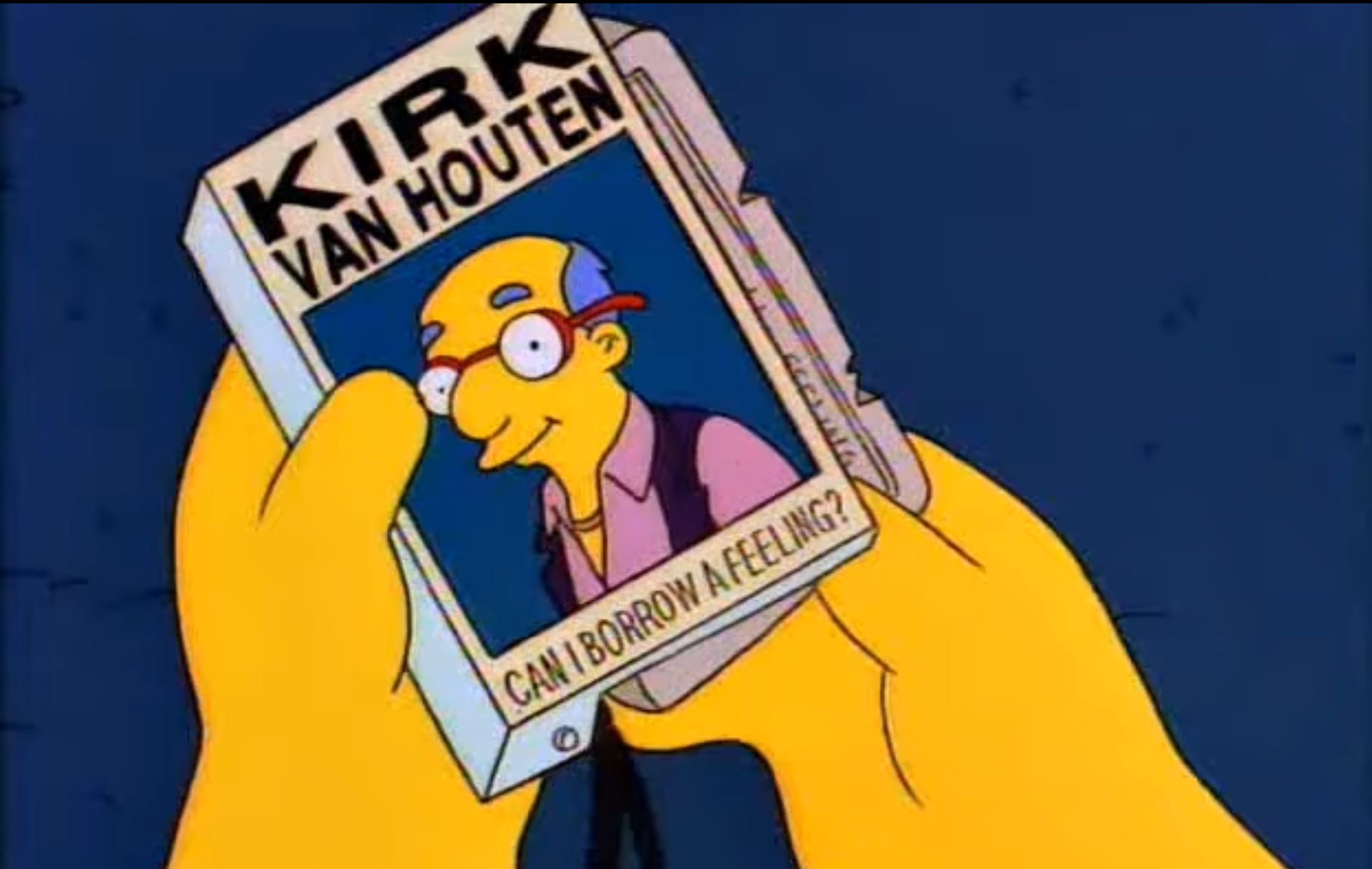
It takes courage to be sincere, but how sappy are we supposed to be?
What if we end up like Kirk Van Houten- having our demo tape, Can I Borrow a Feeling, laughed at by Homer?

Well the first question is, what is worth being sincere about?
What would you still stand by even if you were laughed at?
No posts
Comments
Nothing yet. Say the first thing.
Sign in to join the conversation.