
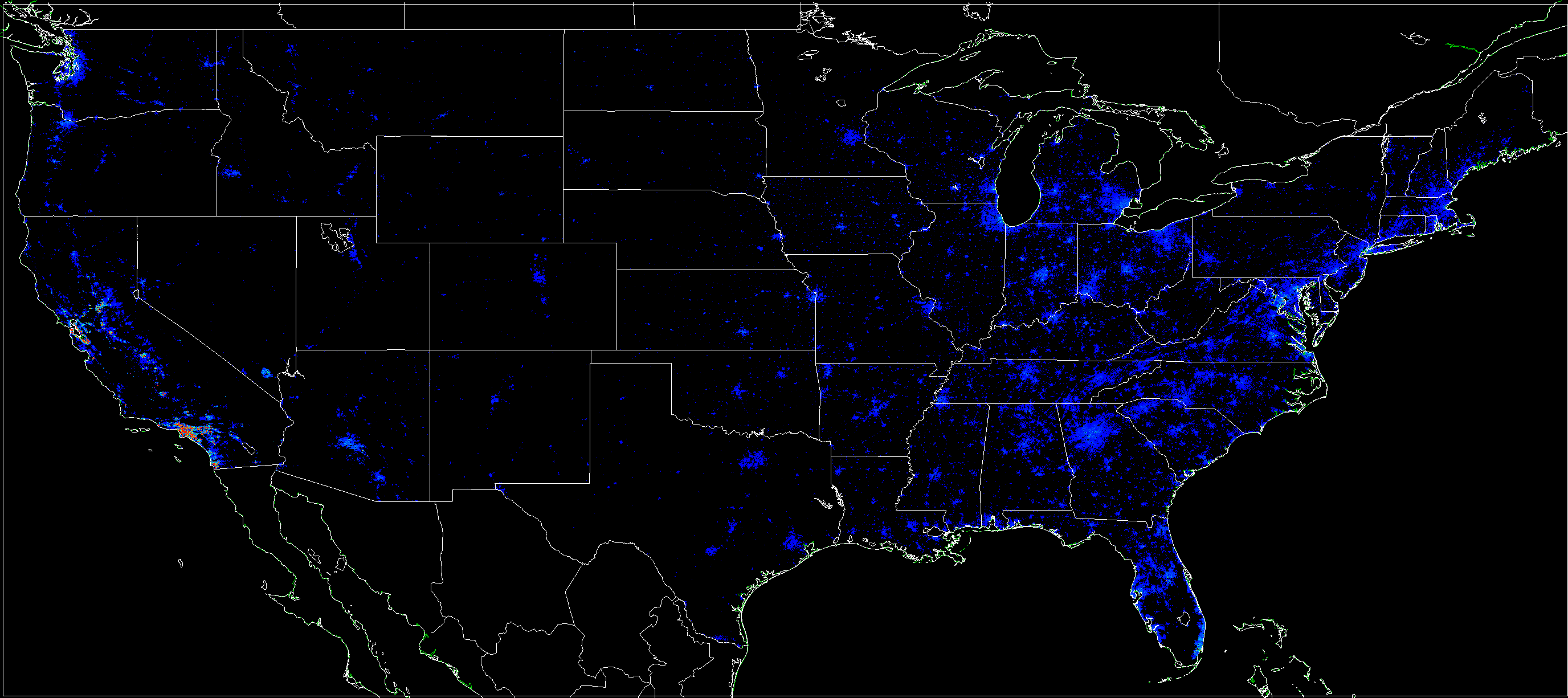
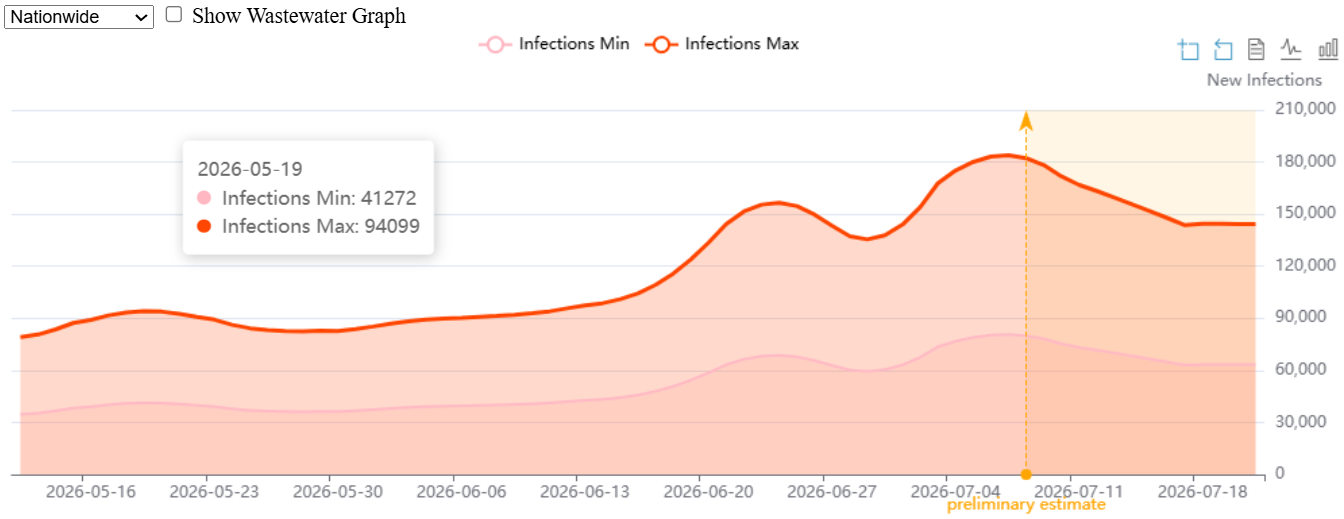
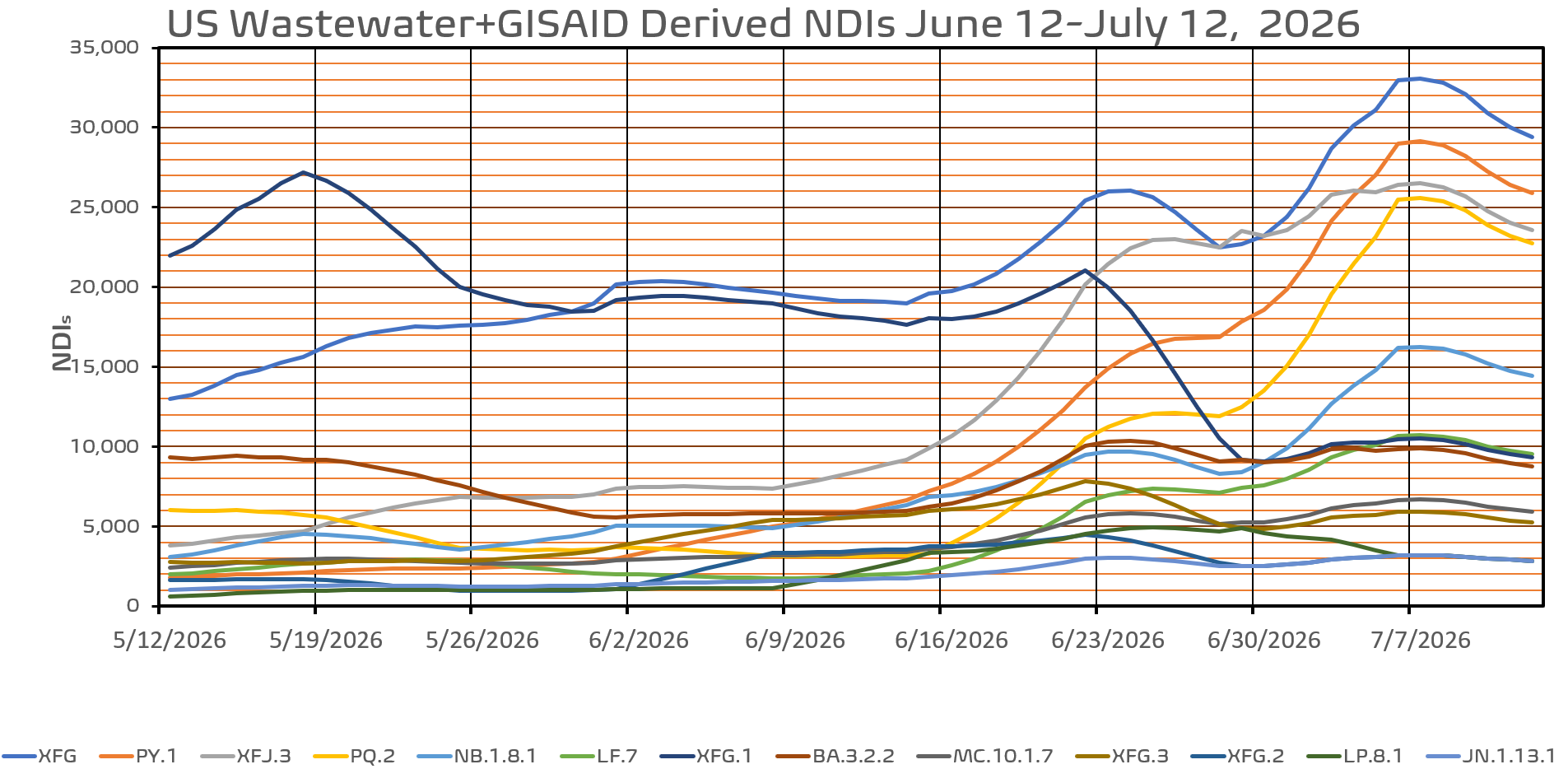
Shown above are the most up-to-date spatial, USA average total, and by variant plots of New Daily Infections (NDIs). The data runs through July 12, 2026. California is the hot spot right now, as indicated by the red, which indicates high NDIs. Other areas of interest are Georgia, Illinois, and Florida. Of interest is the rise of NB.1.8.1 and its child PQ.2. Back in January, I surmised that NB.1.8* would eventually take over for the leading variants XFG*. Overall, in the world we have seen these two fight for the leading with NB.1.8* leading globally. In many of the places they have flipped positions. Why? It is likely a build up of natural immunity for the dominating variant, thus the family has difficulty escape other family members immunity. In this country XFG* has now dominated for almost a year.
I am currently working on a new forecast that starts from 7-12-2026 and runs through 11-12-2026. I should have that ready tomorrow. MAPS is still predicting a peak in early September.

- Highest concern: Ebola Bundibugyo virus disease in eastern Democratic Republic of the Congo remains the dominant global outbreak signal. Recent public counts differ by source because of rapid reporting changes, but all show fast growth, high fatality, and difficult response conditions. Uganda appears to be in enhanced surveillance after no new reported cases since 21 June, while internationally evacuated healthcare/humanitarian workers underscore cross-border response risk.
- Measles remains a high-momentum vaccine-preventable threat. The United States has now reported more confirmed cases in 2026 than in all of 2025, while WHO/CDC global data show large outbreaks across South Asia, the Middle East, Africa, and the Americas.
- Diphtheria remains notable because of geographically broad vaccine-preventable outbreaks, especially Australia’s largest recent outbreak, Haiti, and several sub-Saharan African countries.
- Respiratory viruses are comparatively quieter globally: WHO GISRS reports low global SARS-CoV-2, influenza, and RSV activity overall, with localized influenza and RSV positivity in parts of the Americas, Africa, and Asia.
- Other outbreak signals worth watching: U.S. multistate cyclosporiasis linked to recalled iceberg lettuce; European seasonal West Nile virus, CCHF, and locally acquired dengue signals; cholera’s continuing multi-country burden; and zoonotic/avian influenza A(H5) activity.
Severity: Low globally, Moderate in localized areas
Trend: Stable globally; localized increases Status summary: WHO’s latest dashboard shows SARS-CoV-2 activity generally low and stable globally. For 22-28 June 2026, 57,509 sentinel/systematic surveillance samples were tested across 69 countries, with 1,327 positive, a 2.3% positivity rate. Reported 28-day cases rose modestly to 16,448 for 1-28 June, but WHO cautions that global testing and reporting are incomplete.
Notable countries/regions: Local elevated activity or increases were reported in parts of Central America and the Caribbean, Tropical South America, Northern Europe, multiple African subregions, and South-East Asia. ECDC and UKHSA/UKHSA-linked surveillance continue to show low baseline respiratory-virus activity in Europe/UK settings.
Why it matters now: COVID-19 is not the leading acute outbreak concern today, but SARS-CoV-2 should remain on the watchlist because surveillance is thinner than in earlier pandemic years and localized respiratory co-circulation can still stress healthcare systems.
Severity: High
Trend: Worsening
Status summary: Measles activity remains elevated globally and in the United States. CDC reported 2,318 confirmed U.S. measles cases as of 23 July 2026, surpassing the full-year 2025 total of 2,289. CDC reports 35 outbreaks in 2026 and 93% of U.S. confirmed cases are outbreak-associated.
Notable countries/regions: CDC’s global outbreak table based on WHO provisional data for December 2025-May 2026 lists the largest outbreak burdens in Bangladesh, India, Yemen, Mexico, Pakistan, Cameroon, Kazakhstan, Guatemala, Angola, and Sudan. PAHO reports a multi-country measles outbreak in the Americas with nearly 15,000 confirmed cases and 29 deaths in its 2026 outbreak page. In the U.S., cases are spread across 45 jurisdictions plus international visitors.
Why it matters now: The combination of international travel, persistent immunity gaps, and large outbreaks threatens elimination status and creates repeated importation and outbreak-amplification risk.
Severity: Low to Moderate
Trend: Improving or below 2025 in some monitored settings; unclear globally Status summary: No new global high-severity pertussis signal stood out today. CDC’s U.S. surveillance page says preliminary 2026 U.S. pertussis cases are lower than the same period in 2025, after a post-pandemic peak in November 2024. Australia’s CDC similarly reported earlier in 2026 that national pertussis activity was far below the same period in 2025 and closer to inter-seasonal levels.
Notable countries/regions: United States and Australia are useful markers of the post-2024/2025 pertussis wave easing in some high-surveillance settings. PAHO’s March 2026 update still supports regional vigilance in the Americas because infants and under-immunized communities remain at highest risk.
Why it matters now: Pertussis remains a vaccine-timing and maternal/infant protection issue even when overall incidence is easing; macrolide resistance monitoring remains important internationally.
Severity: High
Trend: Worsening in DRC; improving/controlled signal in Uganda Status summary: The DRC outbreak is the most serious item today. WHO’s 17 July Disease Outbreak News reported 2,124 confirmed DRC cases and 828 deaths as of 15 July, with sustained transmission and substantial increases since the prior update. ECDC’s 24 July CDTR, using data through 22 July, reported a higher and more recent DRC total of 2,905 confirmed cases and 1,269 deaths, with 722 patients hospitalized in isolation. NaTHNaC, citing DRC Ministry of Health data as of 21 July, reported 2,536 confirmed cases and 1,033 deaths. These differences likely reflect fast-moving reporting and reconciliation rather than a resolved discrepancy.
Notable countries/regions: DRC provinces include Ituri, North Kivu, South Kivu, Tshopo, and Haut-Uele. Uganda has reported no new cases since 21 June and has begun the 42-day enhanced surveillance period after discharge of the most recent case. Germany has treated medically evacuated U.S. humanitarian workers; France previously notified a related case, reflecting international response exposures.
Why it matters now: Bundibugyo virus has no approved strain-specific vaccine or treatment, the case-fatality signal is high, and response work is occurring in areas with insecurity, population movement, and health-system stress.
Severity: Moderate
Trend: Mixed; plateauing in Australia but active multi-country risk Status summary: Diphtheria remains a meaningful vaccine-preventable outbreak concern. Australia’s CDC reported 442 diphtheria notifications in 2026 as of 13 July, a substantial increase over historical levels. Most 2026 cases are in the Northern Territory and Western Australia, with smaller numbers in South Australia and Queensland; 32.8% were respiratory diphtheria and one 2026 death had diphtheria indicated as the probable cause. Recent Australian national trends appear to have plateaued or slowed, but recent data are incomplete.
Notable countries/regions: Australia’s outbreak is concentrated in remote and very remote areas and disproportionately affects Aboriginal and Torres Strait Islander people. CDC travel notices identify active diphtheria outbreaks in Haiti and in sub-Saharan African countries including Chad, Guinea, Niger, Nigeria, Mali, Mauritania, and Somalia. PAHO reported 163 confirmed cases and five deaths in the Americas during the first 21 epidemiological weeks of 2026, more than double the prior year-to-date level.
Why it matters now: Diphtheria is vaccine-preventable but can re-emerge where coverage, boosters, access to care, housing conditions, or outbreak control are insufficient. Respiratory diphtheria and antitoxin access are key severity concerns.
Severity: Low globally; Moderate in localized pediatric peaks
Trend: Stable globally, localized elevations Status summary: WHO GISRS reported RSV positivity low globally in week 28, ending 12 July 2026. However, RSV positivity was elevated above 10% in a few countries in Central America and the Caribbean and in Tropical and Temperate South America, and above 30% in single countries in Eastern Africa and Southern Asia.
Notable countries/regions: Central America/Caribbean, Tropical and Temperate South America, Eastern Africa, and Southern Asia have localized signals. ECDC reported EU/EEA respiratory virus activity at baseline levels in week 29.
Why it matters now: RSV is quiet globally but can create sharp pediatric and infant-care pressure when localized positivity rises, especially where access to preventive products or supportive care is limited.
Severity: Low globally; Moderate in localized seasonal/zoonotic settings
Trend: Stable low globally with localized activity Status summary: WHO’s week 28 global respiratory-virus update found influenza detections low globally, with overall positivity below 10%. Influenza A(H3N2) was predominant in Central America/Caribbean and Middle Africa; A(H1N1)pdm09 was predominant in Southern Asia; A(H1N1)pdm09 and A(H3N2) were codominant in Western and South-East Asia; and influenza A and B were codominant in Temperate South America, Southern Africa, and Eastern Asia.
Notable countries/regions: Local influenza positivity was elevated in parts of Temperate and Tropical South America, Southern and Eastern Africa, South-East Asia, Central America/Caribbean, Western/Middle Africa, Western/Eastern Asia, and Southern Asia. U.S. FluView for week 26 showed low seasonal influenza activity, with 0.6% clinical-lab positivity; influenza A represented 60% of clinical-lab positives that week.
Why it matters now: Seasonal influenza is not globally high today, but Southern Hemisphere and tropical activity warrants continued monitoring, and subtype mix matters for severity, vaccine match, and preparedness.
Severity: Low to Moderate
Trend: Stable low globally; locally predominant in some areas Status summary: WHO reported that influenza B viruses were predominant among global influenza detections in week 28, even as global influenza detections remained low overall. Influenza B predominated in Tropical South America and Western Africa, and codominated with influenza A in Temperate South America, Southern Africa, and Eastern Asia.
Notable countries/regions: Tropical South America, Western Africa, Temperate South America, Southern Africa, and Eastern Asia. In the U.S., influenza B accounted for 40% of clinical-lab positives in week 26, with low overall influenza activity.
Why it matters now: Influenza B can still contribute meaningfully to morbidity even when total influenza activity is low; localized predominance should guide clinical expectations and vaccine-performance review.
- Cyclosporiasis, United States: Severity Moderate; trend worsening/ongoing. CDC/FDA updated a multistate outbreak linked to recalled iceberg lettuce from Taylor Farms de Mexico. As of the 24 July FDA update, 1,947 Taco Bell-exposed cases were reported from nine states, with at least 98 hospitalizations and no deaths. FDA says a false-positive sample does not change the epidemiologic basis for the recall and traceback investigation. This matters because cases may continue rising for weeks due to reporting and classification delays, and recalled product distribution involved multiple states and foodservice channels.
- Cholera, multi-country: Severity Moderate to High; trend unclear but persistent. WHO’s 30 June update reported 29,610 cholera/AWD cases from 16 countries in May 2026, a 43% rise from April, and 271 deaths, though May 2026 levels were lower than May 2025. ECDC’s June overview reported 105,813 cholera cases and 1,216 deaths worldwide as of 22 June 2026. This remains a sustained global water/sanitation and vaccine-supply concern.
- Dengue, Americas and Europe: Severity Moderate; trend seasonal/ongoing. PAHO reported 1,373,756 suspected dengue cases in the Americas by epidemiological week 26 of 2026. ECDC reported one locally acquired dengue case in France as of 22 July, highlighting seasonal vector risk in Europe.
- West Nile virus, Europe: Severity Moderate; trend seasonal/worsening as vector season advances. ECDC reported 35 affected areas in six European countries as of 22 July: Italy, Greece, Romania, North Macedonia, Spain, and France.
- Crimean-Congo haemorrhagic fever, Europe: Severity Moderate; trend stable/seasonal. ECDC reported two locally acquired CCHF cases in Spain in 2026 as of 22 July and will continue weekly monitoring through November.
- Airport-associated malaria, Germany: Severity Low to Moderate; trend unclear. ECDC reports four Plasmodium falciparum malaria cases among people who worked at Frankfurt International Airport before symptoms began 4-6 July. This is rare but operationally important for clinician awareness in unexplained fever after airport exposure.
- Avian influenza A(H5): Severity Moderate for zoonotic risk; trend stable. WHO Western Pacific reported no new human H5N1 or H5N6 cases from 17-23 July, but animal HPAI outbreaks were reported in Australia and New Zealand. WHO assesses sustained human-to-human transmission as unlikely, while zoonotic threat remains elevated where avian viruses circulate in birds.
- Mpox clade Ib, Thailand: Severity Moderate; trend unclear. NaTHNaC reported 88 confirmed clade Ib mpox cases in Thailand as of 24 July. Continue monitoring for international spread and clinical/community transmission patterns.
- Lassa fever, Nigeria: Severity Moderate; trend ongoing. NaTHNaC reported 963 confirmed cases and 229 deaths across 23 Nigerian states as of 12 July 2026.
- SARS-CoV-2: Watch for localized increases in the Americas, Africa, South-East Asia, and Northern Europe, and for any variant/severity signal amid reduced reporting.
- Measles: Watch U.S. state updates, PAHO Americas totals, and high-burden WHO-listed countries, especially Bangladesh, India, Yemen, Mexico, Pakistan, Cameroon, Kazakhstan, Guatemala, Angola, and Sudan.
- Ebola Bundibugyo: Watch DRC daily/weekly updates, contact-tracing performance, healthcare-worker infections, Uganda’s 42-day surveillance countdown, international evacuations, and vaccine/therapeutic trial developments.
- Diphtheria: Watch Australia’s NT/WA/SA trends, Haiti, Nigeria and other sub-Saharan outbreaks, antitoxin availability, respiratory-case hospitalizations, and booster campaign uptake.
- Influenza A/B and RSV: Watch Southern Hemisphere and tropical-zone positivity, especially countries reporting simultaneous RSV and influenza elevation.
- Cyclosporiasis: Watch whether U.S. outbreak counts continue to rise after the lettuce recall and whether additional distribution channels or sources are identified.
- Cholera and dengue: Watch areas with water/sanitation disruption, conflict, flooding, vector expansion, or vaccine/logistics constraints.
- WHO COVID-19 dashboard, accessed 27 July 2026: https://data.who.int/dashboards/covid19/summary
- WHO Global Respiratory Virus Activity, Update No. 587, week 28 ending 12 July 2026: https://cdn.who.int/media/docs/default-source/influenza/influenza-updates/2026/202628_rvupdate_587.pdf
- WHO Disease Outbreak News, Ebola disease caused by Bundibugyo virus, DRC and Uganda, 17 July 2026: https://www.who.int/emergencies/disease-outbreak-news/item/2026-DON613
- ECDC Communicable Disease Threats Report, week 30, 18-24 July 2026: https://www.ecdc.europa.eu/en/publications-data/communicable-disease-threats-report-18-24-july-2026-week-30
- CDC Measles Cases and Outbreaks, updated 24 July 2026: https://www.cdc.gov/measles/data-research/index.html
- CDC Global Measles Outbreaks, updated 14 July 2026: https://www.cdc.gov/global-measles-vaccination/data-research/global-measles-outbreaks/index.html
- PAHO Measles Multi-Country Outbreak 2026: https://www.paho.org/en/measles-multi-country-outbreak-2026
- CDC Pertussis Surveillance and Trends, updated July 2026: https://www.cdc.gov/pertussis/php/surveillance/index.html
- Australian Centre for Disease Control, Diphtheria in Australia epidemiological update, 13 July 2026: https://www.cdc.gov.au/sites/default/files/2026-07/20260714-diphtheria_epi_summary_-_web.pdf
- PAHO diphtheria update/news release, 15 June 2026: https://www.paho.org/en/news/15-6-2026-paho-urges-countries-strengthen-vaccination-efforts-diphtheria-cases-rise-americas
- CDC Travel Health Notices, diphtheria and dengue notices, accessed 27 July 2026: https://wwwnc.cdc.gov/travel/notices
- FDA investigation of 9-state Cyclospora outbreak linked to iceberg lettuce, updated 24 July 2026: https://www.fda.gov/food/outbreaks-foodborne-illness/investigation-9-state-outbreak-cyclospora-illnesses-iceberg-lettuce-july-2026
- CDC newsroom, Cyclospora outbreak linked to iceberg lettuce expanded to four new states, 24 July 2026: https://www.cdc.gov/media/releases/2026/cyclospora-outbreak-linked-to-iceberg-lettuce-expanded-to-four-new-states.html
- WHO multi-country cholera outbreak epidemiological update #38, 30 June 2026: https://www.who.int/publications/m/item/multi-country-outbreak-of-cholera--epidemiological-update--38--30-june-2026
- PAHO dengue epidemiological situation, EW 26 2026: https://www.paho.org/en/documents/dengue-epidemiological-situation-region-americas-epidemiological-week-26-2026
- WHO Western Pacific Avian Influenza Weekly Update #1054, 24 July 2026: https://www.who.int/westernpacific/publications/m/item/avian-influenza-weekly-update---1054--24-july-2026
- NaTHNaC Outbreak Surveillance, accessed 27 July 2026: https://travelhealthpro.org.uk/outbreaks
- Reconcile the latest DRC Ebola case/death counts across DRC Ministry of Health, WHO, Africa CDC, ECDC, and NaTHNaC.
- Check whether Uganda completes additional days of enhanced surveillance without new Ebola cases.
- Track U.S. measles updates after the 24 July CDC total and any PAHO Americas revisions.
- Watch for any new human avian influenza A(H5) cases or evidence of mammal/poultry expansion.
- Review whether post-recall cyclosporiasis cases continue rising and whether FDA/CDC identify additional implicated products.
Keep up your kindness and hopefully help someone with Long Covid or prevent it by encouraging masking, boosting, and clean air!
Take care,
Joe
I should be wearing a mask for my emoji on X, but I was in the middle of a lake when I took this.
Comments
Nothing yet. Say the first thing.
Sign in to join the conversation.