
SARS-CoV-2 is currently surging in the United States. The data will be available tomorrow. Here is the current wastewater-derived New Daily Infections (NDIs)
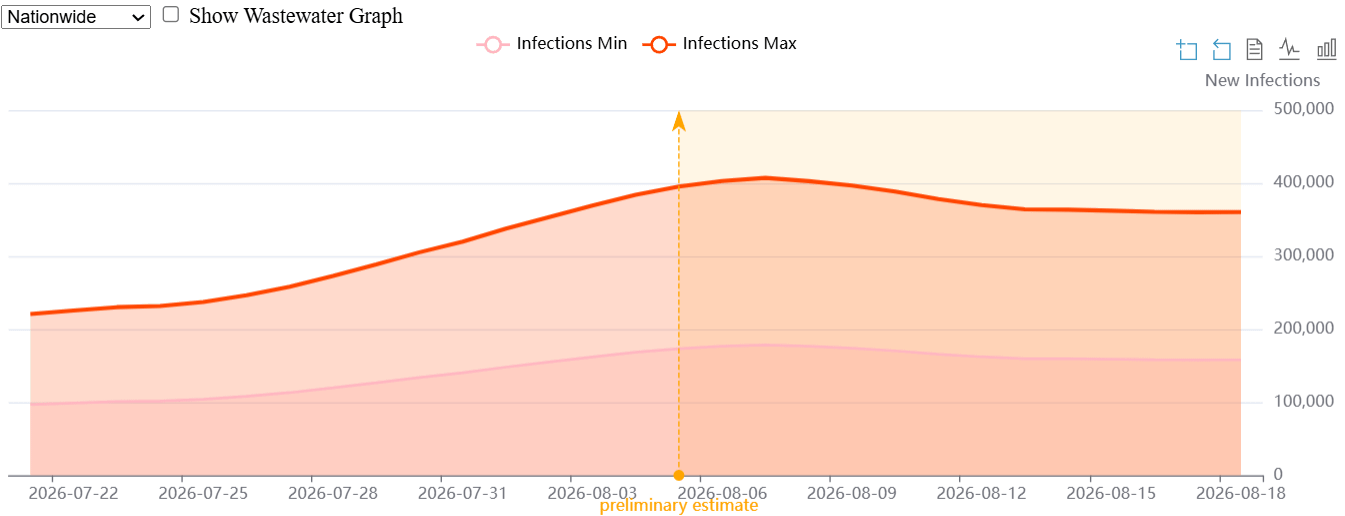
The older MAPS forecast issued on July 21, 2026 continues to track well with the observations. The days after the preliminary estimate start will continue to fill in, so do not be deceived by the dip. Here is the model forecast for matching dates. Expands the observations to indicate 600,000 NDIs when the new updates arrive tonight.
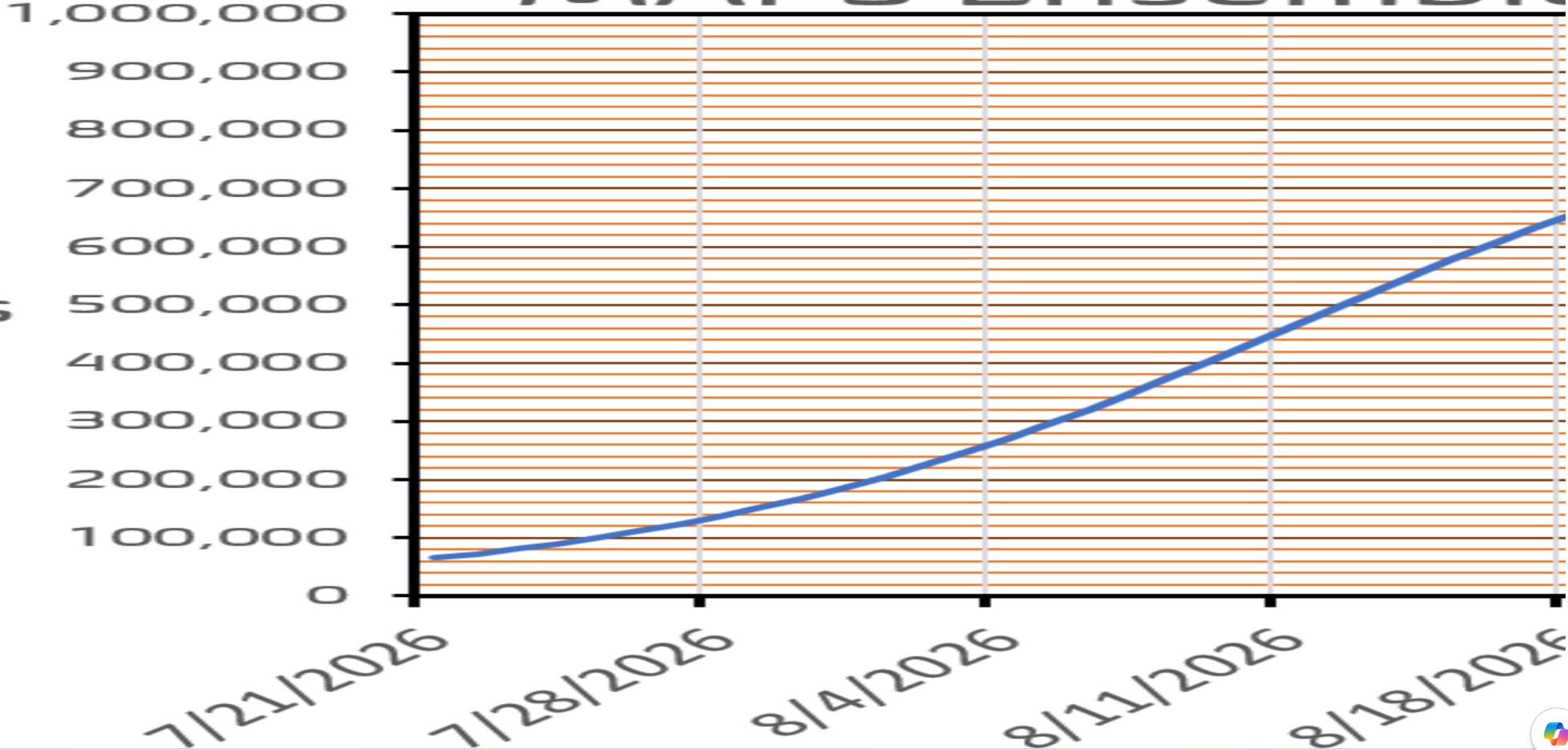
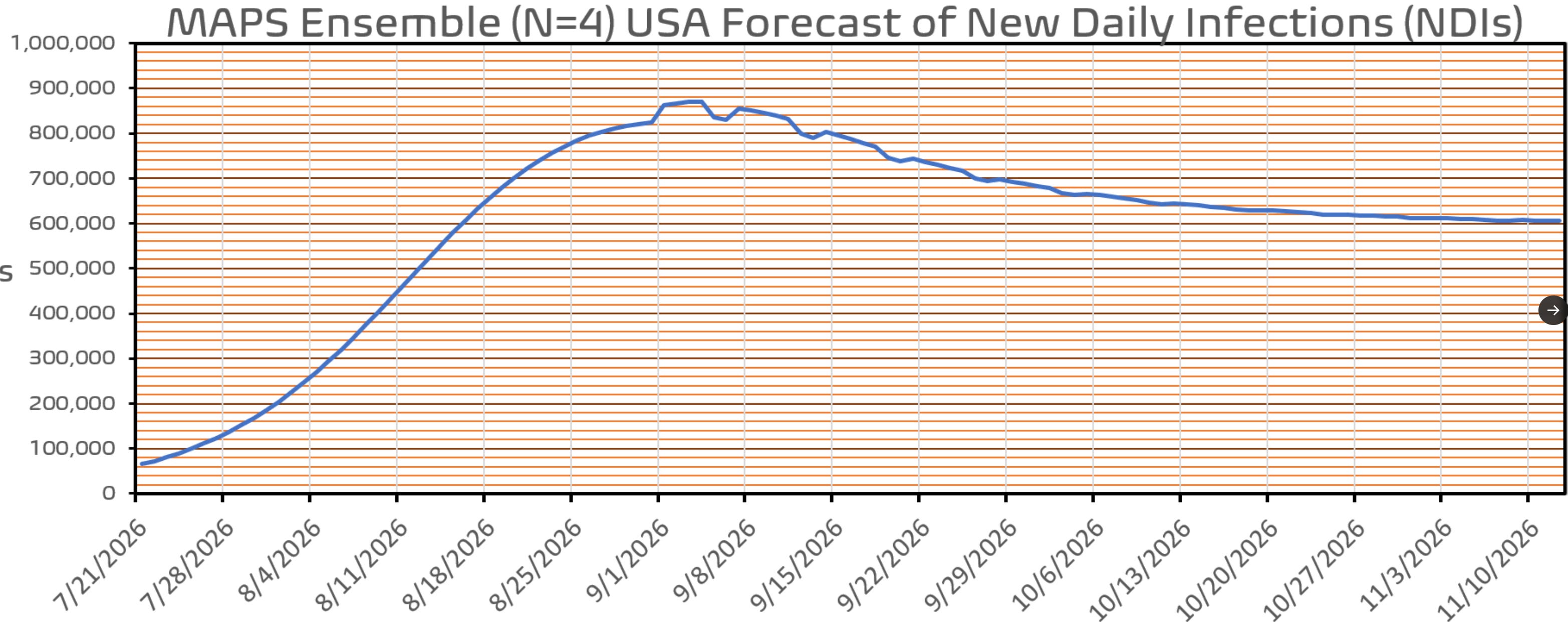
And here is the entire forecast.
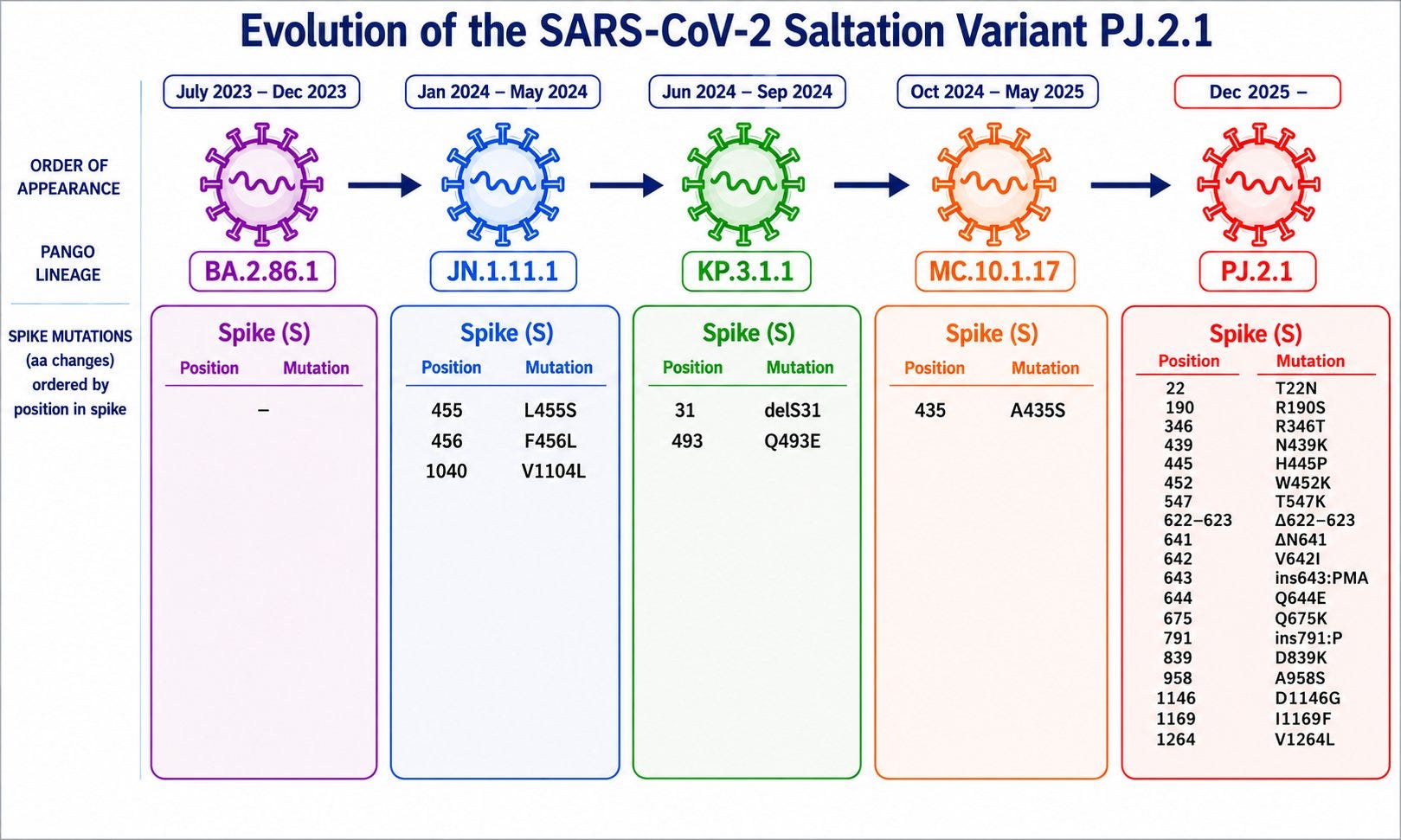
It appears that PJ.2.1 has arrived in the US. Expect that to start dominating in another month or so. It is a saltation, with numerous changes to the S protein. This is shown clearly in the image below.
I will have a new forecast ready by Sunday and will post it then. The new version of MAPS continues to go through a learning cycle, and the forecasts will become more accurate with time.
● DR Congo’s Ebola outbreak (Bundibugyo strain, Ituri province) is now the country’s fastest-growing epidemic on record: 5,514 cases and 2,642 deaths as of ~Aug 24, with a case-fatality rate of 40–60% by health zone and officials describing transmission as outpacing the response. This is the top story this cycle.
● Measles: Pennsylvania’s Lancaster County outbreak produced the first two US measles deaths this year (both unvaccinated, one a newborn); a recent national tally added 211 cases (89 in PA, 73 in OH), and rising kindergarten vaccine-exemption rates raise back-to-school transmission risk.
● Avian flu is expanding on two fronts: continued H5N1 spillover into US dairy cattle and poultry (72 dairy-cow detections year-to-date; new detections in TX, UT, ID) plus Australia’s first-ever wild-bird H5N1 detections (ending its H5N1-free status); China continues reporting human H9N2 cases, including in young children.
● Mpox (clade I) deaths in DR Congo have passed 600, with the Republic of Congo reporting its first cases — a regional expansion — and research suggesting true infections may outnumber diagnosed cases by roughly 33 to 1.
1. SARS-CoV-2 / COVID-19
Status:
● No acute outbreak or surge signal was identified this cycle; coverage skewed toward long COVID research.
● UK data: roughly 1 in 4 infected healthcare workers developed long COVID, with support described as “inconsistent and insufficient.”
● Long COVID symptoms persist into a second year for most affected; exercise intolerance affects about 36% of that group.
● Night-shift workers show an 88% higher long COVID risk, suggesting circadian disruption compounds recovery risk.
● Severe acute COVID has been linked to arterial plaque growth, raising heart attack/stroke risk for up to a year afterward.
● Data gap this cycle: current variant mix (e.g., any successor to recent dominant lineages) and wastewater/test-positivity trends could not be confirmed from accessible sources.
Severity: Low–Moderate
Trend: Stable acute activity; substantial ongoing long COVID burden
Why it matters now: The acute picture looks quiet, but the long COVID data reinforce that prevention — masking in high-risk settings, staying current on boosters, cleaner indoor air — still pays off well after the infection itself resolves.
2. Measles
Status:
● Lancaster County, PA outbreak produced the first two US measles deaths of the year, both unvaccinated; one was a newborn whose death may trace to maternal measles infection.
● A recent CDC tally added 211 new cases nationally (Pennsylvania 89, Ohio 73), and officials suspect the Pennsylvania outbreak may be undercounted.
● US kindergarten vaccine-exemption rates rose again in the last school year, a trend public-health officials link to elevated outbreak risk.
● A cost study estimated ~$60,000 per case for the 2025 outbreak wave, roughly $134 million in total.
● Pediatricians are actively preparing for further measles activity as the new school year begins.
Severity: High
Trend: Rising
Why it matters now: Falling vaccination coverage plus school-year mixing is a well-understood recipe for measles resurgence — the first US deaths this year are a signal this isn’t a hypothetical risk anymore.
3. Diphtheria
Status:
● Data gap this cycle: CDC’s diphtheria outbreak page and CIDRAP’s diphtheria topic page were both unreachable (404) from available sources, so no current case data could be confirmed.
Severity: Unknown — monitor
Trend: Unknown this cycle
Why it matters now: Diphtheria stays on this briefing’s core list because global vaccine-coverage gaps and conflict-zone disruptions keep it a recurring risk; we’ll attempt a fresh check next cycle.
4. Avian Flu (H5N1 / H9N2)
Status:
● US: H5N1 continues in dairy cattle (new detections in Texas, Utah, Idaho; 72 dairy-cow detections nationally year-to-date) and in poultry, including Utah egg-laying operations.
● Australia recorded its first-ever wild-bird H5N1 detections, ending the continent’s H5N1-free status.
● Cambodia confirmed a human H5N1 case in an infant.
● China continues reporting human H9N2 infections — roughly 16–20 cases in the past six months, including young children (one case in a 1-year-old girl).
Severity: Moderate
Trend: Expanding — geographically and across species
Why it matters now: No sustained human-to-human transmission has been documented, but continued mammalian adaptation (dairy cattle) and spread into previously unaffected regions (Australia) both push the long-run pandemic-risk picture in the wrong direction.
5. Pertussis (Whooping Cough)
Status:
● Data gap this cycle: the CIDRAP pertussis topic page returned no accessible results, so no current case counts or locations could be confirmed.
Severity: Unknown — monitor
Trend: Unknown this cycle
Why it matters now: Pertussis resurgence tied to waning vaccine coverage has been a multi-year trend in several countries; it stays on the watchlist pending a confirmed update.
6. Ebola
Status:
● DR Congo’s Ituri-province outbreak (Bundibugyo strain) is now the country’s fastest-growing Ebola epidemic on record: 5,514 cases and 2,642 deaths as of ~Aug 24, more than 100 days since declaration.
● Case fatality rate is running 40–60% depending on health zone.
● WHO’s IHR Emergency Committee has held its second meeting on the outbreak; officials describe transmission as currently outpacing the response.
● A “Congo River Without Ebola” initiative is underway to protect the Kisangani–Kinshasa river corridor from further spread.
● An experimental monoclonal antibody (MBP134) has shown promising early results in the response effort.
● Separately, Uganda’s own Ebola outbreak has officially ended, at 20 cases and 2 deaths.
Severity: High/Severe
Trend: Rising sharply — described as tracking toward one of the largest Ebola epidemics ever recorded
Why it matters now: This is the most urgent item in today’s briefing: a case-fatality rate above 40% combined with transmission reportedly outrunning containment is a genuine international health emergency, not a routine watch item.
7. RSV
Status:
● No acute seasonal-surge signal this cycle; the Northern Hemisphere is currently between RSV seasons.
● Maternal RSV vaccination during pregnancy is linked to about a 70% reduction in infant RSV hospitalizations.
● Newborn RSV immunization was also linked to a 36% lower risk of invasive pneumococcal disease, a possible dual-protection benefit.
● Mayo Clinic data show asthma, chronic kidney disease, and similar conditions nearly double severe RSV risk in adults under 50 — a group not broadly targeted for vaccination today.
Severity: Low
Trend: Stable / pre-season
Why it matters now: The under-50, high-risk-condition finding is worth watching as a possible future vaccine-policy gap, even though current activity is quiet.
8. Influenza A
Status:
● Data gap this cycle: accessible CIDRAP flu coverage did not include Southern Hemisphere season severity or current strain-predominance data.
● Coverage did note flu vaccine availability messaging for the coming Northern Hemisphere season.
Severity: Unknown this cycle — monitor
Trend: Unknown this cycle
Why it matters now: Strain composition data from the Southern Hemisphere season normally previews what the Northern Hemisphere should expect and how well this year’s vaccine is matched; that read isn’t available yet.
9. Influenza B
Status:
● Data gap this cycle: no current strain-specific or case-trend data on Influenza B could be confirmed from accessible sources.
Severity: Unknown this cycle — monitor
Trend: Unknown this cycle
Why it matters now: Influenza B’s co-circulation pattern with influenza A affects total respiratory disease burden each season; will revisit once season data becomes available.
Mpox (Clade I, Central Africa and beyond)
Status:
● DR Congo’s clade I mpox outbreak has surpassed 600 deaths.
● The Republic of Congo has reported its first cases — a notable regional expansion.
● CDC’s clade I detection test was flagged as “most likely not reliable” for distinguishing substrains, complicating surveillance.
● Research suggests actual infections may outnumber diagnosed cases by roughly 33 to 1, driven partly by asymptomatic transmission.
● A CDC assessment suggests mpox is becoming endemic in affected regions; separate research found nonsexual-contact transmission is uncommon, and a dose-sparing Jynneos vaccination strategy is showing effectiveness.
● An older item (dated February 2025) describing a New Hampshire congregate-living cluster (clade Ib; one case exposing 17 contacts across two group homes) also appeared in source coverage — flagged here as historical context, not a new development.
Severity: Moderate–High (Central Africa) / Low (US)
Trend: Expanding regionally; likely becoming endemic
Why it matters now: Spread to a new country plus evidence of substantial underdiagnosis suggest the true regional burden and transmission risk are larger than confirmed case counts show.
Andes Hantavirus (flagged by ECDC as an emerging threat)
Status:
● ECDC’s newsroom listed an “Andes hantavirus outbreak” among current emerging/ongoing threats, but no case counts, fatality data, or specific location could be confirmed from the accessible page content.
● Data gap this cycle — flagged for direct verification next cycle rather than reporting unconfirmed figures.
Severity: Unknown — monitor
Trend: Unknown this cycle
Why it matters now: Andes virus is the only hantavirus with documented person-to-person transmission and historically carries a high fatality rate, so any active cluster warrants close, confirmed tracking rather than a passing mention.
Angola: Measles and Cholera (unconfirmed currency)
Status:
● WHO AFRO’s outbreak page listed measles activity in Cuanza Sul (dated July 29, 2025) and a cholera response with mass vaccination in the same region (dated July 14, 2025).
● Those dates are more than a year old relative to today and may reflect stale or pinned content on WHO’s page rather than new developments — flagged as unconfirmed rather than reported as current news.
Severity: Unconfirmed
Trend: Unconfirmed
Why it matters now: Worth a direct WHO AFRO data-portal check next cycle to determine whether either outbreak is still active before this item is dropped or elevated.
● ★ SARS-CoV-2 — standing watch for new variants and any resurgence in acute activity.
● ★ Measles — active US outbreak with the year’s first deaths and rising exemption rates going into the school year.
● ★ Ebola (DR Congo) — historic case-fatality rate with transmission reportedly outpacing the response; top-priority item.
● ★ Avian flu (H5N1/H9N2) — continued mammalian spillover and first-ever spread into a new continent’s wild birds.
● ★ Mpox — regional spread to a new country plus likely substantial underdiagnosis.
● ★ Andes hantavirus — flagged by ECDC as an emerging threat; details unconfirmed and need direct follow-up.
CIDRAP — Avian Influenza (Bird Flu)
CIDRAP — Ebola: “DR Congo suffers deadliest week in its Ebola outbreak”
WHO AFRO — Health Topics: Disease Outbreaks
WHO AFRO — DR Congo Country News
● 1. Confirm current diphtheria case data and outbreak status (CDC and CIDRAP diphtheria pages were unreachable this cycle).
● 2. Confirm current pertussis case data and outbreak status (CIDRAP topic page returned no results this cycle).
● 3. Track the DR Congo Ebola case/death trajectory and confirm whether it has become the largest Ebola outbreak on record in DR Congo or Africa.
● 4. Confirm the current SARS-CoV-2 variant landscape and wastewater/test-positivity trend.
● 5. Confirm Influenza A/B strain predominance and Southern Hemisphere season severity ahead of the Northern Hemisphere season.
● 6. Verify the Andes hantavirus item flagged by ECDC — location, case count, and whether it is truly active.
● 7. Re-check whether the Angola measles and cholera items on WHO AFRO’s page are current or stale legacy content.
A gentle reminder as always: a little kindness goes a long way — wearing a mask in crowded indoor spaces, staying current on your boosters, and pushing for cleaner indoor air are small acts that can spare someone a case of Long COVID or another lingering respiratory illness.
Take care,
Joe
Comments
Nothing yet. Say the first thing.
Sign in to join the conversation.