
Hello and welcome to Office Hours,
Before I begin, I have a couple of announcements:
The next edition of Office Hours will be on Tuesday, August 5th from 7pm EST-8:30pm EST. I want to try something different this time. If you are interested in joining Office Hours, I’d love for you to sign up for a 15 minute time slot HERE. Bring a work-in-progress or questions about writing and publishing.
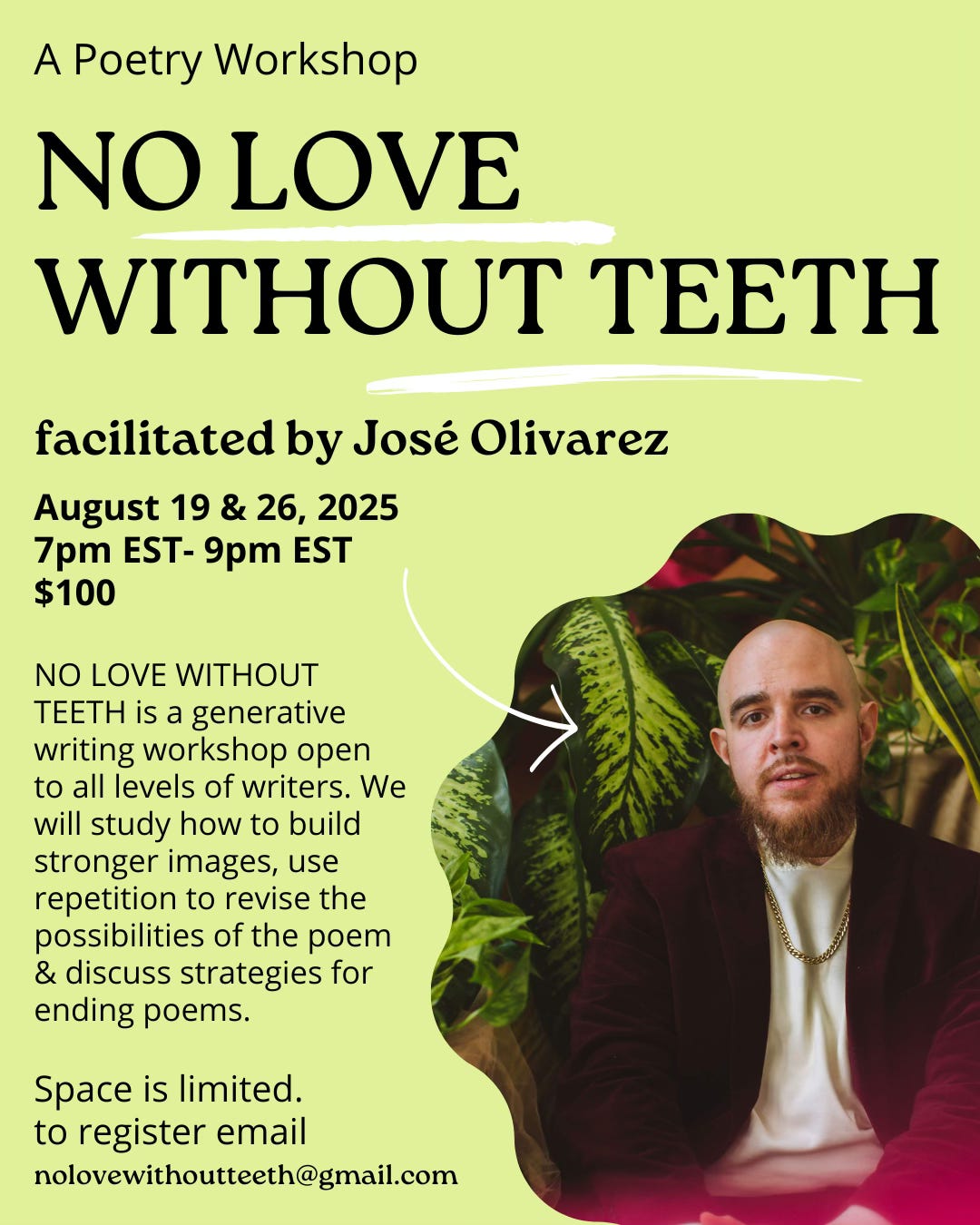
I will be teaching a generative writing workshop open to writers of all levels. The class is called NO LOVE WITHOUT TEETH. In this workshop, we will study how to build stronger images, use repetition to revise the possibilities of the poem & discuss strategies for ending poems. Class will take place on August 19 & 26 from 7pm EST- 9pm EST. Class costs $100. Register by emailing nolovewithoutteeth at gmail dot com.
Cool. Let’s look at a poem.
Thanks for reading Office Hours with José Olivarez! This post is public so feel free to share it.
Text within this block will maintain its original spacing when published
The Beauty of a Busted Fruit
by Natalie Diaz
from When My Brother Was an Aztec
When we were children, we traced our knees,
shins, elbows for the slightest hint of wound,
searched them for any sad red-blue scab marking us
both victim and survivor.
All this before we knew that some wounds can’t heal,
before we knew the jagged scars of Great-Grandmother’s
amputated legs, the way a rock can split a man’s head
open to its red syrup, like a watermelon, the way a brother
can pick at his skin for snakes and spiders only he can see.
Maybe you have grown out of yours—
maybe you no longer haul those wounds with you
onto every bus, through the streets of a new town,
maybe you have never set them rocking in the lamplight
on a nightstand beside a stranger’s bed, carrying your hurts
like two cracked pomegranates, because you haven’t learned
to see the beauty of a busted fruit, the bright stain it will leave
on your lips, the way it will make people want to kiss you.
I imagine that if you are reading this newsletter you are one of three people. You are someone who loves to read poetry, someone who wants to love poetry, or someone who writes poetry. Perhaps you are a combination of the above.
And if you are someone who writes poetry, I imagine that you, like me, want to write brilliant poems that move readers. And that desire can lead us to overwrite our images or get overly sentimental. We want so hard to name our feelings and revelations that we mess up the moment for the reader.
This poem by Natalie Diaz teaches me about imagery.
The first stanza is light on imagery. There is the image of tracing “knees,/ shins, elbows” & the image of the “red-blue scab.” The poem says that these bruises mark us as “both victim and survivor.” Hold that thought.
The second stanza features more and bolder imagery:
“jagged scars of Great-Grandmother’s/ amputated legs”
a rock splitting “a man’s head open to its red syrup”
watermelon
“a brother” picking “at his skin for snakes and spiders only he can see. (notice those s sounds.)
The images in this stanza are more violent at first glance. However, it is too simple to notice the violence. Jagged scars on amputated legs also indicate survival. The ending of the first stanza holds: scars, bruises, wounds mark us as victim and survivor— even if some wounds can’t heal like the pom asserts.
In the last stanza, Diaz turns toward the reader: “Maybe you have grown out of yours—” and I am a sucker for this move in poems. I love when poets turn to me as a reader and invite me to participate. I love when they point at me even if they are scolding me. I love the opportunity to participate in a poem. The images in this stanza begin as abstractions. Diaz writes “maybe you no longer haul those wounds with you/ onto every bus” It’s true that I argue against abstraction in poems. I tell students to avoid abstraction. Here Diaz makes it work by committing to the image. The abstract image of “wounds being carried” gains physicality because it is dragged “onto every bus, through the streets of a new town,/” they are set “rocking in the lamplight/ on a nightstand beside a stranger’s bed” and though the word “baggage” is never used my mind conjures overflowing luggage. It conjures an image of someone lugging all their belongings into a town where they know no one. But the poem does not end there. The poem turns back towards physical imagery. It says “carrying your hurts/ like two cracked pomegranates” and this could be enough. Ending on an image like this might still rock us as readers, but Diaz keeps going.
Diaz writes “because you haven’t learned/ to see the beauty of a busted fruit, the bright stain it will leave/ on your lips, the way it will make people want to kiss you.”
The poem turns the image of the “wounds” being carried into this bright new thing. The poem says we do not need to hide our wounds. They don’t make us ugly or unlovable. It’s the opposite. Our wounds are marks of what we have survived and make us more lovable and attractive. What a turn. It’s beautiful. It’s a poem and ending that I’ve been thinking about for over ten years now.
But again pay attention to the imagery. the images are relatively simple. They are pomegranates. They are red syrup. Watermelon. Choose images that work for you. Don’t try to overwork the images. Trust your instincts and trust your audience to follow you.
Thank you for reading. If you enjoyed this edition of Read Like A Poet consider becoming a paid subscriber. It helps me out a ton. And if you want to take a class with me, register today for my workshop. I’ll leave the flyer below. Thank you and be good.
No posts
Comments
Nothing yet. Say the first thing.
Sign in to join the conversation.