
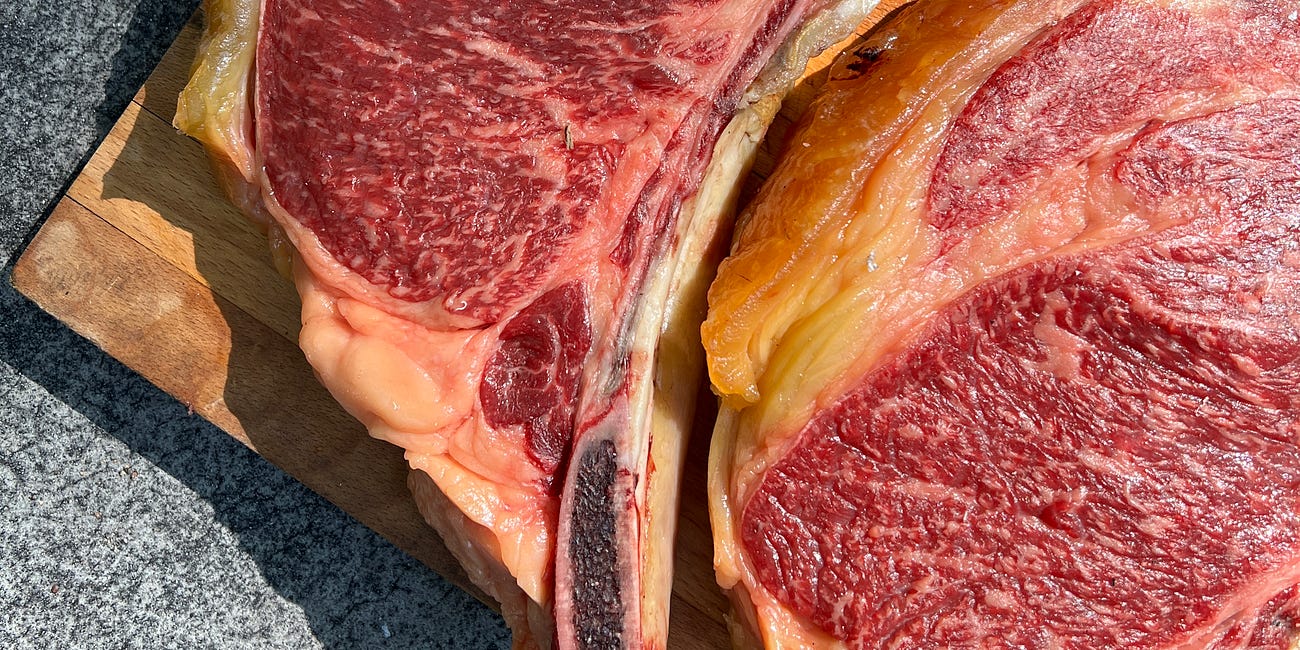
Hola friends, how was your weekend? Are you sick of the heat, or do you love it…are you throwing parties in your backyard and throwing logs on your fire…did you make a txuleton??
Recipes
A perfect Spanish summer dinner on the grill
·
Aug 13
My friends, earlier this week I shared with you some of my favorite Spanish olive oils and why, if I am being completely honest, it is the best in the world. I also shared with you how many Spanish people use olive oil in their homes, and the different types of oil that it makes sense to use when you’re frying, when you’re making allioli or mayonesa, or when you’re simply dipping bread in it or drizzling it on something just as delicious.
Of course, when we are thinking about summer parties and grilling and barbecues, we might also (at least I do!!!) be thinking about what to drink with all those delicious summer foods. You almost always probably want something cold, right? A crisp glass of white wine or a cold beer is always a good idea, especially if you’re eating outside.
The Greeks have been making wine for thousands of years—some of the earliest archeological evidence shows that they were drinking wine about 6,500 years ago…! The wine trade became a very important part of the Greek economy, and important for their agriculture because winemakers…always smart, always innovating…were bringing advances in farming and grape harvesting and pressing. On old vases and wall frescoes, you can see scenes of people drinking wine from large vessels…I guess they hadn’t discovered the porrón yet!
The Greeks also established more modern ways of winemaking, creating technology like the screw press to extract more juice from the grapes. They studied soil types and learned which grapes are best for which regions. It was also one of the first wine cultures to start culling their grape yields for quality and flavor intensity…they saw that the wine was better if they took a lot of care to make sure only the best grapes made it into the winemaking. AND they were one of the first wine cultures to train the vines, which means to help them grow a certain way, and not wildly in different directions. All of these advances and this knowledge still influences the winemaking process today.
The styles of wine that the ancient Greeks were drinking are different than a lot of what you’ll find there today…they were mostly sweeter, though they did also make some dry wines, and it was almost always diluted with water (more mountainous regions could use snow to chill their wine!). This was considered the “civilized” way to drink it…at least it means you can drink more wine!
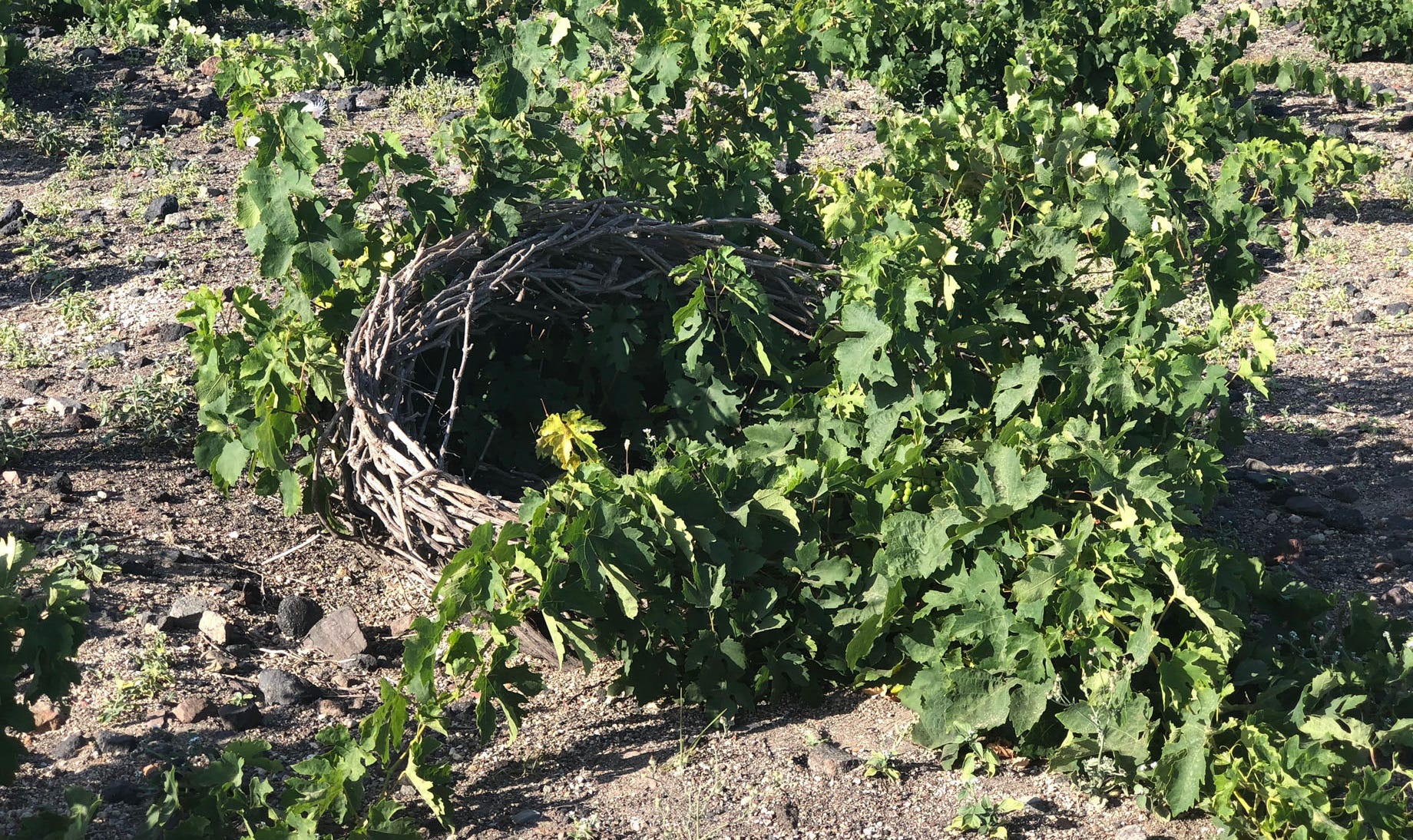
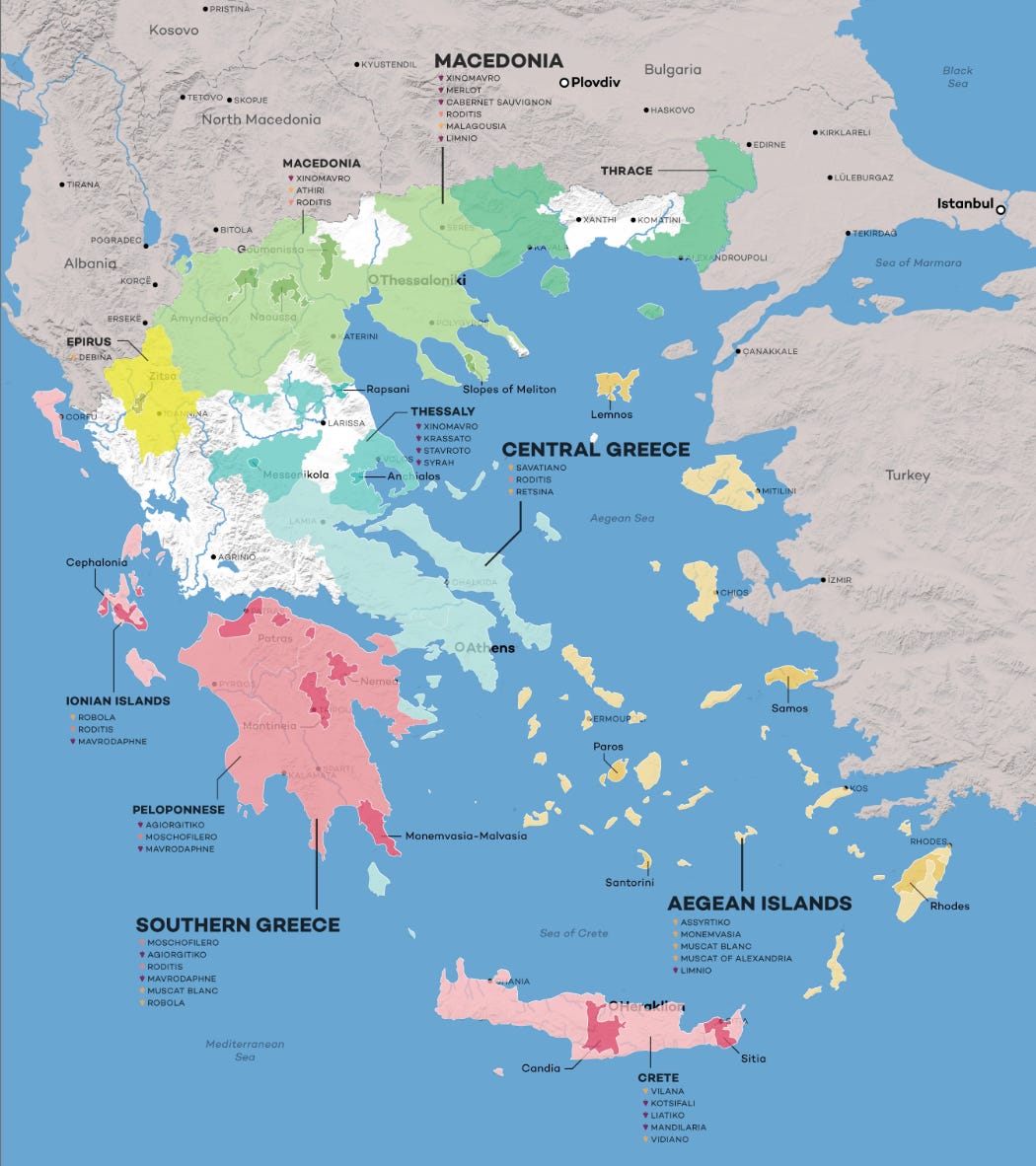
Today, more than 300 different grape varieties are grown in Greece, and the most popular regions on the mainland are Nemea, Macedonia, Mantineia, and Attica. Of the islands, Crete and Santorini are where you will see a lot of wine on wine lists here in the States. Nemea is in north eastern Greece and is known for red wine, especially the Agiorgitko grape. Macedonia is mountainous, and has a cooler climate than many other regions…people sometimes call it “Greek Burgundy” because of their red wines made from the Xinomavro grape. Attica is in central Greece, close to Athens, and known for their resinated wine (a type of wine flavored with tree resin, like pine). Mantineia is another high altitude region with beautiful white wines made from Moschofilero. Crete, an island, is known for both red and white wines made from ancient grape varieties like Kotsifali (red) and Vidiano (white). And of course the famous Mediterranean island of Santorini with its volcanic soils is known for Assyrtiko. In Santorini, the vines are trained in a style known as “basket” to protect them from the high winds that blow through the region. Remember when I told you about island wines, especially the beautiful ones from the Canarias?
Island wines to help us dream...
·
Mar 16

People of the world! I hope you all had a good weekend and are able to ignore the strange weather today—but no matter what it’s like outside…it’s a good time for a glass of wine. When is it NOT a good time for a glass of wine…!
So what are you looking for on a label on a bottle of Greek wine? Here is a little bit more about some of the many Greek grapes, and some ideas of what you could get by the glass or bottle if you happen to want a glass of wine at Zaytinya.
I would like a cold, crisp glass of white, José
Assyrtiko
If you’ve had Greek wine in the U.S., and you’re a white wine lover, you’ve probably tried Assyrtiko. Assyrtiko makes really perfect dry, crisp wines with lots of citrus and salinity from the sea air, and you’ll also get a little bit of minerality from the volcanic soil. People, this is your seafood wine! At Zaytinya, you can enjoy an amazing Assyrtiko from Crete by the glass (2024 Lyrarakis Assyrtiko), OR bottle (2023 Athiri, Adiani).
Moschofilero
Moschofilero is also a dry white wine, but it’s a lot more aromatic…you will still get that nice acidity with a dry wine and all those citrus flavors, and also lots of floral notes like orange blossom and jasmine. It’s going to be a little bit softer than Assyrtiko, which makes it a nice pairing for something with mezze that might have stronger flavors and maybe a little heat. You can also get this by the glass at Zaytinya (2023 Bosinakis).
Vidiano
You will still get some acid with this wine but it’s more full-bodied than Assyrtiko, so you will taste some stone fruits like peaches and apricots. This is your wine to stand up to heartier dishes with more rich ingredients. Zaytinya New York has it by the bottle (Iliana Malihin 2024…when my Wine Director Jordi Paronella visited Greece last year, Iliana Malihin was one of his favorite places)!
Red for me, please!
Agiorgitko makes a really dry and beautiful red wine with lots of red fruit like plum, cherry and raspberry, maybe with a hint of oregano. Because it’s so dry, you will want to drink this wine with food (I won’t judge if you don’t, but trust me, you will want to!), and it will stand up well to anything hearty. You can find it by the glass at Zaytina (Mitravelas “Red on Black” 2023).
Kotsifali
This red grape from Crete has a lot of red fruit—red plum, raspberry, maybe a little tart cherry, so it fits in with its Mediterranean neighbors. It tends to be really smooth with a nice finish, and this is your wine to drink with roasted or grilled lamb.
Xinomavro
You will taste more tart red fruits with this grape…Xinomavro usually has lots of red plum, tart cherry, and strawberry, with some Mediterranean hints of black olive and sun-dried tomato—a savory wine to pair with savory foods, especially grilled meats. Xinomavro (and other red grapes) are also used in the production of rose, and you can get a glass of it at Zaytinya (along with a red by the glass as well, Imathia Foundi 2018).
Tell me, have you tried any Greek wines? Come in to Zaytinya and let us take you on a tour of Greek and other Eastern Mediterranean wines. I promise you will come away with a whole new perspective.
No posts
Comments
Nothing yet. Say the first thing.
Sign in to join the conversation.