
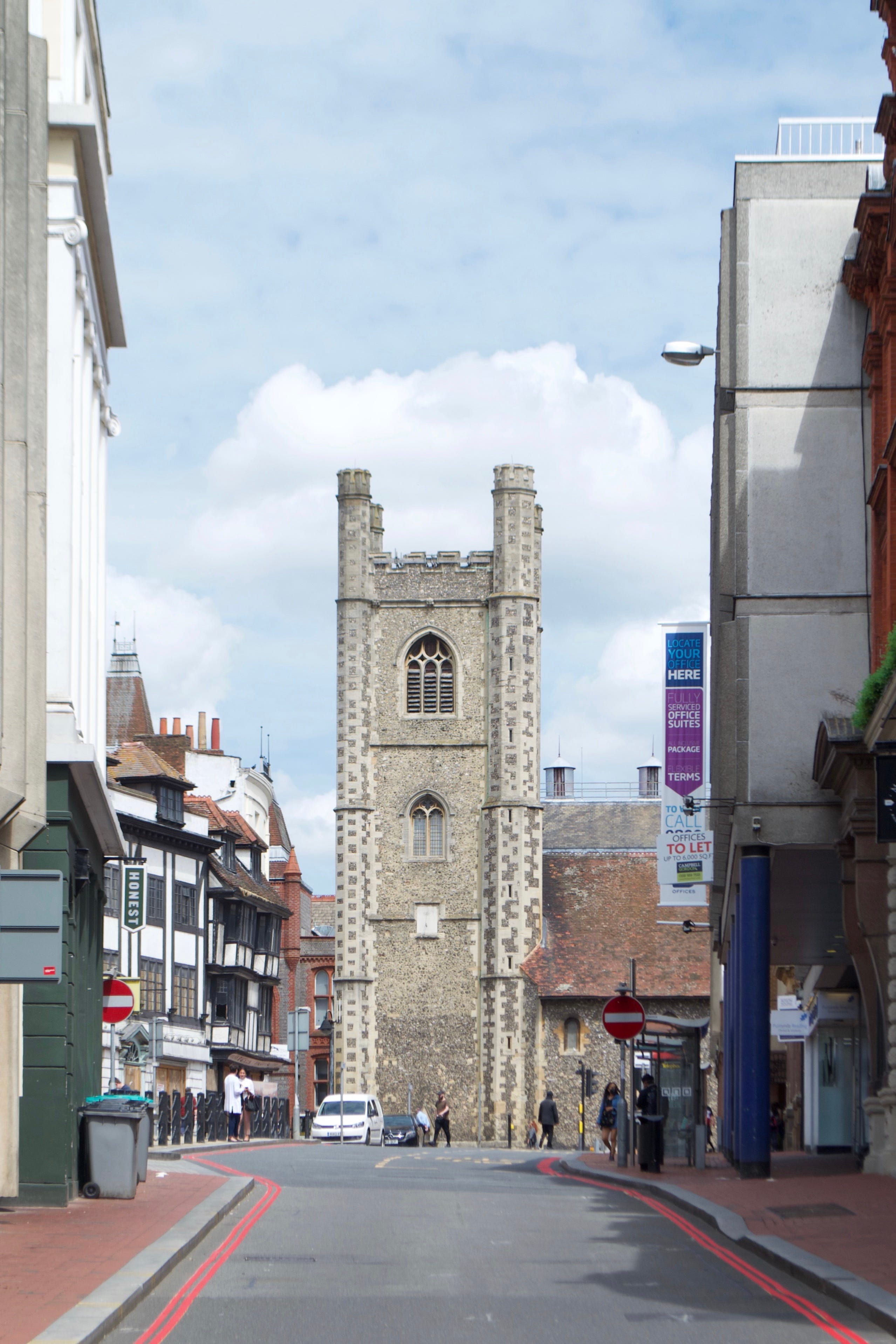
Mary Adams was the daughter of a shoemaker based in Reading, Berkshire in the south east of England. She would have known the town well, with its crumbling abbey ruins and shops which lined Broad Street, along with its ancient pubs, taverns and inns. It is likely that, when young, she lived in or near today’s Market Place, where Shoemaker’s Row had been since the medieval period and was still the centre of the leatherwork and shoe making industry there. Historic pubs and inns like The George and The Broad Face dominated the town and catered to visitors and townspeople, providing food, drink and somewhere to stay. Records of the town in the 1620s and 1630s reveal Reading’s bustling, busy environment, attractive to local pickpockets and cutpurses who hovered behind distracted customers choosing what to have for dinner.
It’s likely that the Adams were among the poorer of Reading’s families, as the moment she reached an age where she could enter service, her father urged her to find work. Going by the average age of entering employment, Mary could have been between 15-20 years old at this time, although the report suggests she was on the younger side. After a while in her new job, Mary began a relationship with the grocer’s son, and she soon discovered she was pregnant. On finding out she was with child, the grocer tried to dismiss her from his service, but when she told him the father was his son (suggesting the son certainly didn’t tell his father himself) the grocer agreed to support her until she gave birth.
It was around now, in the 1690s, that Mary decided to look for work in London. She entered into the service of a mercer in Cheapside, probably choosing the area as it was especially well-known for being busy and commercial and would give her the best chance of finding employment. It is not known if she had her child with her at the time. A sexual relationship was entered into between Mary and her employer, despite him being married, and they met while the wife went out with friends, or away from the home. After some time she once again found herself pregnant, but instead of revealing their affair, the mercer convinced her to force an argument one day with his wife so that he could dismiss her. He would then, he promised, set her up with a temporary home in Hackney, where she stayed and waited for the birth. Sadly, Mary’s second child died within hours of being born and her lover then quickly abandoned her and returned to his wife. Mary, now rejected, exhausted from giving birth and left with no work, decided to bribe the mercer, saying she would tell his wife about their affair unless he paid her 20 guineas, a substantial amount but enough to help her find lodgings, food and new clothing to help get her back on track. The mercer, keen to save his marriage and remove Mary from his life, paid, and Mary went to live in Wych Street in Westminster, near the inns of law. The street, now demolished, was in a good area near the river, a narrow road lined with late sixteenth-century houses. But Mary’s anger at her treatment by the mercer was still strong, and she wrote to his wife, making sure not to leave a return address on the paper, so she could not be traced. Leaving the mercer to explain the letter and what he was really doing when she was at the theatre, Mary fell in love with a sailor who lived locally and they married, but their life together was cut short when he was recruited into the Royal Navy of William III.
Alone, with no sign of her husband’s return, Mary attracted the attention of a lawyer in Clement’s Inn, and she moved in with him. When this relationship ended she began another with his colleague which lasted two years until he told her she had to leave his lodgings as he was soon to be married. She was then introduced to a ‘notorious bawdy-house owner on Drury Lane’, and agreed to become a sex worker, building up a number of wealthy clients. But after one client paid her a substantial amount of money, she argued with the brothel’s owner as to how it would be divided between them and was put out onto the street, the report stated, with a black eye. She then worked for herself, walking London’s streets and seeking new clients, but, desperate for income, began to engage in theft too. It was reported that she was often hauled up in front of judges but dismissed due to lack of evidence. Her fate was sealed when she took a client in Covent Garden and suggested they go to a local brothel to sleep together. Afterwards, she saw him sleeping and picked his pockets of cash and a large bank note and crept out. When he woke, he realised what had happened and sent a message to the bank not to pay out the note. When she tried to cash it the next day she was detained and the authorities were called. After a short trial she was convicted of theft and imprisoned in Newgate Gaol. Some of her clients, on hearing the news, brought her fresh clothes and money, and she was able to buy a mourning suit to wear on the morning of her execution. Mary was conveyed to Tyburn and hanged on 16 June 1702.
What is so heartbreaking about Mary’s story is that despite repeated rejections and adversity, we see her trying again and again to make a fresh start. Her choice of lodgings in late seventeenth-century Cheapside and Westminster reveal that she thought carefully about where to live so that she could make use of the opportunities available in these busier, commercial areas. She sought the company of those she believed could help her to a better life, such as lawyers and mercers and even acquired some wealthy clients. However she was used and abandoned by both men and women when she stood up for herself, asked for help or better conditions, or when they simply grew tired of her. William Jackson, who told Mary’s story in The Malefactor’s Register published in 1779, didn’t see it that way. Mary’s life was told only to drive home a series of ‘moral of the story’ lessons. He warned women that when someone ‘above their own sphere pay addresses to them, it may reasonably be supposed that honourable marriage is not intended’, and accused Mary of being ‘too proud to condescend to accept of a common service’. It was her ‘submitting to be debauched by her master’s son at Reading’ that ‘laid the foundation of her ruin’, he wrote, uninterested in the role played by the young man or his own responsibilities. He described Mary’s threats to reveal her London affair to her lover’s wife ‘mean’, and warned young men against seducing women because, ‘beside the ruin of her, he involves her unhappy parents and friends in the bitterness of woe!’. Eighteenth-century attitudes, at least from Jackson’s viewpoint, placed the blame on Mary for these actions, did not hold to account any of those who abused her and seemed to be more worried about the effect it had on her family and friends than Mary herself. Also worrying is that Jackson’s work was written to educate children. The frontispiece depicts a woman handing the book to her son, ‘tenderly entreating him to regard the instructions therein recorded’, while she points out of the window at a figure hanging limply from a gallows.
The site of the gallows where Mary lost her life is today opposite a Pret A Manger café, and down the road from a modern art gallery. It is near to Marble Arch, where shoppers and tourists sit to eat their lunch, gazing unknowingly between bites in the direction of the site of countless executions. Today Tyburn could easily be missed, but if you find yourself there do give a little thought to Mary Adams. I know I will.
Source: The Malefactor’s Register, or, The Newgate and Tyburn Calendar by William Jackson, Volume 1. London, 1779.
Don’t forget my books are available, Forgotten Women of the Wars of the Roses and Power Couples of the Tudor Era in time for Christmas!
No posts
Comments
Nothing yet. Say the first thing.
Sign in to join the conversation.