
Reading time: 7minutes

I moved my hand. The pendulum moved with it. I never touched it. Three other people were watching. What happened next forced me to reconsider where consciousness ends and the physical world begins.
Even now, I do not know exactly what transpired.
I have experienced many anomalous and non-ordinary phenomena throughout my life, but I have never considered myself to possess any special psychic or paranormal abilities. Nor have I been particularly interested in proving their existence. My intellectual temperament tends in another direction: I am less interested in prematurely categorizing extraordinary experiences than in understanding what they might disclose about the relationship between consciousness and reality.
But occasionally, an experience strains the very frameworks through which we ordinarily make sense of reality.
The incident I am about to describe was one of them.
It happened during a San Pedro retreat. Three other participants and I were gathered in a hermetically sealed room specifically designed for silent meditation and intensive inner work. It was winter, with the doors and windows shut tight, leaving no discernible stray drafts or other obvious physical disturbances.
As the plant medicine reached its peak, my perception became exquisitely sharp. I began seeing what appeared to be energetic phenomena around several objects in the room: luminous fields, subtle textures, and shifting contours of light. None of this was entirely unprecedented for me. Psychedelic states can radically transform perception, and I had encountered comparable phenomena before.
Then, my attention settled on a quartz pendulum suspended from the ceiling.
Around the stone, I perceived a multicolored aura extending a few inches into the surrounding space. Driven by an inexplicably strong impulse to interact with it, I reached toward the pendulum.
But I stopped short of touching the stone.
Instead, I hovered my fingers approximately two inches from its physical surface and gently clasped what appeared to me as its aura. Then, I slowly pulled that luminous field to one side.
The pendulum moved.
Not randomly, or so it appeared. It followed my hand in striking synchrony, swinging in the same direction and at approximately the same speed as my gesture.
Before I could dismiss this as a trick of my mind, one of the other participants suddenly broke the silence.
“Look—it’s moving!”

I froze. My first response was not excitement but analytical skepticism.
I tried it again.
I moved my fingers in another direction. The pendulum instantly followed.
I changed the angle. Again, it followed.
I repeated the gesture several times while desperately searching for some mundane explanation. Was there an air current I had somehow failed to notice? Had I inadvertently vibrated the ceiling hook? Was my body movement disturbing the air enough to drag the pendulum along?
No obvious explanation presented itself at the time.
More importantly, I was not the only witness to the pendulum’s movement. The three other participants watched the sequence unfold and later described a similar sense of astonishment.
The obvious word came immediately to mind: telekinesis.
But the more I reflected on the experience, the less satisfactory that description felt.
Telekinesis normally refers to the purported movement of physical objects through mental intention alone. Yet I had not been concentrating on the pendulum or actively attempting to move it with my mind. During that first gesture, I had no conscious expectation that the pendulum would move whatsoever.
Phenomenologically, something entirely different seemed to be happening.
I was interacting with what appeared to be an energetic field surrounding the physical object—and the object seemed to respond to my manipulation of that field.
I eventually found myself entertaining a new term: energy-kinesis.
I use the expression tentatively. It does not name an established scientific or even paranormal phenomenon, nor do I intend it as a definitive explanation. It simply describes the experience more accurately than telekinesis. Here, embodied consciousness appeared to interact with an energetic medium that, in turn, appeared capable of influencing physical matter.
The distinction matters.
Because the most crucial question may not be whether the mind can somehow push matter around at a distance. The deeper question concerns whether the boundaries we ordinarily draw between consciousness, energy, and matter are as impermeable as we assume.
When confronted with experiences like this, modern culture often pushes us toward two ready-made stories.
The first says: It was subjective. You were under the influence of a psychedelic and hallucinated the entire thing.
The second says: It was objectively real. You perceived an invisible energetic reality and physically influenced it.
Choose your metaphysics.
I find both responses premature.
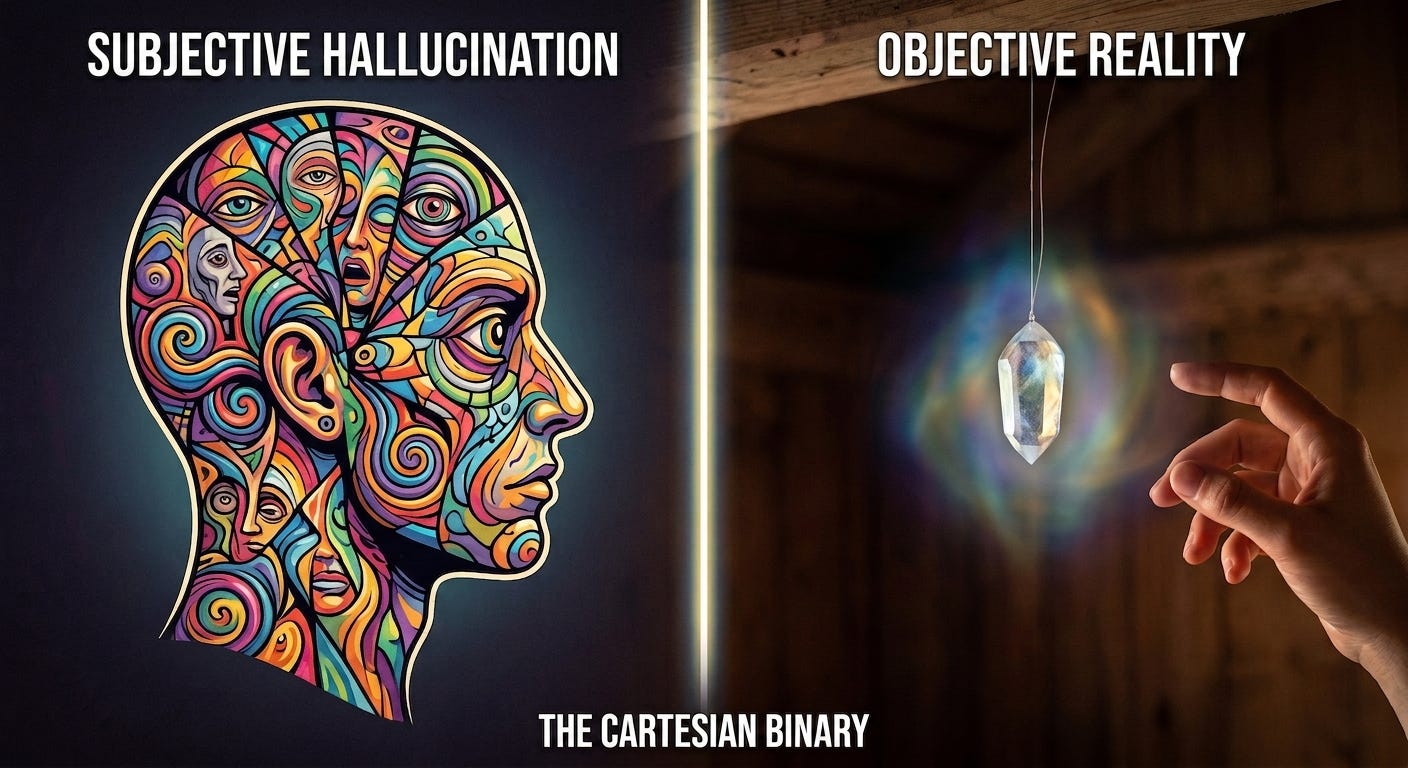
Certainly, psychedelic states can generate extraordinary perceptual phenomena. Memory is fallible. Expectation sculpts experience. Human beings are exceptionally talented at finding meaningful patterns where none exist. Any serious inquiry into anomalous events must take these possibilities seriously.
But simply invoking hallucination does not explain what happened either—particularly when an experience appears to involve observable physical consequences witnessed by several people.
The honest answer is perhaps less satisfying, but far more interesting:
I don’t know.
Perhaps the experience reflected some unusual but ultimately ordinary physical process that escaped our notice. Perhaps it involved an anomalous psychophysical interaction. Perhaps we participated in some form of collectively reinforced, shared perceptual construction. Perhaps there are dimensions of energetic causation that our prevailing scientific models do not yet adequately describe.
Or perhaps the categories through which we are asking the question are themselves part of the problem.
This is precisely where the participatory approach to consciousness becomes useful.
For several centuries, Western thought has trained us to view perception through a deceptively simple model. There is an objective world “out there,” a subjective mind “in here,” and our task is to determine whether the mind accurately represents what exists independently of it.
But what if experience refuses to conform to this neat division?
Contemporary embodied and enactive approaches to cognition increasingly emphasize that organisms do not simply passively absorb a pre-given world. Perception emerges through a dynamic interaction between the nervous system, body, environment, history, expectation, attention, and action.
The participatory perspective pushes this insight further.
It asks us to consider whether some extraordinary states of consciousness might disclose—or actively help bring forth—phenomena and dimensions of reality that defy classification as either purely objective or merely subjective.
This does not mean that whatever we experience becomes ontologically real simply because we experience it. That would simply mistake individual experience into metaphysical truth.
It means something more modest, yet far more radical: reality and experience may co-create each other through participation, in ways more complex—and perhaps more mysterious—than our current scientific models allow us to grasp.
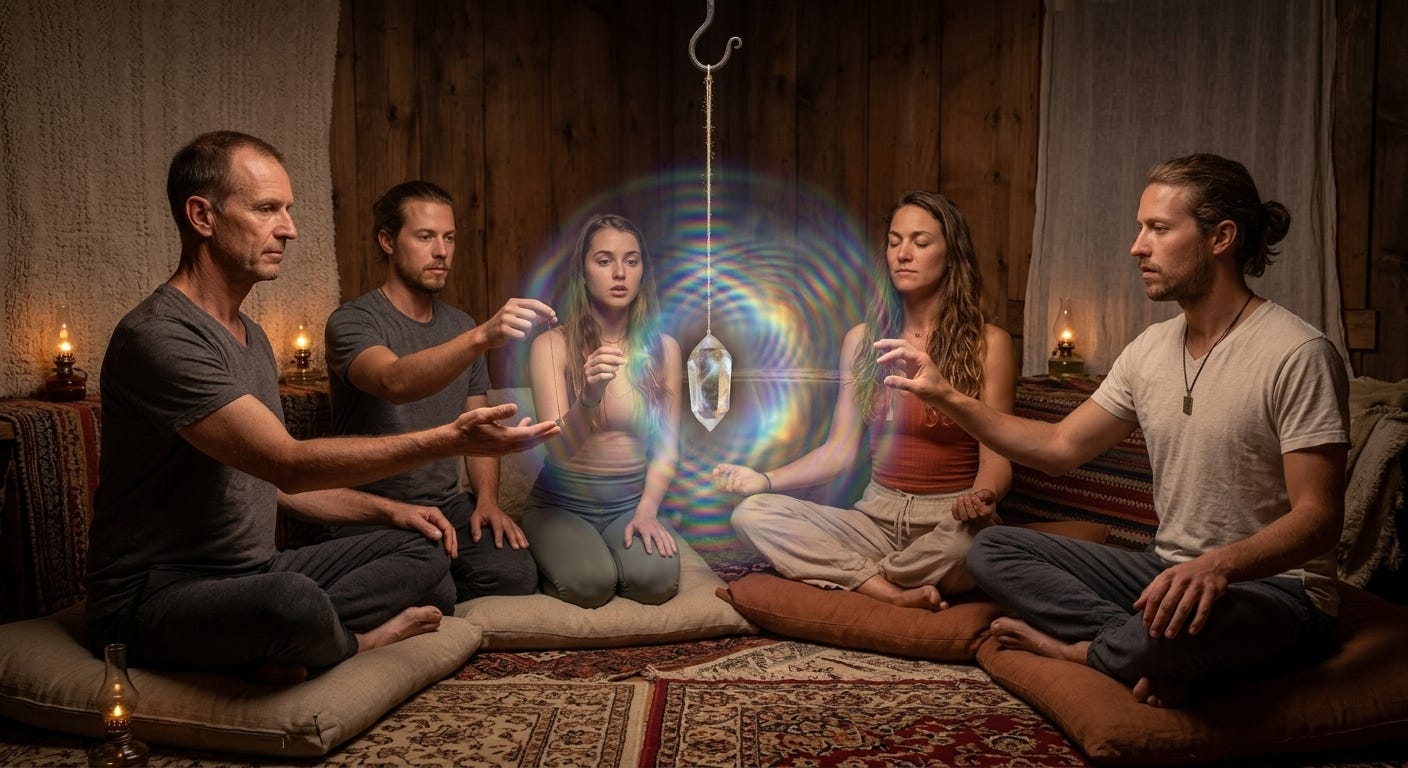
The pendulum episode was not an isolated incident. During other psychedelic encounters, I have perceived energetic fields that seemed to respond to touch and movement in ways that felt strikingly interactive. At times, two or more of us interacted with these fields in synchrony and reported seeing the same responsive movements.
Taken together, these experiences have left me wondering whether the relationship between the experiential, energetic, and material dimensions of reality is more continuous than our conventional categories allow.
I emphasize that word: wondering.
I do not know whether the energetic fields I perceived existed independently of consciousness. I do not know whether our interactions with them somehow participated in their apparent responsiveness—or, in the case of the pendulum, its physical movement. I do not know whether these phenomena involved some combination of perception and participation, or some third possibility that our present conceptual vocabulary cannot yet capture.
And perhaps that uncertainty is not a failure.
Perhaps one of the mistakes we repeatedly make when confronting anomalous experiences is demanding metaphysical certainty too quickly.
The skeptic knows it was a hallucination.
The believer knows it was a paranormal phenomenon.
Both have closed the door.
A participatory approach asks us to keep it open.
It allows us to investigate extraordinary phenomena without collapsing them prematurely into either naïve supernaturalism or reductionistic dismissal. It asks us to remain rigorous about what we know, precise about what we experienced, and genuinely curious about what remains unexplained.
The pendulum moved.
I perceived myself interacting with something surrounding it.
Three other people saw it move.
Beyond those three statements, certainty becomes progressively more difficult.
But sometimes the edges of knowledge are precisely where wonder becomes philosophically fertile.
Experiences like these do not require us to abandon science or critical thinking. Perhaps they invite us to practice them more radically—to resist confusing our present maps with the full territory of what is possible.
And perhaps the deepest implication is not that human beings possess some hidden paranormal power.
It may be something infinitely stranger—yet not necessarily incompatible with the possible existence of such capacities.
The world itself may be more participatory, more continuous, and more responsive than we have yet learned to imagine.
Have you ever experienced an anomaly that refused to fit into your existing worldview? Have you ever experienced anything similar to what in this essay I call energy-kinesis? How did you reconcile it without collapsing into easy belief or easy dismissal?
I would very much love to hear from you in the comments.
Note: This essay has been adapted for Substack from a broader and more rigorous discussion that will appear in Chapter 6, “Shared Visions: The Mystery of Collective Psychedelic Experience,” of my forthcoming book, The Participatory Way: Reimagining Consciousness, Psychedelics, Embodiment, and Culture. As a thank-you for their support, paid subscribers will receive a complimentary e-copy of the book upon publication.
Comments
Nothing yet. Say the first thing.
Sign in to join the conversation.