
A second star awaits Spain after their World Cup success and yet, when people come to look at which star powered this success, it won’t be one name. Some will point to the orchestrator Rodri and the control he has helped provide. Some might point to his midfield partner Fabián Ruiz, who is now at cap 50 and still has never tasted defeat in international football.
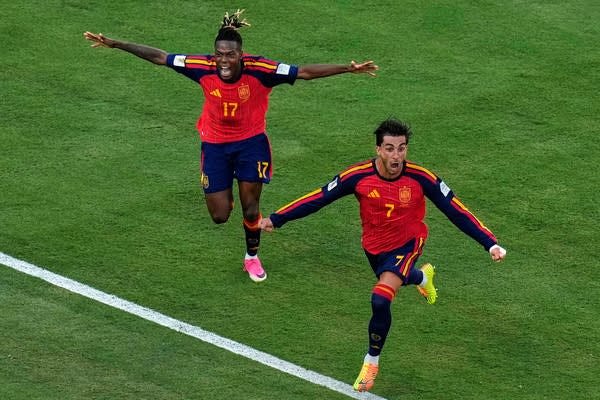
Others might point to the poster boy for the tournament, Lamine Yamal. Others to the unheralded number 10 come false nine, Mikel Oyarzabal. Some might mention the hero on the night, Ferran Torres, who two games in was caught lip reading, “please let it be a goal”, so desperate was he to get off the mark.
Some will mention Pau Cubarsí, the defender who has shown on the global stage the immense talent he has at just 19. All will be right and yet all wrong at the same time.
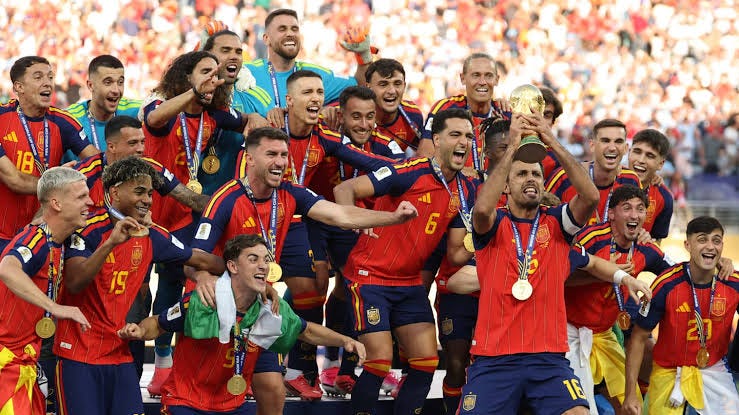
This team won because of that very word, team. The other reason it won is the system, which we will look at in this newsletter, a system that has produced not only the winning coach but the runner up as well and helped to produce elite players and coaches.
Luis de la Fuente does not, in many eyes, have the type of coaching record to see him become a multiple major tournament winner and yet, look beyond the fact he’s never made a go of it in the club game and his résumé in international football deserves far more recognition.
In May 2013, Luis de la Fuente joined the federation set up as the U19 coach. He had come off a painful spell at Alavés, who were in turmoil and had dropped to the third tier. During his absence from the game, he spent time at Athletic, his former club, watching Marcelo Bielsa.
Success came almost immediately, with the U19s winning the Euros. The team that day had a midfield consisting of Rodri and Mikel Merino, while Unai Simón was on the bench. Remarkably, that game was played on 19 July, a date that will now forever be associated with the quartet.
After five years with the U19s, where Spain continued to produce top talent and several of the current team passed through, de la Fuente was promoted to the U21 job. Again, success came almost immediately, with the team winning the U21 Euros in 2019.
On the pitch that day were Fabián Ruiz, Dani Olmo and Mikel Oyarzabal, while Mikel Merino came off the bench. At youth level, success can’t just be judged on trophies but on how many players break through, and Spain is remarkable at this.
The standard of the coaching is first class and the focus on youth development. One of the things that shocked me when I first moved to Spain is how much focus is put on youth development and how much interest there is.
Competitions like La Liga FC Futures, where U12s play, are broadcast on national television and given a big focus in the media.
On a personal note, Spain has reconditioned how I understand football. Living there, the culture is a surprise. Going to grounds, you rarely, if ever, hear a song about a player. It’s about the love of the club and the team.
In the UK, we place so much importance on players and our love for them, but in Spain they’re just a cog in the system. When you speak about football in Spain, your discussion will be more about systems and formations than about a player doing something brilliant.
Once you understand that, and understand the importance of the system when it comes to Spain, the continued success through the levels starts to make sense.
Spain has also promoted a subject many of us don’t like to talk about, which is B teams in the system. It is a bad experience for fans and clubs who play against them, but there is no doubting the benefits from a player development point of view.
When I spoke to Josh Farrell, a footballer in the third tier, about B teams, he was effusive in his praise of Real Madrid Castilla, who he said were the best team he had seen that season. When I asked why they were midtable, he said instantly, “because they’ve not yet learnt to see out a game”, but added, “that’s what they learn.”
By the end of the season, Castilla made the play offs and very nearly reached Segunda, quickly picking up that final element. Spain enjoys success at youth level and it then translates because the bridge we see is much smaller.
This summer in the U19 Euros, the Spain team had amassed 274 appearances that season alone in the league system. Wales, their opponents, had a handful and the score ended 7-0.
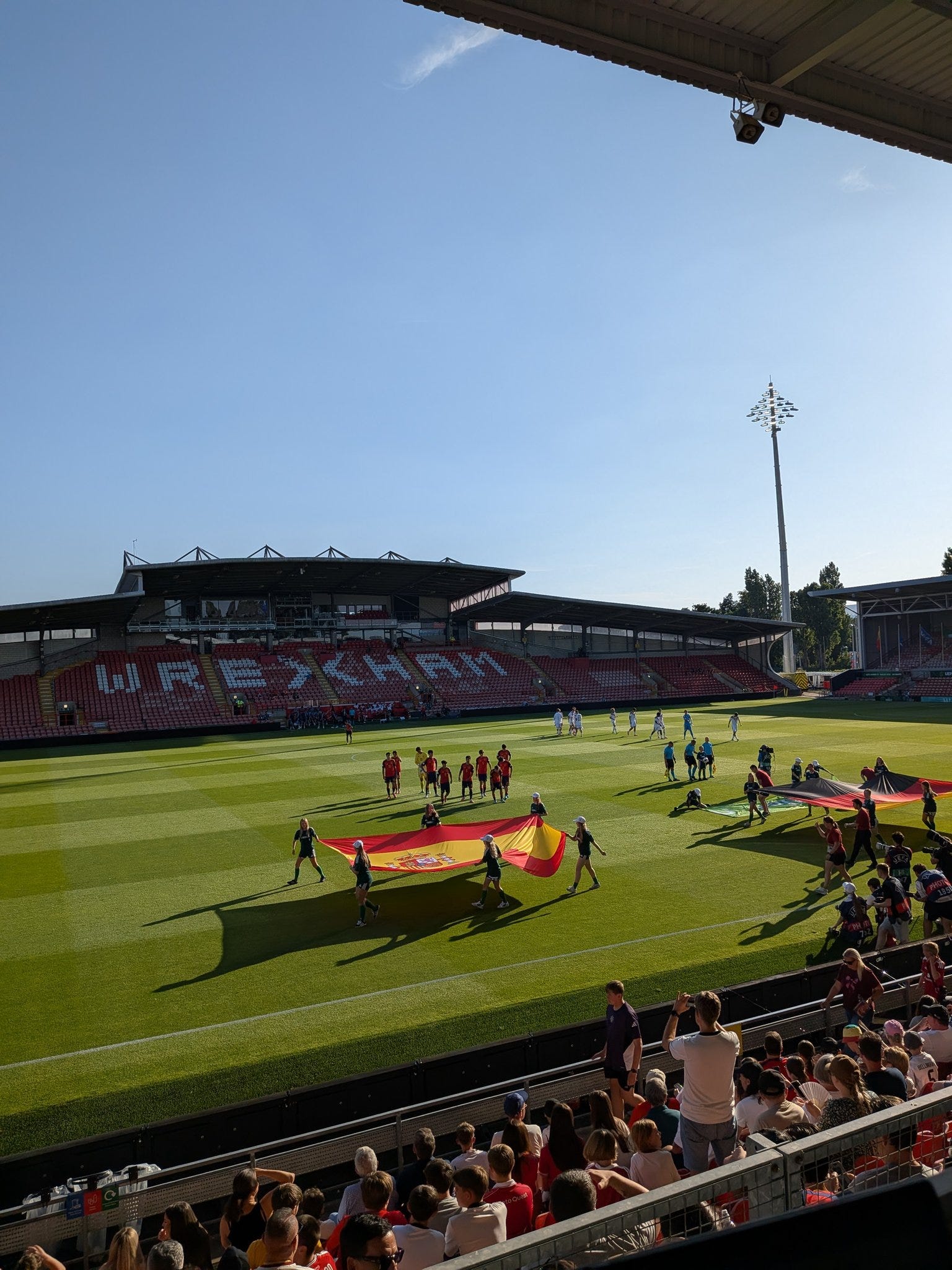
Spanish players play games that matter from 16 and 17 as par for the course and, while many go on to have careers at the top level, those who don’t have plenty of exposure to men’s football so that, if they’re released, they’re not as big a risk to sign.
Having covered the U19 Euros and watched the national team over the World Cup, it’s not a fluke that both teams ended with trophies. The U19s finished the Euros with an aggregate score of 19-0. The men’s team finished with an aggregate score of 14-1.
The similarities don’t end there. At every level, the same controlled, possession based style of play is implemented. At the U19s, Spain played a false nine like the men’s team and all these little things just help the transition as players go through the levels.
Watching both play, it’s a carbon copy and you could put any shirt you wanted on the players and instantly know what country developed them. Having come through this system and played a part in developing the players, de la Fuente was the chosen man when Luis Enrique left the job.
It’s not just that de la Fuente was part of the youth set up. He was also one of the teachers on the federation’s coaching course. The alumni who have passed through under de la Fuente include Lionel Scaloni, Xabi Alonso, Xavi and many more.
Many saw the appointment as underwhelming, particularly after following in the footsteps of a superstar coach like Luis Enrique, but de la Fuente knew not only the players intimately but also the system and the style of play.
There were bumps in the road at the beginning, including a defeat to Scotland where Spain looked to still be that team that passed for the sake of passing, but he started to introduce verticality and Spain became more direct.
Euro 2024 was when the national team first caught the eye for many, with the pace and directness down the wings driving them to success. It’s easy to forget, though, that so many crucial goals came from players such as Mikel Merino against Germany and Mikel Oyarzabal in the final against England.
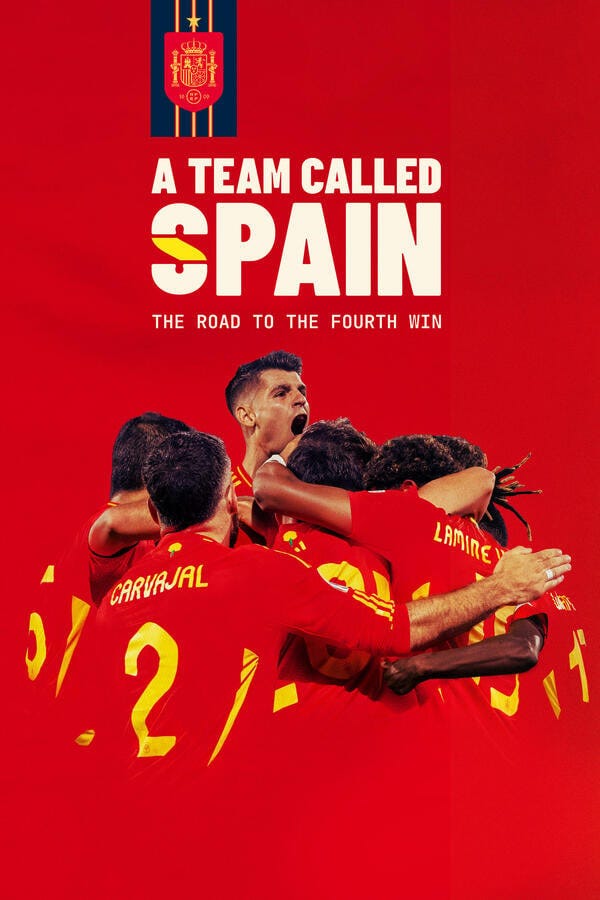
It’s not just fluke or tactical genius. It’s the trust de la Fuente has in the team and the importance he puts on every member. A documentary team followed the squad through the Euros and you got a sense of the importance placed on even players like Álex Remiro, the third-choice keeper, and the role they have to play in the team.
It’s not a coincidence the documentary is called A team called Spain, that identity of the team runs through the whole ethos of the federation.
Time after time, de la Fuente refers to the team when he speaks of praise for what’s going on and he doesn’t just select the 26 best players but the best people to be part of the team.
Players like Borja Iglesias, who has played a handful of minutes, are crucial for de la Fuente in how he supports the starters and the atmosphere he brings to the team, particularly his interactions with Lamine Yamal.
Even when Spain started the tournament badly with that shock draw, there was no internal panic and the message put out was, “we did the right things, we just didn’t get the right outcome.”
That steely confidence has been a trait of this Spain team throughout the de la Fuente reign and it’s something he has focused on. In truth, the Cape Verde game was the only real setback Spain suffered. They conceded just once all tournament, in the last 16, and never went behind in the tournament.
Almost every game, people focused on the strength of their opponents, but Spain disarmed all of them and made every team jump on the carousel, dictating the game in the way Spain wanted it to be played. The last time Spain lost in 90 minutes was March 2024, when Colombia beat them 1-0.
Since then, nobody has figured out a way to stop this Spain team. Some will question how exciting they were as winners, but this depends entirely on how you see the game. The chaos of the 2022 final was never going to be the way Spain won, where the individual brilliance of Messi and Mbappé came to the fore.
Spain doesn’t want the game decided by individuals. It wants it decided by the team and, when it comes down to those factors, there is no better team in the world. That’s why they head home with a trophy and a second star.
In four years time Spain will not only be co-hosts but will expect the current U19 team to be pushing for the first team with players Like Thiago Pitarch, Jose Morante, Xavi Espart and Quim Junyent just some of the next generation of players expected to be challenging.
No posts
Comments
Nothing yet. Say the first thing.
Sign in to join the conversation.