
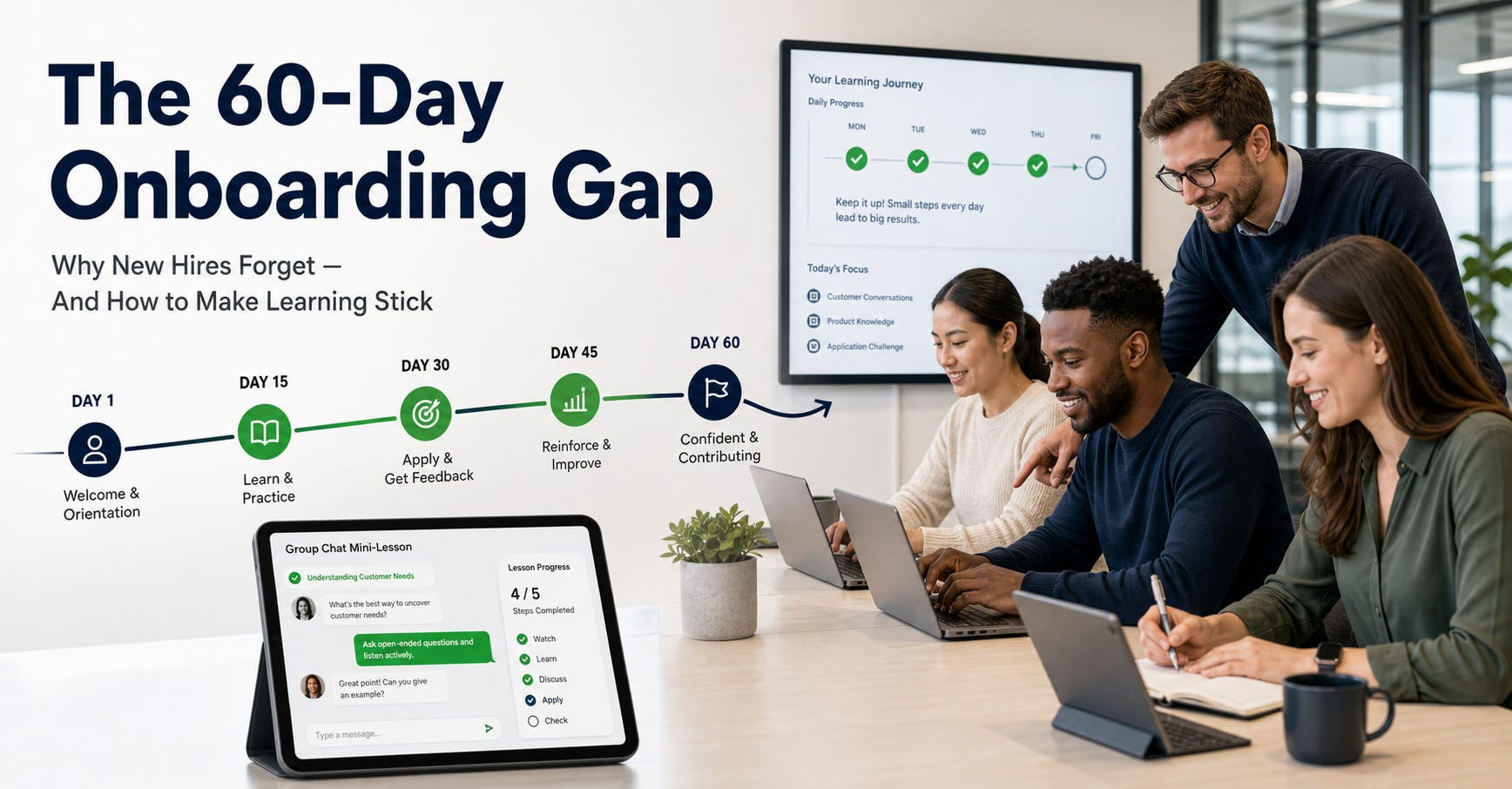
Most onboarding programs are built as if humans remember everything after one lecture. Very optimistic. Also very wrong.
New hires do not need one big orientation dump.
They need repeated, practical reminders until the right behaviors become normal.
This is especially true for employees with less than two years of experience.
They are still learning how work works.
They may know the technical basics. They may have good grades. They may even be fast learners. But the workplace has a different exam format.
Nobody announces the test.
The questions change daily.
And sometimes the answer is hidden in a meeting that should have been an email.
The first two days of onboarding are useful.
New hires need to know the company, the structure, the tools, the policies, and the role.
But that is only the beginning.
The real adjustment happens after the classroom session ends.
That is when they start asking:
How often should I update my manager?
Is it okay to challenge an instruction?
What does “take ownership” mean here?
When should I use AI?
How do I know if my work is good enough?
Why are there three versions of the same file?
That last one may remain a mystery forever, but we do our best.
The point is simple: most onboarding questions appear after onboarding is officially over.
So the support should continue after onboarding is officially over.
One simple way to fix this is to create a 60-day group chat for each batch of new hires.
Not for random announcements.
Not for motivational quotes that sound like they were written on a gym wall.
Use it for daily mini-lessons.
Each day, the facilitator sends one short lesson connected to the onboarding program. It could be about communication, ownership, feedback, AI use, decision-making, or professional behavior.
The lesson should be short enough to read quickly but practical enough to apply the same day.
For example:
“Today’s reminder: If you are stuck, report early. Silence does not look like independence. It looks like suspense. And suspense is only fun in movies.”
That is simple.
That is memorable.
That is useful.
Companies often train behavior only after something goes wrong.
Someone misses a deadline.
Someone gives a vague update.
Someone waits too long before asking for help.
Someone uses AI and submits work that sounds smart but says nothing.
Then the manager has to correct it.
That is expensive.
Not always in money. Sometimes in time, trust, patience, and the manager’s slowly disappearing will to open another “quick update” message.
A better onboarding process teaches expected behavior before mistakes become habits.
New hires should know:
What good updates look like
What ownership looks like
What preparation looks like
What respectful disagreement looks like
What responsible AI use looks like
What “done” actually means
This gives them a map.
Without a map, they improvise.
Some improvise well.
Some create jazz. Not always the good kind.
AI fluency should not be a separate topic that sits beside onboarding.
It should be part of how new hires learn to work.
Teach them how to use AI for small, practical tasks:
Drafting a first version
Summarizing long documents
Preparing questions before a meeting
Checking clarity
Creating task lists
Comparing options
Improving emails
Reviewing their own work before submission
But also teach the warning label.
AI can help you move faster.
It can also help you become confidently wrong at high speed.
That is why new hires must learn verification.
They should ask:
Is this accurate?
Is this complete?
Does this match company standards?
Did I check the details?
Would I be comfortable defending this output?
AI fluency is not about using tools.
It is about using tools with judgment.
The 60-day group chat works because it creates a habit loop.
Lesson.
Application.
Reminder.
Reflection.
Repeat.
That repetition matters.
A new hire may hear “communicate early” during orientation. But when they see the same principle applied in real examples over 60 days, it becomes easier to remember.
This is how onboarding becomes behavior change.
Not information transfer.
Behavior change.
The company does not need new hires who can recite the values.
The company needs new hires who can apply the values when the work gets messy.
Because work will get messy.
Work is very talented that way.
Instead of asking, “Did we finish onboarding?”
Ask:
“Are they behaving, communicating, deciding, and using tools the way we need them to?”
That question changes everything.
It moves onboarding from an HR checklist to a performance system.
That is the idea behind Career Launchpad: a practical onboarding program for early-career employees that combines leadership behavior, workplace expectations, AI fluency, and 60-day reinforcement.
It can also be customized to fit your company’s preferred leadership and behavioral standards.
If you want your new hires to become productive faster without relying on guesswork, DM me or message me at +63.969.600-1-006.
No posts
Comments
Nothing yet. Say the first thing.
Sign in to join the conversation.