
Four consecutive Emergency Energy Alerts in January 2024. The first firm load shed in Alberta since 2013, on April 5, 2024, when thermal generator failures collided with high demand and insufficient wind. Thirteen grid alerts issued over last winter. These are not anomalies from a system undergoing a one-time stress test. They are the early data points of a grid running out of margin, and the trend is not improving.
The most severe alert category (an EEA-3, meaning Alberta is at genuine risk of rotating blackouts) occurred seven times in 2022, four times in 2023, and six times in 2024. The cause that dominated media coverage was renewable intermittency. The cause that actually drove most of those alerts was less politically convenient: unplanned outages at natural gas generation facilities. Several major gas plants failed simultaneously during extreme cold events, at exactly the moment demand peaked. Solar and wind did not cause the January 2024 crisis. Frozen gas generators did.
On the distribution side, FortisAlberta’s own reliability data tells the rural story plainly. In 2022, the provincial average for outage duration was 1.70 hours per customer per year, across an average of 1.08 interruptions. That is the mean. Rural customers at the end of long distribution lines (the acreage owners, farm operators, and small commercial properties that make up most of this territory) experience substantially more. Electrification of transportation and heating is adding load to a distribution system built for a different consumption profile. A 25-year infrastructure decision made today should account for the grid of 2035, not the grid of 2015.
The term battery backup covers a range of systems with fundamentally different capabilities, price points, and financial logic. Before evaluating any of them, it helps to understand what category of problem each one is designed to solve.
There are three meaningful tiers in the Alberta residential and small-commercial market. The first protects critical loads during an outage and reduces your bill modestly. The second provides whole-home backup, meaningful bill elimination, and Solar Club financial returns when properly integrated with solar. The third delivers complete grid independence for properties where a connection is prohibitively expensive or simply not wanted. Each tier has a legitimate use case. None of them is universally right.
Critical loads backup. Around $35,000.
PV, battery, and a critical loads panel. For an existing home where resilience matters more than bill elimination.
Whole-home all-in-one. $54,000.
16 kW solar, 20 kWh storage, and the Hub G2. For a new build on Solar Club aiming to eliminate the bill.
Off-grid. $177,000.
32 kW solar, 80 kWh storage, and a 26 kW Briggs and Stratton generator. For a remote property where a grid connection is prohibitively expensive.
A critical loads backup system does one job well: it keeps your essential circuits running when the grid goes down. The architecture is straightforward. A sub-panel, called a critical loads panel, is wired to carry only the circuits that matter most: refrigerator, well pump, furnace fan, lighting, and basic communications. A transfer switch, either manual or automatic, disconnects that sub-panel from the grid during an outage and connects it to the battery inverter. The rest of the home goes dark, but the things that matter keep running.
For an existing home where resilience rather than bill elimination is the priority, this is often the right answer. You are adding a parallel path for essential loads rather than replacing your electrical service infrastructure. The installation footprint is smaller, the permitting is simpler, and the investment is considerably lower. The trade-off is that without a properly integrated solar array and full energy management system, the bill savings are incremental rather than transformative. This tier makes sense as a resilience investment. It is not primarily a financial one.
Installed cost: approximately $35,000 including PV and battery.
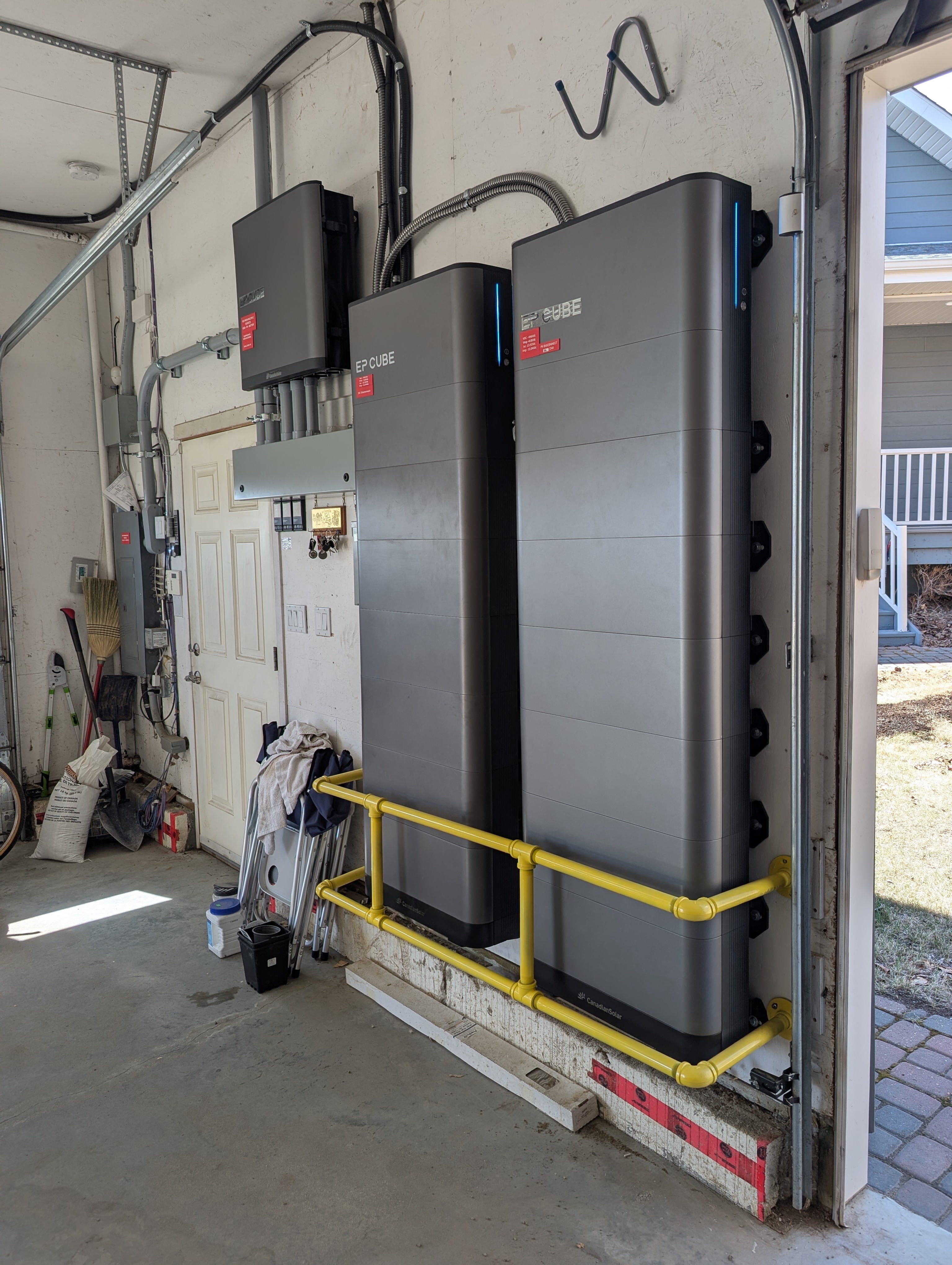
This is the system that changes the economics of owning property in Alberta. The architecture has three hardware components that work as a unit: a hybrid inverter, a battery stack, and an energy management hub. Understanding what each does, and especially why the hub is the component most people do not know exists, is essential before evaluating whether this system makes sense.
The hybrid inverter handles two jobs simultaneously. It converts DC power from the solar panels into usable AC for your home and the grid, managing multiple independent strings of panels through dedicated MPPT inputs. At the same time it manages the battery, charging from solar surplus or from the grid on command and discharging to home loads as needed. This single device replaces what would otherwise require a separate string inverter and a separate battery inverter, two devices, two installation footprints, two sets of communications.
The battery stack uses lithium iron phosphate chemistry, the same chemistry used in most serious residential storage for its safety profile and longevity. Standard configuration for a new build delivers 20 kWh of usable storage. The battery includes internal warming rated to -25 Celsius. In Alberta that specification is not a footnote. A battery that shuts down at -30 is useless precisely when you need it most. Storage capacity scales in modules from 20 kWh in a standard installation up to 80 kWh across four inverter units for large properties or off-grid applications.
The energy management hub is what separates a whole-home all-in-one system from a solar installation with a battery bolted on. In the Fox ESS system, which uses the same architecture as the Canadian Solar EP Cube, this component is called the Fox Hub G2. The hub has five distinct connection terminals: backup load output, non-backup load output, grid connection, solar and inverter input, and generator input. When the grid is operating normally, the hub manages all energy flows in real time, routing solar production to home loads, battery, or grid export based on configured priorities. When the grid fails, the hub detects the outage in under 20 milliseconds and switches seamlessly to island mode. The transition is fast enough that clocks do not reset and computers do not notice.
Several capabilities the hub provides are worth naming specifically, because they are not obvious from looking at the equipment. First, the hub provides a 200-amp busbar that becomes the new electrical centre of the home. An existing 100-amp panel that is already heavily loaded cannot easily absorb the complexity of a full storage system. The hub replaces the service centre rather than adding to it. The existing panel becomes the backup load sub-panel, fully protected by the system. Second, a dedicated generator terminal with a dry-contact auto-start circuit means a standby generator starts automatically when the battery drops below a configured reserve threshold. No manual intervention required during a multi-day outage. Third, full consumption monitoring in addition to production monitoring gives you genuine site-level data rather than just solar generation numbers. You can see exactly where your energy goes. Fourth, a configurable backup reserve lets you designate a percentage of battery capacity for outage coverage while deploying the remainder for Solar Club load shifting. Fifth, dedicated EV and large appliance circuits allow an electric vehicle charger to draw directly from solar production, reducing or eliminating grid interaction for EV charging entirely.
The hub is not an optional add-on. It is the component that makes the rest of the system coherent. Without it, you have solar and a battery. With it, you have a managed energy system.
There is also an upgrade path worth naming. We frequently install the hybrid inverter alone for customers who want solar today but are not ready for the full storage investment. The inverter uses identical architecture to the all-in-one system. When the customer decides to add storage, the battery stack and hub connect to the existing inverter with minimal additional work. The infrastructure decision is made once. The financial decision is phased.
Installed cost (16 kW solar, 20 kWh storage): $54,000.
The financial argument for the whole-home system rests on three things working together: the right solar array size, the right rate structure, and a system that manages both intelligently. The following draws on actual billing data from two Boreal Energy customers on Park Power’s Solar Club program to show what that looks like in practice.
The first customer (Greg, on an acreage property in Parkland County with two electric vehicles and a year-round hot tub) consumed 13,400 kWh through the system in 2025 and ended the year with a credit balance of $1,335 from his electricity retailer. He made no electricity payments from April onward. The credit carryforward covered his subsequent winter bills, and Park Power issued a direct deposit to his bank account in spring 2026. The second customer (Jonathan, a Strathcona County property) received a $206.29 direct deposit to his bank account in November 2025, triggered automatically after his credit balance exceeded the Solar Club payout threshold for two consecutive months. These are not modelled projections. They are documented on utility billing records that Boreal has reviewed.
The rate structure that makes this work is Solar Club, offered by Park Power and available to microgenerators on FortisAlberta’s distribution territory. Customers on Solar Club earn 30 cents per kilowatt-hour for energy exported to the grid. When importing, they pay their chosen commodity rate, currently as low as 7.99 cents per kilowatt-hour on a fixed plan, plus transmission and distribution charges that bring the all-in import cost to roughly 15 to 16 cents per kilowatt-hour. The export credit covers energy only. Transmission and distribution do not apply to exports. This asymmetry is structural and permanent on Solar Club, regardless of which commodity rate product the customer chooses. Every kilowatt-hour the system self-consumes, whether directly from solar or dispatched from the battery, is worth the full import rate including T&D. Every kilowatt-hour exported is worth the energy commodity rate only.
The practical strategy is straightforward. Export as much solar as possible during the high-value season on the variable Solar Club product, where the commodity rate tracks the Alberta market and earns 30 cents per kilowatt-hour in credit. Switch to a low fixed rate for the winter import season, paying 7.99 cents for the grid power the system cannot cover. The battery extends the solar day into evening hours, reducing imports during the production season and increasing the volume of generation that earns the full export credit. Solar Club allows customers to switch between rate products at any time. That flexibility is a deliberate feature of the product design, and it is part of what makes the seasonal strategy executable.
The honest caveat belongs here. The battery’s incremental financial contribution, isolated from the solar array on a flat-rate structure, is modest. The transmission and distribution spread captured by self-consuming through the battery rather than exporting and later reimporting runs to approximately $200 to $400 per year on a 20 kWh system at current rates. The battery earns its place in the financial case as part of the integrated system, not as a standalone investment. On a new build where the hub and inverter infrastructure are costs you are incurring regardless of whether storage is added, the incremental cost of the battery component is the right comparison, and that comparison is considerably more favourable than evaluating the full system cost against battery savings alone.
A large share of Alberta homes already have solar. The common question from those owners is whether a battery can be added to an array that is already on the roof or in the yard, and the answer is yes, though the right method is not always the obvious one.
The approach that works best is to install a complete hybrid battery system (a full EP Cube or Fox ESS with its energy hub) alongside the existing array rather than replacing the existing inverters. The original solar stays in place on its own string or microinverters and is wired into the hub as AC-coupled solar, where it is monitored in the app alongside everything else.
The advantage of this method is not obvious until the grid goes down. A conventional grid-tied solar system is required by anti-islanding rules to shut off the moment it loses the grid. On a clear day during an outage, a standard array produces nothing, and the homeowner sits under a full roof of panels with no power. A hybrid battery system is grid-forming. During an outage it creates its own stable AC reference, and the existing grid-tied inverters detect that reference and continue operating as though the grid were still present. The array that would otherwise be dead weight in a blackout now runs the home and recharges the battery in daylight. The hub manages that production, directing it to loads and battery and throttling it when the battery is full.
The honest trade-off is cost. A hybrid inverter sized to manage the battery is being purchased without any new DC solar connected to its own inputs, so the owner is paying for conversion capacity that is not fully used on day one. What that cost buys is real: outage resilience for an array that previously had none, a clean path to expand with DC-coupled panels later without a second infrastructure project, and the ability to configure the system for zero export so that production is prioritized for self-consumption and battery charging rather than sold back at the export rate. On Solar Club, where self-consumed energy is worth the full import rate including transmission and distribution while exports earn the commodity rate only, that self-consumption bias is worth more than it first appears.
A storage retrofit on an existing array is best understood the same way a critical loads system is. Resilience is the primary return, and the financial case follows from self-consumption rather than from the battery in isolation.
Full off-grid operation is the most expensive configuration and the right answer for a narrower set of situations than marketing materials suggest. A properly specified off-grid system for a large Alberta acreage costs $177,000. That includes 32 kilowatts of solar on ground arrays, 80 kWh of battery storage across four inverter units, and a 26-kilowatt Briggs and Stratton standby generator. The generator is not optional, and understanding why requires doing the Alberta winter math honestly.
In December and January, central Alberta averages three to four peak sun hours per day under clear conditions. A 32-kilowatt system at three peak hours generates roughly 96 kWh on a good day. An off-grid property with a well pump, electric heat backup, standard appliances, and lighting typically uses 30 to 50 kWh per day in winter. On a clear day the system covers it. During a four-day cloudy stretch, common in Alberta winters, daily solar production can drop to 20 kWh or less. At 40 kWh of daily consumption and 20 kWh of production, you are drawing 20 kWh per day from the battery. Eighty kilowatt-hours of storage buys four days before the generator must run. The generator charges the battery and carries the loads simultaneously, bridging the solar deficit until conditions improve. It is not a luxury item in the specification. It is the winter backup for the winter backup.
The economics of off-grid make sense in two specific circumstances. The first is a rural property where the cost of extending grid service (poles, trenching, transformer upgrades, utility connection fees) approaches or exceeds the cost of the off-grid system itself. In Sturgeon County and the broader territory where Boreal works, a new service connection requiring 400 metres of pole line and distribution upgrades can run $80,000 to $150,000 before the first kilowatt-hour is delivered. Against that baseline, $177,000 for a complete energy system that also eliminates the ongoing electricity bill is a different calculation entirely. The second circumstance is a customer for whom grid independence has intrinsic value that does not appear in a payback spreadsheet: a working farm where a multi-hour outage means lost production, or a property owner who has watched FortisAlberta’s rural reliability data accumulate and decided that grid dependency is an operational risk they no longer want to carry.
Time-of-use pricing does not currently exist for residential customers in Alberta, with one exception: a small pilot program in Grande Prairie run by ATCO Electric. For the vast majority of Alberta households, electricity is sold at a flat commodity rate regardless of when it is consumed. That is changing, and the timeline is no longer speculative.
In June 2025, the Alberta Utilities Commission published Bulletin 2025-07, initiating a formal engagement on enabling time-varying rates for residential and small commercial customers. The AUC’s own analysis concluded that the expected benefits of enabling these rates will outweigh the expected costs by orders of magnitude. That conclusion was not challenged by FortisAlberta, EPCOR, ATCO, or the AESO in their formal submissions. An implementation engagement ran through October and November 2025. The AESO is separately targeting five-minute settlement intervals for all loads by 2032. Broad residential TOU rollout is likely to arrive somewhere between 2028 and 2030.
Arbitrage, in the context of storage, means charging the battery when electricity is cheap and discharging when it is expensive: buying low, selling high, capturing the spread. The advantage scales directly with that spread. Ontario’s Ultralow Overnight rate runs from 3.9 cents per kilowatt-hour overnight to 39.1 cents at weekday peak, a spread large enough to make battery arbitrage the dominant use case for storage, independent of solar entirely. In California under the current Net Billing Tariff, the combination of low export rates and high time-of-use import rates makes battery storage financially compelling even without strong solar economics to anchor the system.
The Solar Club rate-switching strategy that Boreal customers are already executing is an early and manual form of this arbitrage. Export at 30 cents during the high-value season. Import at 7.99 cents during winter. When TOU rates arrive in Alberta and interval meters become standard, this optimization moves from a manual retailer decision to an automated system function. Battery systems installed today will be capable of participating in that market without hardware replacement.
The concept is compelling. An electric vehicle’s battery holds 60 to 100 kilowatt-hours of storage, three to five times the capacity of a standard residential battery system, at a cost already justified by transportation rather than energy storage. If that battery can move energy bidirectionally, the economics of residential storage change fundamentally. The technology exists. The regulations do not.
There are three distinct versions of this capability worth distinguishing. Vehicle-to-load means an EV with a power export port can directly power appliances through a standard outlet built into the vehicle. Several current vehicles including the Ford F-150 Lightning and certain GM trucks offer this today. No regulatory approval is required. It is useful for a jobsite or a camping setup but is not a meaningful home backup solution. Vehicle-to-home requires a separate bidirectional inverter installed between the vehicle and the home’s electrical system. This is where the regulatory gap becomes concrete. As of mid-2024, no CSA-approved bidirectional EV charger was commercially available for residential installation in Canada. The equipment category did not yet have the certification pathway needed for a licensed electrical contractor to install and permit it. Vehicle-to-grid, where the EV dispatches energy back to the distribution grid as an active market participant, requires all of the above plus utility-level interconnection agreements and a regulatory framework that does not yet exist in Alberta.
The practical timeline for residential vehicle-to-home in Alberta is probably 2027 to 2029, depending on how quickly CSA certification processes move and how aggressively utilities and regulators engage on interconnection standards. Energy management hubs like the Fox Hub G2 already include dedicated EV charging circuits. Customers installing these systems today are building infrastructure that will be compatible with bidirectional EV capability when the regulatory pathway opens.
A virtual power plant is not a physical facility. It is software that aggregates the storage capacity of distributed residential batteries and dispatches them as a coordinated resource, charging when grid power is abundant and cheap, discharging when demand peaks and prices spike. From the electricity market’s perspective, a virtual power plant looks like a conventional generator. From the homeowner’s perspective, it is a program that optimizes the financial return on their storage investment while providing a grid stabilization service they are compensated for.
Alberta is the only Canadian province where a true commercial residential virtual power plant currently operates. The structural reason is Alberta’s deregulated electricity market, which gives licensed retailers direct access to wholesale prices and the ability to bid distributed resources into the market as actual participants. In regulated provinces this pathway does not exist without direct utility involvement. Solartility, a Calgary-based electricity retailer, operates Alberta’s first retail virtual power plant by connecting homes with solar, storage, and bidirectional interval meters into a software-managed pool. The system optimizes export pricing across the aggregate and minimizes import costs, with customers accessing wholesale electricity prices rather than flat retail rates, potential savings the company describes as up to 30 percent on electricity costs.
The physical instantiation of this at community scale arrived in Edmonton in June 2025. Blatchford Lands, a net-zero master-planned community on the site of the former municipal airport, launched a virtual power plant involving 100 sonnen home batteries representing approximately 500 kilowatts of power and more than 2 megawatt-hours of storage. The project involves EPCOR as the distribution utility, Solartility as the retail electricity manager, Landmark Homes as the builder, and Emissions Reduction Alberta with $3.3 million in program funding. Each home carries 5 kilowatts of solar and a 20 kilowatt-hour battery cabinet. EPCOR and Solartility can draw from the aggregated battery pool to stabilize local grid conditions or respond to high-demand events. Homeowners retain full backup power capability throughout. This is operating infrastructure in Edmonton right now.
When the AUC’s time-varying rate implementation arrives and interval metering becomes standard, the economics of VPP participation will improve further. Residential storage installed in 2025 and 2026 will be eligible to participate in that market without hardware replacement. The equipment decisions made today are not just about today’s electricity bill.
Energy storage in Alberta is not one thing and the financial case is not the same across all configurations. A critical loads backup system on an existing home is a resilience investment that stands on its own terms. A whole-home solar-plus-storage system on Solar Club delivers documented bill elimination and direct deposits to bank accounts (the billing records from two customers across twelve months confirm it), but the financial case requires the right rate structure and proper system integration, not just a battery. Off-grid makes economic sense for specific rural properties where the grid connection baseline changes the calculation entirely.
The battery’s standalone financial contribution at current flat rates is modest. The spread captured by self-consuming through storage rather than exporting and reimporting runs to a few hundred dollars per year on a 20 kWh system. The financial case lives in the integrated system: solar plus storage plus Solar Club rate management, on a new build where the hub and inverter infrastructure are unavoidable costs regardless of whether storage is added. On those terms the case is real, supported by documented customer outcomes, and conservative relative to the rate environment that is coming.
The grid is under pressure. The rate structure is changing. The technology is proven. The question is not whether to engage with storage. It is which tier fits your situation, at what cost, and on what timeline.
Jordan Forsythe is the owner of Boreal Energy Solutions Inc. and the publisher of Boreal Dispatch.
Billing data referenced is from consented customers on FortisAlberta’s distribution system, Park Power Solar Club rate product. System pricing reflects Boreal Energy Solutions retail rates as of 2026.
No posts
Comments
Nothing yet. Say the first thing.
Sign in to join the conversation.