
Part One of this series, Bootleggers and Baptists, described a carbon pricing system that exists not to reduce emissions but to serve the political and financial interests of the parties that depend on it. The Liberals use it to claim climate action. The Conservatives use it as a grievance. The institutional investors who own the credit-generating assets need it to protect the value of their holdings. And the net atmospheric result of more solar generation entering that system is cheaper industrial compliance, not cleaner air. If you have not read Part One, start there. What follows is a concrete Alberta example of everything it described.
I have skin in this game and you should know exactly what kind. I run a residential and commercial solar installation company. Sturgeon County is a third to half of my business territory, which means these communities are my customers and my neighbours. The four utility-scale solar farms proposed there will not directly threaten my revenue. My reputational exposure is different and more important. Most Albertans do not know that there are effectively two solar industries operating in this province with almost nothing in common. The residential and commercial industry installs systems on rooftops and farmsteads and keeps the economic benefit local. The homeowner owns the generation. The savings stay in the community. The utility-scale industry builds industrial infrastructure on agricultural land, sends the financial returns to institutional investors, generates carbon credits that industrial emitters buy to justify continuing to pollute, and presents all of it as environmental progress. The public does not see this distinction. When utility-scale developers overpromise environmental benefits that the carbon credit market quietly neutralizes, and when rural communities eventually realize the deal was not what the consultation brochure described, the skepticism lands on the entire industry. I watched legitimate solar businesses lose customers because of the practices of bad actors in the broader market. Utility-scale solar is doing something similar at a larger scale. I am writing this because Albertans who live near a proposed solar farm deserve to understand which industry is actually coming to their county, and what the audited financial statements say about what they will receive in return.
“Most Albertans do not know that there are two solar industries operating in this province with almost nothing in common.”
A brief technical point matters for everything that follows. Alberta’s electricity grid operates on two levels. The transmission system carries power at high voltage across long distances, connecting large generators to regional substations. Utility-scale solar farms in the 125 to 465 megawatt range connect here. Their problems are primarily economic: who captures the value, and on what terms. The distribution system carries power at lower voltage from those substations to homes, farms, and businesses. Mid-sized commercial solar projects in the five to twenty-four megawatt range connect here, on the same feeders as your house. When those feeders fill, no new generators can connect. Both levels are filling with commercial solar generation. The problems are different at each level but the cause is the same: solar is being built for investors, not for the people who live on the land it occupies.
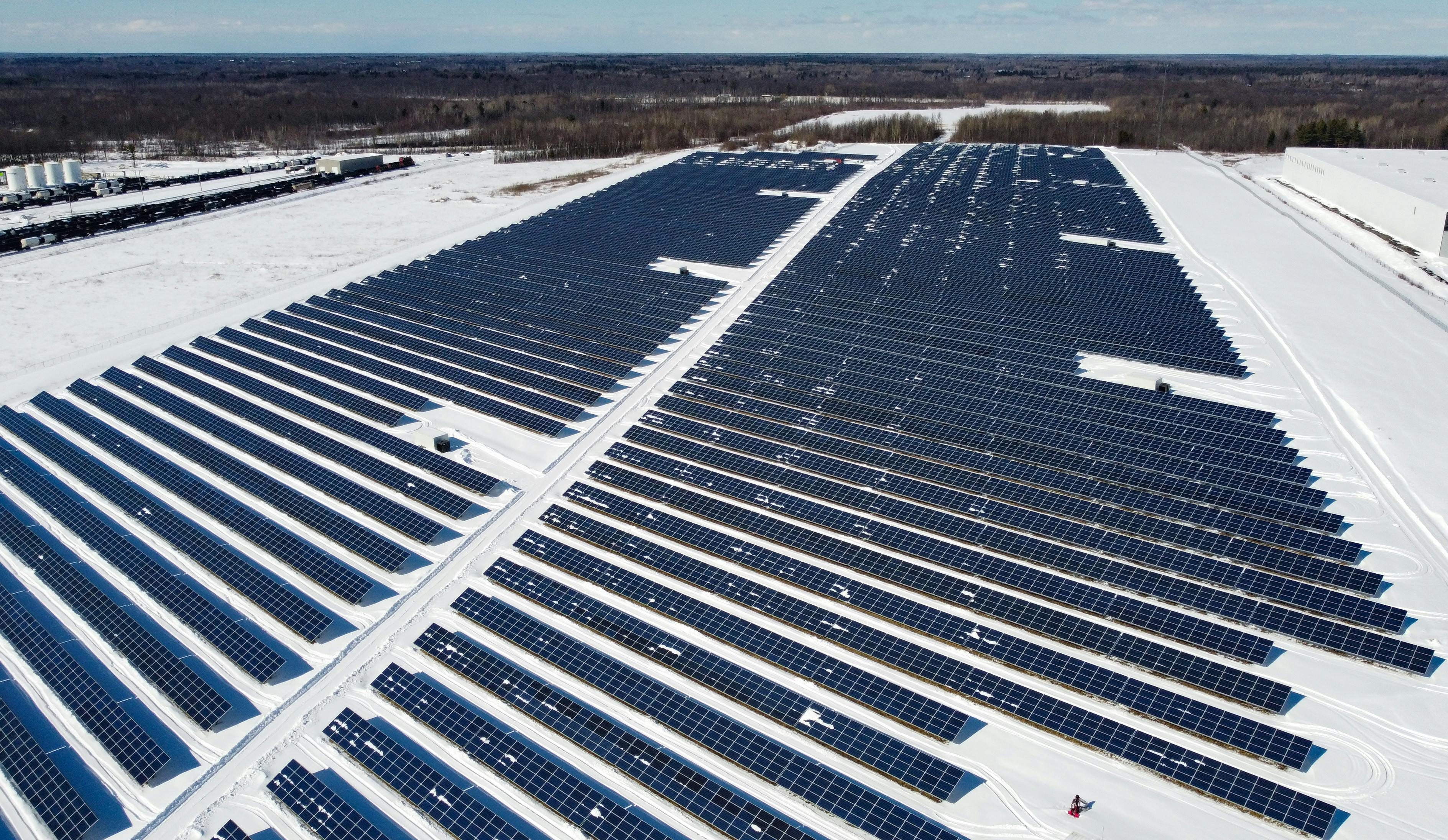
Vulcan County has Canada’s largest solar installation and its financial records are public. The Travers Solar Project is a 465 megawatt facility covering 3,300 acres of southern Alberta farmland. It cost $700 million to build. Greengate Power, a Calgary company, developed it from 2017 onward. That is a genuine Alberta success story. Construction was done by PCL, a Canadian contractor. Then the money arrives. Copenhagen Infrastructure Partners, a Danish fund managing more than 30 billion euros on behalf of international institutional investors, provided the entire $700 million in capital. [1] Less than two months after the project reached commercial operations, CIP sold its 100 percent ownership interest to Axium Infrastructure, a Montreal fund manager. CIP’s own materials describe this timeline with evident satisfaction: build the project, secure a fifteen-year power purchase agreement with Amazon covering 86 percent of output, raise $500 million in senior debt, sell, collect the development profit, move on. [2] The development profit went to Copenhagen. The ongoing cash flows go to Axium’s institutional investors. Amazon gets the carbon credits and the ESG accounting entry. Alberta provided the land, the sunshine, the regulatory access, and the grid infrastructure.
“During 2023, Vulcan County issued supplementary property tax levies as a result of one of the largest solar projects in Canada being completed and commissioned during the year. The total supplementary property tax levies were $4.033 million.” -- Vulcan County Audited Financial Statements, December 31, 2023 [3]
Four million dollars on a $700 million investment. That is a tax yield of less than six tenths of one percent of capital value, because solar farms are assessed as linear designated industrial property at provincially regulated rates rather than at market value. The county has no say in that assessment rate. It is set by the same provincial framework governing oil and gas infrastructure. The permanent employment figure is consistent across every public source: the Travers Solar Project supports up to ten permanent positions. Local officials confirmed that all renewable energy projects in Vulcan County together support around twenty long-term jobs. [4] Ten permanent jobs, four million dollars in suppressed tax revenue, and thirty-five years of financial returns flowing to institutional investors in Montreal and Copenhagen. That is the complete ledger for Canada’s largest solar installation.
“Ten permanent jobs. $4 million in suppressed tax revenue. Thirty-five years of returns flowing to institutional investors. That is the complete ledger for Canada’s largest solar installation.”
There is one part of this ledger that most Albertans do not know and that the developers presenting to Sturgeon County council did not volunteer. Solar farms do not pay education tax. Not a reduced rate. Not a token amount. Nothing. The province explicitly exempts electrical power generating properties from the levy that funds Alberta schools, by ministerial order. [5] Oil and gas infrastructure fares only marginally better, paying a token Designated Industrial Property requisition rather than the school levy that applies to everyone else. The Vulcan County 2023 financial statements make this visible in a single line: school requisitions from all residential, farmland, and commercial property totalled $3.14 million. The provincial DIP requisition from all industrial property combined was $68,938. [6] Every homeowner in Vulcan County pays education tax. Every farmer. Every small business. Every person with solar panels on their own roof pays education tax. The $700 million facility on 3,300 acres pays nothing toward the schools in the county where it operates.
This is happening while Alberta’s education system runs nearly a billion dollars below the national per-student funding average. The Alberta Teachers’ Association described public schools in 2025 as in crisis, with class sizes at record levels and teachers leaving the profession. [7] The provincial government says it cannot afford to fix this while exempting a growing fleet of industrial installations from the levy that funds classrooms. The same government that tells teachers there is no money for smaller class sizes has exempted an entire category of industrial property from contributing to schools, and that category happens to include every utility-scale renewable energy project in Alberta, most of them owned by foreign or out-of-province institutional capital. This is not a federal policy. The education exemption was created by Alberta ministerial order. Ottawa did not impose it. Alberta chose it.
The feeder capacity problem operates at the distribution level and it is closing off options for homeowners and farmers right now. The wires that carry power from substations to homes and farms were built to move electricity one direction. Every commercial solar generator connected to a feeder pushes power back toward the substation. At some point the feeder is full. FortisAlberta or ATCO Electric declares a no-export zone and no new generators can connect without a costly infrastructure upgrade. The cost of that upgrade is not paid by the commercial developer whose project filled the feeder. It is presented as the option for whoever comes next. In at least one documented case in southern Alberta, an agricultural customer spent two years planning a large solar installation, ordered significant equipment with the utility’s implicit involvement, and was then told the feeder was full and the upgrade required would cost more than four million dollars. The developer whose project consumed the capacity paid nothing toward restoring it. Maps circulating among Alberta solar installers show no-export zones spreading across FortisAlberta and ATCO territory. These are not distant future problems. They are closing off options for homeowners and farmers today.
The principle that governs transmission interconnection is called cost causation: the entity whose project creates the need for an upgrade pays for it. That principle does not apply at the distribution level. Commercial generators fill feeders for free and leave the cost for whoever arrives next. This is not anti-solar. It is applying the same rule consistently across both levels of the grid.
Part One of this series explained that building more utility-scale solar under Alberta’s current carbon credit framework drives the market price of credits lower, makes industrial compliance cheaper, and reduces the financial incentive to actually reduce emissions. The net effect of more solar generation entering the TIER credit market is more affordable pollution, not less. That mechanism applies directly to every project described in this article. The solar energy is real and the physical displacement of gas generation is real. The credit market captures that benefit and sells it to industrial emitters as permission to continue polluting. Albertans host the infrastructure, provide the land, and watch both the financial return and the environmental credit leave.
There is one more benefit that is not being realized, and it will be familiar to anyone who has opened an electricity bill lately. Solar has the lowest levelized cost of energy of any generation currently being built in Alberta, roughly $30 to $50 per megawatt-hour for large utility-scale projects. In a competitive electricity market, adding large amounts of the cheapest available generation should suppress wholesale spot prices over time. Cheaper supply at the margin should push out more expensive supply and lower the clearing price for everyone. Albertans should be seeing lower electricity bills as solar capacity grows. They are not. During the period when solar has expanded most rapidly in Alberta, retail electricity prices have increased, not declined. Two mechanisms explain why the price benefit disappears before it reaches a ratepayer. First, the majority of Travers Solar output is locked into a fifteen-year power purchase agreement with Amazon at a contracted rate. That power is effectively removed from the open spot market. It does not participate in price discovery the way generation sold into the pool does. Second, the connection between wholesale spot price movements and what a ratepayer pays on their bill is indirect and frequently absorbed by retail margin rather than passed through. The wholesale benefit of cheap solar generation is captured at the contract stage by the institutional investor and the corporate PPA buyer. It does not reach the family paying their electricity bill. The environmental benefit of the generation goes to the carbon credit market. The financial return goes to institutional investors. The price relief goes nowhere. Alberta hosts the infrastructure, absorbs the land use, forgoes the tax revenue, and pays the same electricity bill. [12] He built the Heritage Savings Trust Fund on that principle, modeled on what Norway was doing with petroleum revenue. Norway has since accumulated a sovereign wealth fund worth approximately 1.7 trillion US dollars, roughly $300,000 for every Norwegian citizen. [8] Alberta stopped contributing to its Heritage Fund in 1987 and has never resumed. The fund holds about $22 billion today. The solar version of this mistake is structurally identical. No royalty on solar generation. Assessment at regulated rates that suppress tax yield. Education tax exemption by ministerial order. Power purchase agreements that send the environmental value to Amazon and the financial returns to European and Montreal fund managers. Ten permanent jobs on a $700 million asset covering 3,300 acres. Every one of these choices was made by the Alberta government, not imposed by Ottawa.
“Alberta provided the land, the sunshine, the regulatory access, and the grid infrastructure. The returns left with the investors.”
The four solar farms proposed for Sturgeon County are a joint venture between CanWest Solar Development Corp., a St. Albert family company with no prior energy construction history acting as local developer and land aggregator, and Starlight Energy, the development arm of NextEnergy Group, a fund manager headquartered in London with more than four billion US dollars under management. [9] The local developers provide community consultation and regulatory navigation. The institutional capital provides the financing and captures the returns. Sturgeon County communities should know before those AUC applications are filed what the Vulcan County financial statements show about what their county will actually receive in exchange for thirty-five years of industrial land use.
The rest of this article is about what should change. Complaining without offering something better is not the point.
The education tax exemption should be eliminated for electrical power generating properties. Solar farms should pay the same education levy that every other Alberta property owner pays. There is no principled justification for exempting a $700 million industrial installation from contributing to the schools in the county where it operates while the farmers leasing their land to the developer pay the levy on their own property. A permanent blanket exemption for a commercially mature industry is not an incentive. It is a subsidy paid by every other Albertan, including the rural communities that host the infrastructure.
The province should require an equity stake in any utility-scale solar or wind project connecting to Alberta’s transmission system. This is not a novel idea. Norway’s state energy company Statkraft is wholly government-owned and is Europe’s largest generator of renewable energy. [10] Denmark went further at the community level: its 2008 Renewable Energy Act requires developers to offer local citizens a minimum 20 percent equity stake in new wind projects, by law. [11] The participation model worked. Denmark built more than 80 percent of its electricity from renewables while maintaining public support because the communities hosting the projects shared in the returns. Alberta does not need to choose between attracting investment and capturing resource value. It needs to require that the terms of access include a provincial equity position, the returns from which flow into the Heritage Fund. Lougheed’s institution deserves a new resource. Sunshine is available.
Foreign ownership of Alberta energy infrastructure should carry a higher cost than domestic ownership. This does not mean prohibiting foreign investment. Alberta needed Copenhagen Infrastructure Partners’ capital to build Travers, and that capital performed a genuine function. It means recognizing that a $700 million asset generating thirty-five years of returns for Danish and Montreal institutional investors represents a structural transfer of Alberta resource value that should come at a price. Higher assessment rates for foreign-owned generating facilities, or a foreign ownership premium on the provincial resource access charge proposed above, would create a financial incentive for domestic and provincial ownership models without closing the door to international capital when it is genuinely needed.
At the distribution level, the first-come-first-served approach to feeder capacity must be replaced with a framework that prioritizes individual and agricultural generators. The wires connecting Alberta homes and farms to the grid are shared infrastructure built over decades by ratepayers including those same homeowners and farmers. A commercial solar developer filling a feeder and foreclosing residential access to that shared resource should be required to pay the cost of restoring it. The cost causation principle that governs transmission interconnection should apply at the distribution level. Beyond that, the AUC should establish a capacity reservation system that protects a minimum allocation of feeder hosting capacity for residential and small commercial generators in every no-export zone declaration. Commercial projects that have filled a feeder beyond that threshold should face a retroactive cost recovery mechanism that funds the upgrade required to restore residential access.
“The resource is Alberta’s shared infrastructure. Locals should have priority access to what they built and paid for.”
The core principle underlying all of these proposals is simple. Alberta’s sunshine is a provincial resource. It belongs to Albertans the way the oil in the ground belongs to Albertans, at least in principle. The province has consistently failed to enforce that principle for oil and gas, settling for royalty rates and assessment frameworks that leave the bulk of resource value with outside capital. Solar development is arriving under terms that are even less favourable than the oil patch at its worst. There is still time to set different terms. The Denmark model, the Norway model, and the Lougheed Heritage Fund model all demonstrate that jurisdictions can attract the investment they need while retaining a meaningful share of the value their resources generate. Alberta has the precedents. It has the institutions. The question is whether the communities hosting these projects will demand better terms before the AUC applications are filed, or accept the consultation brochure at face value and spend the next thirty-five years reading the audited statements.
Jordan Forsythe is the owner of Boreal Energy Solutions, a solar installation company operating across Alberta. Boreal Dispatch covers Alberta’s energy economy, the politics behind it, the industry inside it, and the real costs to the people it serves. Written by a working installer with roots in the patch. No sacred cows. No party lines. Just facts.
Sources
[1] Copenhagen Infrastructure Partners, Fund Overview. CIP manages approximately EUR 30 billion across eleven funds with more than 180 international institutional investors. cip.com
[2] Copenhagen Infrastructure Partners, ‘CIP divests ownership of Travers Solar,’ GlobeNewswire, January 24, 2023. CIP sold 100 percent ownership to Axium Infrastructure within two months of commercial operations commencing November 2022.
[3] Vulcan County, Audited Financial Statements, Year Ended December 31, 2023. Note 4, Tax and Grants in Lieu Receivables. Supplementary tax levies $4.033 million. Audited by KPMG LLP, Lethbridge.
[4] Canadian Energy Centre, ‘Canada’s largest solar facility operating in the heart of oil country,’ June 2023. All renewable energy projects in Vulcan County support around 20 long-term jobs. Power Technology / Construction Connect: up to 10 permanent positions at Travers.
[5] Alberta Ministerial Order MAG:016/21, Education Tax Exemption for Electrical Power Generating Properties, 2022 to 2026. Electrical power generating properties are explicitly exempt from the provincial education requisition.
[6] Vulcan County, Audited Financial Statements, Year Ended December 31, 2023. Schedule 3, Schedule of Property and Other Taxes. School requisitions: $3,138,040. Provincial DIP assessment requisition: $68,938.
[7] Alberta Teachers’ Association, ‘Budget 2025 Fails Public Education,’ February 27, 2025. ATA states $910 million shortfall against what would be needed to bring Alberta to the national per-student average.
[8] Norges Bank Investment Management, Government Pension Fund Global Annual Report 2023. Fund value approximately USD 1.7 trillion. Norway population approximately 5.5 million.
[9] Chambers and Partners, ‘Power Generation, Transmission and Distribution 2025: Norway.’ Statkraft SF is wholly owned by the Norwegian state and is Europe’s largest generator of renewable energy.
[10] World Resources Institute, ‘A Sustained Portfolio of Policies Have Transformed Denmark’s Power Sector,’ March 2024. Denmark’s 2008 Renewable Energy Act requires local citizens to be offered at least a 20 percent share in new wind projects.
[11] St. Albert Gazette, Sturgeon County council meeting coverage, March 2026. CanWest Solar Development Corp. and Starlight Energy (NextEnergy Group, London) presenting four projects: St. Albert Villeneuve (~250 MW), Meadowview, Legal (~125 MW), Lamoureux.
[12] Alberta Electric System Operator (AESO), 2024 Long-term Outlook. Solar LCOE approximately $30 to $50 per megawatt-hour for utility-scale projects. Amazon PPA: 400 MW contracted rate disclosed in Greengate Power and CIP construction announcement, June 2021. Retail electricity price trends: Alberta Utilities Commission rate filings and regulated rate option historical data, 2020 to 2025.
No posts
Comments
Nothing yet. Say the first thing.
Sign in to join the conversation.