
“Lutherans are strong on justification but weak on sanctification.” The refrain has been repeated ad nauseum, even being taken by some Lutherans themselves as a badge of honor. There is an unfortunate perception of Lutheran thought which conceives of Luther’s reforms as decidedly non-ethical, as if the ethical dimension of human life was a hindrance to the simplicity and centrality of the Gospel rather than an aid to the Christian in his or her navigation of the world. Even more unfortunate than this is that some who proudly bare the name “Lutheran” have embraced such a caricature as if it were an actual theology. Thankfully, this perception that Lutheran theology is, as a whole, unconcerned with ethics is easy to dismiss through a quick examination of the many books written and sermons preached on the subject throughout the history of the Lutheran tradition. With that being said, there are certain strains of anti-ethical thinking in corners of the Lutheran world today.
There is a broader phenomena here than just the relationality between justification and sanctification as it arises in a Lutheran context. This is part of a more extensive divide between theology and ethics as disciplines. Debates surrounding the relationship between theory and practice were not new with the Reformation. Twin strains of medieval theology and piety—scholasticism and mysticism—often approached God in divergent ways. The scholastic method prized syllogistic reasoning and the usefulness of philosophy. The mystics emphasized the need for deep prayer and one’s experience of God in search of union with him. While the best of the scholastics also had a mystical piety, in some cases there was a polarization of these tendencies, as if one was obligated to choose between the intellect and the affections.
The Lutheran Reformation contained within itself both of these elements which it inherited from the earlier medieval era. Martin Luther famously decried the use of Aristotle’s philosophy in his 1517 Disputation Against Scholastic Theology, while Philip Melanchthon was far less dismissive of Aristotle’s methods of reasoning. Throughout the seventeenth-century, theologians began to engage more deeply in the scholastic method, while on a popular level Johann Arndt’s True Christianity was shaping Lutheran piety among the laity in a decidedly mystical direction.
In his book The Doctrine of Divine Love, Ernst Sartorius argues that the separation between theology and ethics began to grow during this era to a significant degree simply due to the separation of subject matter within written treatments. For example, Johann Gerhard wrote both dogmatics works and devotional materials (and he was a master at both), but approached those two sets of texts quite differently. Even today, the reader of Gerhard’s Sacred Meditations might have no interest in Gerhard’s far more technical Theological Commonplaces.
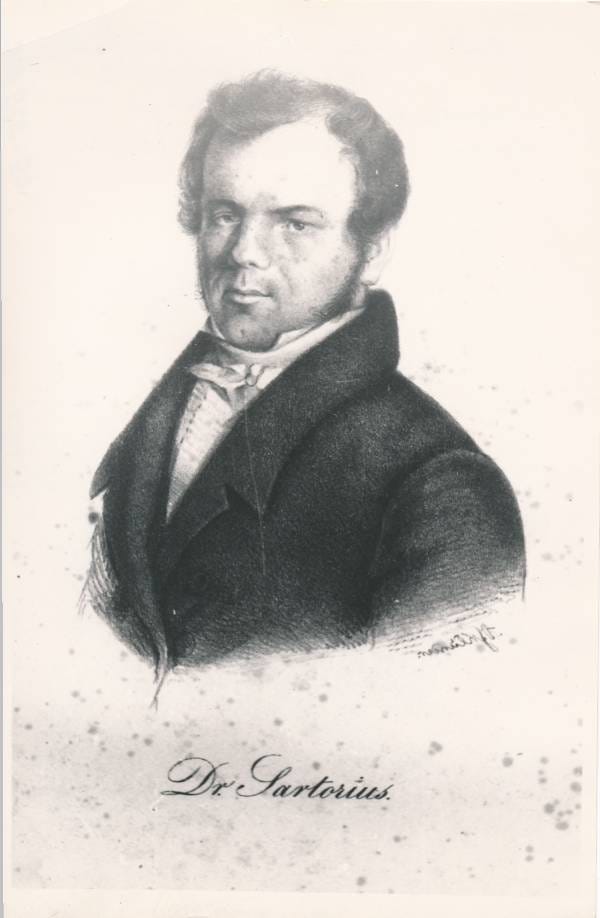
In the generation following Gerhard, theologians began to expand significantly on theological prolegomena, devoting far more attention to questions about the nature of theology, the role of reason, and natural revelation. In Sartorius’s reading of history, the method of doing theology began to eclipse the content of that theology. It was this overemphasis on the particularities of method that began to abstract theology from life, making dogmatic claims more propositional than participatory realities.
Sartorius further argues that this divorce between mind and heart within theological texts—even while the authors of the texts themselves did not actually intend such a divorce—led to the reactionary movement known as Pietism. Rather than an integration of theology and ethics, many of the Pietists contrasted practical Christian spirituality from a deeply studied theology, thus priveleging the mystical approach over the scholastic. While the best of the Pietists did not do this so strongly, on a popular level, academic theology was not only unpracticed, but was sometimes viewed as a hindrance to Piety.
For Sartorius, this divide fed rationalism in Germany in the eighteenth century. The focus on method for method’s sake laid the soil in which Kant’s philosophy would grow—a philosophy concerned almost entirely with prolegomena. Kant’s rationalism allowed him to engage with discourse about method without seriously engaging with any of the actual content of theology whatsoever. This is all quite relevant to Kant’s pietistic upbringing. Further, though Kant had a lot to say about ethics, his ethical writings are nearly entirely methodological. Ethical discourse is sucked dry of its heart, and is nothing more than a rationally constructed set of “duties” to which all rational men and women must conform.
This divorce between theory and practice, or theology and ethics, that occured during the Enlightenment is a phenomena that has been noted by diverse thinkers from divergent Christian traditions. And, in light of that, various solutions have been proposed as to how to bridge this separation. The one which is perhaps most well-known (and most-criticized by Lutherans) is that of Karl Barth. For Barth, Lutherans are (at least partially) at fault for this distinction between theology and ethics due to their sharp divide between Law and Gospel. As Lutheran theology conceives of these as the two words which God speaks, it divides God’s good news from his commands as two completely divergent ideas, and thus separates them into bifurcated disciplines. The resolution, for Barth, is to instead conceive of the Law as a form of the Gospel. The Law is the same word of God as the Gospel—with Law being identified as the call of God to act ethically in the present moment (though apparently that call of God didn’t include refraining from decades-long adultery on Barth’s part).
In response to Barth’s conflation of God’s two words, some Lutheran theologians began to distinguish more strongly between these two ways that God speaks. Werner Elert, for example, speaks almost exclusively of the Law and the Gospel in terms of their effects of condemnation and justification respectively. For Elert, the third use of the Law (its positive function as a guide in the Christian life) was not present in Luther, and was instead a Calvinistic innovation borrowed by Melanchthon. Though Elert himself did not ignore ethics (he wrote quite a bit on ethics in his The Christian Ethos), this began a tendency away from ethics among many Lutherans, as the fear of a conflation of Law and Gospel became ever-present.
This issue of the relationship between theology and ethics, or doctrine and practice, is one I have thought about quite deeply. In many ways, it has really been the driving force in all of my work. I am convinced that there are beneficial aspects of both scholasticism and mysticism which were absorbed by the Lutheran Reformation (though altered rather significantly from their medieval forms), and that a robust theology and life of piety not only can coexist, but must. I don’t just mean that they have to coexist because Christians should try to perform good deeds. I mean that there is an inherent connection between the two, such that theology and piety are not two totally separate realities that have to somehow be squeezed together. A proper understanding of this interrelatedness is not to be gained by conflating the Law and the Gospel, but by recognizing how both the Law and the Gospel form theology and ethics. It is not simply that theology is the study of the Gospel and ethics is the study of the Law. The Law and Gospel paradigm forms both Lutheran theology and Lutheran ethics.
Ernst Sartorius provides quite a helpful resolution to this ever-present problem of theology’s relationship to the ethical life, and his proposal is one that has not received the attention that it deserves. As I am unable to do justice to it here, I recommend reading the author himself. And, if you’ll bare with some brief self-promotion here, I am currently in the midst of editing a new edition of his magnum opus The Doctrine of Divine Love, which will be worth picking up when it’s available if you’re interested in this subject.
Sartorius contends that the core of all one can and must say about God—including his nature, works, and commands—is summarized in the simple statement of St. John that “God is Love” (1 John 4:7). Divine love is not only at the heart of these two disciplines of theology and ethics, but of reality itself. The ontological foundation of all existence is an eternal Triune communion of love. Creation is an external expression of this love, which is at its core self-giving. In contrast to the inter-Trinitarian bond of love which binds the three divine persons together who are mutually worthy and deserving of love, the love which brings forth material reality is a creative love. It does not seek out an object worthy of love. Rather, in the act loving God creates the object of love. In other words, love is the instrument of creation. As Luther says in Thesis 28 of his Heidelberg Disputation, “The love of God does not find, but creates, that which is lovable.”
Divine love is a sharing love—not accidentally, but by its very nature. The divine love is eternally given and received within God’s ad intra acts of generation and spiration. God freely chooses to share this love with others outside of himself. This sharing of love ad extra is accidental, rather than necessary—there is no obligation for God to create. It is not, however, totally distinct from God’s ad intra love. In both creation and redemption, God invites others to participate in that same love whereby the Father, Son, and Spirit are bound to one another.
Divine love is participatory, both ad intra and ad extra (though in distinct ways). Sartorius argues that this is deeply embedded into the nature of humanity itself as testified by the Genesis account. In his rendering, the divine image consists in the capacity of men and women to uniquely reflect and exercise love to one another as personal subjects, and to serve as instruments of God’s creative love in their care for the rest of creation (Gen. 1:26-28). This centralizing of love within the nature of humanity is why all ethical demands can be summarized as acts of love (Rom. 13:10). Humanity was created in, through, and for love. Redemption, similarly, is an act of divine love and condescension. Since love is self-giving by its nature, the redemption of a fallen creation is the ultimate reflection of love. On the cross, not only does the Son offer himself for created beings, but to those who are deserving of the opposite of love (Rom. 5:8).
Theology and ethics are united because both disciplines are rooted in the same thing: divine love. Or, as St. John summarizes, “We love because he first loved us” (1 John 4:19). Theology is the study of God as love, and of how love redeems sinners. Ethics is the study of how that same love is shared by the Creator with his creation, and how we are called to exercise that love toward others.
Both the Law and the Gospel are defined by this love, but manifest it in distinct ways. The Law is the revelation of God’s eternal character and will. It shows the way in which love is to be exercised by creatures, and when speaking to sinners (i.e. everyone save Jesus), it reveals the many ways that we have not acted in accord with God’s loving character. In opposition to our created purpose, our lives are not defined by self-giving, but by self-serving (love’s opposite). The Gospel displays God’s love as given in his promises of mercy and grace for the sake of Christ.
This centrality of love in Sartorius’s theology is not in any way in opposition to the importance of faith as the sole instrument of justification. As he explains throughout the text, love does not justify sinners because love is giving by its very nature. Instead of the sinner giving something to God as an act of righteousness, the Christian is justified through receiving. Faith, unlike love, is an instrument of reception. Faith is a recognition of one’s own lack and a consequent trust in the promise of another to provide for it. While it is true that the sinner is justified by love in the sense that God’s own self-giving constitutes the Christian’s righteousness, the Christian is in no way justified by his or her own love. Faith and love are intimately connected because faith receives God’s free justifying love, which then works through the Christian who mirrors God’s self-giving in service to the neighbor.
Because I have both been editing this book and recording a series of videos on Sartorius’s writing, I have been more deeply engaged with this text than I have with anything else I’ve read in quite some time. While I had read much of this text in the past (not in its entirety), it speaks to me now more strongly than it did then. I don’t know why that is the case exactly. Perhaps I hadn’t spent enough time in other sources then to give it a proper evaluation, or maybe I am just at a better point in life to receive Sartorius’s words now. Whatever the reason, I have found engagement with this text to be a deeply edifying experience over this last month. It is a rarity to both feel like your intellect and heart have been deeply engaged through the same work. Sartorius does this well.
There are places I disagree with Sartorius, which is to be expected. He has those tendencies found within many 19th century theologians of reading language of Persona as conscious subject, which might be seen as moving toward a social Trinitarian model (though he relies almost entirely on Augustine, Gerhard, and Melanchthon in his exposition of Trinitarian theology). There are also some statements that sound a bit Kenotic. Nonetheless, those are some pretty minor complaints about the particularity of his language in a few spots.
The bigger question is whether Sartorius is correct in his critiques of the later Lutheran scholastics. Did they really focus so much on prolegomena that the content of theology was lost? Did they practice so much apophatic theology that positive descriptions of God as holy love were relegated to a secondary position? Were they really indirectly responsible for German rationalism? I’m not sure, honestly. Prolegomena issues are of significant interest to me, especially in an era where we seem to have no conception of first principles, and often waste time on secondary issues without discovering why it is that we disagree with one another. To be clear, Sartorius doesn’t reject prolegomena entirely, but the unnecessary expansion of it. I am yet to be convinced of this part of his argument, though I’m not ready to dismiss it either. Nonetheless, agreement on the geneology of these issues is not a necessity in order to benefit from Sartorius’s work.
Regarding the heart of Sartorius’s argument, his most significant claims are simply expansions on what is already present in the writings of St. John. The Apostle defines God as love—something not seen with any other divine attribute. Further, he continually speaks of love for one another as an outgrowth of that same love by which God first loved us. Sartorius is really just writing a commentary on these simple words from the Apostle, and doing so with the same kind of passion for Christ the St. John himself had. There is a reason why Sartorius is often referred to as the St. John of Lutheranism. And, when all Lutheran theologians seemingly want to be St. Paul, maybe we just need more St. Johns.
No posts
Comments
Nothing yet. Say the first thing.
Sign in to join the conversation.