
The relation between the Triune God of Christianity and Allah of Islam is commonly discussed in theological spheres within the contemporary pluralistic West. It is evident, on the one hand, that both religions share some common conceptions about God and his relation to the world, and have somewhat of a shared history as so-called “Abrahamic faiths.” It is undeniable that, for example, there is more commonality between Christianity and Islam than there is between Christianity and Jainism or Buddhism. Nonetheless, it is also evident that the two religions diverge on some of the most fundamental elements of faith. The divinity of Christ, the Triunity of God, and the vicarious atonement of Christ are at the heart of Christian proclamation and are rejected by Islam.
This leads to the question under discussion here. In light of both continuity and discontinuity between Christianity and Islam, I ask, do Christian’s and Muslims worship the same God? All too often, a false dichotomy is presented as an answer to this question, which attempts an unnuanced yes or no.
On the one hand, the theologically conservative Christian often answers with a strong “no,” for what I believe to be generally sensible reasons. The Christian God is Triune. The God of Islam is not. The Christian God is identified with Christ, through whom the Father is known. In Islam, he is not. At first glance, the notion that these are two different Gods seems straightforward.
Opposed to this stands a bland pluralism which attempts to diminish the distinction between religions altogether, contending that not only do Muslims and Christians worship the same God, but that they are mutually allowable paths to walk to fellowship with that God. In this view, the differences between Christianity and Islam are those of mere preference or culture, rather than those of competing and contradictory truth claims. It is this approach that leads more conservative Christians to shy away from any of the “same God,” language, as such phrases are often perceived as a means of affirming another religion as an allowable path to salvation. This need not be the case.
As I have been working my way through several seventeenth-century ethics manuals for a book project, I came across some comments from Aegidius Strauch (1632-1682), a Professor of Philosophy at Wittenberg, on this very question. The distinctions he makes parse this issue better and more clearly than I often see in current discussions on this topic.
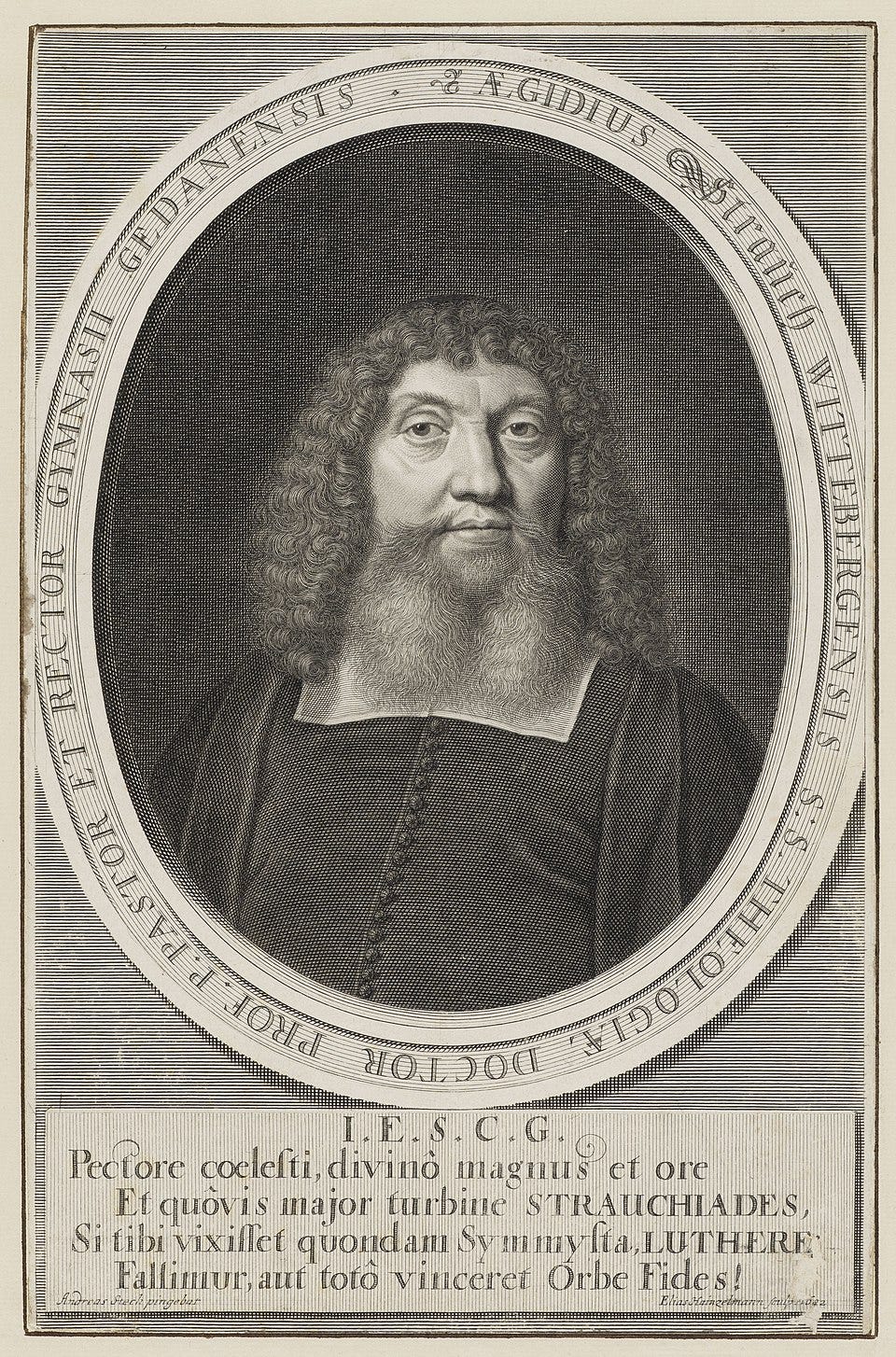
This topic arises within Strauch’s disputations on moral theology delivered in Wittenberg (presented in the 1660s but only collected and published in 1708) published under the title Theologia Moralis. Disputation X addresses the sin of idolatry.
Strauch makes a distinction between an idolatry of object versus an idolatry of mode.1 An idolatry of object is when worship is directed toward a non-divine thing, such as when the Israelites bowed to the golden calf after the Exodus. Idolatry of mode is when there is no object other than God who is worshipped, but that God is worshipped in a way that is not consistent with what God has revealed about himself.
A further distinction is made between the objective concept and the formal concept of a thing. By an “objective concept,” Strauch means that specific element of reality which one identifies when using a given word or phrase. By “formal concept,” Strauch means one’s understanding of the nature of that thing being identified. One can properly identify an object without understanding the nature of that object.
For example, a man in the ancient world who looked up into the sky at night could identify the same objects I do today when I similarly look at that sky—those things we identify as stars. While the object of my identification and that of a Greek in 500 B.C. are the same, our understanding of stars (the formal concept) differs greatly. The ancients often thought of stars as supernatural beings, but we know them to be flaming balls of hot gas. In short, we identify the same objects, but understand those objects differently. Further, the understanding we differ on is not a difference merely in perspective, but in the nature of the truth.
When, then, we ask the question of whether Islam and Christianity worship the same God, the answer can be divided in a similar manner. There is at least something of a common concept of God when a Christian and a Muslim (one can insert other monotheistic religions here as well) use terms to identify the object of their worship. There is only one source of being; there is only one Creator. Thus, we both reference the same object when speaking about God, but we do not work with the same formal conception of God.
Strauch identifies the worship of a non-Triune God as an idolatry of mode, rather than an idolatry of object. Idolatry of mode is “when the true God is worshiped, but not in the way in which he has revealed himself.” He writes that “those are idolaters who do not worship God as Triune in persons, as Jews and Turks.” He further refers to this as an “internal” idolatry, which consists more in false ideas about God than in the external object toward which worship is directed.2
In defense of Strauch, it seems to me that one simply cannot dismiss the ideas of all non-Triune theists out of hand simply because the New Testament does not allow it. The locus classicus for natural theology (Rom. 1:19-20) identifies human knowledge of God as that which discovers God’s existence and some of his attributes, but not his Triunity. Monothestic religions rely, to some degree, upon this inherent natural knowledge of God. Insofar as they do, they identify God as the proper object of worship.
St. Paul himself clearly works within this framework, where he contends that true statements about God from pagan poets are right statements. In his speech in Athens, Paul cites Epimenedes of Crete, who says, “in him we live and move and have our being,” and Aratus, who writes that “ For we are indeed his offspring” (Acts 17:28). In these texts, St. Paul cites statements of pagans referring to Zeus and applies them to the Christian God. This does not work within a framework that dismisses non-Christian conceptions of God solely within the context of discontinuity. Paul, instead, identifies those ideas that were derived through natural revelation, and then corrects their formal concept of God by calling for faith and repentance in the crucified and risen Messiah.
This means that, on the one hand, Paul can both acknowledge that the pagans directed their worship to the right object (as with the altar to the “unknown God”) but also call them to repentance for idolatry. The fact that their worship is in some ways aligned with natural knowledge of God does not mean that their worship is acceptable or God-pleasing.
I do not see how this should be any different than the Christian approach to Islam. An acknowledgement that there is a common object identified with the concept of “God” between the Christian and Muslim seems to me to be a necessity to have any productive evangelistic conversation with a Muslim at all. Just as St. Paul draws from those pieces of wisdom gleaned from pagan poets through the remnants of the imago dei remaining after the Fall to call the people in Athens to faith in Christ, the same can be done with Islam today.
“Knowledge of God must be true, not only on the side of the object, but also on the side of the concept. Thus, when Gentiles and Turks say they worship the creator of heaven and earth, they know the true God as to the object; but not as to the concept, since they do not acknowledge this creator as Father, Son, and Holy Spirit. Therefore, the objective concept is true, but the formal concept is false.”
He also identifies the Calvinistic view of reprobation as an example of idolatry of mode.
No posts
Comments
Nothing yet. Say the first thing.
Sign in to join the conversation.