
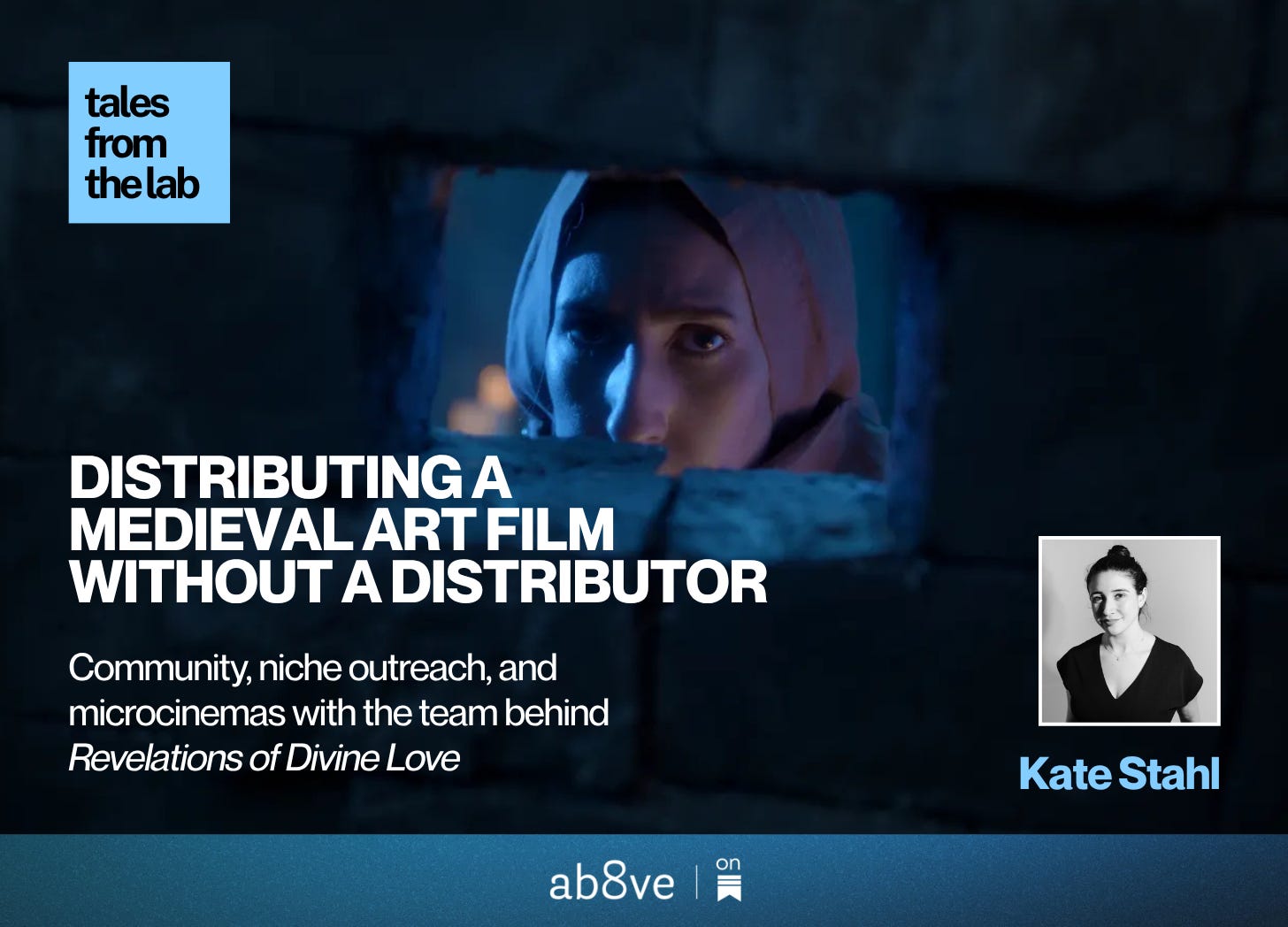
I’m continually inspired by the filmmakers in the 8 Above Distribution Lab, and the highly individual approaches they’re taking to releasing their work. One of the most rewarding parts of the Lab has been watching these approaches evolve through conversation, experimentation, and the shared knowledge of the cohort itself. Today’s guest post by director Kate Stahl of the film Revelations of Divine Love is a great example of that spirit in action.
Note - the Summer 26 cohort of the Distribution Lab is starting to fill up - but there is still some availability - we’re holding a few more info sessions through the first week of July. Sign up to meet me to learn more about the lab. I look forward to meeting you!
Sign Up for a Lab Info Session
By Kate Stahl
What does it mean to release a film that feels fundamentally out of step with the current marketplace? A medieval period piece made in a Ridgewood warehouse. A film about mysticism, faith, performance, and community. A film focused on the handmade while the industry obsesses over AI. A film with no stars, no traditional distributor, and no obvious blueprint for how it should move through the world.
I joined the 8Above Distribution Lab this winter having an idea of what our distribution model would look like, building off of relationships and past experiences but wanting to add some structure and intention to our existing plans. The Lab gave me the tools to better shape our strategy even as we were already moving forward.
But first! A little about Revelations of Divine Love!
Revelations of Divine Love is the second feature from filmmaker/filmworker and ScreenSlate favorite Caroline Golum. Based on the life and writings of Julian of Norwich, a 14th century mystic who became the first woman to publish a book in English, the film delves into questions of faith, art, and community, telling a story at once singular and universal.
We shot the bulk of the film in a warehouse in Ridgewood, Queens in the winter and early spring of 2023. After pick ups in 2024, we began the traditional rounds of festival submissions and the response was frustrating. More than once we had programmers reach out to say, “I really fought for this but…” and one even called their colleagues cowards. While these rejections were disappointing, they were also reassuring that there were and would be people who loved and appreciated this film for what it is: A one of a kind, handcrafted retelling of the life of an iconic woman/artist/mystic, a medieval period piece made for under 200K, a lush medieval world made by a collective of gritty, “diy” New York artists in a Ridgewood warehouse.
Ultimately, we premiered at FIDMarseille in summer of 2025 and made the decision not to do a US festival run and instead jump right to a release. We didn’t have a distributor or a plan just yet, but we knew we could leverage the community that came together to make this movie to bring it out into the world.
Here’s where the 8Above lab comes in. Our goal was always to build and reach the audience for the film, considering them an expansion of the community we developed and relied on during production. But who, exactly, was that audience?
I started with three key niche audiences: art house film fans/cinephiles, medievalists, and religious audiences. We then broke those down further into core audiences.
For art house film fans/cinephiles:
NYC “Downtown” Film Audiences
Micro-Cinema Audiences & Workers
Letterboxd Users
For medievalists:
Academics & hobbyists
“Cult Of Sainthood” fans
And for religious audiences:
Episcopal Churches & Congregations (Julian is a saint in the Anglican/Episcopal church)
Unitarian Universalists
Julianists
We successfully leveraged our community at every step of the process. From the very beginning this project has been crowdsourced: whether building our cast and crew, finding locations, or raising our budget, the NYC film community and beyond stepped up.
When it came time to lock in distribution and reach our audiences, we again tapped into this community. Our distribution partner, Several Futures, was founded by Caroline and my former colleague Graham Carter, and our publicist Kaila Hier (of Exile PR) is both our former colleague and the partner of our editor Zach Clark.
Looking at the OSEP (Owned, Shared, Earned, Paid) model of media, we leveraged our relationships as well as assets we began building during production.
Our poster was designed by friends of the film Jennifer May Reiland (whose gorgeous watercolors can also be seen in the film’s credits) and Ben Tuttle (whose fonts for the film won a prize from the Type Directors Club). We’ve been deploying this piece of Owned media via poster and postcard since our premiere last summer. The posters double as merch and can be seen at all of our presenting theaters while postcards with the design include a QR code to access upcoming screenings.
Our trailer was cut by our editor Zach Clark and includes voiceover from cast member Theodore Bouloukos. We released it in February, six weeks ahead of our theatrical release in collaboration with our distribution partner Several Futures, opening theater Anthology Film Archives, and our friends at Screen Slate.
Additional Owned Media includes a dedicated Instagram account where we share updates, behind the scenes moments, press and more, as well as filmmaker accounts on Instagram, X, and Bluesky.
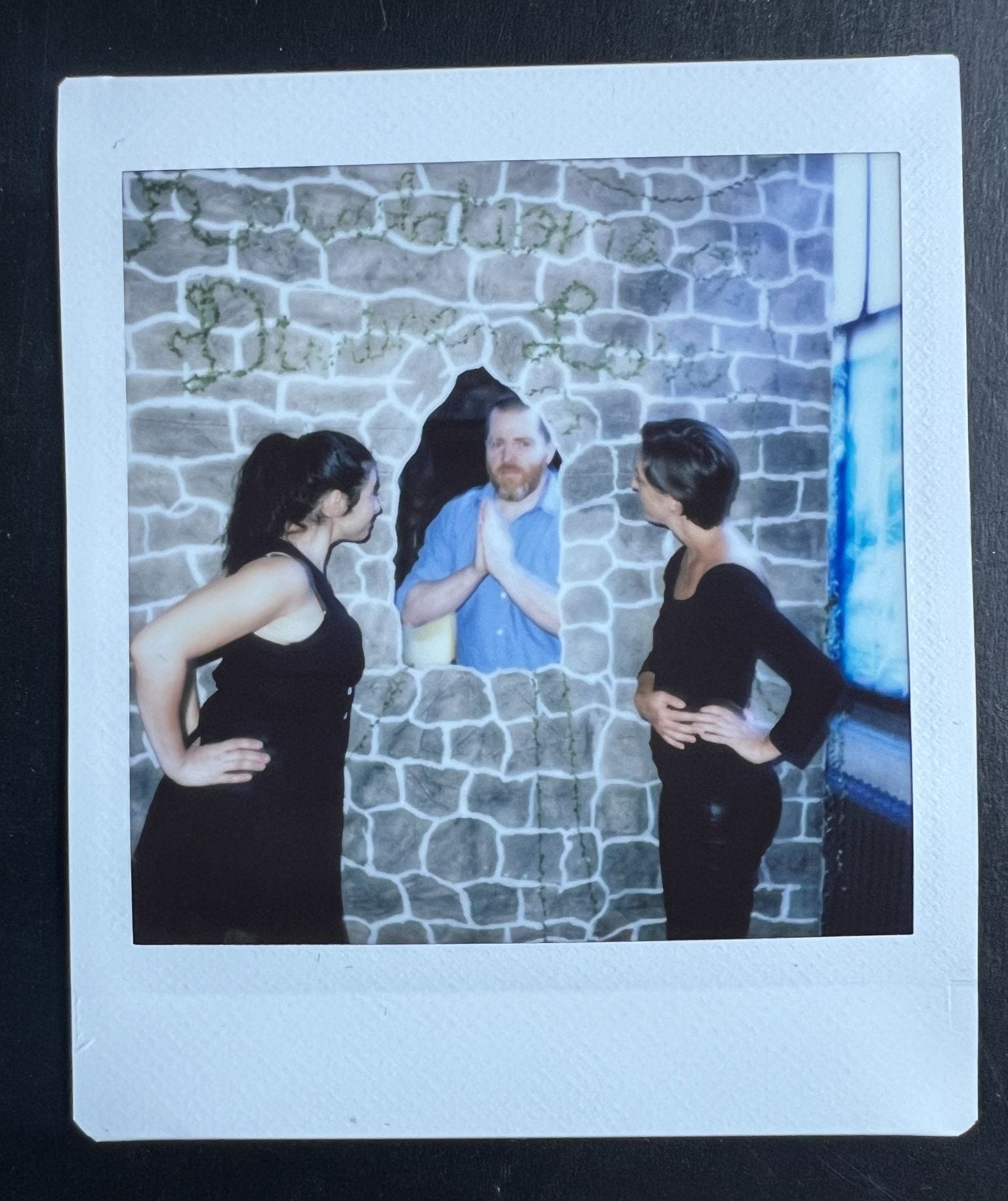
As we approached the opening weekend, our DP, Gabe Elder, came to us with an idea: he (with support from art director Grant Stoops, and assistant director Sydney Buchan) wanted to build us a replica of our key set, the window to Julian’s anchorhold, for a photo op. Once again, our team and community came through for us, creating this perfect standalone moment. Gabe also brought his polaroid camera to the premiere, engaging with the team and audience and getting some amazing photos!
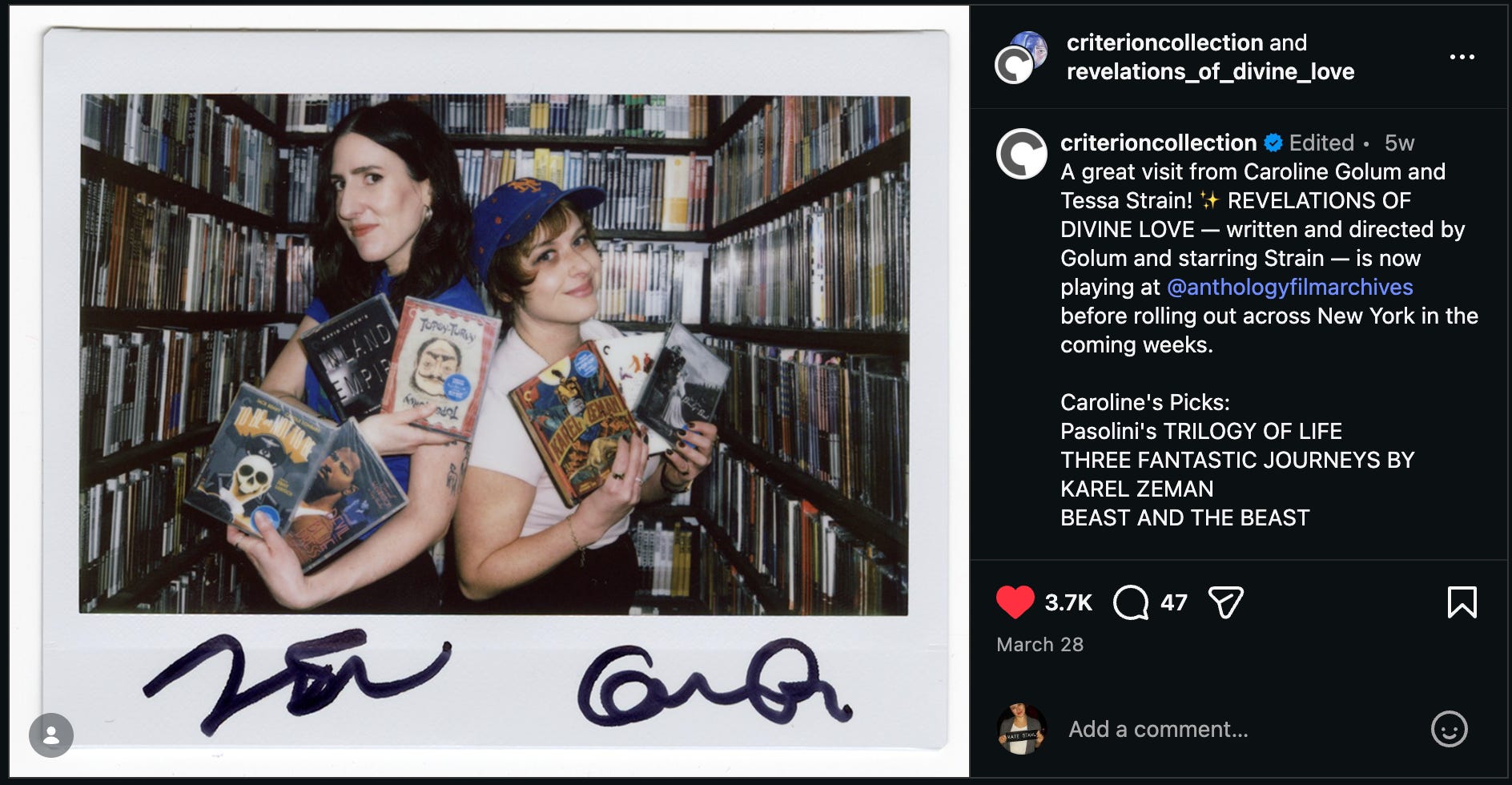
As far as Shared Media goes, we partnered with the New York Medieval Society to include our New York screenings in their newsletters, drawing the medievalist crowd. We received continued support through our ongoing relationship with Screen Slate and their popular listing pages. Additionally, we leveraged the followings of our Q&A moderators to target our different audiences: Vulture writer Fran Hoepfner brought her Substack and other followers (and got us in an NYMag round up) while critic Jo Livingstone (who holds a PhD in medieval literature) brought in medievalists. For our one night of screenings at Low Cinema, we partnered with medieval music group Alkemie who brought their own crowd mixed with the Ridgewood film scene.We also got a coveted Criterion Closet visit for our writer/director and star which boosted our social media and beyond.
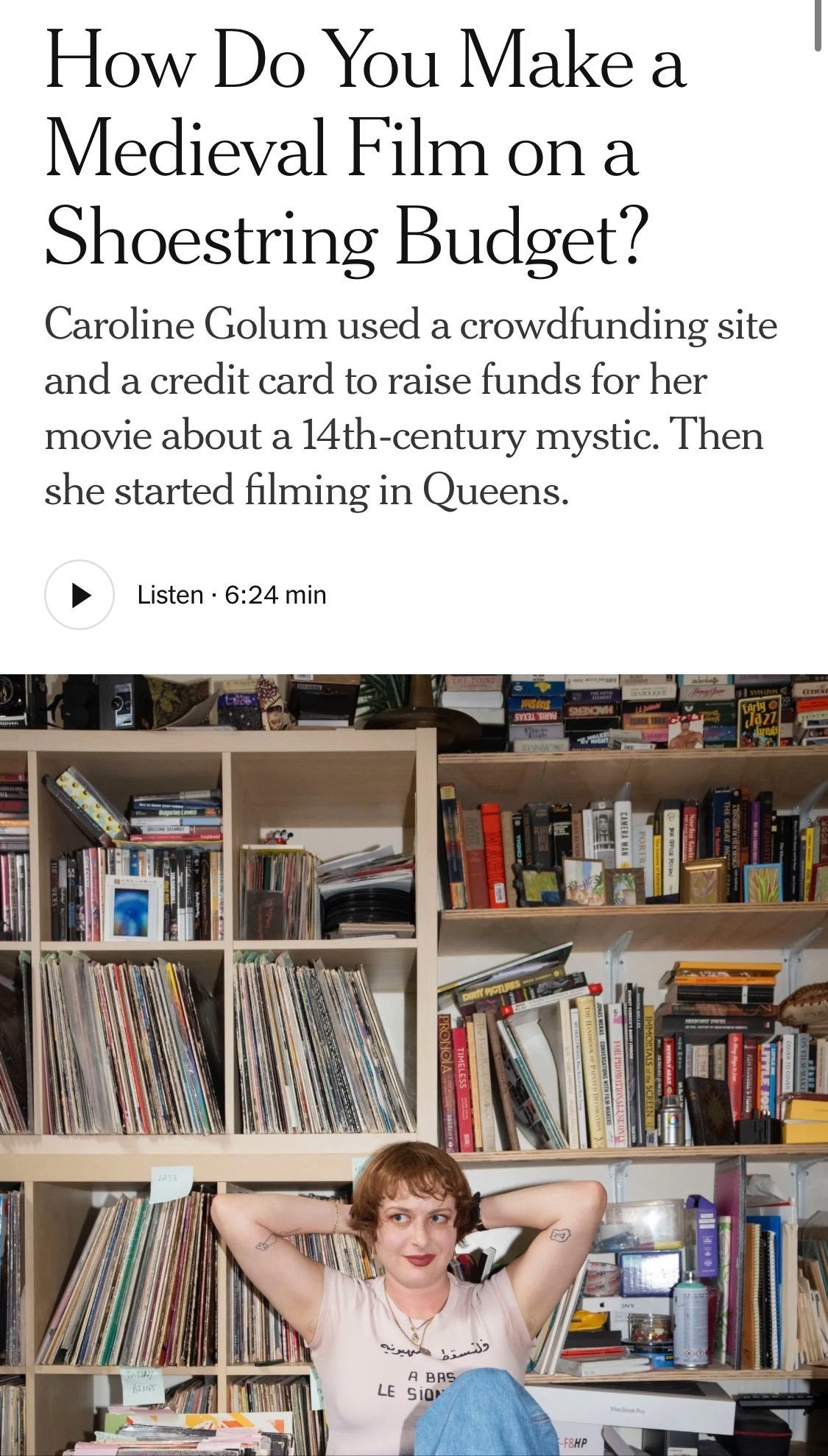
For Earned Media, publicist Kaila Hier of Exile PR went above and beyond securing features ranging from Substacks and interviews with friends to a New York Times Styles profile. Throughout it all it was the identity and brand of the film as gritty, low budget, and artful that proved most compelling to the press and continues to drive our audiences to the theater.
Thus far our Paid Media has been limited to boosting the initial trailer release but we anticipate some additional boosts in specific markets as we continue our tour.
I’ve already mentioned Anthology and Low but now I’ll dig in a little more to our distribution strategy. Our first goal was to secure a full NYC run. We knew a scrappy, low budget, film like ours with no major talent would be difficult to program for one consecutive run so early on we built the plan for a month of screenings here in New York. The New York film world is our home, among our team, we’ve worked, volunteered, and shown at most of New York’s indie cinemas. Plus a whole bunch of local programmers, archivists, and other cinema workers have cameos throughout the film (yes, that is Anthology’s John Klacsman as an executioner and Low’s Cosmo Bjorkenheim as a German pilgrim).
Using our existing relationships, we scheduled a run over five weekends over the course of April. We launched with a sold out screening at the end of March alongside a program of Caroline’s favorite Medieval films (Revelations of the Middle Ages). We followed three successful screenings at Anthology with a sold out Easter Sunday screening at Nitehawk, two sold out screenings at Low Cinema, and a well attended weekend run at the Roxy before closing out our New York run at Spectacle, the longstanding collective micro-cinema where Caroline is a longtime member.
At all of these screenings, we have been successfully selling merch as well. Our baseball cap, originally a cast and crew gift, sold out on opening night requiring a restock. We are keeping merch limited to in person screenings to help maintain word of mouth buzz and exclusivity.
With the sales and media garnered by our New York screenings, our distribution partner Several Futures has been pitching the film across the country. Starting with another sold out screening in Chicago in May, we have continued the pattern of mini regional tours. These regional tours allow us to consolidate travel and maximize audiences with one off screenings including Q&As to generate ongoing interest. In addition to more traditional distribution outreach, we’ve built the tour through contacts made from chatting at film events like the Nitrate Picture Show and academic events like the International Medieval Studies Conference, word of mouth among programmers and audiences and even cold outreach from micro-cinemas and more via Instagram.
Simultaneously, we have been laying the groundwork educational runs by presenting the film at academic conferences and in classrooms. As we proceed, we intend to partner with an educational distributor to continue this pipeline. (If any are reading this feel free to reach out!) We are similarly approaching religious licensing.
What this whole process has reinforced for us is that independent filmmaking is sustained by people being willing to show up for each other. Every screening for this film has grown out of the film networks we’ve spent years building for ourselves, programmers, critics, artists, scholars, projectionists, publicists, theater workers, and audiences who believe cinema can still be exciting, unexpected, and revelatory.
Rather than chasing scale, we’ve really tried to lean into creating memorable events and screenings, cultivating highly specific audiences, and allowing word-of-mouth to do its job. (And yes, a NYTimes feature didn’t hurt, either!) While the path for this film was not conventional it was true to the film itself and reminds us that there is still an audience for ambitious, weird, personal cinema when you take the time to find them.
Through the 8 Above Distribution Lab, participants experience a mindset shift about distribution and the film industry itself that empowers them to tackle this essential task for their current project and the future. Including:
AT THE END OF THE LAB YOU WILL COME AWAY WITH:
A new framework on how to approach distribution and marketing.
A comprehensive distribution and marketing plan and budget for your film and the confidence to pitch and execute it.
A community of filmmakers that you can rely on for support during the lab and into the future.
Connections with a range of industry experts.
Up to date knowledge about industry best practices.
Learn More about the Distribution Lab
To get 25% off, use discount code: 8ABOVE25OFF
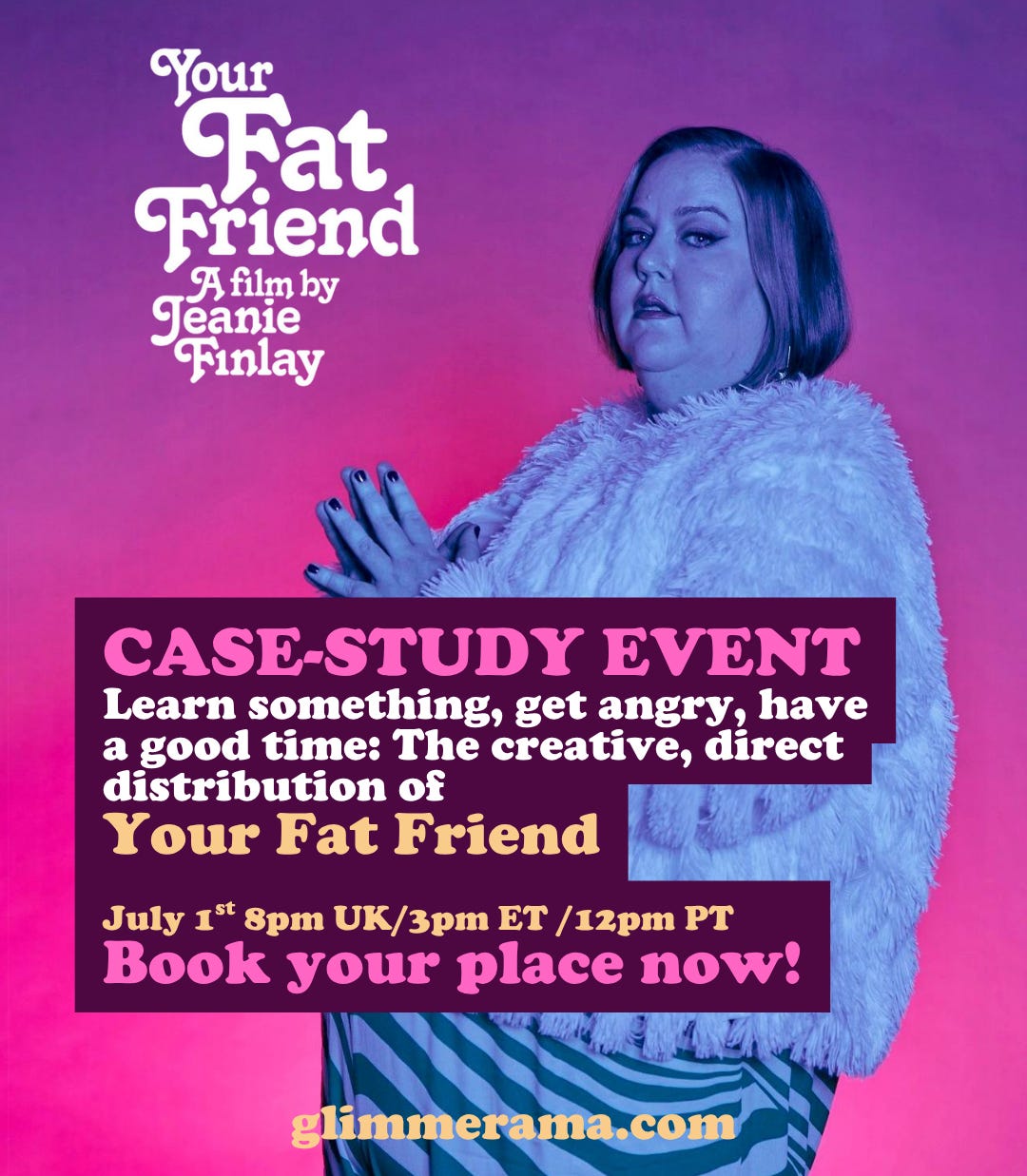
Amid widespread uncertainty in the independent film industry Glimmerama founders - artist & filmmaker Jeanie Finlay and head of business affairs & creative producer Suzanne Alizart - offer an online, image- laden, powerful case-study in resilience and tenacity. Designed to provide inspiration for your projects, the case study will detail the direct, creative approach they took to connecting with audiences, sparking conversations and making meaningful change while distributing their feature documentary Your Fat Friend.
Inspired by the life and work of writer and activist Aubrey Gordon, Your Fat Friend defied the odds and industry expectations to forge deep meaningful connections with audiences around the world. This wasn’t just creative & critical success, it translated into box office, becoming the #1 theatrical documentary at the UK Box Office in its week of release, the #1 film on Curzon at Home and the most successful film on Jolt, ever.
The release of Your Fat Friend initiated conversations about anti-fat bias in the places where it is most keenly felt - from the home and workplace, to doctor’s offices and airplanes.
Don’t just take our word for it:
“The session blew all our minds... incredible - informative and unmistakably serious.”
SAM WIDDOES - Entertainment attorney and producer
Comments
Nothing yet. Say the first thing.
Sign in to join the conversation.