
I seem to be a lightning conductor for highly sensory brushes with Jew hate. Not the everyday ‘shorts’ on social media: a halfwit barking at a quiet Jewish family or some Palestine hate-marcher projecting their own self-hate onto a freedom-loving Israel supporter.
No, these feel like cries rising up from the ground beneath one’s feet.
I know many of you have read my chilling story where I was trapped with my family in a Barcelona cab with a virulent antisemite taxi driver. A crossed word might well have inflamed his bristling anger into something more confrontational.
But my very appearance in this simple alleyway in a far-flung European outpost seemed to trigger a guilty aggression in a local eighty-one years after their place became yet another scene of the greatest crime in the history of the world.
By coincidence, it was Tisha B’Av in 2025, the most solemn of days in the Jewish calendar. I left my family at our hotel and ventured into the old town alone.
The Kahal Shalom synagogue in Rhodes sits deep inside a maze of stone walkways in the eastern corner of the walled city. Kahal Shalom means Community of Peace. Of course it does. That’s what we in the diaspora offer our fellow citizens wherever we’re allowed to make a life.
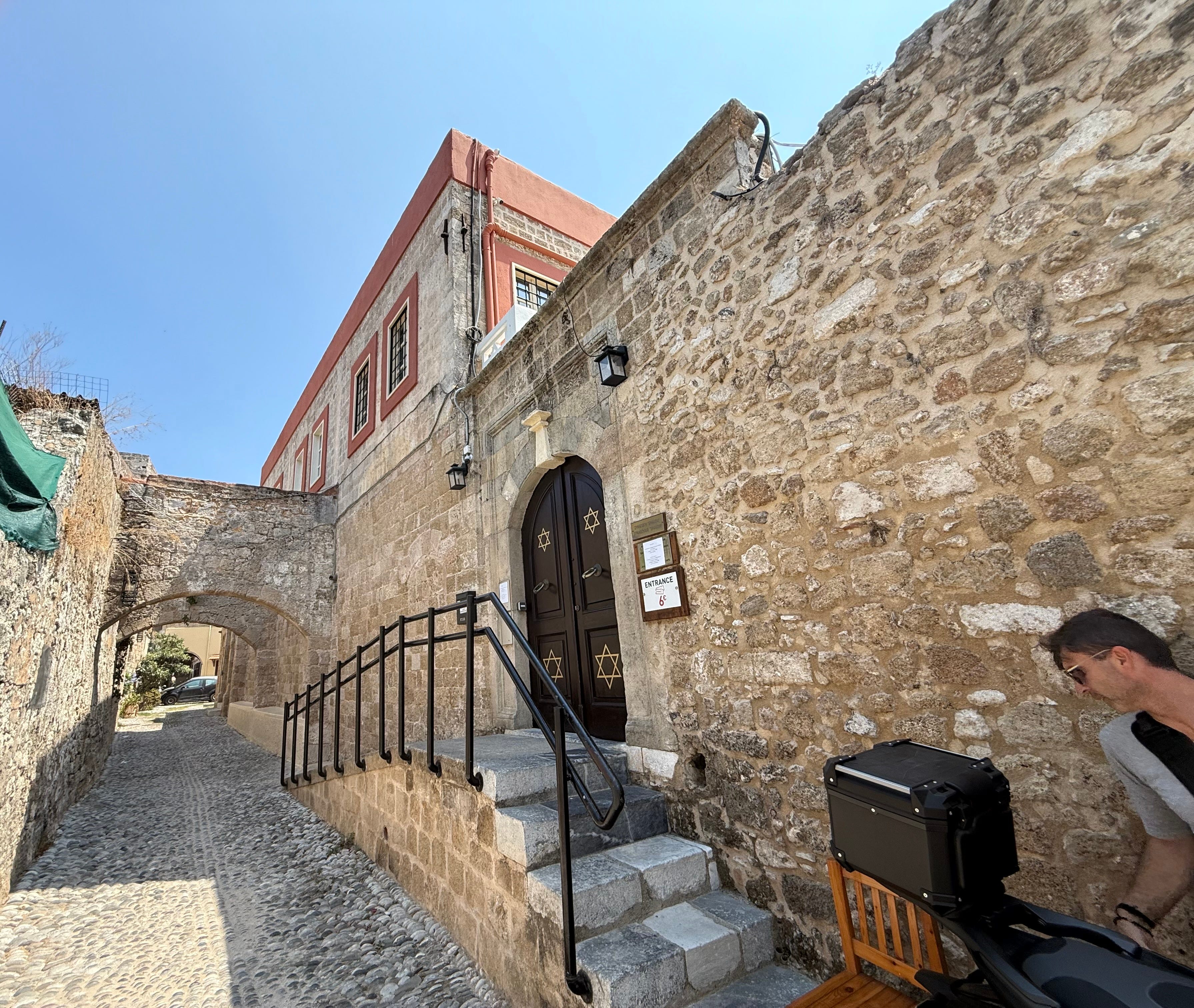
The synagogue was built in 1577 and it’s the oldest in Greece, and for most of the year it functions as a museum — though it still stages services on High Holidays and weddings for the descendants of the community that built it. They come back from New York, Brussels and Zimbabwe with a mixture of nostalgia and defiance to begin the next Jewish generation somewhere else in the world.
Somewhere else is the point.
Jews are recorded on Rhodes from the second century BC. After the Ottomans took the island in 1522, Sephardi exiles from Spain rebuilt the community here in a quarter called the Juderia, and for four centuries they were bookbinders and weavers and merchants who walked these same alleys to pray three times a day and observe Shabbat.
But on the 18 July 1944, Jewish life here came to a shuddering, brutal termination. The German command ordered every Jewish man over sixteen to report the following morning with his identity card and work permit. The permits were the trick — they suggested labour, and labour suggested a future. Every man who obeyed the order was held. The next day the women and children were ordered to join them and to bring their valuables. By the 21 July the entire community was under guard and their property confiscated.
At noon on Sunday 23 July they were marched to the harbour. Not at night. In the full white heat of a Rhodes afternoon, guards with Alsatians beating the slow ones with rifle stocks. The streets were empty because the Germans had sounded the air raid alarm and ordered the town indoors. Nobody had to watch.
They were loaded into the holds of three old cargo boats. Such was the sick European obsession to search out and remove all known Jews, the boats called at Leros to collect the single Jewish man who just happened to be there on business, then off to Kos to abduct another community of a hundred.
From Piraeus they went by truck to Haidari, then in cattle wagons from Rouf station. Twenty-four days — the longest journey Hitler’s machine ever inflicted on anyone. Of the 1,673 deported, only 151 came back.
But the Turkish consul-general, Selahattin Ülkümen, saved about fifty people by inventing a Turkish law that did not exist and daring the Gestapo to check. He insisted those with Turkish passports or papers should not be taken.
His decency should be recorded. It is always worth saying who did something.
I had made no appointment and I did not expect the synagogue to be open, and on the ninth of Av, the date when both Temples in Jerusalem were destroyed, it was not.
Visitors to such places stop there and say nothing. A minute’s silence: it’s a decent instinct but with no spiritual equipment behind it. The silence can sometimes create a vacuum.
We have equipment. We have Kaddish.
I have no connection to the Sephardim of Rhodes. My family came out of Austria and Russia. But that is rather the point of the prayer: it does not ask who you knew.
And here’s where the story gets weird.
A Vespa moped was parked underneath the entrance, and a young man was standing with it.
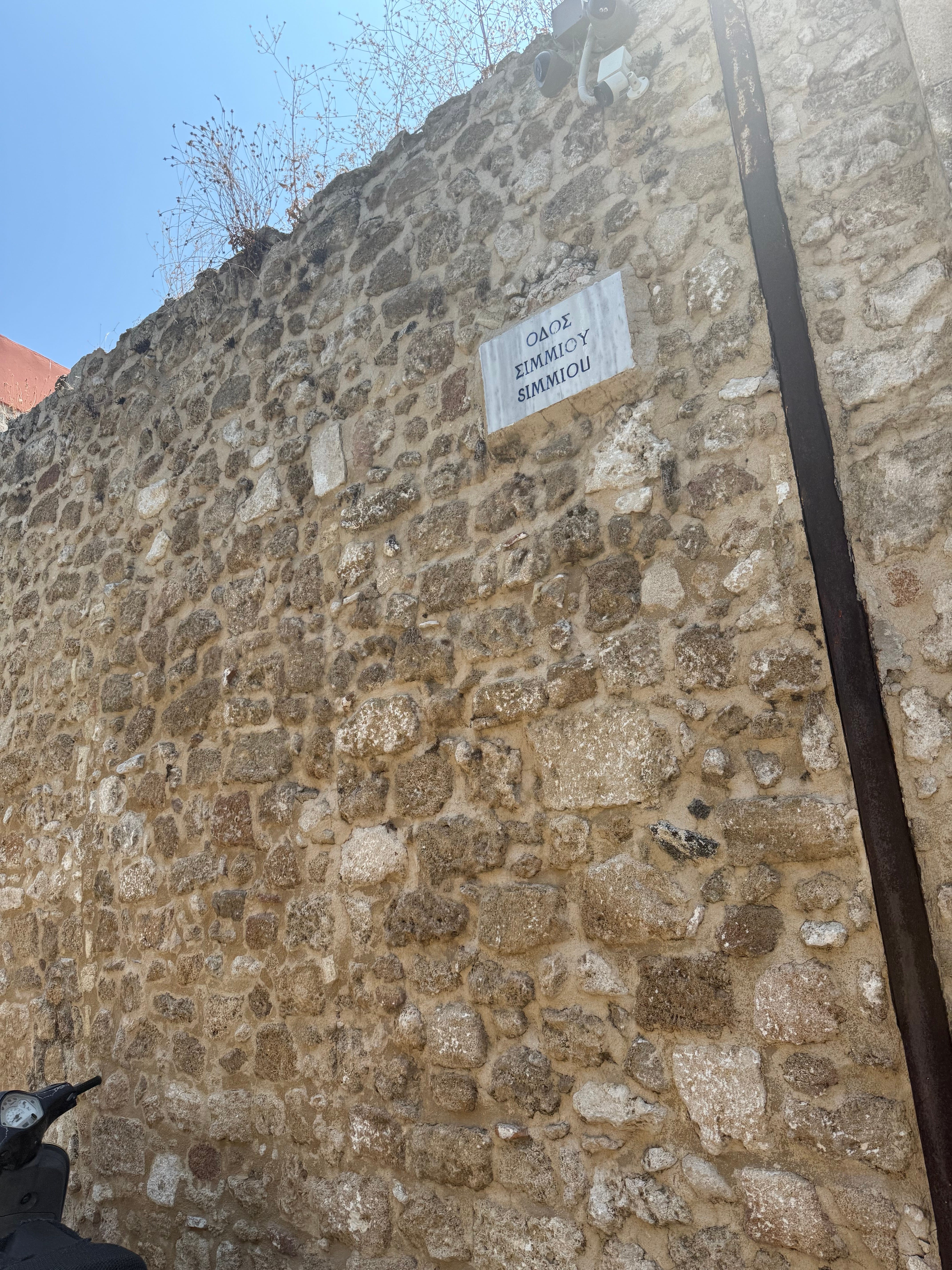
I went round the corner to a sheltered wall of the synagogue. Close enough to feel like the Kotel, I put my forearm across my eyes and pressed my head against the worn stone, as if to connect with those lost to the ovens of Auschwitz.
Strictly I should not have said Kaddish on my own at all — the Mourner’s Kaddish wants ten men and I had none with me. I said it anyway, for the people taken out of these alleys eighty-one years earlier.
Kaddish takes less than a minute to recite.
I did not get the minute.
Vespa man followed me round and interrupting my private prayer, told me the stones underfoot were dangerous, that I might fall. But they were the same stones as every other alley I had walked through that morning. I turned around, and there with us stood an elderly woman standing in the doorway of the house directly opposite the synagogue wall, watching me and Vespa man, saying nothing.
What I was effectively told was I had no business there. That between his warning and her silence I had been identified — a returning Jew, standing too close to something.
I don’t know who they were and what their relationship to that building in the environs of the former Jewish area were.
What I do know is this. The Germans looted the emptied houses of this quarter as they sent 450 years of everyday life there to its destruction. Most of the homes and shops in the Juderia belonged to Jews, and today they belong to other people, and sometimes to the city and the state. A handful of families won them back through the courts in the fifties and sixties. My family achieved similar in Vienna.
Most did not, because most were dead.
What I cannot know is anything at all about that particular house or that particular woman. She may well have been a child here in 1944. Her family may have bought or claimed the place after the war. Half this quarter was rubble by then anyway — the Allies bombed the Juderia twice that spring and levelled the Kahal Grande Synagogue a few streets beyond. I just have a remark about loose paving and a very old woman in a doorway, and I am not going to build a conviction out of that.
But the mass theft in Rhodes’ Juderia is not in doubt. It is documented, it is enormous, and it did not require a single islander to lift a finger — the German administration did it thoroughly and on paper.
There are no Stolpersteine outside that house. There is no plaque, no name and definitely nothing special to trip over. But that, in the end, is what I was standing in: part of a crime scene, but an absence so complete that a man saying a prayer for one minute read as an intrusion to the new people who live there now.
A year later I will go back.
To finish the Kaddish.
Comments
Nothing yet. Say the first thing.
Sign in to join the conversation.