
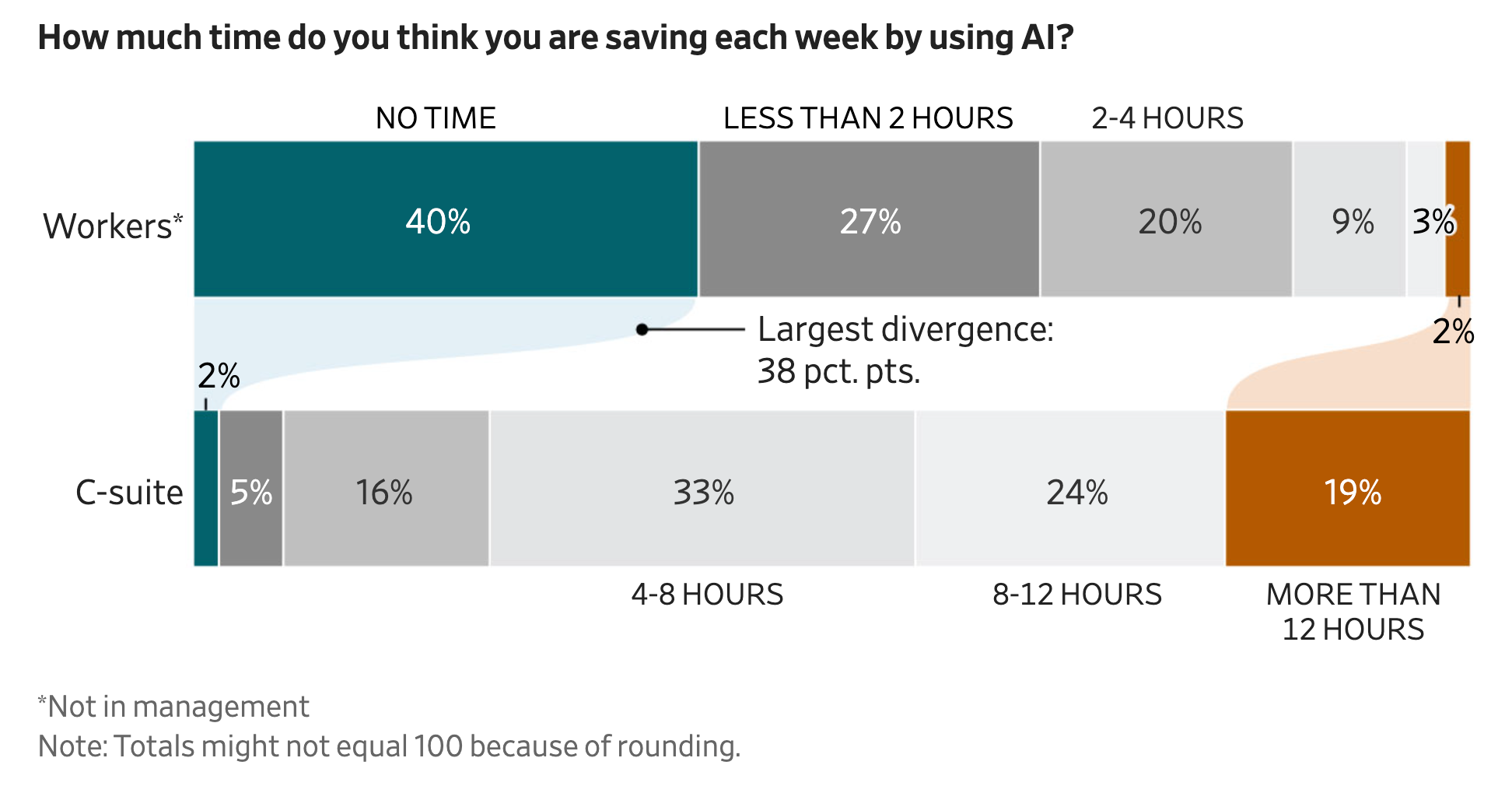
A recent chart circulating in AI and business circles reveals a striking gap: executives report saving many hours per week using AI, while most non-management professionals report little to no time savings at all. At first glance, this looks like a familiar story of uneven adoption or resistance to change. But the reality may be more structural than behavioural, or where AI currently fits and doesn’t fit into daily work.
The survey behind the chart is a simple stated preference approach (i.e. how much time respondents feel they save, not what is quantitatively revealed) where respondents were asked how many hours per week AI saves them. Executives overwhelmingly reported large gains, while a significant share of workers reported none. The largest single difference appears in the “no time” saved category for workers.
At face value, this invites a familiar set of explanations:
Perhaps executives are more open to AI,
Perhaps workers need more training, or
Perhaps the technology is being oversold (i.e. there is a bubble).
However, the above explanations don’t hold up particularly well.
The chart only measures self-reported time savings – not productivity, output quality, or organizational impact. What it really captures is how different roles experience AI inside the structure of their work or, in other words, how work itself is organized, constrained, and evaluated.
Executive work is generally more abstract and synthetic. Much of it involves:
Reviewing and summarizing information,
Framing options and trade‑offs,
Drafting communications, and
Preparing narratives for decision‑making.
Generative AI is exceptionally good at these tasks. Inputs are often ambiguous, outputs are narrative, and “good enough” is frequently sufficient to move work forward. There is relatively low risk in using AI to accelerate this kind of thinking.
In that context, AI often feels like a direct time‑saving tool.
For many professionals, especially in technical, regulated, or standards‑driven fields, work looks very different.
Outputs must be defensible, auditable, and compliant with established methods, tools, guidelines, and regulations.
AI suggestions often require careful verification, reformatting, or translation into approved workflows. In some cases, the effort required to validate an AI‑generated output offsets the time saved in producing it.
As a result, AI may feel cognitively helpful but operationally inefficient. It assists thinking without reducing net task time.
This is not resistance by professional workers, such as engineers; it’s rational risk management. If this is the case, why not perform the work conventionally yourself?
The chart implicitly presents a binary or false dichotomy: executives versus workers. But that framing leaves out a crucial middle layer that is the people who both understand the work deeply and design how AI is applied to it.
This is not a marginal role. The middle layer where AI shifts from novelty to leverage.
This group isn’t primarily using AI for drafting or summarization. Instead, they focus on:
Translating messy, real-world problems into structured inputs;
Designing guardrails, databases, prompts, and review loops; and
Turning one-off AI use into repeatable, auditable systems.
This is where real productivity gains can emerge because entire classes of repeated work are reduced or eliminated. Critically, this kind of work is largely invisible to surveys like this one. Its benefits compound over time and across teams, rather than showing up as immediate, personal time savings.
This is where my own recent work with AI has increasingly sat, and why I wish to raise the “missing middle” challenge and opportunity.
My own work does not fit cleanly into either side of the chart, and that’s part of what makes it relevant to this discussion.
I am not using AI the way most workers do. I’m not primarily consuming AI outputs, using it as a drafting shortcut, or leaning on it for generic ideation. At the same time, I’m not using AI the way most executives do either. I’m not simply delegating work, compressing inbox time, or relying on AI to summarize decisions made elsewhere.
Instead, my work sits in what might best be described as a technical-strategic hybrid role. I remain directly accountable for correctness, defensibility, and method, while also designing the systems, prompts, databases, and guardrails that shape how AI is applied.
That difference matters.
Many workers ask: “Does AI make this task faster?”
Many executives ask: “Does AI compress synthesis and decision-making?”
The question that has shaped my own work is a third one altogether: “Can AI eliminate entire classes of repeated analysis work?”
This is the distinction between substitution and leverage.
In practice, that means treating AI as infrastructure rather than assistance:
Removing the need to manually inspect every individual case by designing systems that surface only what actually needs attention;
Eliminating repeated lookup, interpretation, and explanation by embedding standards and context directly into analytical workflows; and
Reducing coordination and translation overhead by building tools where data, logic, and visualization are tightly coupled.
The result focuses on structural time savings. The slope of effort versus output changes.
This also explains why my own AI use would likely under-report as “hours saved” in a survey like this. Any time freed is almost immediately reinvested into better architecture, stronger validation, and new capabilities. Subjectively, the workload feels similar. Objectively, the volume, quality, and durability of output increase by orders of magnitude.
This kind of productivity gain doesn’t map neatly onto the executive or worker bars in the chart. It accumulates unevenly, varies week-to-week, and often shows up as entire phases of work shortened or removed altogether.
That dynamic is largely invisible to stated preference surveys, but it’s where much of AI’s real, lasting value is currently being built.
There is an important paradox at the heart of this kind of AI use. When AI changes how work is structured, its benefits rarely appear as freed time.
Freed capacity is almost immediately reinvested into:
Better quality control,
Broader scenario testing, and
Faster iteration and learning.
From the outside, the workday can look unchanged. But the outputs are more robust, more defensible, and produced with far less reinvention.
If productivity is measured only by visible time savings, this impact is easy to miss. Productivity here is about doing different work, at a higher level of leverage.
When organizations look only at executive‑level AI enthusiasm, it’s easy to draw the wrong conclusions:
That workers need more training,
That adoption is the primary barrier, and
That productivity gains should already be visible everywhere.
In reality, what’s missing is often workflow redesign, not willingness. AI needs to be embedded where work actually happens, with clear accountability and technical stewardship, including human-in-the-loop review.
And, without this redesign of the workflow, the gap between leadership optimism and practitioner experience will persist.
This is about structure, not enthusiasm. The gap reflects how different roles are organized, constrained, and evaluated and not who is more “open” to AI.
Perceived time saved does NOT equal productivity gained. These types of stated preference surveys capture felt efficiency, but much of AI’s value appears as reduced reinvention, stronger workflows, and better-quality output.
The opportunity sits in the missing middle. Real gains come from embedding AI into systems and processes, not just layering tools on top of existing work.
So, where do you fit in this survey? Are you a worker, an executive, or somewhere in the “missing middle”?
Comments
Nothing yet. Say the first thing.
Sign in to join the conversation.