
What could the future of traffic management look like, where your car’s dashcam does more than record your scenic drives or that moose that darted across the road? Imagine a world where dashcams, powered by artificial intelligence (AI) and edge computing, continuously capture real-time road data and feed it into systems like Waze. The result? A smarter, safer, and more responsive transportation network. Buckle up, as we explore how this emerging tech is already reshaping the way we navigate our roads.
If you've ever used Waze to dodge a traffic jam, you've already seen the power of real-time, crowdsourced data in action. But you often need to make a traffic report while you’re driving! How is that safe? How many reports are missed that could be helpful to other road users?
Instead, what if we could take crowdsourced data a step further using a safer, more accurate approach?
Enter AI-powered dashcams with edge computing. These technologies promise to gather detailed, real-time information, like road signage, construction activity, and weather, and feed it directly into systems like Waze. The result? A next-generation connected infrastructure that’s more automated, more accurate, and more responsive.
Waze has changed how we drive, but it’s not without limitations. User reports can be delayed or inaccurate. That’s why Waze launched its “Waze for Cities” program to collaborate with municipalities and improve data quality.
Data Exchange: Cities report road closures and special events; Waze provides real-time traffic insights in return.
Traffic Management: This mutual data loop helps optimize flow and enhance safety.
Emergency Response: First responders can use this data to reroute and react faster.
Community Engagement: The public becomes a partner in improving transportation conditions.
Even with these advances, there’s still a gap, particularly in precision and consistency. This is where dashcams and AI step in.
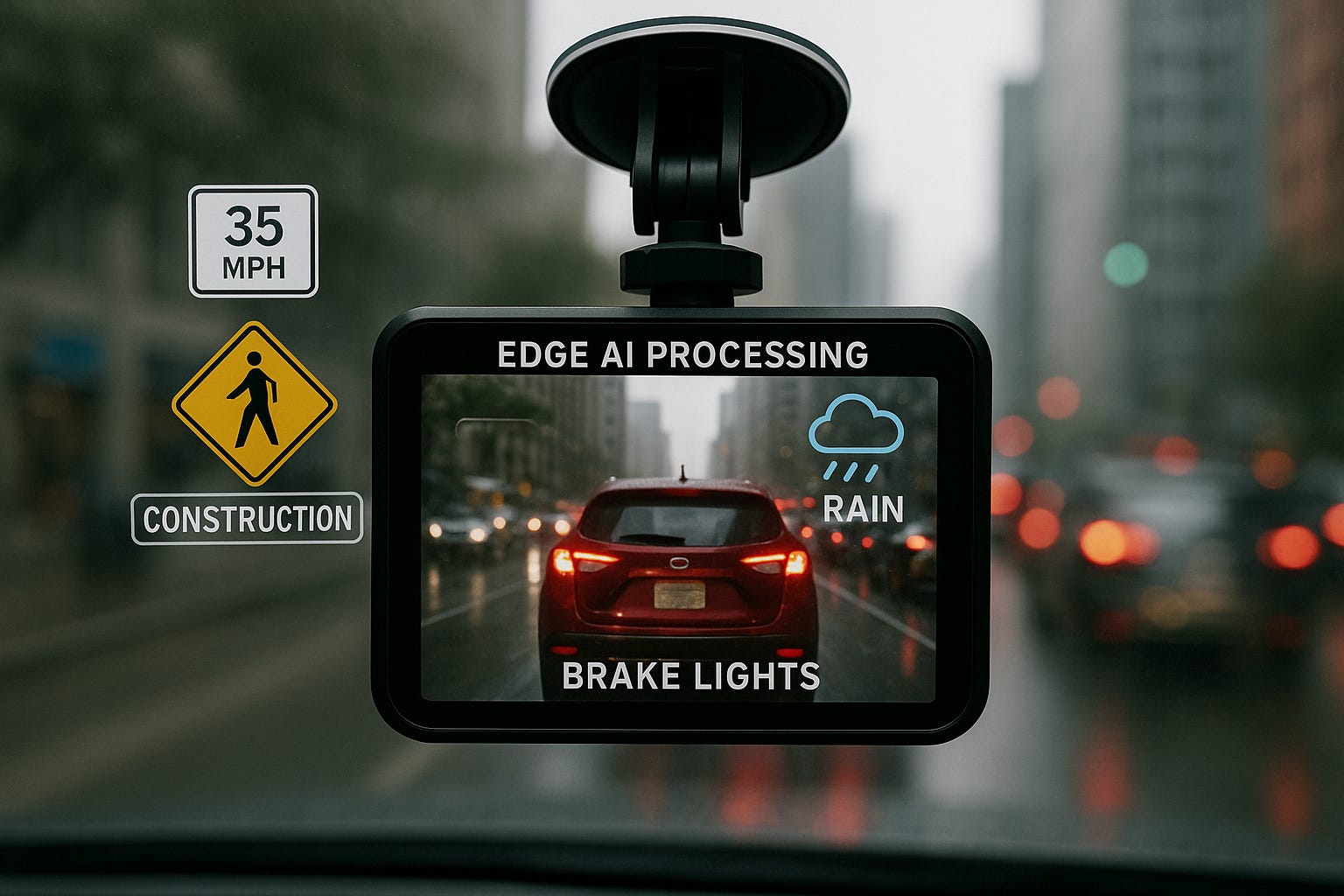
Dashcams have long been silent witnesses to our drives. But paired with AI, they become powerful tools for real-time road intelligence.
Road Signage: AI can read signs and update systems instantly.
Weather: Conditions like fog or rain can be flagged in real-time.
Construction Zones: Detected visually and used to reroute traffic.
Speed Limits: Captured and confirmed against digital maps.
Brake Lights: A signal of sudden slowing ahead, identifies potential collision or congestion risks.
Some vehicles already display detected speed limits. Imagine scaling that up across millions of vehicles and integrating it directly with city systems.
AI provides the pattern recognition, and edge computing provides the speed.
Instead of waiting for data to upload to the cloud, edge computing processes it right inside the vehicle. The benefits?
Real-Time Response: No latency from cloud uploads.
Lower Bandwidth: Only essential data gets transmitted.
Improved Privacy: Data can stay local unless flagged for sharing.
This local processing power allows for immediate insights and actions, without burdening the driver or the network. For example, Waze is notified immediately (via API), and the report is added to real-time conditions, corroborated by similar systems in nearby vehicles, improving confidence.
Integrating this AI-processed data into navigation platforms supercharges their effectiveness.
Navigation: Live, verified data improves route selection and hazard warnings.
Traffic Management: Cities see the bigger picture in sharper detail.
Safety: Drivers gain timely alerts about real-time risks.
Speed: Edge computing ensures swift delivery of insights with minimal lag.
But there are trade-offs. Systems must be interoperable, and privacy concerns must be addressed. That’s where encryption and anonymization come in.
At its core, connected vehicle infrastructure is about communication between vehicles, traffic systems, and even road surfaces.
Smarter Roads: Up-to-date, localized information improves flow.
Safer Driving: Instant alerts can prevent crashes.
Emergency Response: Faster data = faster help.
Maintenance: Road damage can be identified and reported automatically.
Edge computing ensures this entire cycle runs quickly and efficiently, reducing response times and increasing accuracy.
Of course, with great data comes great responsibility.
Local Processing: Analyze it on the dashcam to avoid cloud leaks.
Anonymization: Strip personal identifiers before sharing.
Encryption: Secure data in transit and at rest.
Transparency: Make sure users know what’s being collected and why.
Balancing innovation with privacy is essential for public trust and adoption. Edge computing allows this, with raw video images being processed directly in the vehicle. Processed, anonymized data is sent away, but personal vehicle data is immediately discarded at the source.
AI-powered dashcams, supercharged by edge computing, could represent a pivotal advancement in connected vehicle infrastructure. By processing and sharing accurate, real-time data, these technologies promise to elevate traffic management, improve safety, and optimize our road networks.
But adoption will hinge on public trust, which means privacy, transparency, and interoperability must remain top priorities.
So next time you hit the road, think of your dashcam not just as a passive observer, but as a partner in creating a smarter, safer future.
AI-powered dashcams and edge computing are revolutionizing how traffic data is captured, processed, and shared, turning every vehicle into a real-time sensor. Would you trust your car to help manage traffic? What privacy safeguards would make you more comfortable with this future?
Comments
Nothing yet. Say the first thing.
Sign in to join the conversation.