
All three women are identified here by the pseudonyms used in open court and in the trial coverage. None of the three has been publicly named.
“Jane” had a friend over on the night of September 23, 2024. They stayed up in her apartment at Sundance Court, on the campus of Midwestern State University, until about one in the morning. She got into bed and fell asleep around a quarter to two with her phone beside her head.
Fifteen minutes later, a sound woke her. She turned over and found a figure kneeling on her bed, dressed in black, a white bandana covering everything below his eyes.
At first she didn’t understand what she was looking at, or what he was holding. She swatted at the gun a few times before he pressed it against her forehead and told her he would blow her head off.
“I was freaking out and half asleep,” she testified. “It’s like nothing I’ve ever experienced. Who’s this stranger that’s saying they’re going to kill me?”
She would do anything, she said, to keep from dying. So she did. He raped her, and before he left, he told her that if she told anyone, he would kill her.
She never saw his face. She couldn’t identify him. She didn’t know him.
Jane testified under a fake name, and so did the two women who came after her. What the public record of this case says is what was done to them and what they did about it. Nothing else. No ages, no majors, no year in school, nothing about who any of them was before this happened. That is the trade these prosecutions make. A woman gets to testify without her name, and the price is that the record holds no version of her that is not a victim.
There was a nurse afterward, an exam, swabs sealed into envelopes and driven to a lab. There was another name nobody had yet: Haeven Watson, a defensive back for the Midwestern State football team, living in the same apartment complex.
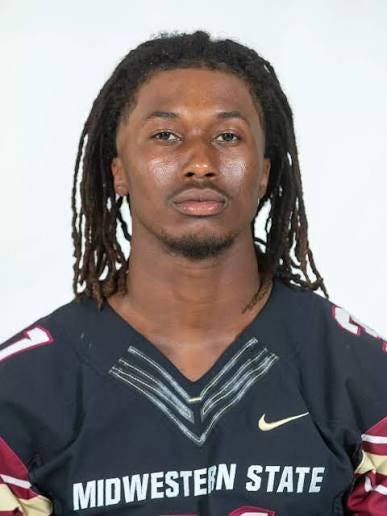
Haeven Watson was nineteen years old when he was arrested.
It would be seventeen days before anyone linked him to that rape. It was too long for other students to be safe.
“Kylie’s” apartment was in Sundance too. In the early morning of October 3, a man came in uninvited. Grey zip-up hoodie. A bandana over his nose and mouth. Purple, this time.
“The only thing I could see about his face was his eyes and his forehead,” she testified.
He assaulted her three times. She testified she felt disgusting while it was happening.
When he left, she called her boyfriend at the time. “I was just raped,” she told him. She called MSU police next, then went to United Regional for a SANE exam.
Like Jane, she couldn’t identify her attacker. Like Jane, she’d never met Haeven Watson.
At the Wichita Falls Police Department, Sergeant Marissa Hughes of the crimes against persons unit was already tying the two cases together. She testified she believed the September 24 and October 3 assaults were connected. Same complex. Same method. Same man, she suspected, though she didn’t have a name yet.
Nine days does not seem like enough time for a man to convince himself he has gotten away with something. It was. Whatever the first assault gave him, it was enough to send him looking for it again.
Before he found “Sarah,” he tried another door.
A male student in McCullough-Trigg Hall told detectives he was asleep on the morning of October 11 when a knock woke him. He opened the door and found a man with neck-length black braided hair standing in the hallway. The man looked at him, said “Wrong room,” pulled his hoodie up over his head, and walked away.
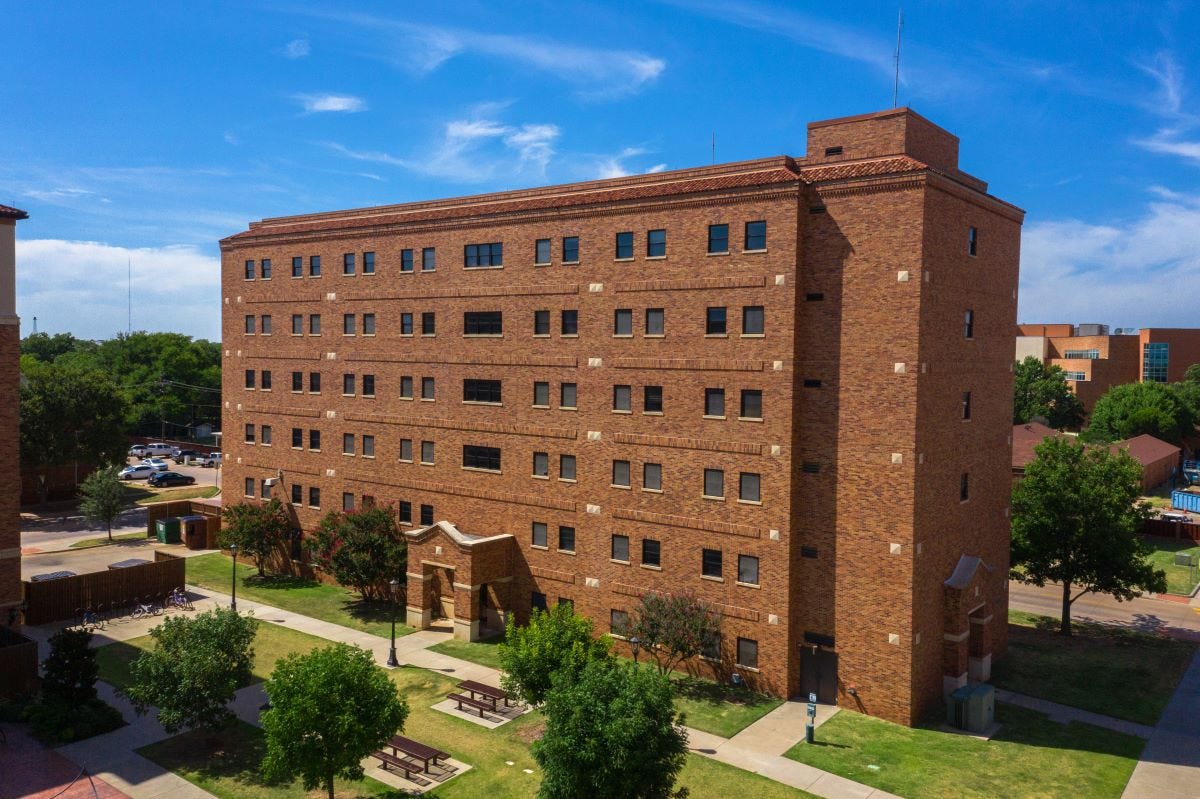
McCullough-Trigg Hall at MSU
That is not a man who knows where he is going. It looks like a search, conducted door by door, in a building he had no key for.
It is also the only time that morning he let anyone see his face. The bandana went up for the woman whose door he tried next. For the man in the doorway, he was a student on the wrong floor, and there was nothing to hide from someone he had no intention of touching. That student’s description, down to the neck-length braids, was the only account police got from anyone who had seen him uncovered.
What he found at the next door didn’t go the way the first two had.
It was October 11, shortly before noon, McCullough-Trigg Hall. Not Sundance. Sarah had been notified of the two Sundance assaults by an email alert. She testified later that she couldn’t remember what the alert said. She only remembered that she knew.
A man with shoulder-length dreadlocks came into her room. He was wearing red sweatpants and a black shirt, with a blue bandana over his nose and mouth. He grabbed her by both shoulders, and there was a struggle.
She screamed.
He tried to shush her. It didn’t work. She kept screaming, and he let go and rushed out.
On cross-examination, Sarah acknowledged she couldn’t identify him either. He hadn’t said anything sexual to her. She didn’t know for certain what was happening. She just knew enough to be afraid and to make noise.
That scream is the reason there was never a fourth.
By that fall, the fear was no longer one building’s problem.
Kristi Schulte, MSU’s housing director and ten years into the job, testified at trial about the concern among residents across the whole MSU campus. She had started sending out safety tips, and before Watson reached McCullough-Trigg, a campus-wide alert went out naming the two Sundance assaults. Those were the tools the job gave her: tell every student what had happened, and tell them to lock their doors.
She also testified to the exact reason nobody had caught him yet. At the time, cameras covered only the buildings’ entrances. Watson lived on the first floor at Sundance with his own key card. The system wasn’t broken. It was built to capture a stranger walking in. Watson wasn’t one.
He was arrested on October 11, hours after Sarah screamed. But not for rape.
Word of what had happened at McCullough-Trigg reached police fast. MSU police and staff identified the suspect from camera footage captured at the residence hall, and Wichita Falls police named nineteen-year-old Haeven Watson within hours. Officers obtained an arrest warrant for burglary and a search warrant for his apartment at Sundance, where they seized clothing, masks, a handgun reported stolen in San Antonio, and his phone.
Police booked him on burglary of a habitation and theft of a firearm. The local coverage that ran that week closed with a line meant to be comforting: WFPD assured the citizens and students of MSU that they were safe.
On October 15, Watson posted a $260,000 bond and walked out.
For the next sixty-nine days, the man who had raped two women at Sundance was out on bond, charged with a burglary and a stolen gun. Nobody had accused him of anything sexual. Jane, Kylie, and Sarah had told their accounts to detectives and waited.
MSU athletics quietly took Watson’s roster page down. His phone was in an evidence locker the entire time. What he had typed into it would not be read out loud in a courtroom for another twenty-one months.
Detectives kept working. Detective Kylar McKinley, who helped execute the search warrant on Watson’s apartment, testified that he recovered multiple items of clothing matching what the women had described their attacker wearing, along with a silver handgun. He then testified he spent more than fifty hours reviewing MSU surveillance footage before he found what he needed: Watson, on October 11, appearing to piggyback his way into McCullough-Trigg, a building where he had no card access of his own. Piggybacking leaves no swipe record. It requires only waiting near the door for someone who does have access and following close enough behind before it shuts.
On cross-examination, McKinley said the surveillance timestamp ran about fifty minutes behind real time. MSU Police Lieutenant David Wilks, testifying separately, put the gap closer to an hour and ten minutes. Neither number matched the other. It would have mattered if the case had turned on video timestamps alone. Fortunately, it didn’t.
Sundance was where he belonged, and Sundance is where he succeeded. McCullough-Trigg was the one door he had to work for, and it was the only one of the three that ended with him running. He never forced his way into any of them. He had a card that opened the building where two of them lived; he followed a stranger through the third, and when he went looking on the eleventh, he knocked and waited for someone to answer.
Watson had agreed to an interview on the day of his arrest. He admitted going to McCullough-Trigg Hall. He denied entering any apartment. When police asked if he owned a firearm, he ended the interview.
What ended his freedom was the evidence Jane and Kylie had handed over in the first hours after their assaults. The Texas Department of Public Safety lab worked the sexual assault kits through October. On December 23, Watson was charged with two counts of aggravated sexual assault, his bond rose past a million dollars, and he has been in custody ever since. The burglar with the stolen gun was the man who had raped two of his own neighbors. By the time the case reached trial, the aggravated sexual assault counts had grown from two to four.
The trial began July 15, 2026, in the 78th District Court in Wichita Falls, Judge Meredith Kennedy presiding. Wichita County District Attorney John Gillespie prosecuted with Assistant District Attorney Chelsea Carlton. Bob Estrada, a long-time Texoma defense attorney, represented Watson with Holly Crampton. Watson had elected to have the jury, not the judge, set his sentence if it convicted him.
The indictment divided cleanly among the three women. One count of aggravated sexual assault for Jane, on September 24. Three counts for Kylie, on October 3, one for each time. One count of burglary of a habitation with intent to commit a sexual offense for Sarah, on October 11. Five counts, three women, seventeen days.
All three testified on the first day. While Jane was describing what had been done to her, Estrada objected more than once that she was giving a narrative rather than answering the question in front of her. Judge Kennedy overruled him every time and let her keep going.
The second day belonged to law enforcement. More than half a dozen officers took the stand. Lead detective Coral Casillas testified that morning, and Estrada’s cross-examination of her put the word piggybacking in front of the jury for the first time. After lunch, Gillespie called the state’s first expert witness: Detective Dale Finnegan of the Wichita Falls Police Department, who had analyzed the data from Watson’s cell phone. Everything Finnegan described to the jury had been in police custody since the day Sarah screamed.
A Cellebrite extraction pulled the search activity from Watson’s Twitter app. He had used it to search for pornography. Several of those searches included the keyword rape. Two of them were read to the jury.
“Dorm rape porn.”
“Snuck in rape.”
His search queries described almost exactly what three women would later tell a jury he did to them. On cross-examination, Estrada asked whether Finnegan could say for certain that Watson was the person who typed into that search bar, or whether someone else might have. Finnegan couldn’t say for certain. It was the only distance the defense could try to put between Watson and his phone screen.
Finnegan also testified that cell tower data placed Watson’s phone in the area of each assault on the dates and at the times they occurred, and that gaps in his data usage lined up with those windows. Estrada pushed back hard. “At best, you’re only making some sort of educated guess as to where that cell phone may be,” he said, and pointed out that Watson lived at Sundance Court, where two of the three assaults took place. Of course his phone pinged there.
A script tells us who does what, in what order, and what comes next. People follow them constantly without noticing. A first date has a script, and everyone on one knows roughly what it is: where you go, who pays, what it means if you get invited upstairs. Nobody sits you down and teaches it. You pick it up from movies, from friends, from what you watch by yourself.
Sexual script theory says sex works the same way, and that the script comes together at three levels. The culture writes the first draft and hands the same one to everybody. A man rewrites it to fit his own life, his own building, his own reach. Then he runs it in his head, in fantasy, before he runs it anywhere else.
“Dorm rape porn” and “snuck in rape” are genre categories that existed online before Watson ever searched for them. He didn’t invent this scenario. He found it, already built by someone else, circulating as content: a residential intrusion, a surprised woman, forced sex, packaged and searchable. That is the first level. It was there for anyone.
The second level is where it became his. A generic scenario doesn’t specify a bandana, a first-floor apartment with a key card, or a piggyback entry into a building he didn’t live in. Those details came from his own life: the complex he lived in, the building he could reach, the disguise he had on hand.
The third level is the one nobody can reach. A Cellebrite report shows what a man typed, not what he pictured while he typed it. But rehearsal leaves marks, and the marks are repetition and narrowness. Watson was searching pornography on Twitter, and several of those searches used the word rape. Two named this scenario exactly: not sex in the abstract, not force in the abstract, but a man getting into a residence and a woman who did not know he was coming. That is not idle looking. A 2024 study of 101 incarcerated sex offenders found the same thing in the minority who said they used pornography this way. They were not looking for arousal in general. They were looking at what they later did.
What changed: the original never said why the searches were evidence of the third level. It listed them and moved on, leaving the reader to work out the connection. Now the logic is stated. You can’t see the fantasy, but rehearsal shows up as repetition and narrowness, and that’s what the phone has. And the study sentence stopped speaking academic. “The same specificity in the minority who described drawing on pornographic scripts” became a plain sentence about what those men were actually looking at.
Nobody has published the dates, and they would answer one question. If the searches came before September 24, he found the scenario and then carried it out close to as written. If they came in the gap between Kylie and Sarah, he was going back to it between assaults, loading up for the next one. What the dates would not change is the rest of it. Either way, he returned to the same scenario more than once, and by September 24 it had stopped being someone else's content and become a plan with an address.
The third day came down to a single word: conclusively. Four DPS forensic analysts took the stand, two from the Corpus Christi laboratory and two from Garland, to testify about DNA testing on the sexual assault kits and on the two women’s underwear.
Both women’s underwear tested as highly probable to carry Watson’s DNA. Semen was indicated in both.
Then the belt buckle. Investigators had swabbed the buckle Watson was wearing, and the swab held a mixture of two people. One of them pointed at a victim. The other pointed at him.
Estrada had one question, and he asked it four times. Suggestive, not confirmatory. That was what the first analyst agreed to, and the second, and by the fourth he had what he came for, and it was still the same word. Not one of them would say the DNA was conclusively his.
It was as close as the trial came to a crack in the state’s case, and it wasn’t very close.
The state rested on the morning of July 21.
In closing, Estrada argued that neither the DNA nor the cellphone data proved anything. Prosecutors countered that the DNA, the cell tower records, and the surveillance video together left no real doubt, and asked the jury to convict on every count.
The jury went out shortly before three in the afternoon. At 3:27 p.m. it returned guilty verdicts on four counts of aggravated sexual assault and one count of burglary of a habitation with intent to commit a sexual offense.
Ten of the twelve were men. In a sexual assault case, that is closer to the panel a defense hopes for than the one it fears. Estrada had spent three days telling exactly those jurors that nothing had been proved. They were back in under half an hour.
That settled what he did. It didn’t settle what happened to him. Because Watson had chosen jury sentencing, twelve people would come back the next morning to hear a second round of evidence and decide how long he would serve.
Nineteen sounds too young for this. Most people carry a picture of the serial rapist as a man in his thirties, someone who has had time to become what he is. The data says otherwise. Sexual offending, like most violent crime, peaks in the late teens and falls off through the twenties. Watson was not early. He was on schedule.
Then there’s the short interval—nine days, then eight. A 1999 FBI-affiliated study of serial rapists found that offenders who escalated in violence across a series of offenses offended roughly three times more often than those who didn’t: an average of every nineteen days against every fifty-five. Watson’s tempo was roughly twice as fast as even the escalating group. He was arrested after the third incident. There is no way to know where he was headed, but it’s frightening to think about.
Three victims in seventeen days is not ordinary serial-offense pacing. He did not know any of the three. He held a gun to one woman’s forehead and told her he would kill her if she spoke. The search history matches the offense pattern point for point. And a campus-wide safety alert had already gone out before he went to McCullough-Trigg, which is what warnings were worth to him.
The recidivism research says something separate and worse: among adult men, measured rates of sexual reoffending run highest in the youngest, high enough that the actuarial instruments eventually had to be age-adjusted because they had been built on samples weighted toward that group: the age-crime curve and the recidivism data point in the same direction.
The series stopped at three. It wasn’t police work that stopped it. A recent behavioral study of thirty-four serial rapists found that nothing repelled them more reliably than two things: a victim screaming, and the sudden appearance of someone else. Sarah screamed. Watson tried to shush her. It didn’t work, and he left.
Everything about his method had depended on total control in the first few seconds, before a victim could orient and react. Jane was half-asleep. Kylie had no warning at all. Sarah, forewarned by an email she couldn’t even remember reading, had just enough of a head start to make noise.
Nothing else in this case stopped him. Not the cameras, which were built to catch a stranger walking in. Not the campus-wide alert, which had already gone out before he crossed to McCullough-Trigg. Not the sergeant who had connected the first two assaults and was waiting on a name. One woman made noise, and it was over.
Before any of this, Haeven Watson was, by any ordinary measure, a success story. Three-year letter winner at cornerback. First-team all-district as a junior and again as a senior, all-state as a senior, a San Antonio All-Star. In his last high school season, he made forty-six tackles, broke up sixteen passes, and allowed three completions all year. He was Academic All-District both of those years too.
He redshirted at Midwestern State in 2023, a season held in reserve. In 2024, he played. Midwestern State played five games before October 11, starting with the opener on August 29; Watson was on the field for all five. He finished the year with three solo tackles, all of them recorded before his arrest. He never appeared in another game. What the record shows is a backup defensive back working his way into a rotation in his first eligible season, on a team that would finish 4-7.
The punishment phase opened on the morning of July 22, and the defense made the argument the research had already answered. The defense asked the jurors to give Watson a chance to grow and change, and argued that sending a law-abiding person to prison only turns him into a criminal. Gillespie urged the jury to send a clear message and sentence Watson to life on every count.
Watson’s father testified that his son and his siblings had been raised in a loving home.
And then Rich Renner, the head coach of the Midwestern State football program, testified that Watson had been a quiet student and a great teammate, and was the last person he would have expected to commit these crimes.
The jury had returned five guilty verdicts the previous afternoon. Renner took the stand knowing it.
Renner did not have to be there. Character witnesses at a punishment hearing are volunteers, and he showed up under his own name in a town where everyone would hear about it.
Gillespie asked him whether the convictions had changed his opinion.
Renner said that he still loves Watson as a former student and teammate, and that his opinion of him had not changed.
The jury deliberated for just under an hour and sentenced Watson to life in prison on all five counts. Judge Kennedy then stacked every count she could. Four of the life sentences, one for each aggravated sexual assault, run consecutively. The fifth, for burglary of a habitation with intent to commit a sexual offense, runs concurrently.
In Texas, a life sentence for aggravated sexual assault carries parole eligibility at thirty calendar years, and good behavior does not shorten it. Consecutive sentences do not run together, and a parole panel is forbidden by statute from treating them as one. Watson would have to serve thirty years on the first life sentence, be released on it by the full seven-member parole board with two-thirds of them agreeing, and only then begin the second. Then the third. Then the fourth. He was twenty-one the day the jury came back. Gillespie, speaking outside the courthouse afterward, said Watson would never have a realistic chance of parole and would die in prison.
Outside the courtroom, a friend of one of the women said she could not believe Renner had spoken for Watson instead of for the three of them, and that MSU should say publicly that it did not stand with what he had said. Then the mother of one of the victims spoke.
“I saw this man who holds a position of power at MSU, who is in charge of these football players, defend a convicted serial rapist on the stand,” she said. “I think that he should be terminated immediately from this position. He is not a man that needs to be in charge of any young men. He is a terrible example for these young men.”
She also said the university had been advised to take the names off the doors of the campus residences and had refused, and that in refusing, it contributed to the second and third assaults. Whether that advice was given, and by whom, is not something the trial record answers.
What the trial record does show is the difference between the two buildings. MSU sorts its housing by class year. Sundance Court is an apartment complex for upperclassmen and transfer students, and McCullough-Trigg is one of the halls the university puts its incoming students in.
Watson lived at Sundance. He had a key card, neighbors, and no need to guess which door was whose. At McCullough-Trigg he had none of that, and on the morning of October 11 he was knocking on doors to find out who answered. He did it shortly before noon, in daylight, in red sweatpants. The first two he had done at two in the morning, in the dark, dressed in black.
The difference between those two mornings was not luck. At Sundance he knew who was behind every door before he opened it, and he raped two women without anyone getting a look at him. At McCullough-Trigg he had to knock and find out, and the first door he tried was answered by a man who saw his face. The second was answered by a woman who screamed. He was in custody before dinner. Knowing who was on the other side was not one of his advantages. It was the thing the whole method rested on, and the morning he had to do without it was the morning it ended.
Renner was not lying, and he probably was not even wrong.
A coach’s knowledge of a player is built from a specific and narrow sample: supervised practice, film sessions, a locker room, team travel, all of it public, structured, chaperoned, and watched by dozens of other people. Sexual violence is committed in the opposite conditions. It happens behind a closed door, at two in the morning, against one person, with no witnesses and nothing recorded. The two sets of observations barely intersect. Renner was reporting accurately on the only Haeven Watson he had access to, and that Watson genuinely was quiet and coachable. The problem is not that his testimony was false. It is that it was true about something else.
Which is why “the last person I would have expected” carries no information. Some version of that sentence is said in nearly every one of these cases, by neighbors, by teammates, by pastors, by mothers. A statement made about everyone distinguishes no one. In one widely cited study, researchers surveyed 1,882 college men and found 120 who described conduct meeting the legal definition of rape or attempted rape. Almost none had ever been reported, and every one of them was, to the people around him, an ordinary student. Researchers still argue about whether such men offend across their college years or inside a single window. Nobody argues about the part that matters here: not one of them was detected by the people who saw him every day.
Athletic programs select for and reward the traits Renner named. Quiet. Coachable. Great teammate. Those words describe how well a young man performs a role the organization has designed and rewarded, and they are the highest praise the institution has to give. When a program later offers that assessment as evidence of character, it is not reporting an independent observation. It is reading its own selection criteria back to a jury and calling the result knowledge. A coach who says a player was a great teammate has said only that the player was good at being a player.
Renner was also not speaking from a distance. He ran the Midwestern State defense from 2008 through 2023, and moved up to head coach for the 2024 season. Watson redshirted under Renner, the defensive coordinator, and played under Renner, the head coach. There was no season of his college career in which Renner was not directly above him. Quiet, coachable, and a great teammate is the assessment of a man with as close a view of this player as anyone in the program had. That is what makes it worth taking seriously. It is also what makes it useless. The closest available observer, watching for two years in every setting a football program provides, saw nothing.
No amount of vigilance fixes that, because the behavior that matters is never on the practice field or locker room.
The mother outside the courtroom was not aiming at any of that. Her complaint was not that Renner had misjudged Watson. It was that he took the stand for him after a jury had convicted him on all five counts, and that when Gillespie asked him directly whether those verdicts had changed his opinion, he said they had not.
That is a different question, and it has a different answer. A witness at sentencing is not a bystander offering an impression. He is evidence, called for a purpose, and the purpose was to persuade twelve people that the man they had just convicted deserved less time. The proceeding turned Renner’s accurate observations into an argument he may never have meant to make: that a football program’s read on a young man’s character should weigh against what four days of testimony had established about his conduct. The limits on what a coach can know do not fall away when he raises his right hand. They go up on the stand with him, unlabeled, and the jury has no way to see them.
Renner told the truth about the young man he coached. The other one never came to practice.
None of the three victims could identify Haeven Watson. Each said so from the stand, and Estrada made certain the jury heard it every time. Jane never saw anything but his eyes. Kylie saw his eyes and his forehead. Sarah saw a blue bandana and red sweatpants for the few seconds it lasted. Even the two accounts of his hair that morning do not match. The student in the doorway described neck-length braids. Sarah, the same morning, described shoulder-length dreadlocks. That is what a description of a stranger does, given in seconds and under fear. The swabs did not vary.
It changed nothing.
Jane went to the hospital and submitted to the exam while she was still shaking. Kylie did the same at United Regional, hours after being assaulted three times. Neither had any way of knowing whether it would come to anything, and both endured it anyway. Nearly two years later, four analysts from two state laboratories spent a full day of testimony on what those two exams contained.
That is what put him in a cell. It is not what stopped him.
The lab did not identify him until December 19. Sarah screamed on October 11. Nothing in the public record says he assaulted anyone in the ten weeks between, and if he held off, it was because a woman in a hallway had made enough noise to get him arrested for something else.
Every door he went through was open to him. At Sundance he used a card the university had issued him. At McCullough-Trigg he waited for a student to swipe in and walked through behind her, the way anyone holds a door for the person coming up the walk. He broke nothing. He picked nothing. In seventeen days and three assaults, the only lock that ever stopped him was a woman who made noise.
He was twenty-one the day the jury came back. Thirty calendar years have to pass before a parole board can consider the first of his four life sentences, and there are three more stacked behind it.
Thank you for reading this issue of The Mind Detective. If you enjoyed this issue, please pass it along to your fellow true crime fan. Hope you’re having a great summer. See you next week!
Trial and case reporting drawn from KFDX/KJTL (Texomashomepage.com) day-by-day trial coverage, July 14–22, 2026, including “Jury sworn in for trial of alleged MSU serial rapist,” “Victims testify in trial of alleged serial rapist at MSU,” “DNA evidence linked to Haeven Watson in MSU assault trial,” “Jury deliberates in Haeven Watson trial, verdict reached,” “Jury decides on sentencing for Haeven Watson,” and “Families of Haeven Watson’s victims react to trial”; “MSU student disturbed after burglar enters dorm,” Texomashomepage/KFDX-KJTL, October 12, 2024; “MSU football player arrested for burglary on campus,” The Wichitan, October 2024; “MSU student accused of burglaries also facing sexual assault charges,” Texomashomepage/KFDX-KJTL, December 24, 2024; and the KFDX/KJTL broadcast report by Josh Hoggard on the second day of testimony, July 16, 2026. High school and recruiting background drawn from Haeven Watson’s Midwestern State University Athletics roster biography, since removed from the site.
References
Watson’s 2024 participation and defensive statistics, the game dates and results, and the team’s 4-7 record from Midwestern State University Athletics, “2024 Football Cumulative Statistics” and “2024 Football Schedule” (msumustangs.com). His individual roster page was taken down after his arrest; his line in the team’s participation and defensive tables was not.
Rich Renner’s coaching tenure from Midwestern State University Athletics, “Rich Renner, Head Football Coach” staff biography, and “Rich Renner elevated to lead Midwestern State football program,” MSU Athletics, December 10, 2023; corroborated by “Bill Maskill to retire, Rich Renner elevated to MSU head coach,” Dave Campbell’s Texas Football, December 10, 2023.
Assignment of campus housing by class year from the Midwestern State University Office of Residence Life and Housing, “Housing Options” and “McCullough-Trigg Hall” (msutexas.edu/housing).
Parole eligibility and the operation of consecutive sentences under Texas Government Code §§ 508.046, 508.145(d), and 508.150; aggravated sexual assault is an offense listed under Article 42A.054, Code of Criminal Procedure.
Lisak, D., & Miller, P. M. (2002). Repeat rape and multiple offending among undetected rapists. Violence and Victims, 17(1), 73–84.
Lussier, P., Chouinard Thivierge, S., Fréchette, J., & Proulx, J. (2024). Sex offender recidivism: Some lessons learned from over 70 years of research. Criminal Justice Review, 49(4), 413–452. https://doi.org/10.1177/07340168231157385
Osuna, A. I., & Holt, K. (2024). Pornography use and sexual scripts among men who have committed sexual offenses. Crime & Delinquency, 70(3), 1005–1033. https://doi.org/10.1177/00111287221115647
Simon, W., & Gagnon, J. H. (1986). Sexual scripts: Permanence and change. Archives of Sexual Behavior, 15(2), 97–120. https://doi.org/10.1007/BF01542219
Simon, W., & Gagnon, J. H. (2003). Sexual scripts: Origins, influences and changes. Qualitative Sociology, 26(4), 491–497. https://doi.org/10.1023/B:QUAS.0000005053.99846.e5
Steffensmeier, D., Slepicka, J., Schwartz, J., & Lu, Y. (2025). Has postponed entry into adult roles modified U.S. age-crime curves? Age-arrest patterns of teens, emerging adults and adult age groups, 1980–2019. Justice Quarterly, 42(4), 553–586. https://doi.org/10.1080/07418825.2024.2410260
Visdómine-Lozano, J. C. (2026). Offender–victim interactions in serial sexual offending: A behavioral approach using descriptive statistical analysis. Journal of Interpersonal Violence, 41(9–10), 2041–2074. https://doi.org/10.1177/08862605251325922
Swartout, K. M., Koss, M. P., White, J. W., Thompson, M. P., Abbey, A., & Bellis, A. L. (2015). Trajectory analysis of the campus serial rapist assumption. JAMA Pediatrics, 169(12), 1148–1154.
Warren, J., Reboussin, R., Hazelwood, R. R., Gibbs, N. A., Trumbetta, S. L., & Cummings, A. (1999). Crime scene analysis and the escalation of violence in serial rape. Forensic Science International, 100, 37–56.
Comments
Nothing yet. Say the first thing.
Sign in to join the conversation.