
The most common activity in software engineering isn’t writing code. It’s predicting the future.
When will this be done? How long will it take? Are we still on track? Should we invest in this now or wait? Engineers, managers, and product managers get asked some version of these every single day. None of us are prophets, so we do the next best thing. We make an educated guess.
The “educated” part is where most people stop thinking. You need information and a framework, sure. But you also need a way to gauge uncertainty, the variance that creeps in the further out you look.
That’s where the Curve comes in.
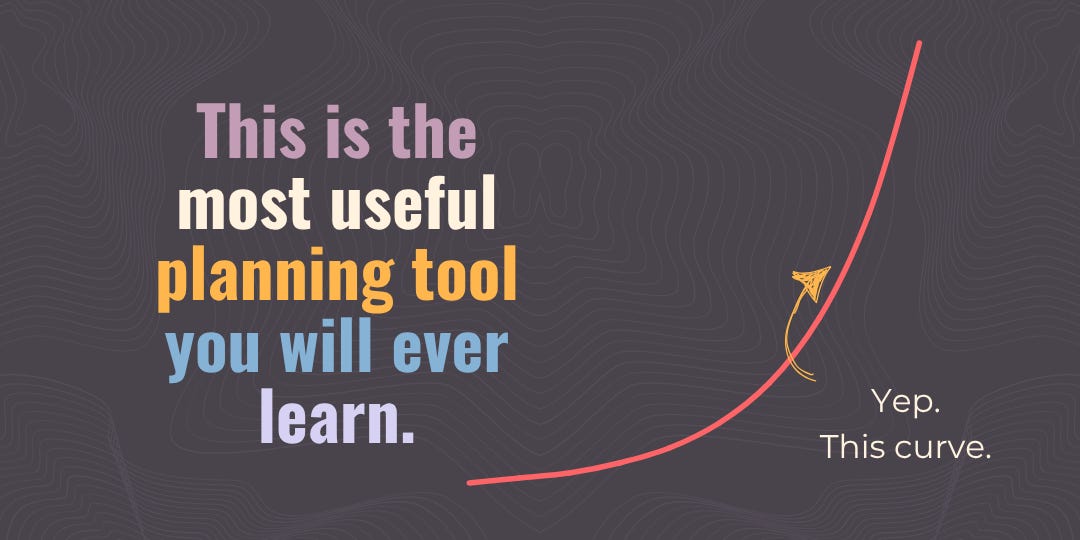
Picture an exponential curve. Time on the horizontal axis, uncertainty on the vertical. Near the present, uncertainty is low. As you look further ahead, it grows, and it grows faster and faster. This is the single most important tool I use when I’m trying to understand the future, and once you see it you can’t unsee it.
The Curve can’t predict the future, but it estimates unpredictability. It won’t tell you what’s going to happen. It tells you how much you can actually know about what’s going to happen, and that turns out to be the more useful thing.
Once you have the Curve in your head, it changes how you shape a roadmap, where you cut scope, when you commit to a decision, and how you judge a call after the fact. It even hands a team a shared language for talking about uncertainty, which is half the fight.
I wrote the whole thing up. It got too long for Substack, so the full article lives on my site. It covers the Cone of Uncertainty, how to set your own time scale, and the handful of ways the Curve earns its keep day to day.
No posts
Comments
Nothing yet. Say the first thing.
Sign in to join the conversation.