
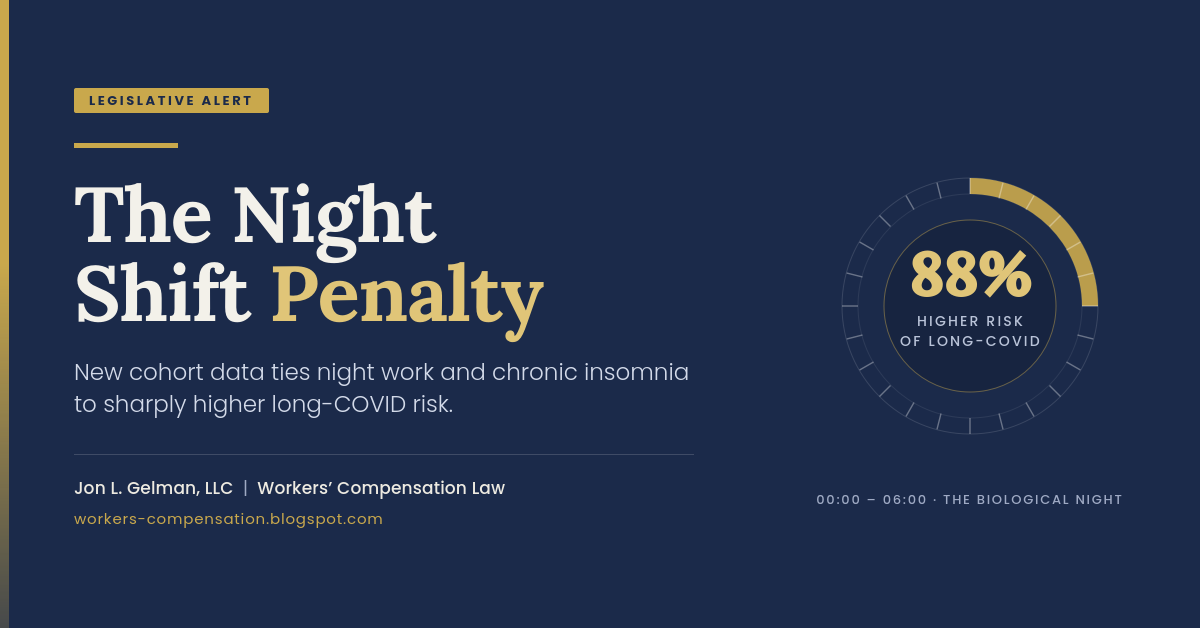
A prospective cohort study published online on August 4, 2026, in the Scandinavian Journal of Work, Environment & Health reports the first population-based evidence that night-shift work increases the risk of long-COVID. The study, Night work, sleep disruption and long-COVID risk: a population-based cohort study, was led by Kyriaki Papantoniou of the Medical University of Vienna with investigators from the Barcelona Institute for Global Health and the Germans Trias i Pujol Research Institute.
For the workers’ compensation bar, the headline number is not the most important part of the paper. The most important part is what the authors did not find.
What the study found
Researchers followed 2,941 adults in the COVICAT/GCAT cohort in Catalonia, Spain, between 2021 and 2023. Night shift work and sleep characteristics were measured in 2021, before the outcome. Of the 1,899 participants who acquired a new SARS-CoV-2 infection during follow-up, 283 developed long COVID, defined as symptoms persisting more than 3 months after infection.
Exposure measured in 2021
Adjusted risk ratio (95% CI)
Night shift work (any)
1.88 (1.29 to 2.72)
Night shift work, 3 or more nights per month
2.07 (1.41 to 3.03)
Night shift work, 3 or more months duration
2.06 (1.39 to 3.06)
Chronic insomnia (general population)
1.42 (1.12 to 1.78)
Night shift work with obesity (BMI 30+)
3.77 (2.40 to 5.91)
Late chronotype (top tertile)
1.32 (1.02 to 1.70)
Night shift work AND chronic insomnia
2.69 (1.60 to 4.51)
The exposure-response gradient matters. Risk increased with frequency and duration, and was elevated among both current night workers and those with a pre-pandemic night work history. That pattern is the kind of internal consistency a judge of compensation is trained to look for, and it is the pattern a defense expert must explain away.
Night workers in this cohort were not exotic occupations. The most commonly reported jobs were police officers (22 percent), nursing professionals (14 percent), health care assistants (14 percent), and mechanical machinery assemblers (11 percent). Those are the same job titles that populate municipal, hospital, and manufacturing workers’ compensation dockets.
The finding that changes the argument
Night-shift work was not associated with a higher risk of SARS-CoV-2 infection. It was associated only with the transition from acute infection to persistent disability. The authors conclude that circadian disruption appears to influence recovery rather than susceptibility.
That single result reframes the standard defense. For six years, carriers have argued that COVID-19 is an ordinary disease of life, ubiquitous in the community, and that no worker can trace infection to the workplace. This study does not contest that premise. It sidesteps it. The claim is no longer that the schedule made the worker catch the virus. The claim is that the schedule, a condition of employment fixed by the employer, impaired the worker’s ability to recover from it.
Causation moves from where did you get it to why did you not get over it. The second question is far harder for an employer to answer with community-prevalence data.
Fitting the data to the occupational disease statute
New Jersey defines a compensable occupational disease at N.J.S.A. 34:15-31(a) as a disease arising out of and in the course of employment that is due in a material degree to causes and conditions characteristic of or peculiar to a particular trade, occupation, process, or place of employment. N.J.S.A. 34:15-7.2 defines material degree as an appreciable degree, or a degree substantially greater than de minimis.
Night work satisfies the “characteristic of or peculiar to” element more cleanly than most exposures, because it is not a substance that migrates into the community. It is a schedule. It exists only because an employer assigned it. Police, correctional, nursing, transit, warehouse, and continuous-process manufacturing jobs are defined in part by round-the-clock coverage; office workers are not exposed to it at all.
Fiore v. Consolidated Freightways, 140 N.J. 452 (1995), supplies the causation template. There the Court sustained an occupational heart disease claim brought by a truck driver who was obese, a two-pack-a-day smoker, and carried a family history of cardiac disease. Personal risk factors did not defeat the claim; the question was whether the work exposure contributed in a material degree. Substitute obesity and chronic insomnia for smoking and family history and the Papantoniou data maps directly onto that framework.
The obesity interaction in the study is the sharpest example. Night workers with a BMI of 30 or above carried a risk ratio of 3.77, against 1.28 for night workers below that threshold, with a p-value for interaction of 0.003. A carrier will read that table as proof the disability is personal. Fiore says otherwise: a synergistic occupational co-factor is still an occupational co-factor.
Timing, notice, and which carrier is on the risk
Long-COVID is by definition a delayed manifestation. Symptoms are ascertained months after the acute infection, and the night work exposure in this study frequently spanned years. Bond v. Rose Ribbon & Carbon Manufacturing Co., 42 N.J. 308 (1964), remains the operative rule for a progressive occupational disease that lies undisclosed: liability attaches to the employer or carrier on the risk when the disease is revealed by medical examination, work incapacity, or manifest loss of physical function. Expect disputes among successive carriers where a worker rotated onto and off nights.
Brunell v. Wildwood Crest Police Department, 176 N.J. 225 (2003), is worth rereading alongside it. Brunell reaffirms liberal construction of the Act as remedial social legislation and draws the line between an accident and a gradually acquired occupational condition. Long-COVID sits on the occupational disease side of that line, which matters for notice, for the statute of limitations, and for the proofs required.
Exclusivity still holds the perimeter
Employers should not read this study as an invitation to tort exposure. In See’s Candies, Inc. v. Superior Court, 73 Cal. App. 5th 66 (2021), and then in Kuciemba v. Victory Woodworks, Inc., 14 Cal. 5th 993 (2023), the California courts held that the derivative injury rule does not bar a spouse’s own negligence claim, but that an employer owes no duty of care to prevent the spread of COVID-19 to employees’ household members. The practical effect is that the worker’s own long-COVID claim runs through the compensation system, where it belongs, and where the causation fight described above will be decided.
Six practical consequences
1. Plead the schedule, not just the virus. The exposure alleged should be circadian disruption from assigned night work, pleaded as an occupational disease under N.J.S.A. 34:15-31, with the infection as the triggering event rather than the whole case.
2. Discovery targets are now specific. The study’s own cut points, three or more nights per month and three or more months of exposure, tell you what to demand: timekeeping records, shift rotation schedules, bid sheets, overtime logs, and collective bargaining provisions on shift differentials and consecutive-night limits.
3. Upgrade the medical proof. An expert who says only that the petitioner had COVID and remains fatigued will lose. The opinion should address circadian control of immune function, impaired viral clearance, and the documented exposure gradient, and should tie the petitioner’s actual roster to the exposure categories in the literature.
4. Anticipate the psychosocial attack. The authors report that adjusting for perceived stress, anxiety, and depression attenuated the sleep associations, and in some analyses significance was lost. A prepared expert concedes that point and explains why it does not defeat the night work finding, which survived those adjustments.
5. Reserve and underwrite by schedule. Twenty-four-hour operations, hospitals, corrections, law enforcement, transit, warehousing, and food processing, now carry a quantifiable excess tail risk for post-infectious disability. Reserving models built on acute claim severity understate it.
6. Build the prevention record before the claim. Forward-rotating schedules, ceilings on consecutive nights, fatigue risk management programs, and documented sleep health education are the employer’s best rebuttal evidence, and they are cheaper than the claims they prevent.
Where the study is vulnerable
Candor is more persuasive than advocacy here. The cohort was limited to adults aged 40 to 65, so the findings may not extend to younger or older workers. Outcomes were self-reported through 2021 and 2023 surveys. Only 89 participants were night-shift workers, and just 18 fell into the combined night-work plus chronic insomnia cell, so the joint-effect estimate rests on small numbers. The questionnaire did not capture weekly or monthly hours, so overtime could not be controlled. And the study period was dominated by the Omicron variant in a population with roughly 97 percent vaccine coverage, which limits generalization to earlier waves. The authors themselves flag each of these.
None of that is fatal. It is the ordinary posture of epidemiologic proof in an occupational disease case, and the Fiore standard has never required scientific certainty. It requires a material degree.
The bottom line
Asbestos, silica, benzene, noise, and repetitive motion earned their place on the list of compensable workplace exposures one study at a time. The work schedule is now on that list. A companion analysis from the same cohort, Occupational determinants of Long COVID in the population-based COVICAT cohort, published in Occupational and Environmental Medicine in February 2026, points in the same direction.
Employers control the clock. When the clock makes workers sicker for longer, the cost of that decision belongs on the employer’s books, not the worker’s.
Sources
1. Papantoniou K, Espinosa A, Karachaliou M, et al. Night work, sleep disruption and long-COVID risk: a population-based cohort study. Scand J Work Environ Health. Published online August 4, 2026. doi:10.5271/sjweh.4318. https://www.sjweh.fi/article/4318
2. PubMed record for the above study (PMID 42550964). https://www.ncbi.nlm.nih.gov/pubmed/42550964
3. Barcelona Institute for Global Health (ISGlobal). Night shift work linked to a higher risk of long COVID. News release, August 2026. https://www.eurekalert.org/news-releases/1139037
4. Center for Infectious Disease Research and Policy, University of Minnesota. Night shift workers face 88% greater risk of long COVID, study suggests. https://www.cidrap.umn.edu/covid-19/night-shift-workers-face-88-greater-risk-long-covid-study-suggests
5. De Matteis S, Consonni D, Espinosa A, et al. Occupational determinants of Long COVID in the population-based COVICAT cohort. Occup Environ Med. 2026;82(12):579-588. doi:10.1136/oemed-2025-110398. https://doi.org/10.1136/oemed-2025-110398
6. Loef B, Bosma E, van Kerkhof LW, et al. Night-shift work and susceptibility to infectious diseases: a systematic review and meta-analysis. Scand J Work Environ Health. 2025;51(4):298-311. https://www.sjweh.fi/article/4225
7. Loef B, van der Beek AJ, Hulsegge G, et al. The mediating role of sleep, physical activity, and diet in the association between shift work and respiratory infections. Scand J Work Environ Health. 2020;46(5):516-524. https://www.sjweh.fi/article/3896
8. Kogevinas M, Karachaliou M, Espinosa A, et al. Risk, determinants, and persistence of long-COVID in a population-based cohort study in Catalonia. BMC Med. 2025;23(1):140. https://doi.org/10.1186/s12916-025-03974-7
9. Wang S, Huang T, Weisskopf MG, et al. Multidimensional sleep health prior to SARS-CoV-2 infection and risk of post-COVID-19 condition. JAMA Netw Open. 2023;6(5):e2315885. https://doi.org/10.1001/jamanetworkopen.2023.15885
10. National Academies of Sciences, Engineering, and Medicine. A Long COVID Definition: A Chronic, Systemic Disease State with Profound Consequences. Washington, DC: National Academies Press; 2024. https://doi.org/10.17226/27768
11. N.J.S.A. 34:15-31, Compensable occupational disease defined. https://law.justia.com/codes/new-jersey/title-34/section-34-15-31/
12. N.J. P.L. 2020, c. 99 (A-3999), rebuttable presumption of workers’ compensation coverage for essential employees who contract COVID-19, codified at N.J.S.A. 34:15-31.11 to -31.13. https://www.njleg.state.nj.us/bill-search/2020/A3999
Cases cited
13. Fiore v. Consolidated Freightways, 140 N.J. 452, 659 A.2d 436 (1995). https://www.courtlistener.com/c/N.J./140/452/
14. Bond v. Rose Ribbon & Carbon Manufacturing Co., 42 N.J. 308 (1964). https://www.courtlistener.com/c/N.J./42/308/
15. Brunell v. Wildwood Crest Police Department, 176 N.J. 225, 822 A.2d 576 (2003). https://www.courtlistener.com/c/N.J./176/225/
16. See’s Candies, Inc. v. Superior Court, 73 Cal. App. 5th 66 (2021). https://scholar.google.com/scholar_case?case=14015654447066963785&q=See’s+Candies,+Inc.+v.+Superior+Court,+73+Cal.+App.+5th+66+(2021)&hl=en&as_sdt=6,31
17. Kuciemba v. Victory Woodworks, Inc., 14 Cal. 5th 993, 531 P.3d 924 (2023). https://scholar.google.com/scholar_case?case=11136435177877500167&q=Kuciemba+v.+Victory+Woodworks,+Inc.,+14+Cal.+5th+993+(2023)&hl=en&as_sdt=6,31
About the Author
Jon L. Gelman of Wayne, NJ, is the author of NJ Workers’ Compensation Law (West-Thomson-Reuters) and co-author of the national treatise Modern Workers’ Compensation Law (West-Thomson-Reuters).
No posts
Comments
Nothing yet. Say the first thing.
Sign in to join the conversation.