
Once upon a time…
Do hard drives get dusty? Possibly, but unless we actually take off the lid - and which of us does that anymore, though even I, thirty-odd years ago, could when necessary summon up sufficient courage to turn the screwdriver and, however tentatively, approach boards and allied plugs and sockets - who’s to know. I’m surrounded by books - inadequately sorted at the cruel behest of my lousy back which no longer allows either ladder-ascension or its floor-wards antithesis - but there - and not only because so much reference has been taken over by the same machinery and shelves remain undisturbed far longer than once was the case - dust undoubtedly reigns1.
But today’s dust is metaphorical. Just a click away, albeit not the one you intended. Let’s give things a shake.
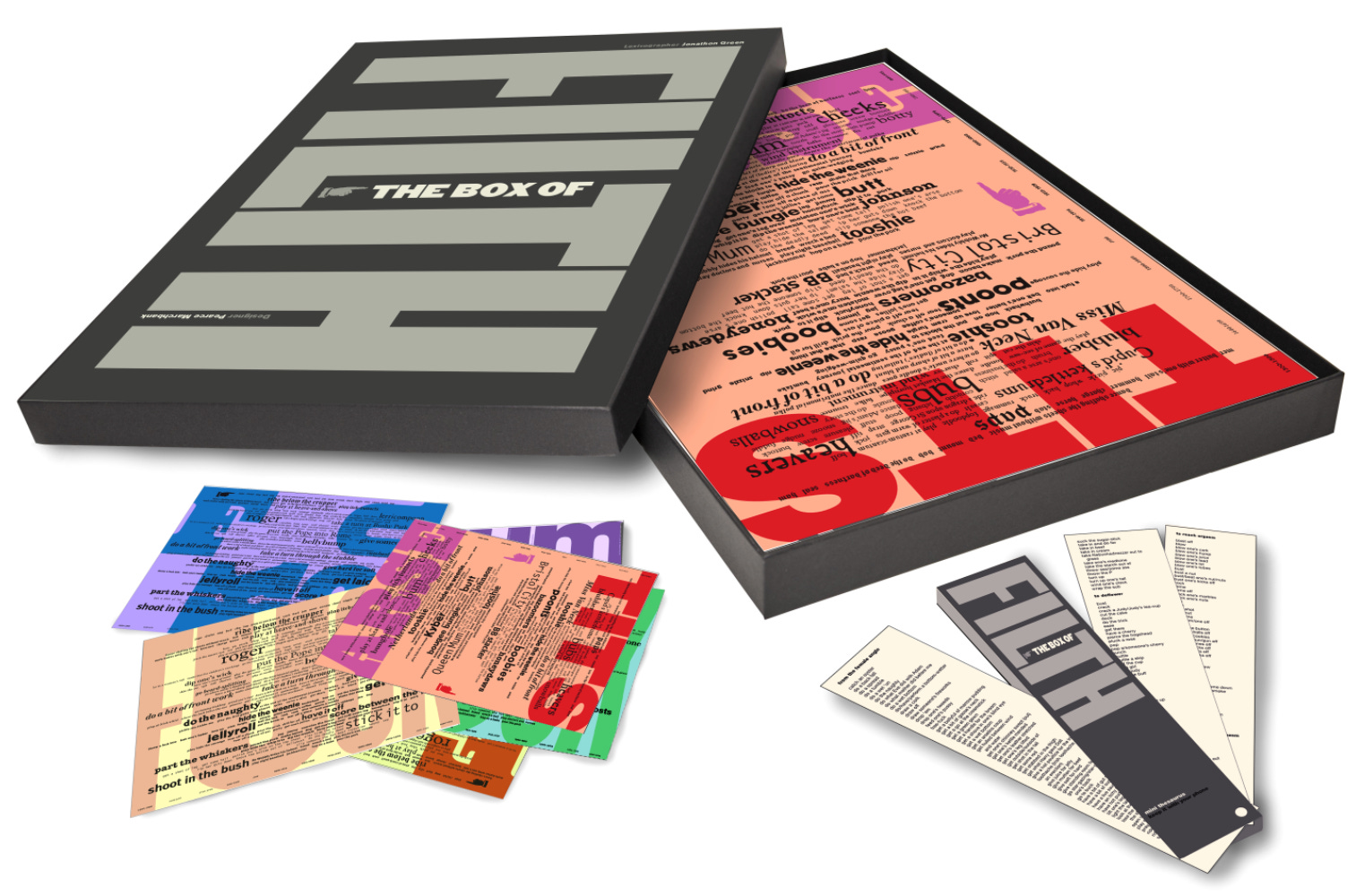
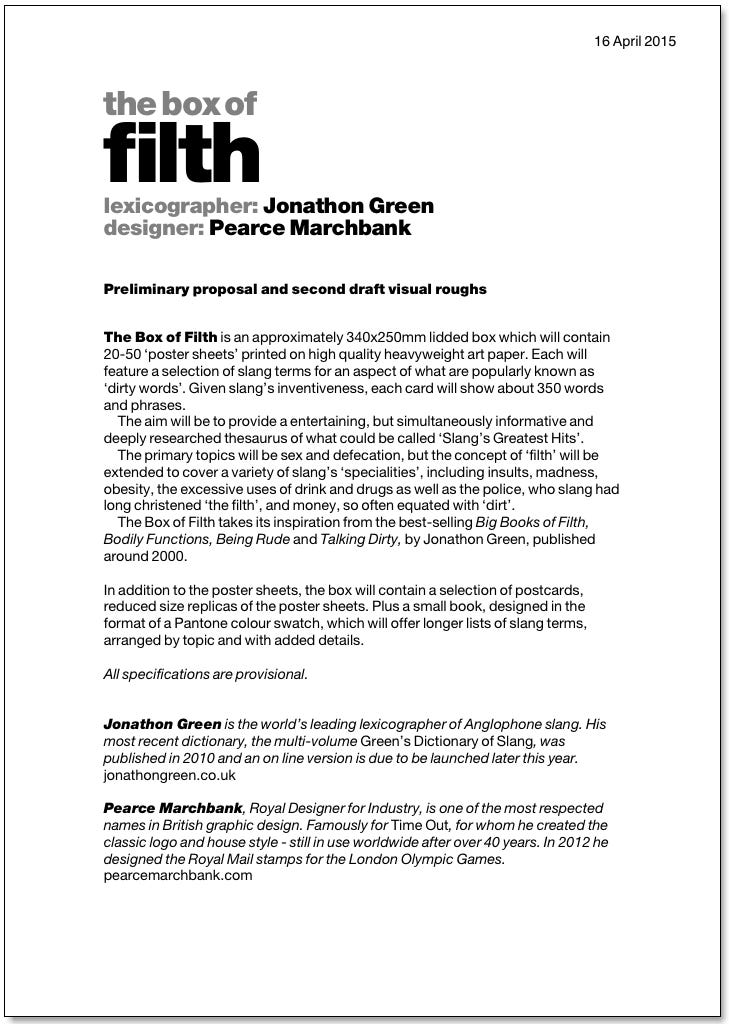
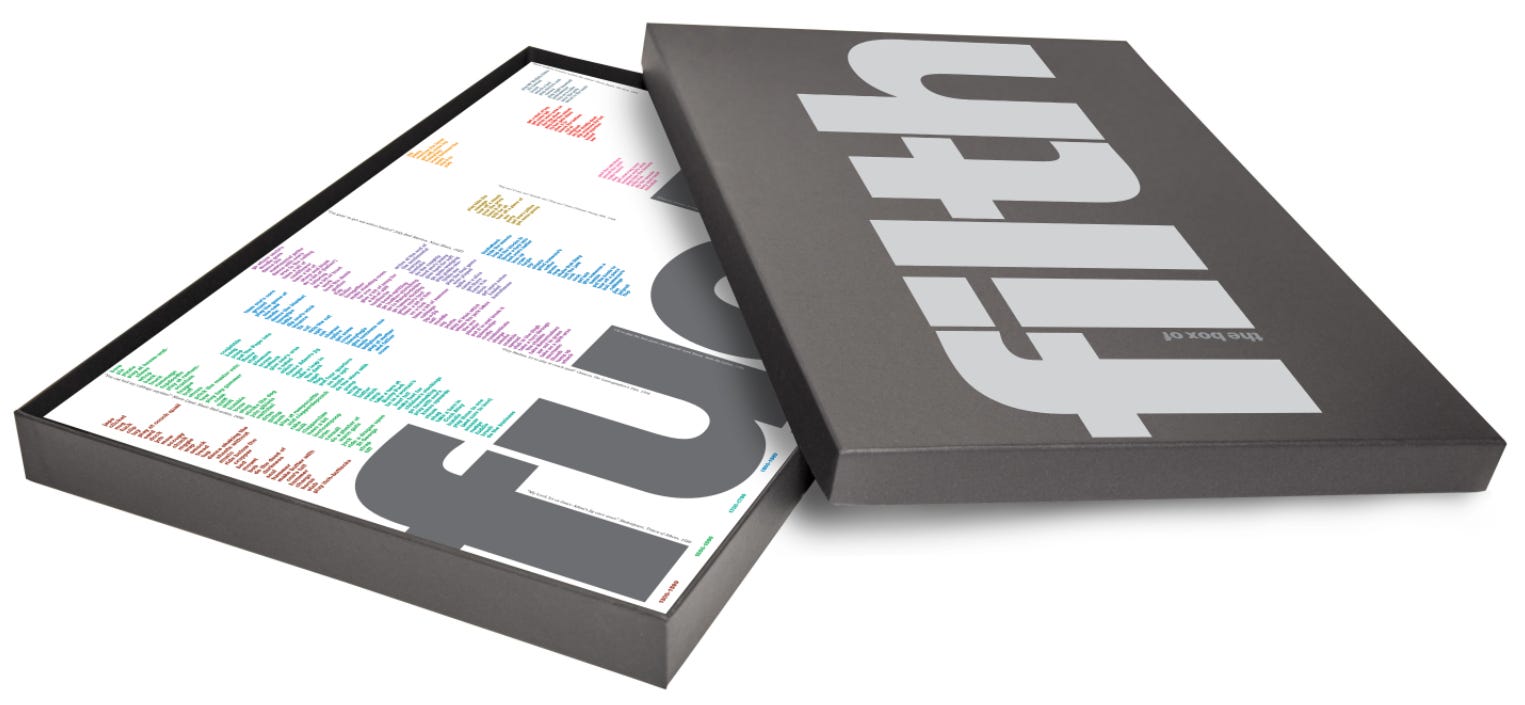
In 2015, fresh from my making of the Timelines of Slang (https://thetimelinesofslang.tumblr.com) my oldest friend the graphic designer Pearce Marchbank suggested what would effectively offer a three-dimensional version.2 It would be called
Which is what it was destined to be. It was a box, rather a large if not very deep container, which would hold, on a number of single sheets not dissimilar to posters, the kind of material that slang produces in so impressive a volume. As I have said perhaps too often, slang is not a true lexis, but primarily a body of synonymies, and these synonymies in turn reveal just what slang is there to illumine. A set of themes, of obsessions even, that have lasted for well over half a millennium.3 It was these that buyers would get.
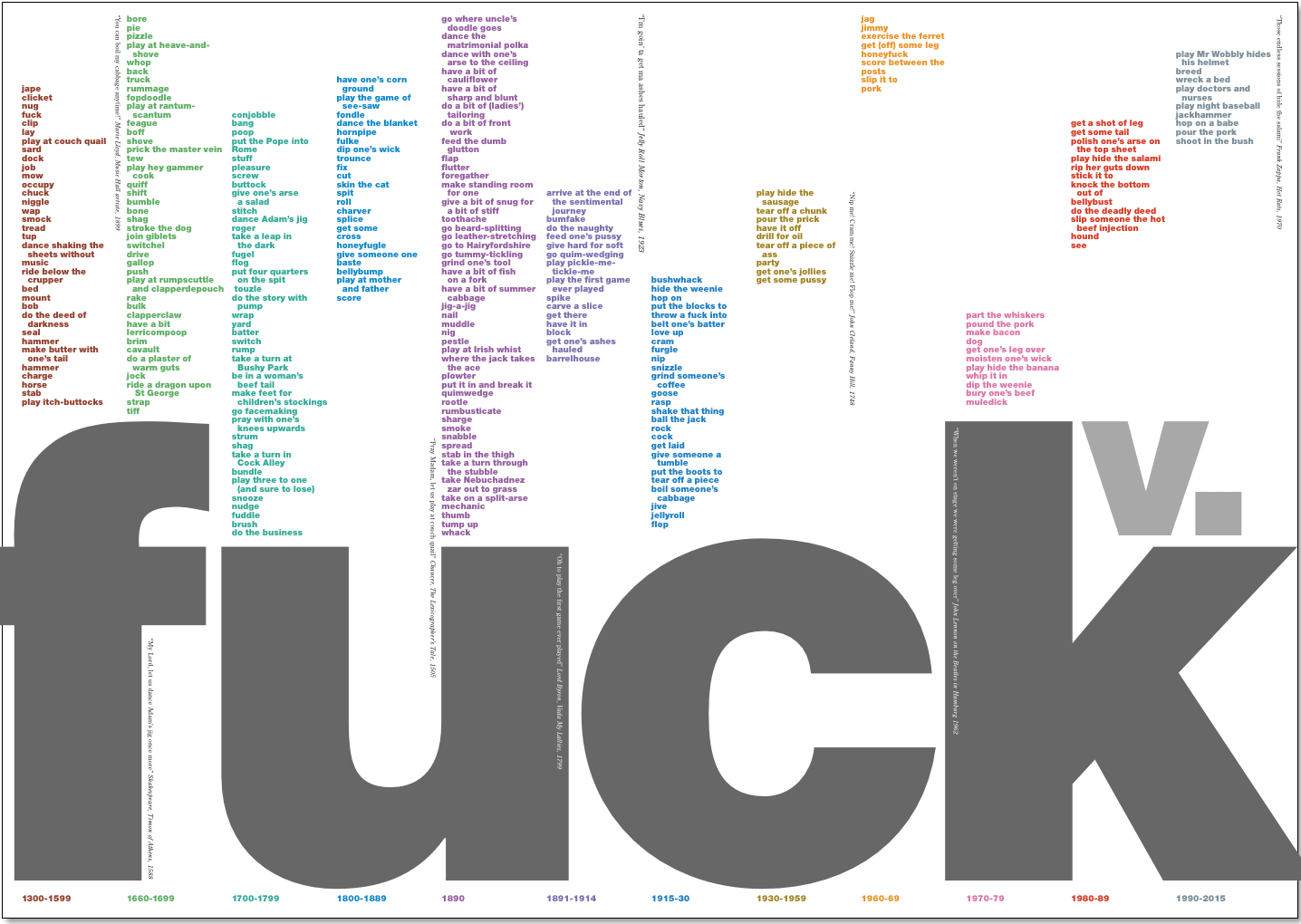
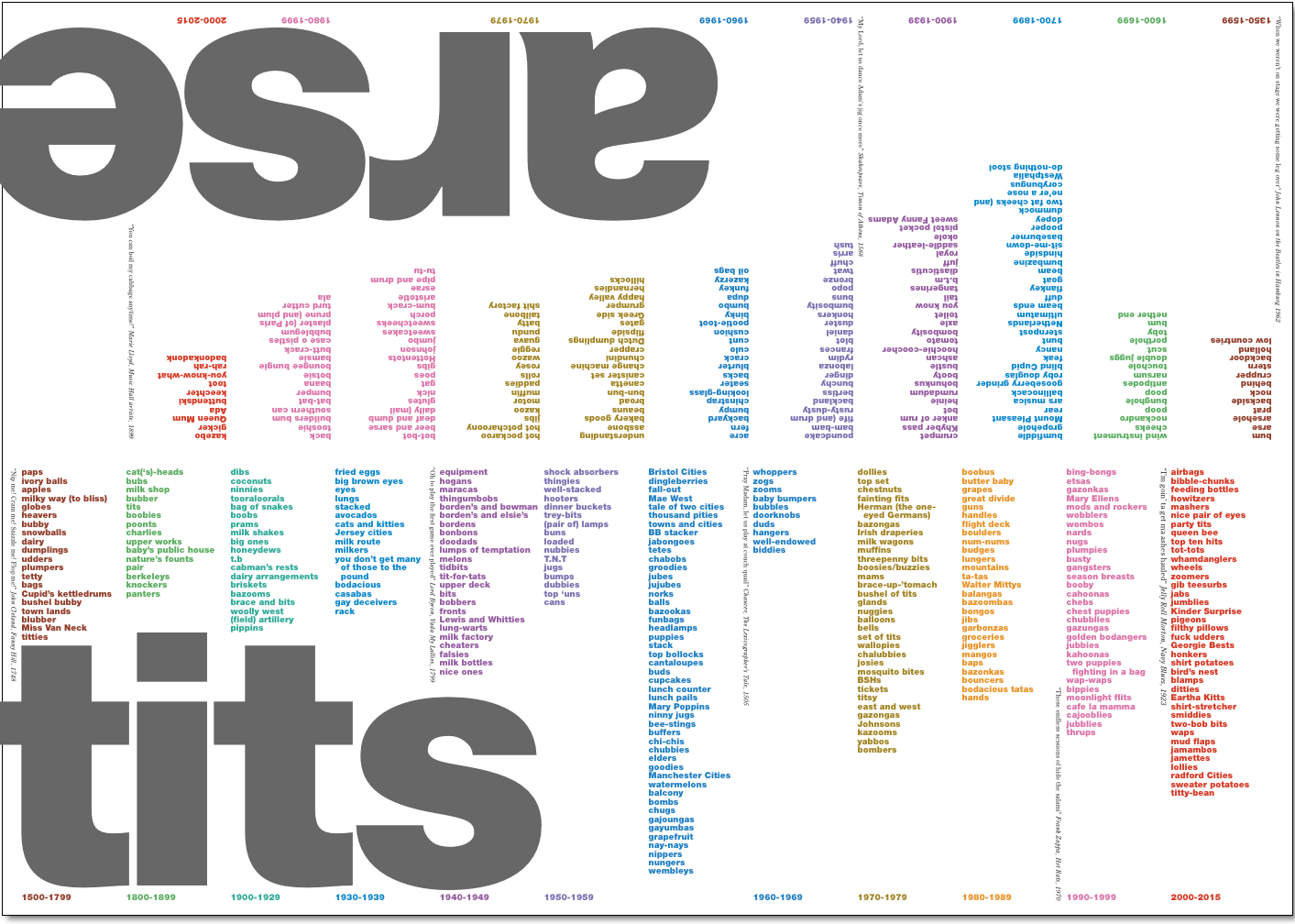
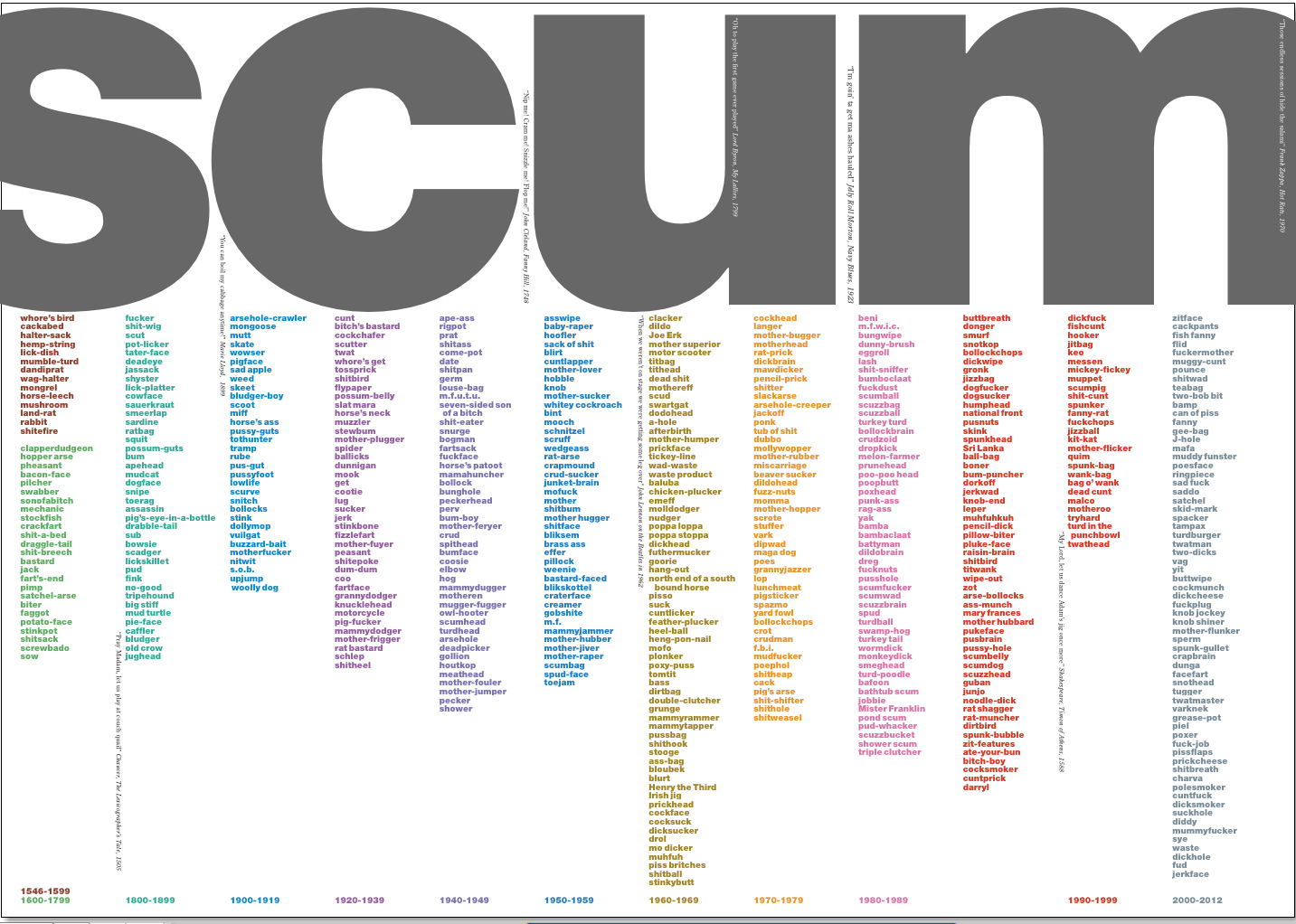
I have no idea when Pearce redesigned the text. Indeed I’m not sure whether the simple, if colourful lists came first or are actually his second shot. I just sent him the information as requested. Certainly the change was radical.
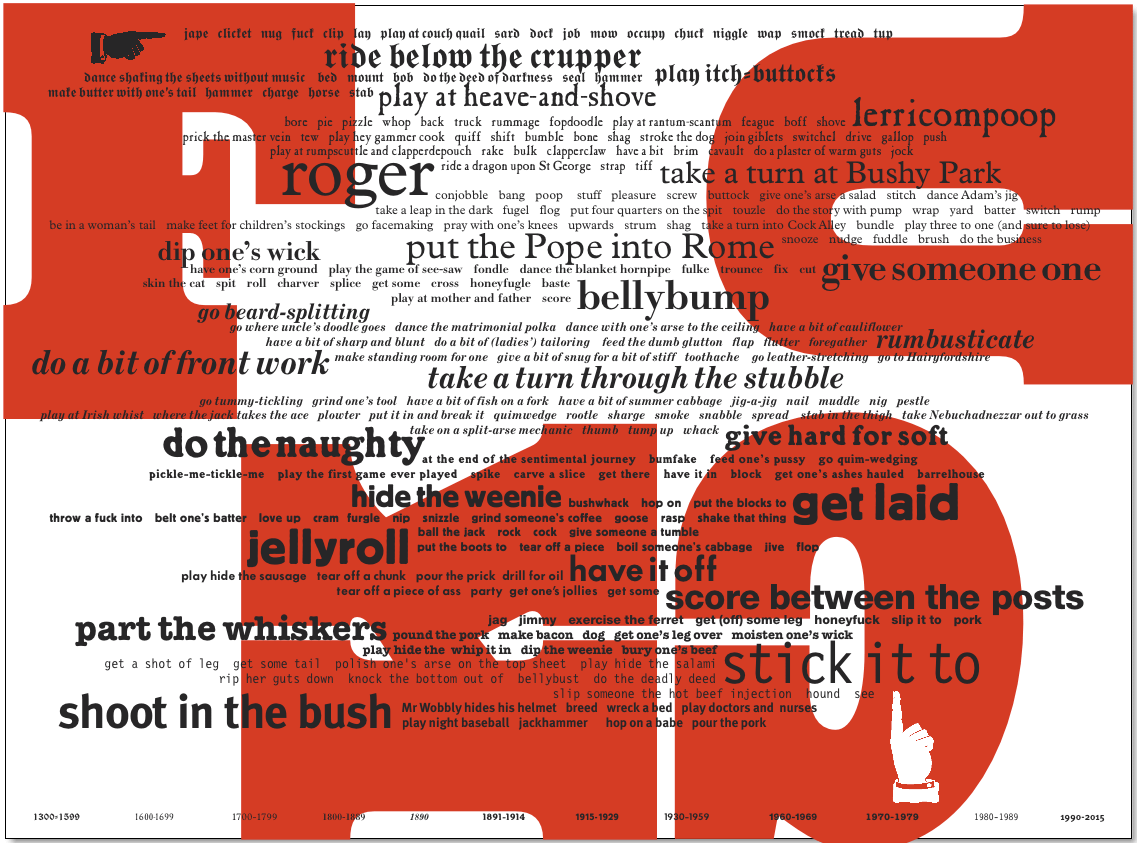
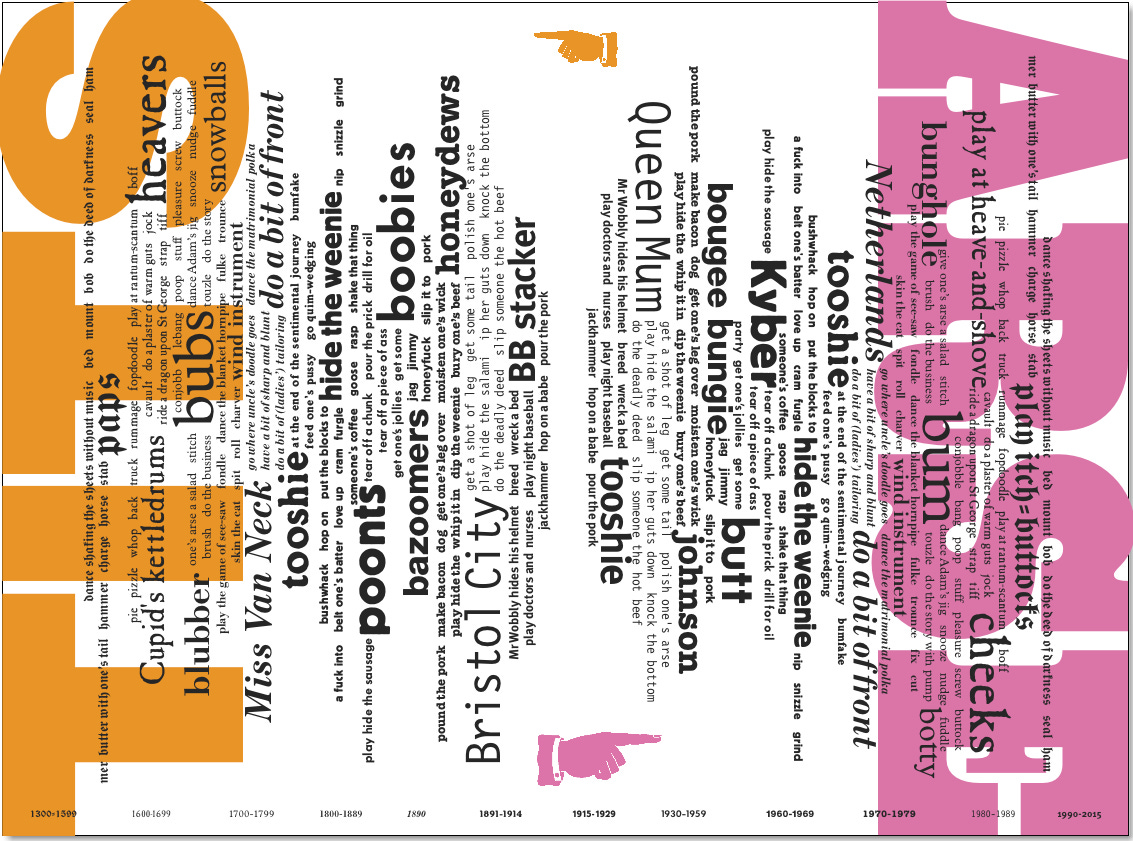
I preferred, fwiw, the sterner, minimalist, Bauhausian (probably mis-used but imparted to me as was any knowledge I might profess in the world of graphics, by my old pal) rectilinearity. But that was that.
Self-publishing was not something either of us fancied. Nor would the box have simply been a pile of pages set twixt the trad covers. First and foremost it would have been…a box. And A3 boxes do not come cheap. Nor would the rest of Pearce’s visual embellishments.
We sought a publisher. The establishment, IIRC, turned us down. I don’t recall what the mainstream’s bandwagon was that year (looking back I find much celebration, at least in the Guardian, of the accelerating success of women authors and the concomitant decline of blokes) but I doubt if many years would have welcomed our proposition. In your face, it seemed, arrived around 1974 (the first cite I have, from a US newspaper adds ‘as they say on the street’ to its use) and the Box of Filth undoubtedly was.4 As is ever the case with my work, whether lit. and fig. no-one really knows where it fits.
However we did find a publisher. Of sorts. A year previous I had noted that a more recent friend and the former editor-in-chief at Cassell, John Mitchinson, along with a pair of colleagues, had launched what was intended as a new model of book production based on pre-print subscriptions (with treats): Unbound. In his Cassells life John had commissioned GDoS and the regular print version of Filth, another long-established friend, Jonathan Meades was prominent on the launch list, and what, surely, was there not to love. We duly pitched - what you see here would have been the supportive ‘hardware’ - and as far as John was concerned, we had a green light. This is not a shitpost, although I do see that badmouthing Unbound and its apparat and their failings is depressingly popular. I’m an E.M. Forster man - friends before country - and I forbear further comment.
Anyway, we never hit the downside. We lost no money. Such things never entered our equation. Our idea wouldn’t face step one: trial by subscription. We never really hit much beyond the front door. I have been told that this was an underlying problem for Unbound, that the boss level and the wider staff didn’t always communicate. Vision, perhaps, vs practicality? Wodehouse’s Ukridge - all ideas, not so much execution - meets publishing.
Pearce and I waited a long year, punctuated by the odd lunch (Unbound, whatever its sins, was faithful to some of publishing’s traditions), before the light turned red. What old school printers called the bastard measure, i.e in this case the atypical A3 (an odd measurement for book designers) plus the box itself, was too much.5 Maybe time had changed, the content was too much. (It was only a year or so before the twenty-something copy-editor of my book on women and slang would demand that I remove a use of ‘MeToo’ (the context was the absence of the movement from the world of Chaucer’s Wife of Bath) from my text. Its construction at male finger-tips, she claimed, made her ‘uncomfortable’.
Whatever the reason, the Box of Filth picked up its detritus and retired to my hard disk. It lives there now. Only a fat finger, or an old man’s eyesight brought it back to the light this morning.6
A coda: Hope, well we know about hope. Let’s just say that I came up with another idea (Pearce, with a thriving studio, had stepped aside), another way of looking at the lexis, submitted it, had it welcomed and…it came to nothing. There’ll be an admonitory proverb somewhere, possibly many. No matter. And quite what was idea number two? I neither know, and quite frankly, could not care less. AFAIK, no box was specified.
The best accretion of book-plus-dust I encountered was when researching in the London Library, that incomparable institution wherein one may approach the stacks themselves and therefrom pluck both those volumes of which one is already aware, but equally important, serendipitously stumble upon those, destined to equal utility, of which one had never even heard. The Library, established in 1841, did not, unlike the British Museum’s Reading Room (as it still was) amass everything, but it had much. For instance rows of the 19th century’s once best-selling, ‘triple-decker’ novels. Once being the key. Years pass, the books stand untouched, and naturally the dust collects. How much? Suffice it to say that they keep (or certainly did in my time) a soft brush at the issue desk, with which to remove the decades’ accretion. Or that, reaching eagerly for freedom, had not already transferred itself to the researcher’s clothes.
Other than a few earlier collaborations for Pearce’s then employer, a music publisher though these were books of quotations, the last thing we had put together by ourselves was in 1972 when Pearce designed and I wrote The Bickershaw Bullsheet, an ‘underground press’-style mag. aimed at visitors to that May’s Bickershaw Festival. Today I read that it is a ‘rare countercultural souvenir magazine’ (the festival itself is labelled ‘legendary’). Its rarity guaranteed, perhaps, by my recollection of a bulldozer pushing the unsold copies into a purpose-dug pit.
In print, that is. As for the content, let’s plump for hard-wired.
My own Big Book of Filth (small-format, pubic hair printed on the inside flap - pun perhaps intended, but the design was of course not mine and this is the first time I ever thought so - the lists of verbal vileness stripped from the pages of my recent Cassell Dictionary of Slang) had appeared in 1999 and sold…more than anything else I had or would ever achieve. It brought…royalties. Autre temps, squire, autre moeurs too it would turn out.
Really, I at least had no excuse. Somewhere on my shelves lies, I believe, another ‘book in a box’, B.S. Johnson’s The Unfortunates, which I had bought in 1969. Wikipedia (https://en.wikipedia.org/wiki/The_Unfortunates) explains that it featured ‘27 unbound [surely coincidental] sections, with a first and last chapter specified, but the 25 sections between them, ranging from a single paragraph to 12 pages in length, being designed to be read in any order, giving a total of 15.5 septillion possible combinations that the story can be read in.’ Our posters certainly aimed nothing like so high. Nor was my stick-to-it-ive-ness and the dust had gathered almost from day one.
It is almost nonsensical even to ponder anything other but the big horse laugh, but please don’t think of half-inching our box. It is ©Jonathon Green & Pearce Marchbank and, however dusty, ever more shall be so. And anyway, I’m not giving you the content and Mr Marchbank, even in this digital age, surely has a load of 10A scalpels.
No posts
Comments
Nothing yet. Say the first thing.
Sign in to join the conversation.