
0:00
-10:03
I try to avoid rules when it comes to writing. Rules should keep people safe, ensure justice for all, and make board games slightly less confusing. There is one rule, however, of which I am quite fond. I’ve used it here already, and you probably didn’t even notice the slight uptick in joy it invariably induces. I speak, of course, of the Rule of Three.
In writing and comedy—things I try to mush together on occasion—the Rule of Three rules. I don’t know why, and if there is an explanation I don’t care to hear it, not because I’m inherently contrary or don’t value anything I don’t think of my own self, but because I like some things to remain mysteries. Like I actually love that I don’t understand how a radio works today more than I did in the early 1960s when I brought an AM-only transistor model to school to hide in my desk so I could listen to the World Series that my favorite team was never in. And the fact is I have some idea of why and how both the rule and radio work, but it’s all blissfully thin.
Like most things, the Rule of Three was better when fewer people knew about it. But I get it; when you find a tool that works, you use it. The only ones who piss me off are the non-fiction book title writers, for they have taken this fine and helpful thing and driven it deep into the Earth’s mantle. Their titles have become uniquely and irritatingly formulaic.
EYE-CATCHING/SCARY WORD: The Real Truth/Inside Story About Something, Something, and Something Else.
A quick perusal of the current NYT non-fiction best-seller list yield’s Leah Litman’s Lawless: How the Supreme Court Runs on Conservative Grievance, Fringe Theories, and Bad Vibes. Yes, the meter is way off, but her troubling triad is at #4 so it’s working for somebody. David A. Kessler, MD, went rogue by not only putting his three before—and arguably after—the colon but adding alliteration in his #12 bestseller Diet, Drugs, and Dopamine: The New Science of Achieving a Healthy Weight. And on whichever side of the colon your title does its heaviest lifting, it does seem you need one. Thirteen of the top 15 on the list feature this useful bit o’ punctuation, which is always a bit unsettling when spelled out.
The Rule of Three apparently originates from ancient Roman rhetoric and the Latin phrase omne trium perfectum (”everything that comes in threes is perfect” an assertion that clearly pre-dates celebrity death clusters, Three Amigos, and the blissfully short-lived Taco Bell Triplelupa). Writers as far back as Aristotle have commented on the Rule’s notable bang for your buck when it comes to ease of use and efficacy, and as writing is an almost inherently solitary pursuit it’s nice to feel kinship with anyone, especially someone with Ari’s street cred. But an internet glance confirms my suspicions: the Rule of Three, already wildly overexposed on the Google machine, has become a darling of AI, and so in order to keep the writing world—as it must always be—ahead of all leading-edge technology, I think it’s time for the Rule of Four.
I took a typically roundabout route to this realization, and if you’re not at all interested in a flythrough of my path you can skip the rest of this paragraph (and not for nothing, what other writers are so respectful of your time?). I had been on something of a prose bender of late, having written three more than acceptable essays in three days, a significant acceleration from my usual one and at most two per week. I awoke the fourth morning wanting to write, but felt battered and constrained by a long weekend’s worth of employing narrative flow and proper sentence structure, so instead I decided to write a letter to a friend in which I could make the whole thing a five-page sentence if I wanted and if he complained—which he wouldn’t—I’d say okay then just ignore my letters and read all the ones you get from all the other people who write you letters, like Mr. and Mrs. Nobody!
As I finished the letter and felt its palate-cleansing properties ease my psyche, a man’s name popped into my head that you’d never guess but I felt a little bad it didn’t happen earlier given the impact he had on my life and his resonance in this moment: George Washington Carver.
Let me explain.
My oldest memories of reading are biographies of Lou Gehrig and George Washington Carver. I can’t remember which I read first, but each made a lasting impression. Gehrig was a huge, sickly, lonely, poverty-stricken child—the only one of four to survive infancy and as a result raised by a fiercely protective mother—who blossomed as an athlete in high school and college, and you know the rest.
Carver was a flat-out genius who I thought until fairly recently counted peanut butter as the tastiest of the 325 distinct uses for peanuts he discovered, all in service of his most important invention: crop rotation. You see, growing cotton year after year was drying out the soil in the American South, and Carver discovered that if, every fourth year, you planted legumes—in this case peanuts—it would re-enrich the soil and you could get away with growing cotton the other three years. Without the aforementioned 325 uses for his proposed new crop there would have been no way to convince early 20th century white farmers and poor black sharecroppers to not plant their most valuable crop in perpetuity. And when the boll weevil wiped out cotton in the 1920s, Carver’s alternative crops and methods saved the South’s economy. (Parenthetically, I’m fairly stunned at how vivid my memories are of these two books—down to their covers and inside photos—given I can’t remember anyone’s name anymore.)
So twas crop rotation that put me in mind of a potential Rule of Four, though if the change seems too drastic, I’d be fine to try a pilot Rule of 3+1 for a while and see how that goes. As usual, some fringe elements, desperate to gain any and all social media traction, have trotted out their own Rules of Four, mostly to the sound of one hand clapping. The United States Supreme Court, for example, has one. Apparently, it takes only four of the nine justices to agree to hear a case, a practice designed to prevent a majority of the Court’s members from controlling their docket. I can think of a whole lot of other rules this Supreme Court could follow before that one.
The Rule of Four is a 2004 bestselling mystery about four Princeton seniors trying to solve a mystery in a 1499 book published in Venice that Wikipedia describes as “a complex allegorical work written in a modified Italian language frequently interspersed with material from other languages as well as its anonymous author’s own made-up words,” and I bring this up only because it sounds pretty cool.
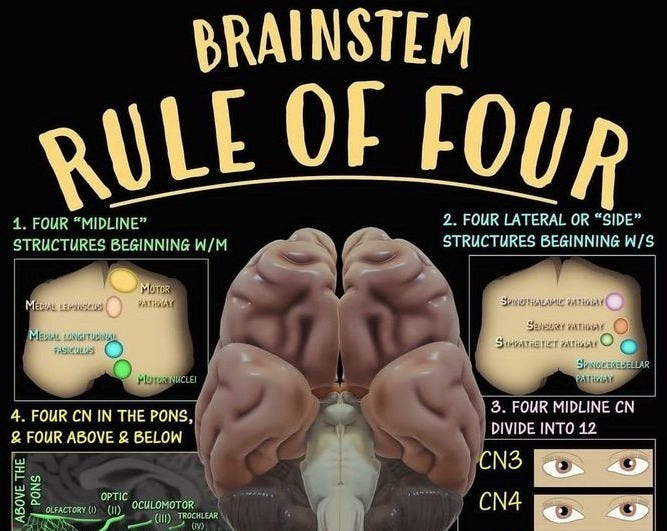
And as always, when you really need something, Reddit is there for you. Just four months ago, Sensayori echoed the sentiments of many when they wrote “It’s essentially a rule of Reddit that the fourth person in a chain of repeating the same word or phrase will be downvoted to oblivion. It just happens.” Our brainstem also features a Rule of Four I will not try to describe for way more than four reasons.
But that leaves a pretty open field, especially since I’m not surfing the dark web anymore. My first thought was one I had while bemoaning our hyper-hereditary democracy to a New Zealand readership after Lindsay Graham’s sister suddenly added US Senator to her resume, to wit: Descendants of members of Congress and other highly placed elected officials must wait four generations before any can run for similar office. This would solve so many problems, most notably the following possibility: President Donald Trump Jr. A related rule is that the seat of a dead or retiring member can only be given, even temporarily, to a spouse if they’re number four—I’m looking at you Clay Higgins, the only one of 527 members of Congress to vote against the Epstein Transparency Act, and the only one to have been married four times! And he’s only 64, so one for the thumb is certainly not out of the question.
Turns out there’s something of a Rule of No Four for many in East Asia, as the word for four is considered bad luck because it sounds so much like the word for death in both Mandarin and Cantonese Chinese, and in Japanese and Korean the words are exact homophones! It’s okay, I think the Rule needs a domestic beta rollout anyway. We can put East Asia in the 10-year plan.
Like many things these days, the Rule of Four will likely have to be rushed through production so we can get it on the shelves for Christmas or before AI co-opts it too. Or, while I clearly have no specialized or even generalized knowledge of AI’s capabilities and shortcomings, I wonder if you could headfake it into thinking the Rule of Four was a hot commodity and thereby induce it to abandon the Rule of Three so that us human writers could have it back. And while we’re at it, keep your grubby mitts off my em dash.
No posts
Comments
Nothing yet. Say the first thing.
Sign in to join the conversation.