

My biggest issue with much of the conventional writing advice out there is that so much of it focuses on routine:
“Write in the morning, edit in the afternoon.”
“Take a walk if you get stuck.”
“Use an outline.”
There’s nothing wrong with that advice, per se. But ChatGPT can tell me that much. None of those “tips” actually improve the quality of the writing itself.
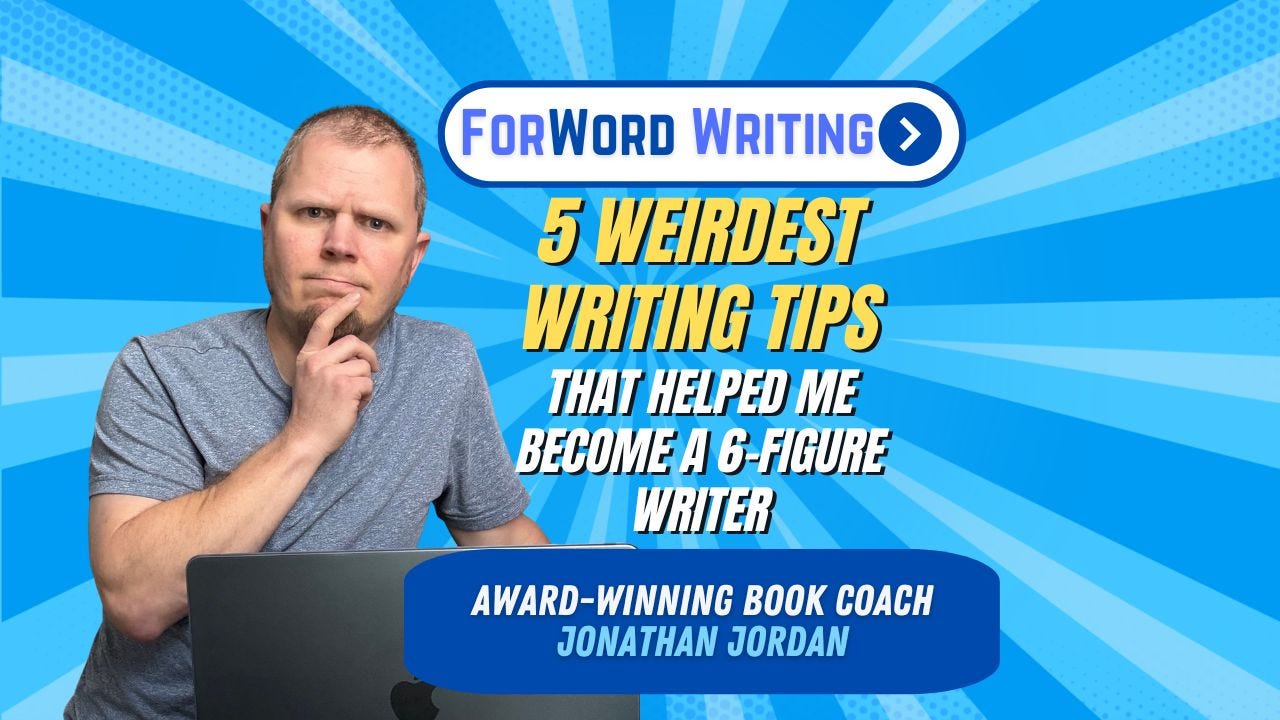
But these 5 Weird Tips have changed how I write—for the better. And when I say “for the better,” I mean that these are the tips I credit with:
A client’s book earning the Kirkus star
A client’s book doubling her service fee from $25,000 to $50,000
A client’s book landing him a company-wide speaking gig for a global corporation of 35,000
And more.
You were probably taught in high school to never write to your reader directly. So now you write sentences like “One can see quickly that this system…” or “I saw quickly that this system…”
But the truth is that books aren’t written for the writer but for the reader. [I’ll die on that hill.]
To build a stronger connection with your reader, speak directly to them.
“You’ll quickly see that this system…”
Any time you catch yourself writing an “I” or “one” sentence, see if you can reframe it around the word “you” instead. 90% of the time, you can. The rest of the time, leave it. Never force an “I” sentence to become a “you” sentence when “I” makes the most sense.
Ex: “My favorite Disney movie is The Lion King” is clearer than “You should know that the Disney movie The Lion King is my favorite.” But for some personality you could say, “We can’t be friends if you don’t agree The Lion King is the greatest Disney movie ever.”
(FYI: We can still be friends. My wife’s favorite Disney movie is Peter Pan but I still love her.)
Many authors find themselves mired in so-called “Writer’s Block” when they attach too much significance to the first few lines of a blog, book, post, etc.
Don’t get me wrong: hooks are important. Maybe the most important.
But they don’t usually come first. Write what you want to say first. Then find the most powerful, emotionally resonant, or shocking part of your message. That’s your beginning.
Reading is linear. Writing is not.
One client told me with continually tweaking the language in his draft. So I asked him, “Are you making actual improvements to the meaning of the sentence or just swapping out synonyms?”
A lightbulb went off. “Oh, I’m just swapping out synonyms.”
He realized he had reached the point he needed to stop “revising.” He was perfectly happy with the content but had walked into the never-ending revisions trap. Once he figured this out, the rest of the book revisions went so much smoother.
Seriously, that one mental switch saved probably 20 hours of revision time for the rest of the book.
One of my own personal writing foibles is that I love to italicize. And I’ve always justified this as wanting to make sure the reader can “hear” my voice. But then my editor pointed out something:
“It can come across as condescending. Like you don’t think they’re smart enough to understand your meaning. Only italicize when there is the potential for lost clarity.”
Whoa.
Now, I still need to work on this one. But I definitely italicize far less now. (And this is why even book editors need their own book editor.)
Trust your reader’s intelligence. If the sentence works without the italic, leave it.
Arguably one of the strangest writing tips I’ve ever come up with, but possibly the most effective. One day, I was working on a client project, trying to figure out why it felt “off.”
Then I saw it. Four paragraphs in a row all started with the same letter. The visual repetition on the page made me realize the content was also feeling repetitive. So I played with the structure and made sure each paragraph started with a different letter. Suddenly, the content leapt off the page, infused with new energy.
Once you start practicing this one, you won’t be able to un-see it.
You can also watch/listen to this topic on YouTube with some bonus context and examples. Also, you can consider this me begging for you to subscribe while you’re there as I’ve decided to set a crazy ambitious goal of hitting 1,000 subscribers there by year’s end.
Until next time, keep changing the world—one story at a time.
Did this help you? If so, share this with someone you know via the handy little button below.
If you suck at saving like me, then automate your savings (and help support this newsletter) by signing up for the Acorns app. Oh yeah, and get a $5 thank you gift from them when you do.
No posts
Comments
Nothing yet. Say the first thing.
Sign in to join the conversation.