
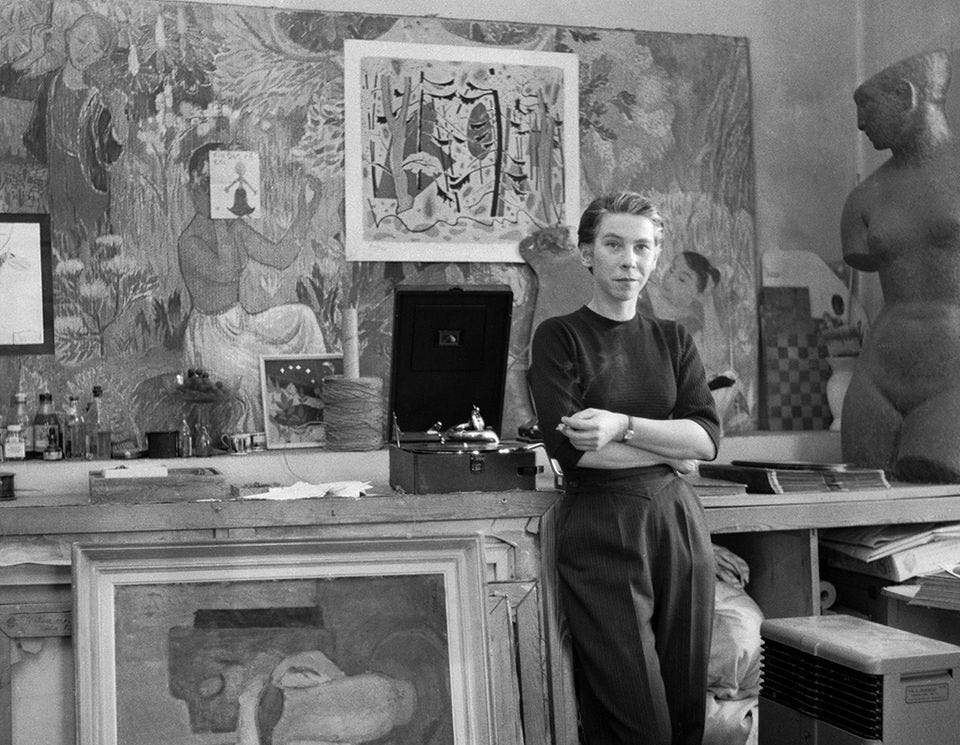
I hope you enjoy this contemplative return to regular writing here on The Crow. I’ve published regularly over the last three or four years and I sorely needed a break. So I took one. I wandered off and then I returned just like Snufkin.
And now I’m back with a refreshed soul and plenty of energy for all kinds of new and exciting writing. I’ll be announcing some changes here on The Crow that I hope help to make this an even more fascinating place for lovers of independent fiction and non-fiction.
More of that another time though. For the time being, thanks to Canadian writer Ailsa Ross for inviting me to contemplate Tove Jansson’s The Summer book.
I hope you enjoy my thoughts on a wonderful book. Feel free to leave a comment, I’d love to hear from you, after all, it’s been a while :)
It was Snufkin I fell in love with when I discovered the Moomin books as a child. His floppy hat and his playful and wise attitude. I loved that he was a philosophical observer forging his own path. I loved his relentless dislike of authority. Reading the Moomin books, one after the other, I experienced the evolution of the books and the writer Tove Jansson as the illustrations matured, the seasons came and went and the themes oscillated through whimsical to chaotic to melancholy. But Snufkin always seemed to remain the same, hovering just beyond the fray, like a witness in-the-forever-nowness. I loved the books and I loved Snufkin.
Back then, in my childish mind, Tove Jansson was a mysterious figure from a land where the sun never set but then disappeared forever. A land where the past lurked like wisps of smoke in the endless forests that hid promises of something more than the life I knew. Tove Jansson was the embodiment of an ethereal poetic dream I’ve never really recovered from.
In my early 20’s I discovered Tove Jansson had written novels, and short stories and essays and non-fiction. The first two I read were, The Summer Book, and The Winter Book. These beautiful books were nothing like the Moomins, and yet they also oscillated between whimsical and melancholy, deeply rooted in a landscape where the past weaved through the present as if to make a mockery of both. Especially The Summer Book, set in a fabled landscape I’d never seen but nonetheless seemed to contain everything I knew.
In my mid thirties I moved to Sweden. I lived in the city, and the forests and the archipelago, and slowly, over time, the fabled landscapes of Tove Jansson’s world became my own. Sometimes a dream can turn into reality and the yearning poetry conjured by a text can become a lived experience. Those endless blue summer days, the sparkling sea, the gnarly pines clawing smoothed granite skerries, and the timelessness of an ancient world that seemed to hover just beyond the fray, like a witness in-the-forever-nowness, became my own.
By the time I read The Summer Book again, in my forties, on an island in the Stockholm Archipelago, I had learnt to speak Swedish, and had become somewhat immersed in “Swedishness,” so that timelessness, that yearning, that wisdom and that strong love that flows through the text sang to me, danced with me and invited me to see the beauty of being alive by experiencing the world in Tove Jansson’s own language. But more than that, the landscape itself had settled in my soul. And who should come wandering up to me as I read the book, after all these years, but Snufkin himself.
The intimate relationship Tove Jansson had with her landscape also flows through her characters and her stories, and it flowed through me in an new way when I read her book once again in her language on her islands. The unsentimental and wise grandmother and the curious and impetuous Sophia were like an expression of Snufkin’s personality, their philosophical conversations, their disregard of authority, their independence and love, and their strangely isolated, just beyond the fray existence
Of course you don’t have to move to Sweden (or Finland) to fully gorge the beauty of The Summer Book. I’m not pretending authority here, just describing about my own journey. One I am deeply grateful to have experienced, for so many reasons, including that it brought me closer to a writer I’ve loved since I was a small child. The kind of writer, the kind of person really, that we need more of these days, a fiercely independent women who forged her own path, a philosophical observer who also immersed herself in the real world and shared her wonder with us all.
In the current climate of right leaning political and social power with our inequality, so extreme even the ancient Egyptian Pharaohs would blush, there is a class of person who love banning books, a person who assumes that readers, especially the young, are neutral, passive creatures waiting to be corrupted by some dangerous ideology. My experience is the opposite. Readers, of any age, are fully formed seekers of views and ideologies that suit their disposition. Book banners don’t want to ban books, they want to ban people. The book banners assume books are windows through which readers can see the world, and in doing so, understand themselves. And of course they’re right. Readers are looking for a way to understand themselves. Which is why book banning isn’t about banning books, it’s about rejecting fellow humans and their fully formed souls. It’s about banning people.
The landscape of the Moomin books reflects the psychological interior world we all inhabit. The seasons are our moods and personality traits. The characters exhibit the potential behaviours we all exhibit. We are all influenced and formed by our interior and exterior landscapes. We are all subject to the vast emotional spectrum of kindness, honesty, free-spiritedness, coldness, introspection, rule-breaking, order-loving, mischievousness, mutuality, loneliness, cruelty, generosity and all the rest.
In The Summer Book, the Grandmother and Sophia, with their intricately balanced co-dependent relationship, are able to investigate their philosophical questions and test the boundaries of authority and themselves precisely because they are in a place of love, trust, kindness and patience. Their exterior landscape informs their interior landscapes and vice versa.
Tove Jansson understands the relationship between the individual and community and society. She is rightly described as an antifascist because she intellectually and emotionally graps the regressive and stagnating nature of any constricting environment. Instead, her books are pro-community, pro-love, pro-self-expression. Her books pulsate with themes of inclusion, and sharing, and tolerance, and the awareness of our place in the delicate natural landscape. But none of these things lead to rigid conformity or a lack of independence. Her books fiercely push back against the forces of repression and negativity and against those who chose to minimise the world through fear and anger.
Tove Jansson led an independent, creative and loving life precisely because she was brave enough to reject constricting social expectations and allow her true character to flourish. And because she was surrounded by friends and family who did not make vicious, small-minded judgements, but instead accepted love and self-expression in every form, she was in an environment where she could be herself.
The Summer Book is a slow, gentle treaty on being a curious, contemplative actor in a space where people are subject to the ebb and flow of their interior and exterior landscapes and can navigate both with poise and virtue and respect. Much like Snufkin would certainly have done, the grandmother and Sophia resist rules and feel indignant at being compelled by dark forces of authority in whatever form. And yet they both welcome a specific brand of authority, the authority of respectful and loving human relationships, the authority granted though communal responsibility, the authority offered by love and honesty, and the authority of an ever present death that reveals the duty to live fully in the short day before the coming long night.
The philosophical treatise of the Summer book, as with the Moomin series, ponders our responsibility to resist oppression and to celebrate life through the daily practice of just being. Tove Jansson is a radical thinker who dares to write about a world where the potentiality of each of us to thrive is infinite when nurtured by love. Tove Jansson’s bravery as a writer, besides her wonderful imagination, is to reveal that tolerance and acceptance and gentleness and love are the underpinnings of true freedom.
When I read The Summer Book recently, I once again felt the same intense wonder I felt as a young child. And once again I fell in love with Tove Jansson and her courage to liberate herself, and potentially all of us, from oppression, by merely daring to be herself. And I realised that Tove Jansson’s bravery, and Snufkin’s playful and wise philosophical independence, and Sophia and her grandmother’s rejection of arbitrary authority whilst embracing the authority of mutual interdependence and loving community are exactly what the world, and each one of us, need right now.
If you’d like to support my writing with a one off donation please click on the button below. It takes you to my Buy Me A Coffee page
No posts
Comments
Nothing yet. Say the first thing.
Sign in to join the conversation.