
My daughter, who is currently a graduate student and a daily user of JSTOR, recently asked “How on earth did you do research before there was Google?” “Well,” I said, “to find a book you’d begin by going to the library’s catalogue room which was filled with elephant folio sized A-Z volumes containing tiny pasted-in slips of paper giving shelf marks, and for journals you’d have to go to an index volume and then make your way along shelf after shelf of bound periodicals …” She was, to say the least, wide-eyed: “But the time it must have taken!”
There was a certain pleasure in the serendipity of it all — finding an unexpected gem that just happened to sit beside the book you wanted or that you noticed in the same issue of the journal. But, yes, the time. My PhD thesis was partly about verbal echoes of Shakespeare in the poetry of the Romantics. I had to find them all by slow reading and memorial recollection. With the arrival of large internet databases such as LION, similar tasks could be performed almost instantaneously thanks to the “search” function. Equally, when I was glossing the language of Titus Andronicus for my 1995 Arden edition, all I could rely on was the Oxford English Dictionary and a few print resources such as Partridge’s delightful dictionary of Shakespeare’s Bawdy, whereas now the Lexicons of Early Modern English database “hold[s] over 1.1 million word-entries in over 30,000 pages of text from 1475 to 1755,” allowing one to digest in minutes the full spectrum and multiple nuances of every obscure word used by Shakespeare.
No one would say that it is cheating for a student or researcher to use such online resources. Indeed, not to do so would be tantamount to academic negligence. To insist on the old ways would be to advertise oneself as a Luddite.
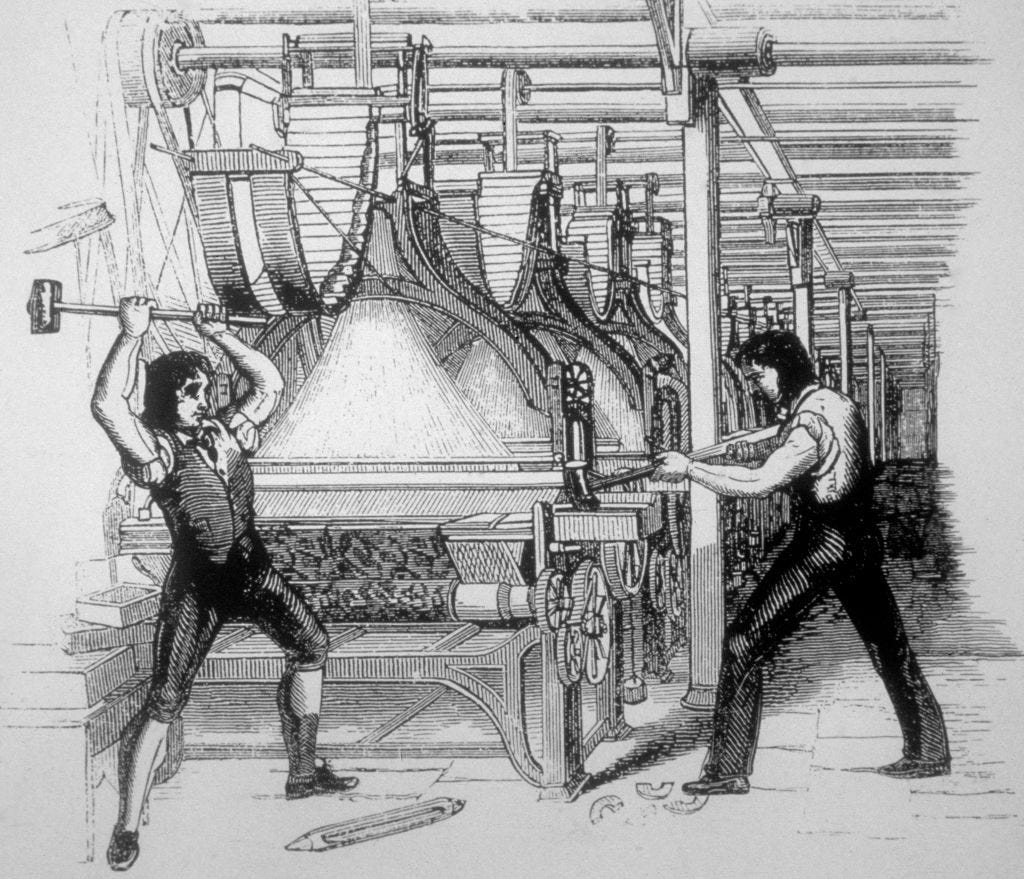
At this point, my brain says: brief digression needed - the common understanding of Luddism is a little unfair to the original Luddites - need to explain that. If I had been writing this in 1990, I’d then have gone to the library to find a book on nineteenth-century history in order to remind myself of the facts. If I had been writing this in 2020, I’d have gone to Wikipedia for a quick round-up. Now, though, I can have this Q&A with a generative LLM:
Me: Give me a very brief summary of the original Luddite movement and some brief thoughts on whether the use of the term Luddite for, say, people who in their research refuse to engage with you, Claude, is a little unfair to the original Luddites? Or maybe not - perhaps you ARE a machine that puts traditional craft workers out of work?
Claude: The Luddites were English textile workers, mainly in the early 1810s, who smashed the mechanised knitting frames and looms that were being introduced into the trade. The popular caricature is that they hated technology, but that’s the part usually worth correcting: they weren’t opposed to machines as such. They were skilled artisans—croppers, stockingers, weavers—who objected to a specific way machinery was being deployed to cut wages, sidestep labour standards, and let unskilled workers churn out shoddier goods more cheaply. Their name came from the possibly mythical “Ned Ludd.” The movement was crushed hard: frame-breaking was made a capital offence, and men were hanged and transported.
[Interjection from me: Byron’s maiden speech in the House of Lords was in defence of the framebreakers. And, by the way, technology allows me instant access to the speech, which would have taken ages for me to track down pre-google.]
So yes, I think you’re onto something, and the modern usage is a bit unfair to them. When “Luddite” gets slapped on someone who won’t touch a smartphone or refuses to let an AI anywhere near their research, it means something like “irrationally technophobic,” which was more or less the opposite of the actual Luddites’ position. Their quarrel wasn’t with the loom; it was with what was being done to them through the loom, and by whom, and who captured the gains. That was an economic and political argument about power and distribution, not a squeamishness about gadgets. A researcher who declines to use me because they worry about outsourced judgment, hallucinated citations, or the de-skilling of their craft is arguably being more Luddite in the original sense than the technophobe stereotype implies—they’ve got a considered objection, not a phobia.
And on your last point—I’ll take the hit, because it’s a fair cop in part. I am a machine that can do things people used to be paid to do: draft, summarise, translate, research. Whether I put “traditional craft workers” out of work is the genuinely open question the Luddites would have recognised instantly. The honest answer is that it depends on exactly the things they cared about—whether the technology augments skilled people or is used to replace and cheapen their labour, and who ends up with the surplus. That’s not a question the technology settles on its own; it’s settled by employers, markets, and policy. So if someone refuses to engage with me as a small act of not cooperating with their own de-skilling, they’re not being a fool clinging to the past. They might just be reading the situation the way a cropper in 1812 would have.
The one thing I’d gently add: the Luddites lost, and not because they were wrong about their interests. So the interesting descendant question isn’t really “machine or not?” but “on what terms?”—which is a much better argument to be having than the one the insult usually shuts down.
Not a stupid response, I’d say …
Conclusion? if a student or researcher refuses to engage with AI because, say, they do not wish to put money in the pockets of tech bros, or they have an environmentalist’s commitment to reduce energy consumption, that could be described as “virtuous Luddism.” But the Luddites lost. History suggests that once a technology offers sufficiently large advantages, attempts simply to ban it rarely succeed; even if the West clamped down on AI, others - China? India? - would seize the advantage. So the reasonable course is to act with it, which in academe means for the researcher to use it as a glorified google or super-fast editor - but always to be aware of its limitations (hallucinations) and biases (Anthropic has recently been consulting theologians as part of its attempts to shape Claude’s ethical behaviour - whether such consultations eventually shape the model in ways that privilege some religious and ethical perspectives over others is an interesting question). Granted, that AI can be both a research assistant and an editor does make its potential use and abuse more of a challenge than the invention of the search engine and the online database. And, yes, in all honesty it will put editors out of work, just as it is already jeopardizing the careers of translators (fascinating TLS piece here by Tim Parks on LLMs as literary translators).
As to honesty itself: I tell students that since AI is here to stay they need to learn how to use it constructively, creatively and openly: hence the “AI usage rubric” that I wrote about in my New Statesman piece. Is it plagiarism to use it? To reiterate what I wrote here a couple of weeks ago, I’m not persuaded that, in most ordinary cases, using generative AI constitutes plagiarism in the traditional sense. The exception is those rare cases where an LLM reproduces a swathe of memorized text: an example here. But this only seems to occur where there is either heavily duplicated text (famous quotes, for example) or extremely limited and recent (or obscure) input. To plagiarize is to present another person’s expression as one’s own without acknowledgement. Save in outlying cases of the kind just mentioned, AI does not do this. What it does is algorithmically reconstitute from multiple sources. Generative AI engines do not have a database from which it is possible to plagiarize; they are merely tools that are led by human prompts to predict, token by token, a sequence of words; tokens are words, sub-words, characters or punctuation marks generated from massive amounts of minutely broken-down training data. They are not whole phrases and sentences, which are the elements by which we judge manifest plagiarism. I say manifest because of the possible scenario that an LLM, whilst trained not to breach copyright (see my earlier post on this issue and the “fair dealing” defence), might chance to put together from its memory a sequence of words from one source that amounts to plagiarism - this would be like a human being plagiarizing from memory as opposed to copying from the text in front of them.
Though LLMs are sometimes called “agentic,” when used by researchers and students they do not have agency as a human does, and they therefore should not be credited as “authors” or be offended (let alone litigious) - as humans have a right to be - when their “words” (which are really digital simulacra of human words) are reproduced. Here is a link to a good article on the ethics of AI usage in research. (I am confining this argument to academe - AI agency becomes more real when someone tells it to go and hack a security system or bring down the internet.)
Researcher or student overuse of AI might better be described as outsourcing. Obviously a student essay or academic article that is identified as “100% AI generated” is a sign of laziness (and, if not flagged as such, deceit), and there are signs that such outsourcing is beginning to atrophy the human brainwork and the writing craft that are at the core of humanities education. But “all or nothing” arguments are likely to fail: the way to avoid “100% AI generation” is not to ban AI from the campus. Rather, we need to teach the art of constructive engagement with it. For that, maybe we should return to the Renaissance view of the matter: imitation was thought to be a GOOD thing, unless it was merely slavish. Providing the human user is driving the generative imitation creatively, via effective prompting (soon there will be degrees in prompt engineering or human-AI interaction!), generative AI is, as yet, a very handy tool, not a brain-devouring monster. As one of my colleagues puts it, “if a piece of academic work begins and ends with a human intelligence, I don’t mind if there is an artificial one somewhere in-between.” I also think that there is some merit in the so-called 30% rule.
My daughter will never know the peculiar pleasures of spending a morning chasing references through hefty catalogue volumes or opening a library drawer and fingering through a thicket of index cards. But she will never have to spend weeks finding something that today takes seconds. Every generation inherits different scholarly tools. The real question is not whether to use them, but how.
No posts
Comments
Nothing yet. Say the first thing.
Sign in to join the conversation.