
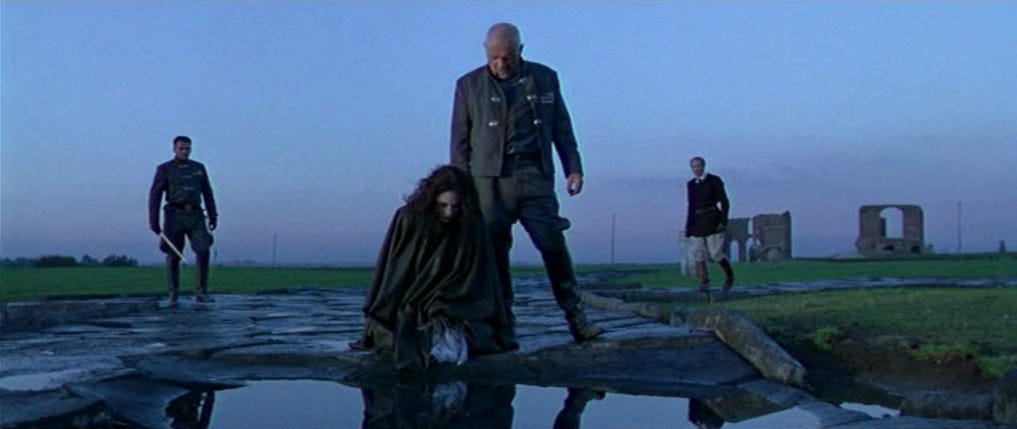
I recently stumbled across a piece in The Australian newspaper, in which I interviewed Julie Taymor and wrote about her movie version of Titus Andronicus (this link looks like a full version without a paywall), the play I edited for the Arden Shakespeare. I still think, more than 25 years on, that it is one of the great Shakespearean films. Here’s the piece, with some added hyperlinks:
JULIE Taymor’s West End stage production of Disney’s The Lion King begins with a procession: as you sit waiting for curtain-up, the music starts and fantastical elephants and giraffes, lions and zebras begin lumbering down the aisles. The colours are dazzling, the tones vibrant. Music, dance, mask and design are unified as if by magic.
Taymor’s eagerly awaited first film, Titus, also opens with a procession, but it couldn’t be more different. Drums and trumpets hail the return of hundreds of Roman soldiers from their bloody campaign against the Goths. Armour and skin are caked with mud and black with soot. The exhaustion of years at war is seared into the face of General Titus.
The Lion King was all fire and air. Titus takes us into a world of blood, earth and stone. Twenty-one of Titus’s sons have been slain in battle. During the next two hours, the remainder of them will be murdered or exiled. Titus’s daughter will be raped and mutilated. He will exact the most gruesome revenge, courtesy of a rare meat pie. Anthony Hopkins, who plays the part, describes it as “King Lear meets Hannibal Lecter”.
What has led Taymor from Disney’s happy “circle of life” to Shakespeare’s bleakest vision of death? Partly “a desire not to be boxed in as a particular kind of director”, she says. But principally it was because of her passion for the play itself and her feeling that it “just reeks of wanting to be a movie - far more than most Shakespeare”.
Titus Andronicus has had a chequered history. It was hugely successful in Shakespeare’s lifetime and did more than any other play to establish his reputation. But its graphic violence and its incongruous mixture of comedy and grotesquerie made it unacceptable to 18th and 19th-century tastes. With the horrors of the 20th century, it took on new life. Peter Brook revived it in the 1950s when the “theatre of cruelty” was emerging.
Behind the Iron Curtain, the Polish intellectual Jan Kott made it central to his argument that Shakespeare is “our contemporary”. The Romanian director Silviu Purcarete found it spoke to the chaos of the years after the 1989 revolutions.
The play’s troubling representation of rape and female mutilation has made it particularly challenging to female directors. Deborah Warner established her reputation with a production in the 80s, starring Brian Cox. “Is it a coincidence,” I once asked him, “that you and Antony Hopkins have both played Titus and Hannibal?”
Taymor, who directed an off-Broadway version in 1994, was shattered by her first reading of the play. “It literally shocked me,” she remembers. “I don’t think there’s ever been anything better written about the nature of violence - and if there was ever a time that should understand the implications of what Shakespeare was writing about, it has to be now.”
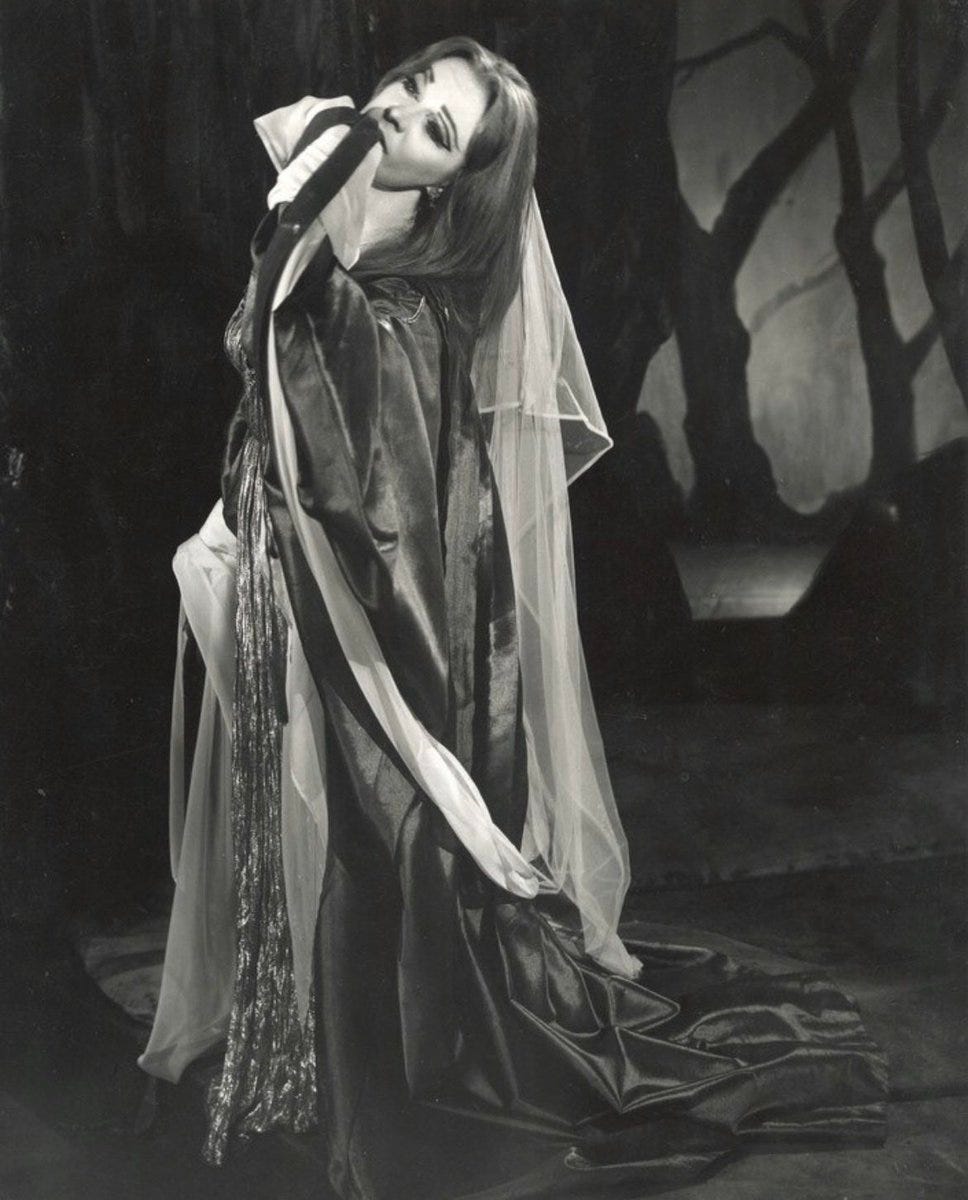
For Taymor, the play does not indulge in gratuitous violence. It is a dissertation on how and why we make entertainment out of violence. Brook’s famous production with Laurence Olivier as Titus and Vivien Leigh as his raped daughter, Lavinia, stylised the violence, opting for red silk ribbons instead of stage blood. Taymor, by contrast, approaches the drama through a striking combination of realism and stylisation. Some scenes present brutality head-on, while the action is punctuated by surreal montage sequences that she calls “penny arcade nightmares”. Taymor has an amazing capacity to work the language of a text into visual effect. “Everything I do becomes visual imagery,” she says. Shakespeare’s own proto-cinematic imagination becomes a source of inspiration as she finds visual equivalents for the dramatist’s figurative verse. Two key locations, a swamp and a crossroads, are peculiarly haunting.
As her production of The Lion King testifies, Taymor is above all a choreographer of human bodies and stage spaces. Watching Titus, an audience may wonder whether she is another Leni Riefenstahl, without any of the dark political baggage.
Before The Lion King, Taymor was known as one of New York’s most exciting avant-garde directors, her productions shaped by the journey she had taken through many different theatrical traditions. She grew up in a well-to-do suburb of Boston. She and her sister played theatre games in the garage.
From the beginning, she was drawn to “mime, puppetry, masks, the whole business of making believe and the leap of faith that theatre requires”. At 16, she went to the Lecoq drama school in Paris, where she learned the very European idea that an actor must start from the physical body, not the process of conceptual identification with a role that is characteristic of the New York “method”.
Then at college at Oberlin in the Midwest, she studied under a director called Herbert Blau, who was interested in the “ideograph” - the stage image or tableau that symbolically visualises the distinctive world of a play.
In Amsterdam, she saw a one-minute puppet show that veered wildly and instantaneously from slapstick comedy to brutal violence. In Indonesia, she discovered the intimate relationship between theatre, ritual and priestly magic.
All the different theatrical traditions that have informed her work come together in the film. Blau’s ideographs sowed the seed of the iconographic “nightmares”, while that one-minute puppet show anticipated in miniature the mix of tragedy and comedy, lyric poetry and black farce, the tender and the grotesque.
The influence of the director’s experience of Eastern theatre cannot be pinned down so exactly, but the key to it is the sense of drama as spectacle. As in Japanese bunraku and Javanese ritual theatre, both eye and ear are perpetually feasted. Music always plays a key part.
Taymor works closely with her husband, the composer Elliot Goldenthal, whose score for Titus brings together a bravura array of musical styles and traditions that sounds like modern jazz or Shostakovich one minute, indie rock the next.
Like Sam Mendes, another theatre director who turned to film - with American Beauty - Taymor knows the value of the rehearsal process, something for which few movie-makers have time. For them both, it was essential there should be a three-week rehearsal period before shooting began. This was especially valuable for the members of the Titus cast who lacked experience with Shakespearean language. Jessica Lange, who plays Titus’s enemy Tamora, Queen of the Goths, had never done Shakespeare. She benefited from work with Cicely Berry, the Royal Shakespeare Company’s voice coach.
“We were coming from very far reaches of the universe as far as acting experience was concerned,” Lange says. “The rehearsal period gave us an equal ground to work on. It was the only time the actors could have Julie’s full attention and concentration. Her strength as a director is in the visual - there was so much going on the way she was shooting and designing the film that you had to have your foundation in place from the rehearsal time.”
The other thing the films have in common is that they gave the directors the opportunity to work with the person they regard as the best actor in the world - Kevin Spacey for Mendes, Hopkins for Taymor. Why did the great Welsh actor agree to play the proud Roman general, when he had vowed never to tackle Shakespeare again?
“He loves the darkness of the story, the grotesqueness of it,” explains Taymor. “I guess that deep down he identifies in some way with a man who has this veneer of ordinariness, who is a repressed gentleman, who then has his world torn out from under him and through madness comes to see reality.”
During the gruelling four-month shoot, there were reports that Hopkins was going to give up acting for good. It was a turbulent time. You cannot live with the extremity of Titus for that period without sharing some of his derangement.
“If you ask Tony,” Taymor confides, “he’ll tell you he tore his soul apart playing this role, he went to hell and back.”
The other extraordinary performance is that of Harry J. Lennix, the one actor in the movie who was also in Taymor’s original stage production. He plays the villainous Aaron the Moor, the first great black role in English drama.
Taymor’s eyes are bright with admiration as she talks of both the man and the part: “Harry’s from Chicago, which is one of the most racist cities in America. He was both a Jesuit priest - I mean he was studying to become one - and a black Muslim. That sort of tells you who Harry is. You know black Muslim means peace and strength, but he’s got a very particular view of race in America. He will tell you that Aaron is justified in saying “f... you” to all the other characters; he’s got no reason to be nice to anybody. What I love so much about what Harry brings to it is the total joy in the evil of violence, the total easiness, and then the incredible humanity he brings to the love of his child.”
The transformation of Aaron from devilish villain to protective father is one of the great surprises of the play. It gives a special power to the last half-hour of the movie.
After seeing Titus, one of Shakespeare’s biographers, Anthony Holden, said to me: “The best Shakespeare film ever made? Discuss.” Probably not quite, but I would say that it is the only one of the recent celluloid treatments of the Bard to be up in the premier league along with Akira Kurosawa’s Throne of Blood and Orson Welles’s Chimes at Midnight.
Yet the reviews were decidedly mixed when the movie was released in the US at the beginning of the year. For Time magazine, it was a stunning foretaste of what serious film-making could become in the new century, while The Washington Post took the view that Taymor would have been better advised to stick to Disney.
Part of the problem was that many reviewers had no understanding of the original play. They went to Harold Bloom’s bloated book on Shakespeare, found a few pages of brisk dismissal along the lines of “a ghastly parody of Marlowe”, and felt justified in blinding themselves to the tragedy’s troubling artfulness.
Ellen Little, one of the film’s co-executive producers, says a print was sent to Francis Ford Coppola. After seeing it, he phoned Taymor to tell her she had made a truly great movie, but one so far ahead of its time that it would be several years before people realised just how important it was.
The fact that Titus only garnered a single Oscar nomination, for its costumes, shows Coppola may be right. The voters of the academy were afraid to look into the heart of darkness beneath the dazzling surface.
Maybe Coppola was right about the long weight for recognition: an article published in 2024 was rightly titled “Titus: The Masterpiece that the Cinematic Greatness of 1999 Obscured”.
No posts
Comments
Nothing yet. Say the first thing.
Sign in to join the conversation.