
This is best described as a cross post (do visit the site for more, https://www.leekaweek.org )
that I believe it will be useful to those in the substack community.
MBLs recognize pathogens for our innate immune system to destroy
MBLs identify coronaviruses, including SARS-CoV-1, by their spike structures
SARS-CoV-2 spike structures are the same as those found on SARS-CoV-1
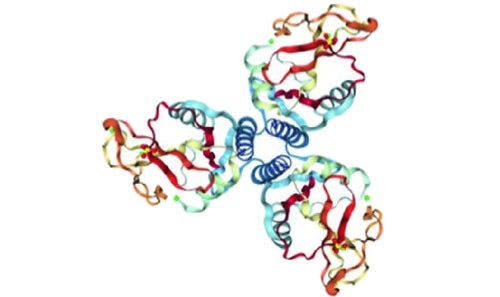
Mannose Binding Lectins (MBL) recognize a broad range of pathogens, including SARS-CoV, using carbohydrate recognition domains (CRDs) (red/orange) to bind to pathogens. MBL is often formed with three CRD “heads” (trimers, right) or four CRD heads connected together by a flexible “neck” (blue). The flexible heads and neck provides the CRDs flexibility to “reach” and bind to a variety of mannose structures on a broad range of pathogens.
After the MBL “heads” bind to a pathogen, the collagen “tail” end of MBL activates the lectin pathway of our innate immune system which enhances phagocytosis by acting as an opsonin (from Greek opsōneîn meaning “to prepare for eating”). Phagocytosis (from Ancient Greek phagein meaning “to eat”) is the process where our immune system destroys pathogens by “eating” it.
Vulnerabilities in coronavirus glycan shields despite extensive glycosylation
The SARS coronavirus is covered in spikes, which are primary targets for our immune response, including antibodies and vaccines. Scientists have scanned the SARS-CoV-1 spike protein (S).
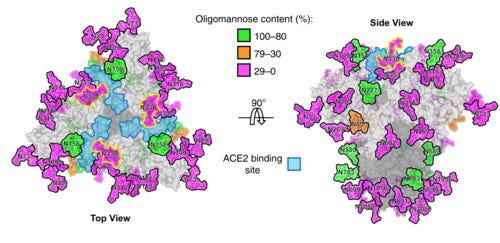
SARS-CoV-1 infects our cells by using its Receptor Binding Domain (RBD) at the top of each spike (blue) to bind to ACE2 on our cells. In addition to the RBD, each spike is also covered by many oligo-mannose structures (green, orange, and purple). These mannose structures act as a “glycan shield” camouflaging the virus from being recognized by immune systems. Fortunately, the glycan shield is not very dense so those mannose structures also allow MBL, short for Mannose Binding Lectin, to recognize and bind to the SARS coronavirus.
The MBL in leek, allium porrum agglutinin (APA), is very effective at binding to SARS coronavirus. At the top of the spike, the N330 sites (yellow outline) are especially important because those are the primary binding site for MBL.

Site-specific glycan analysis of the SARS-CoV-2 spike
The N330 sites where MBL binds to SARS-CoV-1 correspond to N343 sites on SARS-CoV-2 (yellow outline). The structure and layout of these MBL binding sites are very similar so, as expected, MBL also binds to SARS-CoV-2.
In addition to the primary N343 binding sites, the nearby N331 sites have very similar mannose structure profiles so those may be a secondary MBL binding site making it easier for MBL to bind to the top of the spike.
The N343 and N331 binding sites are critical to the infectivity of SARS-CoV-2 with those mannose structures protecting the part of the spike that binds to ACE2. Mutations to N343 and N331 to avoid MBL recognition would likely reduce the infectivity of the virus.
Innate immunity alone may be powerful enough to eliminate SARS-CoV-2 so it is important to provide our innate immune system with the tools necessary to recognize SARS coronavirus.
Our innate immune system uses MBL for our first line of defense against SARS-CoV-2. Lower levels of MBL are associated with a higher risk of infections, uncontrolled inflammation due to cytokine storm, and a higher risk of infection by SARS coronavirus.
Allium vegetables are a natural source of MBLs with the MBL in leek particularly effective against SARS coronavirus.
The above was all leading up to some nice lentil soup,
not intended to cure /diagnose
Lentil
Lentil lectin derived from Lens culinaris exhibit broad antiviral activities against
SARS-CoV-2 variants
https://www.ncbi.nlm.nih.gov/pmc/articles/PMC8330776/
Leeks
https://www.leekaweek.org/mbl-binding
Celery
Luteolin and luteolin-rich fractions are found to have antiviral property, including SARS–CoV,
https://pubmed.ncbi.nlm.nih.gov/25036464/
https://barefootcontessa.com/recipes/lentil-sausage-soup-updated
No posts
Comments
Nothing yet. Say the first thing.
Sign in to join the conversation.