
Common Ground is Ground’s newsletter highlighting the most important consumer news, tech trends, artificial intelligence, in-depth analysis, along with a few extra thoughts from our team.

Our very own Growth Strategist at Ground, Jacqueline, brings you the hottest news in commerce and what that means for growing brands today.
On July 14, Prenetics announced that IM8, the wellness brand it co-founded with David Beckham, had secured up to $1 billion in growth financing from General Catalyst’s Customer Value Fund.
This was not a billion-dollar check dropped into IM8’s bank account. General Catalyst can finance up to 70% of the brand’s selected monthly marketing spend, then collect a capped return from the revenue generated by each funded customer cohort.
But here is what most people are missing. General Catalyst is not betting $1 billion on David Beckham’s reach. It is betting on what IM8’s customers do after they click.
This is not a traffic problem. It is a yield problem.

IM8’s disclosed customer acquisition cost rose from $104 in Q1 2025 to $305 in Q1 2026. That is nearly 3x as much to acquire a customer in one year.
Yet its mature cohorts reportedly paid back in roughly 3-6 months. Across those cohorts, every $1 of CAC produced $1.44 in blended gross profit. Those economics gave General Catalyst enough confidence to finance customer acquisition cohort by cohort.
IM8 did not prove that CAC is falling. It proved that higher CAC can still work when the customer produces enough value after acquisition.
The pressure is not going away. Meta reported that its average price per ad increased 12% year over year in Q2 2026. Brands can keep fighting for a cheaper click, but the auction will always belong to the platform.
What happens after the click belongs to the brand.
Most acquisition dashboards end too early. They track CPM, CTR, CPC, ROAS and CAC, then treat the first purchase like the finish line.
It is not. The first purchase is where the customer economics begin.
The full equation includes how many paid visitors convert, how much first-order revenue they produce, how quickly CAC is recovered and how often those customers return. Shopify identifies a 3:1 LTV-to-CAC ratio as a commonly used benchmark for sustainable growth.
You may not control what Meta charges for the visitor. You can control how much revenue that visitor produces once they reach your Shopify store.
That leaves two levers. Convert more of the traffic you already paid for. Then create more value from the customers you worked so hard to acquire. Ground’s revenue agents does this all automatically with it’s suite on revenue agents.
See How Ground Converts Your Traffic
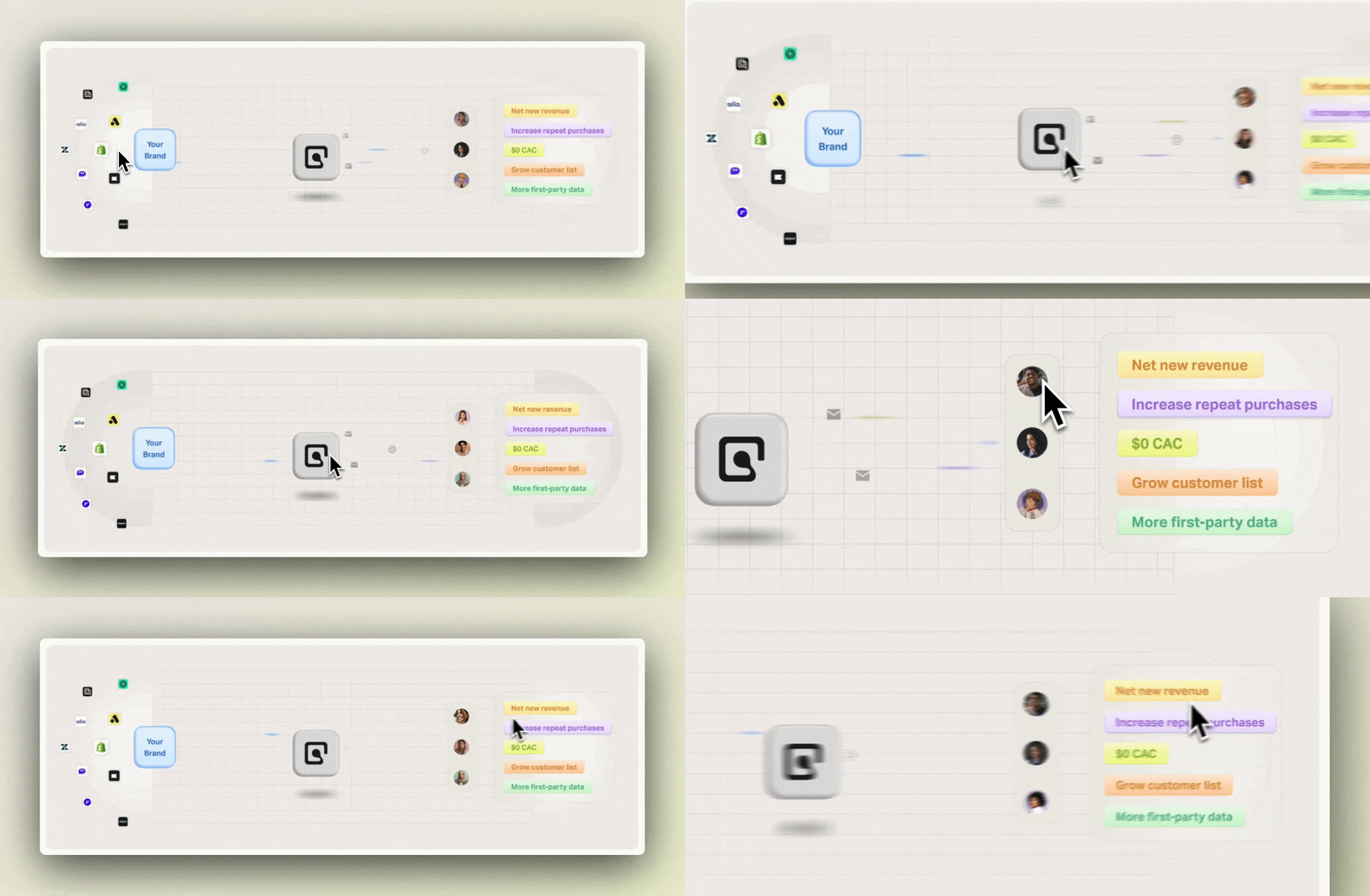
This is where revenue agents change the model. Instead of waiting for a team to build another campaign, they continuously act on the moments that determine whether an expensive visitor becomes a valuable customer.
Ground is an Autonomous Revenue System across Shopify and Klaviyo. Greet AI acts before the first order, helping brands drive 30-50% more first-time revenue from existing traffic. ReCartify resolves identity so the models understand who is engaging and abandoning. ReBeat AI acts after acquisition, driving 2-4x repeat purchase revenue. Terra connects the intelligence and execution across the journey.
These models do not operate independently. They work as one revenue brain.
The result is not another audience to rent. It is incremental revenue from the audience you already paid to reach.
🔌 If paid traffic is getting more expensive, Ground can show you where first-time and repeat revenue are escaping across your Shopify journey.
The most important asset in IM8’s financing is not the billion-dollar commitment. It is the customer cohort that can convert, repay its acquisition cost and keep purchasing after the fund’s return has been capped.
That is the new growth advantage. Not access to more traffic, but an autonomous revenue system that makes every hard-earned customer worth more.
If every click is getting more expensive, are you still trying to buy cheaper traffic, or are you building a revenue system that makes every customer compound?
If you’re curious about learning more, let’s chat.

Prenetics and General Catalyst investor presentation - The CAC, payback and cohort economics behind the $1 billion commitment
Prenetics’ official financing announcement - How the financing structure funds marketing without issuing equity
Meta’s Q2 2026 results - Average ad prices increased 12% year over year
Shopify’s 2026 customer lifetime value guide - How retention, purchase frequency and customer lifespan determine how much CAC a brand can support
Common Ground’s revenue-agent explainer - Why the revenue after discovery belongs inside a system the brand owns
Give your AI an anonymized cohort table with acquisition month, spend, new customers, first-order gross profit and 30-, 60- and 90-day repeat revenue. Ask it to calculate CAC, gross-profit payback and LTV-to-CAC by cohort, then identify the largest revenue leak. Verify every result against your finance source data before acting.
I share the ideas behind Common Ground on LinkedIn - what I’m hearing from DTC founders and operators, the AI and commerce shifts worth paying attention to, and how I turn those signals into each issue.
Follow along for the research, writing process, and practical takes that don’t always make it into the newsletter.
No posts
Comments
Nothing yet. Say the first thing.
Sign in to join the conversation.