
On the night of November 23, 2021, a small inflatable raft carrying 28 people, and maybe more people than that, set off from the coast of France to cross the English Channel. Within a couple hours, the engine cut and the raft started taking on water. In a scene that has become common in and exemplary of our age, when the desperate passengers began making a flurry of distress calls to both English and French authorities, rescue operators were dilatory, dithering, and — as the sea overtook the small dinghy and the passengers began to sink — failed to send a rescue ship.
Iraqi Kurds, Afghans, Ethiopians, a Somali woman, a Vietnamese man, one Iranian, one Egyptian — some of the passengers children — all ended up drowning in the Channel that night. The tragedy was later novelized by French author Vincent Delecroix in his short, dense, guilt-inducing and hauntingly beautiful book, Small Boat.
As played out in Delecroix’s novel, after the press publishes excerpts of the distress calls, the French rescue operator who fielded most of them is interrogated for her non-response as well as mocking — or at least not empathizing with — the migrants.
At one point during the interrogation the rescue operator defends herself, saying that, unlike many of the dinghies carrying migrants, her judgement has “no holes… no fissure, but it does have boundaries, which correspond exactly to the boundaries of territorial waters.”
Judgment ending at national boundaries is the de facto political stance taken in the Channel, the Mediterranean, as well as along many of the world’s borderlines as nations duck, buck, and otherwise foist our most basic social responsibilities: caring for the downtrodden, protecting the persecuted, welcoming the stranger. Political philosopher Jacqueline Stevens notes that, too often, “nation-states compromise the limits of empathy.” Bounded empathy, I believe, constitutes a paradox. (For more on the promises and perils of empathy, check my last newsletter.)
To bring it to the US border, see for example the last part of No More Death’s report, The Disappeared, which describes how 911 operators in Southern Arizona are dangerously slow to respond, or simply patch migrant distress calls over to Border Patrol.
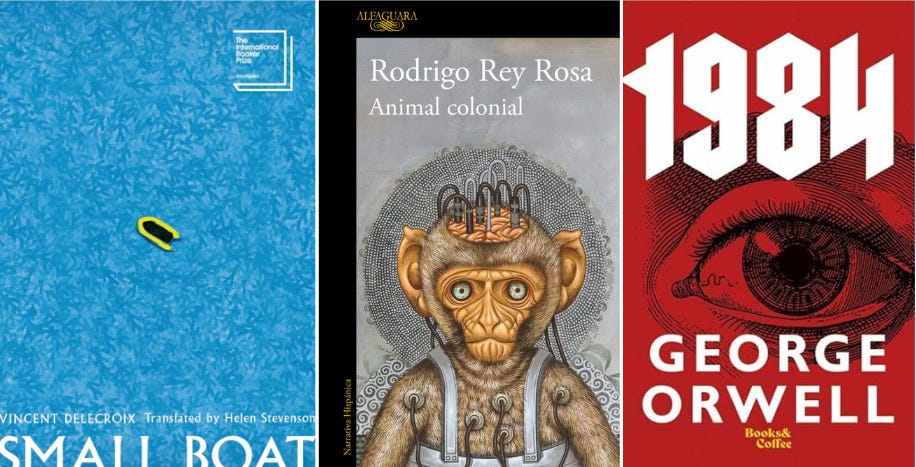
“I show up every evening for the migrant drama: they give me a free seat and even pay me for it,” the narrator of Small Boat reflects. She may have a front row seat, but we are all party to the drama, and we have long been party.
Recall, for example, the oft-overlooked opening pages of 1984 (published 77 years ago) in which George Orwell lays out an almost identical moral tangle as that captured by Delecroix:
April 4th, 1984. Last night to the flicks. All war films. One very good one of a ship full of refugees being bombed somewhere in the Mediterranean. Audience much amused by shots of a great huge fat man trying to swim away with a helicopter after him, first you saw him wallowing along in the water like a porpoise, then you saw him through the helicopters gunsights, then he was full of holes and the sea round him turned pink and he sank as suddenly as though the holes had let in the water, audience shouting with laughter when he sank, then you saw a lifeboat full of children with a helicopter hovering over it…
Orwell’s passage eerily presages not only Small Boat, or the disturbing scenes at the US-Mexico border, but the haphazard war-crimes currently being committed against alleged fishermen in the Caribbean and Pacific. Will there be a novel about the US bombing fishing boats? Or one told from the perspective of a drone operator stationed in Indian Springs, Nevada? Too on the nose, perhaps: reality crueler than fiction. We watch — perhaps aghast, perhaps inured, perhaps just scrolling at the trough — as the spectacle draws, tightens, and strangles. Delecroix writes, “There is no shipwreck without spectators.”
Such use and abuse of spectacle brings to mind the vindictive machinations of the US Justice Department, especially the recent indictment in Minnesota, in which the DOJ pinned conspiracy charges on 15 community members defending their neighbors from the violent anti-immigrant invasion dubbed MetroSurge. The indictment is shocking not because of the crimes it describes but for its lack of describing anything at all that sounds criminal.
One section details an article published on Crimethinc. Another count cites a banal Signal conversation that includes the phrase “Fuck ICE.” (Remember Trump’s campaign claim: “If we don’t have free speech, then we just don’t have a free country.”) There’s also much mention of mutual aid and fundraising for community protection networks, which is, in my calculation, the opposite of crime.
A revealing fixation from the indictment is the many — 32 in total — references to the defendants’ use of shields. There’s little that better evokes the Trump administration’s attempt to criminalize mutual aid, community defense, or general do-goodery than declaiming the non-violent self-protective use of shields. As one attorney put it, these people are being prosecuted for “political organizing and resistance.” The indictment, which you can read in full here, doesn’t name or claim a single incidence of a federal officer being injured.
All of it is an attempt to chill dissent, a tactic that has been aggressively wielded by the Trump administration. The great Natasha Lennard has a helpful and sobering recap for The Intercept, in which she enumerates the new federal charges against people in the Stop Cop City movement, FBI raids on Palestine-solidarity activists, and more.
In sum, the indictment against the Minnesota 15 is flimsy in content but heavy in signaling, an attempt to push people towards bystanderism.
That is, as M Gessen recently pointed out in an especially astute column, the purpose of the Trump administration’s constant rhetorical attacks against migrants, especially that vile and puerile Aliens page, is not to turn “normal people into murderers,” but to turn “them into bystanders.” That’s Gessen quoting Benjamin Valentino, a professor of government at Dartmouth College, who thinks that the intent of vilifying migrants is not to get Americans to necessarily do anything, but to get them to do less, to step back as the government continues to wage its murderous campaign against migrants.
“They want a majority of the population to turn their backs,” Valentino told Gessen.

“Why do men, women and children drown every night in the Channel or the Mediterranean?” the narrator from Small Boat asks herself. “Because,” she answers herself, “these people were sunk long before they sank.”
She’s right in principle but wrong in grammar. The answer is not in the passive voice. We — as a society, as a system — sink them.
In an unnamed but very Guatemalan Central American country, a rightwing populist administration builds a behemoth supermax prison to lock up alleged gang members for life. It’s not El Salvador’s CECOT, but it’s quite like it, except that the horrors inside don’t end at torture, humiliation, or perpetual sentences. In Rodrigo Rey Rosa’s wild new novel, Animal Colonial, the people imprisoned also have “the option” of being connected to an Interceph, or a network of hundreds of brains connected together to share thoughts, memories, consciousness, and supposedly create something like a human-powered supernet. Imagine Mircea Cărtărescu but in Latin America. The book dips into magical realism but, despite the “biblical plague of intelligent insects” — nano-bots that help stage a massive prison break — the genre feels asymptotically close to a nearish future AI reality. It’s a haunting and fabulous read.
I’m also just dipping back into one of the best and under-appreciated Russian greats, Ivan Turgenev. I’ve just cracked Fathers and Sons for “research” — the best, most delightful, deepest kinds of research — for my own novel-in-progress.
No posts
Comments
Nothing yet. Say the first thing.
Sign in to join the conversation.