
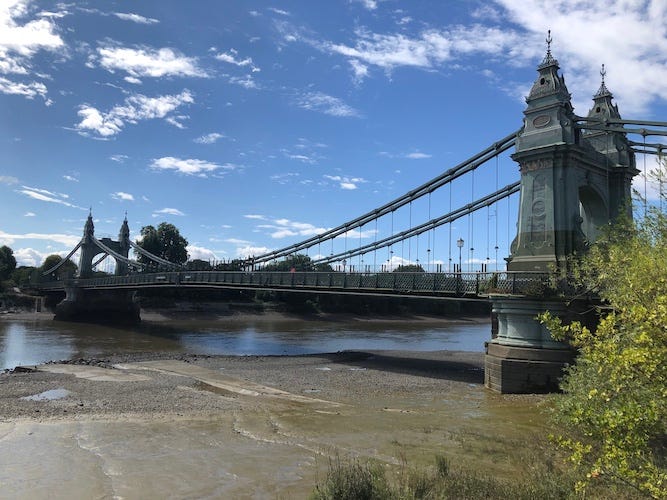
I went to Hammersmith to learn about lesbians, to cross the Thames and to construct in my mind’s eye a pop star domestic scene that unfolded there four decades ago.
The pop star was the late Ian Dury, vivid, exceptional, unique and originally from Harrow, not Essex, as his lore suggests. One day, a radio producer and presenter went to interview him in his flat in Hammersmith, which had a brilliant view of Hammersmith Bridge. The flat was brilliant too – open, arty and spacious in an Edwardian mansion block. It’s stayed in the family.
Someone else who went there to see him has recalled an Axminster carpet. Our radio duo were struck by what looked like a silk boxer’s robe hanging on clothes rail and by the unscheduled arrival of a member of The Blockheads, Dury’s band.
He shall remain nameless, given that he’s still alive and, for all I know, might not wish to be identified in this re-telling of a long-ago tale. Whatever, the causal aplomb with which he assembled, ignited and puffed his way through a spliff that rivalled the size and the sizzle of the Olympic torch was as impressive as it was unexpected.
This hazy scene ran through my mind as I made my way across the Grade II* bridge, which has been stricken for a good ten years and feels that way, all forlorn with barriers and temporary lanes, its once regal green paintwork on the fade. There were a few fellow pedestrians. The odd cyclist trundled by. Below, a thin thread of river seemed exhausted by the effort required to flow. Aquatic birds pecked at its exposed flanks. The sun blazed, as has been its habit recently.
The psychology of my traverse was kind of trippy. Once half way across Joseph Bazalgette’s grand design, opened in 1887 by the ill-starred Prince Albert Victor, every footstep conveyed a sense of leaving the city behind. And suddenly, I was in Barnes in the London Borough of Richmond upon Thames, with a lady evangelist standing outside a church to my left and a huge expanse of school playing field to my right.
Welcome to the countryside. It had been only a short walk from the heart of Hammersmith, with its growling flyover and gyratory and it complex pedestrian challenges. Striking out from the Tube station, I passed what was once called the Hammersmith Odeon, where Dury and company played strings of sold out nights in the late 1970s and 1980s. Then it was along Queen Caroline Street, with its famous postwar housing estate, and to the Riverside Studios (clue in name).
Which brings us to the lesbians. The Riverside has been running its annual Bitesize Festival, and I had a ticket to see a play called Custard Tarts, “an hour-long inquisition into sexuality, lesbian coding and archetypes”. It was shrewd and funny and also rather nostalgic if you’re old enough to remember the heyday of Ian Dury. Read all about it here.
My London novel, a political satire called Frightgeist, can be bought here.
No posts
Comments
Nothing yet. Say the first thing.
Sign in to join the conversation.