
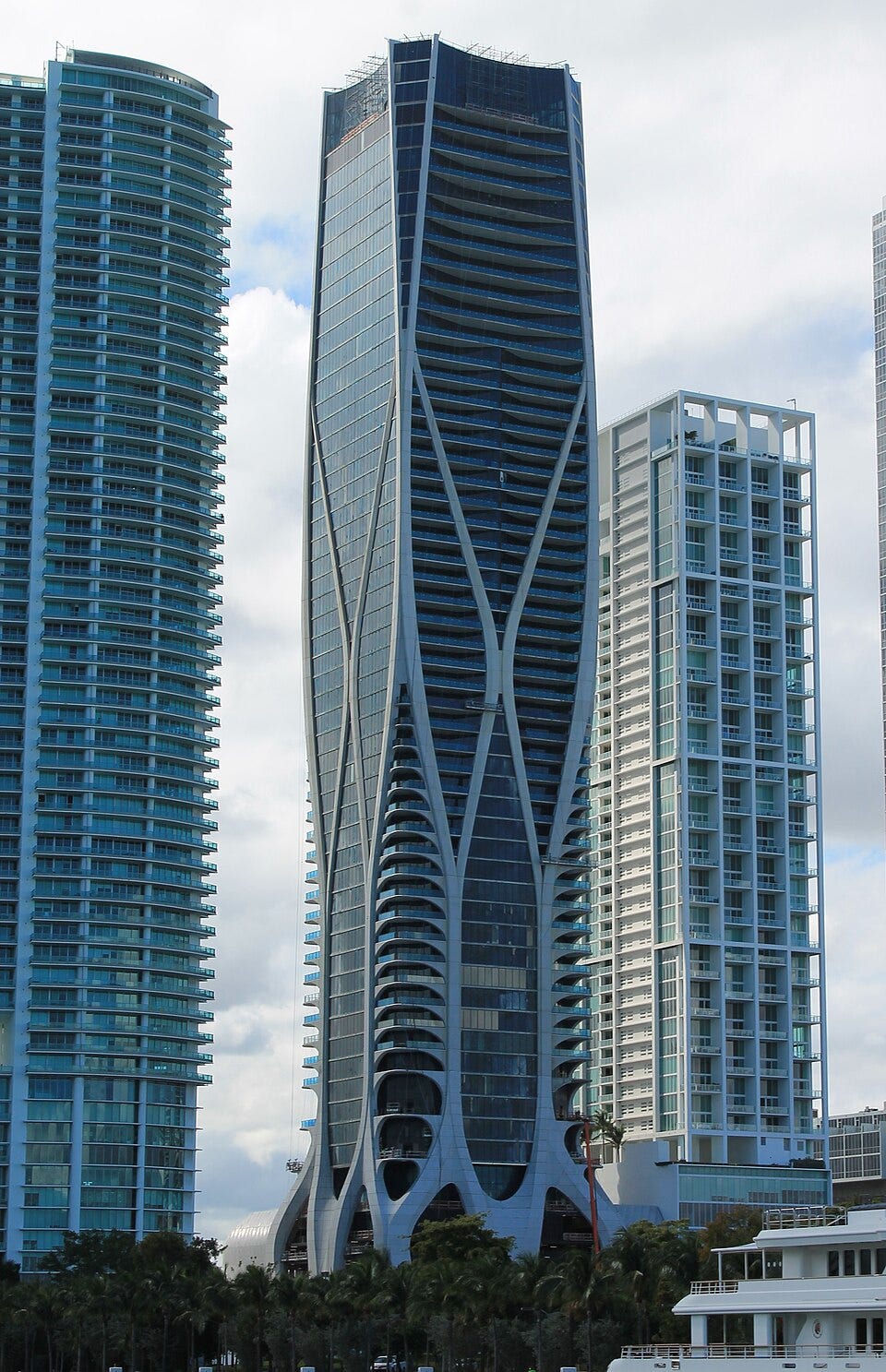
Completed in 2019 amidst ever-present South Florida fanfare, One Thousand Museum (The Museum Tower) is instantly recognizable for its concrete exoskeleton. More about the exoskeleton will be discussed later. The design work was started by the late Zaha Hadid and completed by her firm after her passing in Miami in 2016. At 62 stories, it still ranks as one of South Florida’s tallest residential structures. Which is saying something.
Developers Kevin Venger and Louis Birdman had conceptualized the project in 2013. Critical to their plan was the site location, which was adjacent to a redeveloped area of downtown Miami.
The developers described the challenge presented to Zaha Hadid as creating :
a new level of dynamic, sculptural form to the skyscraper. One Thousand Museum showcases Hadid’s signature style, with its flowing lines and curves, and is a testament to her forward-thinking approach to design and technology.
The Developers
Louis Birdman
After decades of real estate development experience, including multiple luxury projects, Mr. Birdman seemed to have a singular vision of what a Miami ultra-luxury residential high-rise should be. His website adds this to his background:
Mr. Birdman has an extensive background in property acquisitions, dispositions, entitlements, financing, planning, design, construction, sales, and marketing.
Mr. Birdman holds a Bachelor of Design in Architecture from the University of Florida and a Bachelor of Architecture from the University of Miami.
Kevin Venger
According to his website:
Has managed and co-developed the construction and development of six (6) major high-rise mixed-use buildings with more than 1,400 residences and over 7 million square feet throughout South Florida.
Mr. Venger graduated cum laude from the University of Miami, earning a Bachelor's in Architecture with a minor in business administration/finance.
The Architect
Zaha Hadid
Dame Zaha Hadid was born in Baghdad, Iraq, in 1950 into what has been described as an upper-class family. These circumstances allowed her to attend boarding schools in England and Switzerland and, as the story goes, to develop an appreciation for architecture during childhood trips to ancient Sumerian sites.
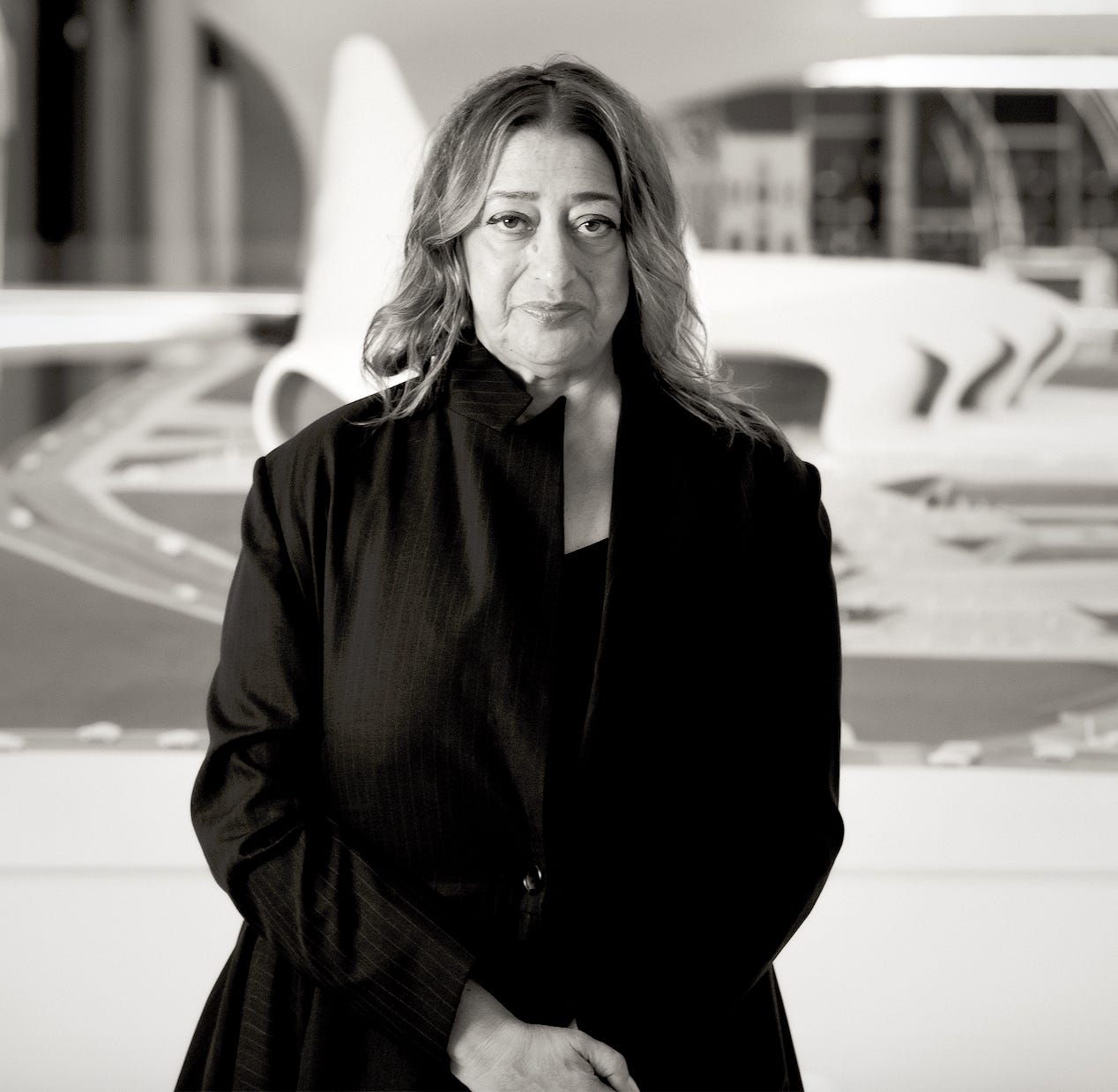
Dame Zaha studied at the Architectural Association School of Architecture in London, where she completed her work in 1977. One of her teachers there was Rem Koolhaas, who, long before her Pritzker Prize in 2004, admired her potential as an “architect,” not a “female architect.”
The architectural firm said this regarding the design:
The design expresses a fluidity that is both structural and architectural; the structure gets thicker and thinner as required, bringing a continuity between the architecture and engineering.
Unfortunately, the visionary architect behind the project did not survive to see its’s completion. We have previously posted about Dame Zaha Hadid. Which can be found HERE
The Builders
As the general superintendent for the project, Joe Cerri was a veteran construction professional who was quoted in a PBS documentary:
I’ve been in the business for 39 years, and I look for challenging, exciting projects.
Superintendent Tony Patriarca was tasked with overseeing all external work; according to the same PBS documentary, he offered this summary on the challenge:
Anyone can build that square building down the road that’s a couple of floors high. Doing one at 62 stories high with columns like this……
Keith Bisson, another industry veteran, was the shell superintendent, which, given the complex shapes involved, was quite a role.
A critical decision in the design/construction process was to use Glass Fiber Reinforced Concrete (GFRC) panels, which were judged to provide a finer and lighter colored finish for the exoskeleton.

The man behind this technology was Harold Halvorsen. A complicating issue was that the panels were to be designed and built off-site and transported to the project. However, in this case, off-site was Dubai, approximately 8000 miles from Miami, where design engineer Nasr Yahir was designing and coordinating approximately 4800 custom-made GFRC panels. The logistics of moving the panels 8000 miles fell to Simon Hanlon, the head of logistics for the project.
Major challenges
As with any coastal high-rise, the water table is an ever-present issue. To make matters worse, the soil here is a very porous limestone. As a result, 227 steel-reinforced piles were drilled 177 feet down into that soil, prior to the pouring of the foundation slab.
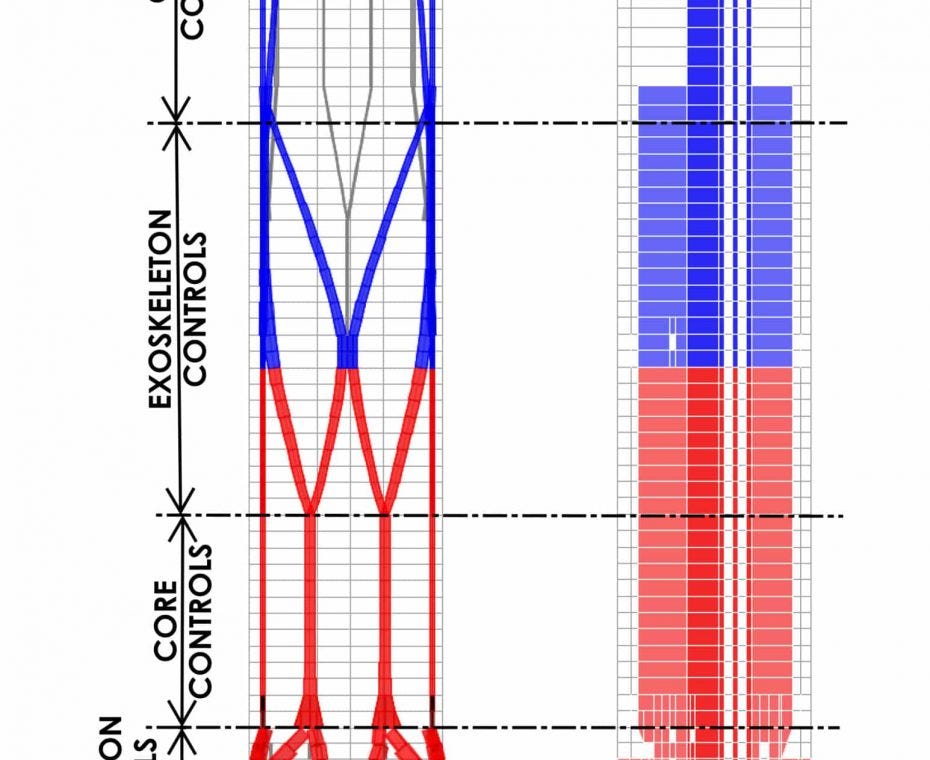
More detail on the total foundation system, as provided by the Concrete Reinforcing Steel Institute(CRSI), can be found below:
Design of the structure’s foundation system was also a challenge for the project team. Even after reducing the typical floor thickness to 11 inches, the slabs remained thicker than a traditional 9 inch thick slab. The additional thickness resulted in higher gravity loads on the foundation system. In addition to gravity loads, the project site is located just south of a 48-story high-rise tower whose foundation system sits only 2-inches away from One Thousand Museum’s property line. All considered, the selected foundation system would have to ensure the least possible tower settlement, to prevent major impact on the adjacent property.
Based on the subsurface conditions and the preliminary soil analysis, the 30 inch diameter, 165 foot deep Auger Cast-In-Place (ACIP) piles were selected. The ACIP had a capacity of 1,050 tons in compression and 250 tons in tension. The tower is supported on a 12-foot-thick deep mat foundation measuring 147-feet-wide by 149.5-feet-deep. The mat foundation is supported on 227 30-inch ACIP piles and it is expected to settle only 2.5 to 3.5 inches in a dish like pattern with the greatest magnitudes in the core. These magnitudes diminish with increasing distance from these areas.
Columns/GFRC
We are all reasonably familiar with typical high-rise construction in the 20th century. By envisioning steel framing and a glass curtain wall hanging on that steel frame, you get the idea.
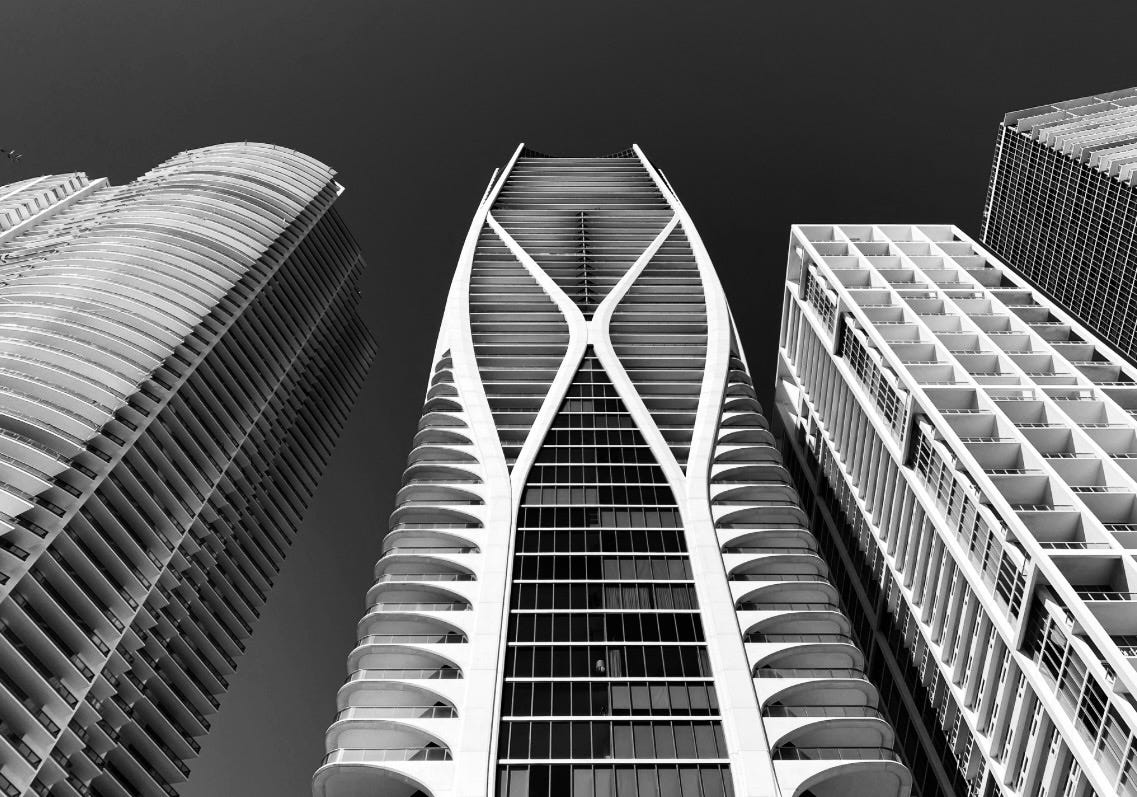
In this ecosystem, columns bear weight, beams span space, and joints transfer loads as needed and planned for. The basic idea was that loads were transferred downward to the foundation and sunken piles. As you can clearly see above, the exoskeleton was anything but vertical.
Another issue would eventually make itself felt. When GFRC panel field adjustments were deemed to be necessary by the on-site personnel, the experts who needed to approve such adjustments were 8000 miles and multiple time zones away from Miami. Taken in isolation, this is certainly not fatal to the project. But each small communication lag inevitably adds up to real delays. Speaking as someone who has been there, a major high-rise build that has fallen behind schedule is not a fun place to be.
But then, more bad things began to plague the project. On March 31st 2016, the legendary designer of the project, Zaha Hadid, passed away in a Miami Hospital. As the design spirit, a piece of the site's soul was lost.
In the late summer/early fall of Miami in 2017, the entire site had to be shut down as Hurricane Irma zeroed in on Miami. On September 10th 2017, the storm arrived as a Category 4 hurricane.
The project withstood Irma relatively well, and the race upwards continued, with the building topping out in early 2018. By mid-2022, the building was reportedly completely sold out.
This success was driven by many of the usual South Florida buyer demographics such as wealthy Central and South Americans and well-heeled Western Europeans. But the bonus for the sellers of ultra-premium real estate was the bonanza provided by northern urban dwellers racing to South Florida during Pandemic times. The Pandemic accelerated remote professional work. Given that new reality, why not relocate to bright, sunny, warm, and hip South Florida? While this provided sales tailwinds, the passing of Zaha Hadid created headwinds, especially given South Florida's hypersensitivity to luxury branding. More on this later.
From the architectural perspective, the reviews of One Thousand Museum have been largely positive.
Thomas Musca, writing in Metropolis Magazine, opined on the work:
Flanked by the aquamarine windows and cookie-cutter balconies of other Miami high-rises, the 709-foot skyscraper, with its Cardi B curves, is downright exuberant. It is an instant landmark, a structure that could have been conceived only by the late Dame Zaha Hadid.
I may not be able to pick Cardi B out of a lineup, but I completely agree with Mr. Musca that adjacent and nearby buildings look quaint in comparison.
The nature of architecture and architects, and more importantly their place in society, is of infinite interest to many of us.
For example, Winston Churchill said this:
We shape our buildings: thereafter they shape us.
I believe architects and architecture should create buildings that draw attention to where we live, which then draws attention to how we live. Etc, etc.
When Arquitectonica produced the building “with a hole in it,” a television show picked it to be featured in episode openings. Those two events helped propel a sleepy South Florida (previously better known for the Jackie Gleason show on Miami Beach) into its current role of international hotspot.
When Frank Gehry built a unique museum in Bilbao, huge swaths of the planet learned where Bilbao was and who the Basques were.
Today, the initial building sell-out was presumably a big win for the developer. However, the resale market, a benchmark of the relative success of the buyer's investment, has perhaps not been so great. This is a Gordian knot of facts and/or propaganda, given the viciously competitive, zero-sum game that is the South Florida luxury real estate market. After all, there is a fairly shallow pool of buyers for 50 million apartments. On a morbid note, it is totally reasonable to factor in the loss of short-term cache the building may have experienced in unit resales with the passing of the famous architect.
No posts
Comments
Nothing yet. Say the first thing.
Sign in to join the conversation.