
You have probably seen the argument by now: neoclouds like CoreWeave and Nebius are structurally fragile because GPU depreciation cycles are too short. Chips go stale, you have to keep buying new ones, the earnings look bad, the model breaks. It is the most common bear thesis on the entire AI infrastructure complex, and it shows up in every investment analyst note and X thread on the space.
The framing is wrong. Not because the depreciation math is wrong — it isn’t — but because depreciation cycle length is not an independent variable. It is a downstream signal of demand. Short cycles can mean demand has collapsed, or they can mean demand for the newest generation is so strong that the TCO gap forces upgrades. Long cycles can mean demand has died, or they can mean demand is so insane that even Hopper-era silicon runs at full utilization. Two of those four scenarios are bear cases. Two are wildly bullish. The debate conflates them which I will shed clarity in this post.
The depreciation cycle length debate is really just a proxy for one underlying question: how long does AI demand stay real? That is the only variable that actually matters. Map out all four scenarios, set aside the demand-is-dead ones that nobody actually believes, and what is left is two real scenarios — both net positive for the GPU ecosystem, and both with non-obvious distributions of who wins inside that ecosystem.
In this post, I will walk through the system-level TCO mechanics that drive neocloud upgrade decisions that cause large depreciation in their income statements in the first place, the four scenarios that explain what short and long cycles actually signal in terms of AI demand, the accounting-versus-unit-economics split that hides actual good unit economics in neoclouds like CoreWeave and Nebius, the supply physics and supplier relationships underneath, and the hidden-asset framing that explains why some neoclouds survive strong-AI-demand scenarios while others get ground down.
Before walking through the scenarios, one piece of foundation that does most of the work downstream — Total Cost of Ownership (TCO), and how Nvidia/Broadcom frame new the cost of running workloads on newer generations of AI accelerator systems.
Nvidia is not selling chips anymore. They are selling complete systems — chip plus interconnect plus rack architecture plus power and cooling design plus the software stack on top. When people talk about a “Blackwell GPU” they are usually picturing a chip, but the unit Nvidia and its largest customers actually transact on is a full system: a Kyber rack populated with Blackwell silicon, paired with NVLink and InfiniBand networking, water-cooled, drawing a defined power envelope, running CUDA and the Nvidia software stack. The system is the product.
This matters because the economic argument only makes sense at the system level. Nvidia’s pitch is that even though a new Blackwell system costs two to three times more upfront than a Hopper system, it is cheaper to operate per useful unit of work — lower TCO over time, energy, and token throughput given the same model and workload. The savings come from the whole stack, not the chip:
Energy — newer racks deliver dramatically more compute per watt.
Cooling — liquid-cooled designs are far more efficient than older air-cooled racks.
Density — more compute per square foot of data center, which lowers real estate cost.
Software — each generation gets faster on the same workload as CUDA and the Nvidia libraries improve.
Reliability and maintenance — newer systems fail less often and are designed for serviceability.
Nvidia has explicitly reframed the industry conversation from “cost per chip” to two system-level metrics: performance per dollar and performance per watt — TCO. Together those define how much useful AI work a system produces per dollar of total cost — and the generational gap on those two metrics is huge.
That gap is what forces neocloud upgrade decisions and why neoclouds are constantly acquiring newer generations of AI accelerator systems. Without it, depreciation schedules would be an accounting choice. With TCO in mind, they are a competitive choice in efficiently running AI workloads in neoclouds. If a competing neocloud runs newer AI accelerator systems can serve the same model and workload at a fraction of operating cost, neoclouds have to upgrade, otherwise a neocloud will lose on pricing and efficiency. So the depreciation cycle length is downstream of the system-level TCO gap, which is in turn downstream of how strong demand is for newer Nvidia systems, which in turn is a downstream demand for how strong AI demand overall, which in turn is a strong read-through to why neoclouds are structurally undervalued at current valuations.
That is the context-setting to ensure we’re on the same page with TCO. Now, I walk through the scenarios and my lines of thought on why I have this perspective.
The common complaint against neoclouds assumes one direction of causation: short cycles cause bad economics. But once you map out what short or long cycles actually signal about demand, the causation flips the other direction. There are four scenarios — two for short cycles and two for long cycles — depending on whether demand is strong or dead.
The real world is of course a blend. Training frontier models forces operators onto the newest systems; inference at lower SLAs happily runs on Hopper or even Ampere systems for years. But the four scenarios are useful for thinking about which forces dominate.
Scenario 1: Short depreciation cycle because there is no demand. Chips get retired fast because nobody wants to run workloads on them. AI demand has dried up. The true bear case — but we all agree AI workload demand is real, so I won’t dive deeper into this meaningless scenario.
Scenario 2: Short depreciation cycle because demand for new Nvidia systems is too strong. This is the real short-cycle scenario. Operators are being economically forced to upgrade because newer Nvidia systems deliver so much better TCO that running old ones becomes uncompetitive. If your competitor upgrades to a Blackwell-on-Kyber system and you are still on Hopper, they can serve the same AI workload at a fraction of your total operating cost. You either upgrade or you lose on price.
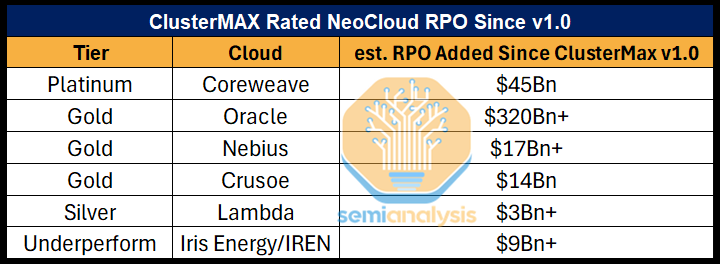
Neoclouds might look like they are on an upgrade treadmill here, but the scenario is good for them. High AI demand means their capacity is always full. Yes, aggressive depreciation compresses reported margins — this is the common diss against CoreWeave and Nebius, and it has the same shape as the common diss against OpenAI and Anthropic: earnings look bad because of accounting artifacts from constant prep for the next generation, but unit economics are good. They could stop reinvesting tomorrow and the earnings picture would look beautiful, but that is like Amazon stopping AWS buildout after one generation of data center infrastructure to make the income statement look pretty. That obviously did not happen, and it is not going to happen for neoclouds either. The earnings look bad because the reinvestment opportunity is massive, and the unit economics underneath are what make that reinvestment a no-brainer.
And critically, the broader chip ecosystem — Nvidia, but also Broadcom and the custom ASIC designers — has every incentive to prioritize neoclouds. Neoclouds buy at full price, absorb every new generation faster than the hyperscalers do, and do not turn around and negotiate aggressive multi-year price cuts or threaten to design their own silicon to escape the relationship. The hyperscaler relationships are notoriously tense in exactly this way — there are recurring X reports of pricing friction between Google and Broadcom on each generation of co-designed TPUs, including reports that Google has wanted to ditch Broadcom by 2027 to save billions and has brought MediaTek and Marvell in as leverage. Chip designers naturally channel more allocation, more co-design attention, and more pricing flexibility toward the junior neoclouds that behave like ideal customers, not adversaries.
Scenario 3: Long depreciation cycle because demand has dried up. Chips last 8 to 10 years because nobody wants the new ones. AI demand has collapsed and operators are milking old assets. Same bear case from the other side — but again, we all agree AI workload demand is real, so I won’t dive deeper into this meaningless scenario.
Scenario 4: Long depreciation cycle because demand is crazy strong. This is the real long-cycle scenario, and the one Gavin Baker recently flagged on a podcast as a real possibility. My read is that this only happens if demand is genuinely insane at both ends — end-AI demand pulling every GPU into service, and demand for the newest Nvidia systems so strong that new supply stays constrained. According to Google Cloud, old Ampere and Hopper systems still run at full capacity even at 6 or 7 years old. Hyperscalers have indicated that systems of that vintage are still at full utilization. The TCO on these older systems is genuinely worse (worse performance and energy serving 2026 frontier models), but operators run them anyway because (1) there isn’t enough new Nvidia supply to go around and (2) the demand from inference workloads are so real that they can still be profitably run on older chips.
And the supply constraint is not just a today problem. The whole stack underneath Nvidia is physics constrained, not software-bits constrained — TSMC on the foundry side, ASML, Applied Materials, KLA, Lam Research, Tokyo Electron and the rest of the semicap ecosystem on the tool side. You cannot 10x a fab the way you can 10x a software deployment. Supply tightness on leading-edge nodes is structural for the foreseeable future, not a transient ramp issue.
This is bullish for neoclouds because older assets keep generating cash flow longer than expected, which materially helps both reported margins and unit-level returns. And it is still bullish for Nvidia because new frontier capacity still requires new system purchases at full price the moment supply becomes available.
The only bad scenarios above for both short and long depreciation cycles are the two “demand-is-dead” scenarios, and nobody serious believes those given that AI adoption is real and have measurable impact. As mentioned, I won’t dive deeper into those two scenarios.
For the other two real scenarios mentioned above — whether cycles end up short or long due to “demand-is-strong” situations — are net positive for the GPU ecosystem. Nvidia wins in the short-cycle world via forced upgrade revenue. Neoclouds win in the long-cycle world via extended asset lives. And in the short-cycle world, neoclouds are not the losers they appear to be on paper, given the demand environment and the chip-ecosystem alignment.
The depreciation cycle length debate is really just a proxy for one underlying question: how long does AI demand stay real? That is the only variable that actually matters. In both of the real scenarios above, the paradox of both short and long depreciation cycles imply demand-is-strong scenarios.
So far the argument has treated neoclouds as a monolith. They are not. The obvious pushback to the bull case on Scenario 2 is: if neoclouds are just execution treadmills, what separates CoreWeave and Nebius from weaker players who get ground down on TCO every generation? The answer is relationship capital — and it applies across both real scenarios.
Buffett has talked for decades about how traditional accounting misses a company’s most important assets. In his era the classic example was a consumer brand like See’s Candies or Coca-Cola. The brand does not appear on the balance sheet, but it is worth billions because it creates pricing power and consumer habit that competitors cannot replicate just by spending money. He extended this thinking to other hidden assets too — a key person, a proprietary process. More recently, Amazon’s and Google Maps’ accumulated review inventory gave been recognized as the same kind of hidden asset: not on the balance sheet, but it makes consumers trust Amazon’s marketplace and Google Maps more than any competitor’s, and it cannot be replicated even with unlimited capital.
For Nvidia, Jensen’s personal relationships across the foundry ecosystem, the data center power and cooling contractors, and the hyperscaler C-suites are not on any balance sheet. But they are worth an enormous amount. Jensen can move supply, shape roadmaps, and get things done in ways a less connected CEO simply cannot. We’ve already seen this play out in how Jensen has adeptly secured not just fab capacity at TSMC, but raw materials capacity from Asian suppliers further upstream — glass substrates, ABF film and the packaging substrates built from it, and the rest of the advanced packaging materials chain where supply is concentrated in Japan, Taiwan, and South Korea. That relationship network centering on Jensen is a hidden asset of Nvidia that does not show up in any financial statement but is a core reason the company operates the way it does. For historical validation, we have seen the same pattern of strong CEO-centered industry relationships function as hidden assets for Henry Ford, Mark Leonard at Constellation Software, Jack Welch at GE in the 1980s and 1990s, Elon Musk, and Henry Singleton at Teledyne, among others. The pattern is durable across decades and across industries.
For CoreWeave and Nebius, the same logic applies one level down. Their deep supplier relationships with Nvidia put them high in the allocation priority queue — not literally ahead of the largest hyperscalers in absolute volume, but ahead of every undifferentiated GPU rental shop, and treated as a strategic counterweight to the hyperscaler-ASIC pressure described earlier. Given that supply tightness is structural, being high in that queue is a durable advantage, not a one-cycle perk. Their relationships with data center contractors and infrastructure financiers also let them build and finance capacity faster than competitors. None of this appears on their balance sheets. But in Scenario 2, where the upgrade treadmill is running fast and execution speed determines who survives, these hidden assets are the actual hinge. Undifferentiated neoclouds renting spot GPUs with no relationships get ground down. CoreWeave and Nebius stay ahead because they sit consistently near the front of the line among the operators who actually matter to Nvidia.
The hidden asset framing also explains why this is hard to replicate. A new entrant cannot buy their way into Jensen’s/Hock Tan’s/Lip Bu’s network or into CoreWeave’s/Nebius’s position in AI accelerators’ allocation queues. Those assets were built over years of relationship and volume. Just like you cannot replicate Amazon’s or Google Maps’ review trust with a marketing budget, you cannot replicate these ecosystem relationships with capital alone.
Everything I have argued above is to say that financial engineering and supplier relationships are real, durable, underappreciated additional strengths for CoreWeave and Nebius. None of it is to say that those are the sole moats or the primary edge. They are not.
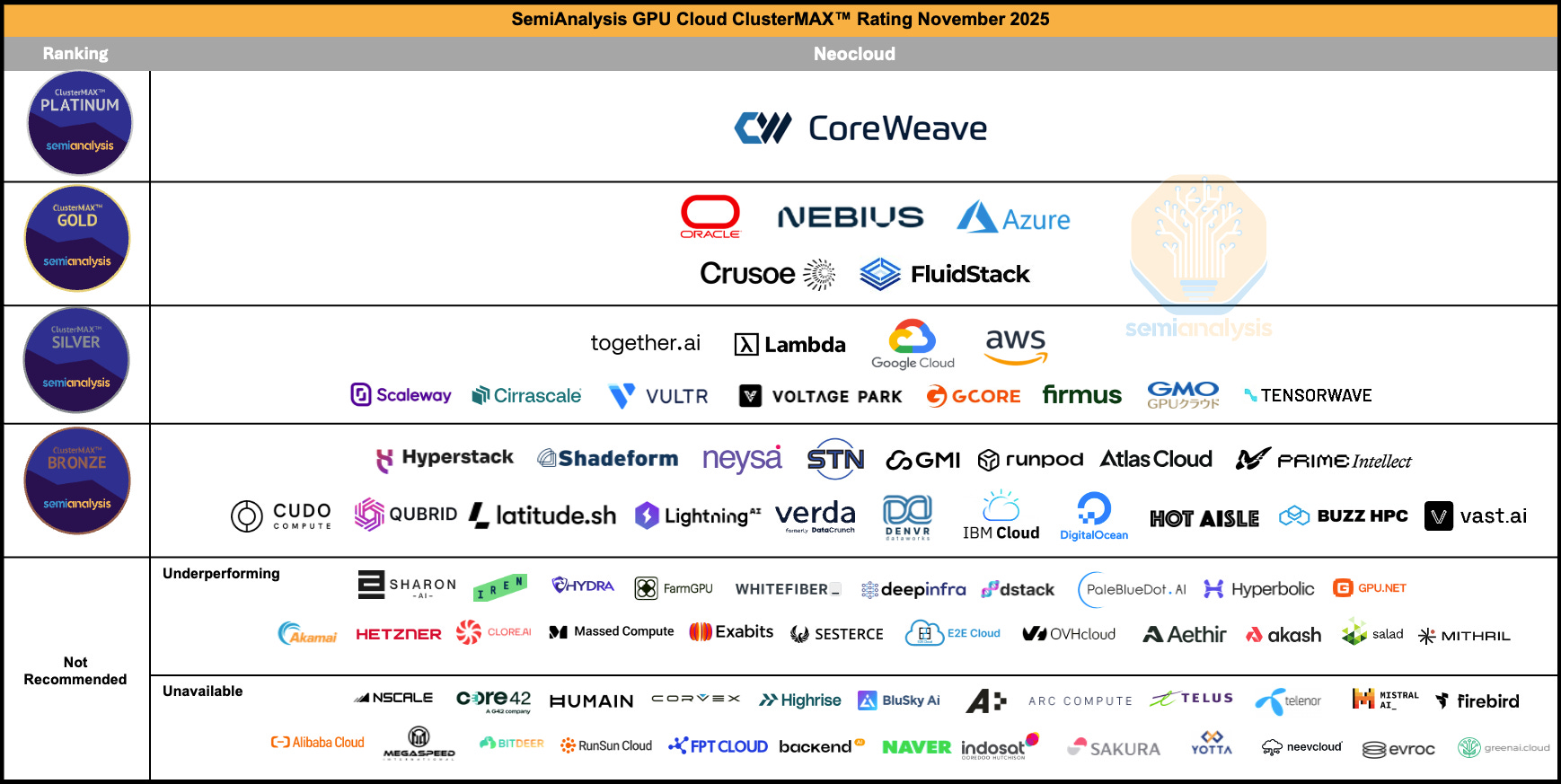
The primary edge of neoclouds is execution. CoreWeave and Nebius earned their positions in the Nvidia allocation queue, the financier relationships, and the customer roster in the first place because they run superb data center operations and launch new cloud services — bringing new sites online faster than competitors, delivering higher cluster reliability, hitting tighter SLAs on AI workloads, and increasingly extending that operational excellence up the stack into actual cloud services. CoreWeave’s and Nebius’s growing software and platform offerings are not afterthoughts. They are the reason these companies show up at the top of SemiAnalysis GPU Cloud ClusterMAX ratings, and the reason hyperscaler-grade customers are willing to run frontier workloads on them in the first place.
I have a lot of respect for the product and engineering teams at both companies — the quality, the service, the integration depth. The relationship-capital argument is meant to explain what compounds on top of that execution, not to replace it as the explanation. If the underlying execution were not excellent, no amount of relationship capital would have gotten either company to where it is. Hidden assets compound on visible ones.
The four-scenario framing is useful, not a complete model. A few honest caveats.
The accounting drag is real, even when unit economics are good. Saying earnings look bad “because of accounting artifacts” is true, but public markets price off reported earnings, not just unit economics. CoreWeave and Nebius will trade with significantly more volatility than their underlying cash generation justifies, particularly into and out of each generation transition. From first principles analysis of AI demand and depreciation cycles that we just did, we see that a close-enough behavior analogy the market will play out is the AWS analogy. However, it took Amazon roughly a decade for the market to fully internalize that AWS reinvestment was building durable infrastructure rather than destroying it. Neoclouds may need a similar adjustment period, and shareholders have to be willing to sit through it.
The chip ecosystem’s prioritization of neoclouds is contingent on hyperscaler tension persisting. Building on the dynamic described earlier — Nvidia, Broadcom, MediaTek, Marvell, and the rest of the chip designers have every reason to keep prioritizing neoclouds. Their hyperscaler relationships are tense, full of pricing fights and credible insourcing threats, while neoclouds buy at full price, absorb generations fast, and behave like ideal customers. Whether Nvidia systems or custom silicon systems take more share over the next several years, the favorable chip-and-fab allocation, co-design attention, and pricing flexibility should extend across the chip ecosystem. The caveat is that all of this is contingent on the hyperscaler tension persisting. If hyperscalers and their co-design partners ever land on durable, mutually agreeable terms — multi-year price stability, clear roadmap commitments, no more insourcing threats — the neocloud allocation premium becomes less valuable. The TPU-versus-Broadcom-versus-Nvidia dynamic shows the tension is structural, not a one-off. But “structural” is not “permanent,” and a thesis leaning on adversarial commercial dynamics is worth naming as such. In my opinion, this case is unlikely, because the hyperscaler-vs-AI-accelerator tension is the equilibrium of the relationship, not a temporary phase. Hyperscalers have a permanent incentive to keep insourcing pressure on chip designers — cost, control, strategic differentiation — and chip designers have a permanent incentive to defend pricing power and avoid commoditization. Neither side has reason to disarm. As long as that equilibrium holds, the favorable treatment of neoclouds holds with it.
Relationship capital is the most non-obvious risk, not just the most non-obvious asset. Hidden assets are hidden in both directions. The same supplier network that gives Nvidia, Broadcom, Intel, and their priority neoclouds structural advantages also concentrates execution risk in a small number of personal relationships. If key executives like Jensen Huang at Nvidia, Tan Hock Eng at Broadcom, or Tan Lip Bu at Intel step back; if a key supply chain relationship at TSMC, ASML, or Corning sours; if the CoreWeave executives who built the Nvidia, Delta, Vertiv, Comfort Systems, and Quanta Power relationships leave — the hidden asset can erode quickly, and there is no accounting line to flag it. In my opinion, this case is unlikely, because the relationship capital sitting inside several-dozen-billion-dollar neoclouds is more durable than any single person. Relationship capital has become institutional to these mid-large cap neocloud participants. The Nvidia/Broadcom/Intel allocation team, the financier rolodex, the power supply chip web, the data center contractor networks — these are now teams, processes, and standing relationships, not one executive’s contact list. Institutional relationship capital typically does not depend on a single chair staying filled.
Earnings thinking: depreciation cycles are an income statement problem.
Unit economics thinking: depreciation cycles are a demand signal.
Also, this is what first-principles thinking does in understanding new market paradigms: it lets you surface stronger analogies than the ones the market is reaching for by default.
The accounting-versus-unit-economics split is just AWS one industry over. The relationship-capital argument is just See’s Candies and Amazon reviews one layer up the stack. The market has access to all of these. It just isn’t building the bridge, because the surface framing — “short cycles are bad for the business model” — is already there and feels self-evidently true. First principles is how you get past framings that feel self-evident, and analogies are how you stress-test the answer you find on the other side. I have to thank my friends Akash Singhal and Ganeshkumar Ashokavardhanan for encouraging me to think in both terms — first principles and analogies — simultaneously to understand the neocloud ecosystem better. I also have to thank my friend Juan-Lee Pang at CoreWeave for helping me sharpen my understanding in this space by being a good listener and sounding board.
The whole debate over whether GPU depreciation cycles will crush the neocloud business model has been argued at the wrong layer of the stack. It is not really about depreciation. It is not really about how long a chip lasts. It is about whether AI demand is durable — and conditional on that, about which operators have the hidden assets to sit inside the ecosystem of allocation, co-design, and infrastructure financing relationships that decide who participates in the upside. That is a much narrower and much more answerable question than “are short cycles good or bad,” and it is the question the income-statement framing actively obscures.
If you found this useful, I write about AI infrastructure, the macro shape of the buildout, and the technical decisions that determine who wins inside it. Subscribe for more.
No posts
Comments
Nothing yet. Say the first thing.
Sign in to join the conversation.