
There is a pattern hiding in plain sight across every major technology transition of the last thirty years. It doesn’t get named often, but once you see it, you can’t unsee it.
Anything that can be capitalized eventually becomes operationalized — for predictability.
It has played out in infrastructure. In labor. In licensing. In airplanes too. Each time, the driver is the same: CFO logic. When a capitalized function can be reliably sourced externally and priced predictably, the market operationalizes it. Every time.
AI is now running that same playbook — but on two things at once. Not just on how software is produced, but on who produces it.
In this post, I’ll define the pattern precisely, walk through three historical examples that prove it, and then show why it’s happening again right now — simultaneously — to software production itself and to human capital.
Capitalized means a cost treated as an asset — recorded on the balance sheet, amortized over time, built once and monetized repeatedly. The defining feature is the upfront commitment: you pay now to own something durable. The risk is yours. The asset is yours.
Operationalized means a cost treated as a recurring expense — paid as you go, variable with usage, sourced from a vendor rather than owned outright. The defining feature is flexibility: you pay only for what you consume. Risk transfers to the provider. You give up ownership in exchange for predictability. Operationalized expenses also typically have the benefit of being easier to gain spending approval compared to CapEx costs.
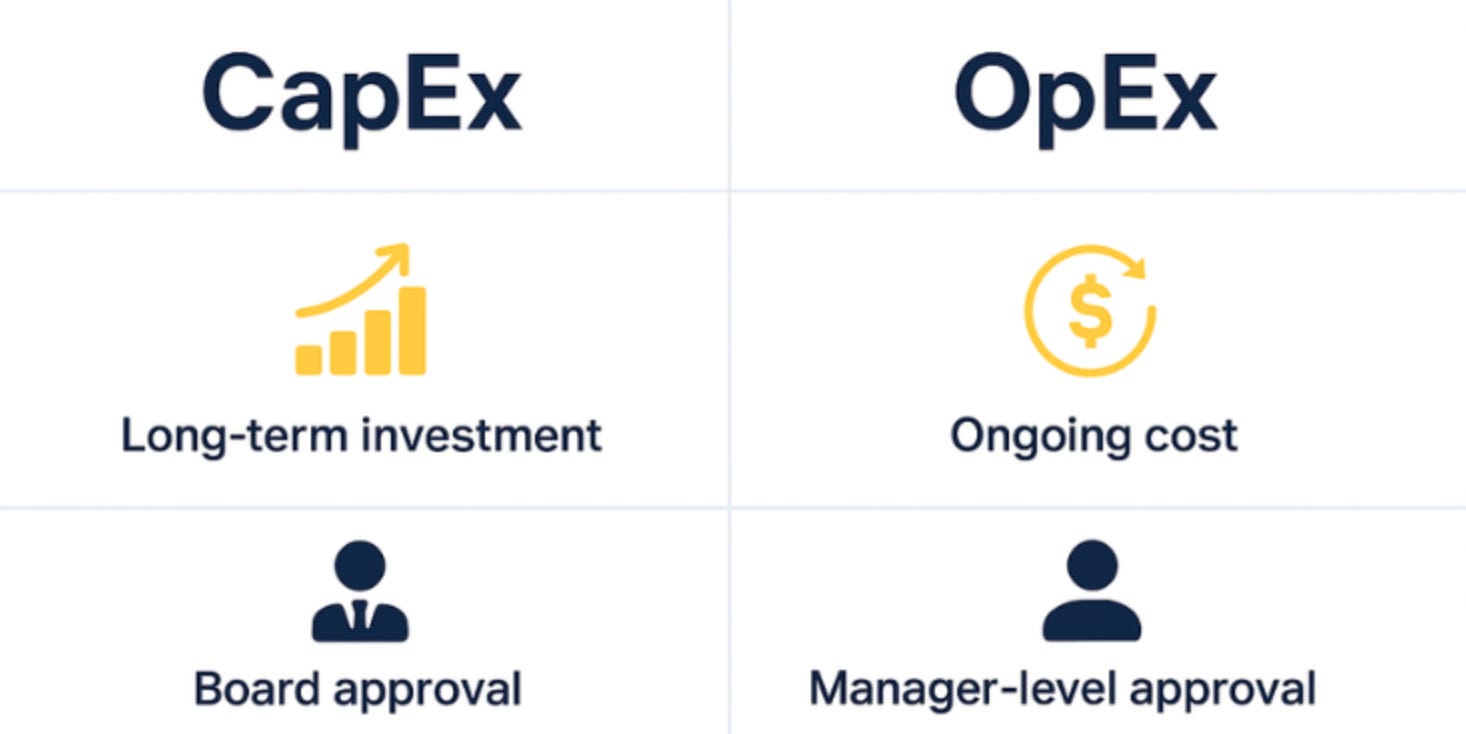
The migration from one to the other follows a consistent logic: variable costs are easier to budget, easier to cut, and easier to scale than fixed commitments. When a capitalized function can be reliably sourced externally and priced predictably, the market eventually operationalizes it.
On-premise servers → Cloud
Companies used to own their data centers. Racks, cooling, power, depreciation schedules — all of it capitalized on the balance sheet as fixed assets. Then Amazon Web Services (AWS) arrived with a simple offer: pay per hour, scale up and down, own nothing. The hardware that took years to procure and amortize became an OpEx line on a monthly invoice. The migration wasn’t primarily technical. It was financial. CFOs moved CapEx to OpEx because variable cost structures are predictable in the way that capital investment cycles are not.
In-house labor → Outsourced services
Full-time product and engineering headcounts are fixed cost commitments — salary, benefits, severance, onboarding time. When those functions could be reliably sourced externally — offshore development shops, staff augmentation firms, managed service providers — companies substituted the fixed cost with a variable service contract. The capability stayed. The capital commitment disappeared. Risk transferred to the vendor.
Perpetual software license → SaaS subscription
The old software model asked buyers to pay a large upfront license fee to own the software indefinitely. That’s a capital commitment — justified by the assumption that you’d use it long enough to amortize the purchase. SaaS replaced that with monthly subscriptions. Buyers got flexibility and predictability. Vendors got recurring revenue. The capitalized purchase became operationalized consumption.
In each case, the sequence is identical: a function starts as a capital asset with upfront cost and fixed commitment. The market develops reliable external supply. The function migrates to variable operational expense. The CFO prefers it. The balance sheet shrinks. “Asset light businesses” were in vogue for decades, driving boards to demand asset light operationalization in lieu of CapEx from management teams. Predictability wins. Financials and stock charts smooth out.
Owned assets → Sale-leaseback
The private equity (PE) world is full of this phenomena. Let’s take airlines as an example. Airlines would sell their aircraft — capitalized assets on their balance sheets — to GE Capital (rest in peace), Air Lease Corp, or AerCap. Airlines would then lease them back (rent these planes that they just sold a minute ago) at a fixed monthly rate. The plane didn’t move. The route didn’t change. But overnight for indebted “asset-heavy” airlines, a capital asset became an operational expense, the balance sheet of airlines shrank, and airline CFOs booked predictable lease payments instead of dealing with timing capital investment cycles and depreciation schedules. That’s the whole raison d’etre for companies like Air Lease Corp and AerCap (for engine fuselages), as well as for FTAI and Willis Lease Finance Corp (for engines) — allowing airlines to lease fuselages and engines from these PE-oriented firms instead of owning them outright.
GE Capital itself ran the same playbook across real estate and industrial equipment, growing to contribute nearly 60% of GE’s total profits at its peak — until the financial engineering unraveled in 2008 and nearly took the entire company down. The incentive was never operational. It was always financial: convert owned assets into predictable cash flows, clean up the balance sheet, and let someone else hold the risk.
AI is running the same playbook simultaneously on two distinct things: the software itself, and the humans who build it. These are not the same argument. They are two independent operationalization events happening at the same time, to adjacent parts of the same production system.
Software production → AI-generated on demand
The traditional software economics model worked because development cost was fixed and marginal cost was near zero. You paid once to build something, and you could distribute it to a million users without building it a million times. That structure made software the best business model in history — 80%+ gross margins, infinite leverage on fixed development cost.
AI breaks both halves of that equation simultaneously. Stripe CEO Patrick Collison put it plainly on TBPN last week: “Software should be like pizza — cooked right then and there at the moment of use. You don’t want mass-produced industrial scale software. You want bespoke custom software made for you, that moment.” He called it the “non-Walrasian software regime” — a reference to the classical economics assumption that marginal cost approaches zero. For traditional software, that assumption held for thirty years. AI ends it.
Every AI-native invocation produces a fresh output, custom to that user, at that moment. The marginal cost is not zero — it’s real compute, real token spend, real expense at the moment of consumption. The “build once, amortize forever” model is over. What replaces it is the same structure that replaced the data center: pay per use, variable with consumption, expensed in real time.
Software production has moved from a capitalized asset (involving upfront development costs from product managers and engineers) to a metered utility function (just-in-time generation of custom software). We’re already seeing moves in that direction from Anthropic from their MCP Apps demo. Take note in the demo below, the traditional SaaS vendor (in this case, Figma) presents a custom UI to the user (just-in-time) when the user asks something relevant in Claude.
Human capital → Agentic inference spend
The second operationalization is less obvious but equally significant. Product and engineering headcount have always been capital commitments in practice, even if they doesn’t appear on the balance sheet as a formal asset. You hire product managers and engineers to build things — capitalized software, internal tools, proprietary systems — that accumulate as organizational assets (organizational human capital) over time. The headcount is the means of production. The software they produce is the asset being created.
AI agents are now substituting for those functions in software production directly. Instead of hiring a PM or an engineer to build a feature — a fixed cost human capital commitment that produces a capitalized software output — you run an agent to generate the output on demand, paying inference per task. There is no capitalized intangible being created and amortized. There is only operational compute expense, running in real time.
The accounting shift is identical to the outsourcing transition: a fixed capital commitment replaced by a variable operational expense. The capability stays. The headcount human capital has been operationalized to agentic expenses. But unlike prior outsourcing cycles — where you were still commissioning humans to build durable artifacts — agentic substitution operationalizes both the labor and the output simultaneously. Nothing accumulates. Nothing amortizes. The production function runs, the output is consumed, and the expense clears.
Human capital is being converted from a means of capitalized production into a metered agentic operational cost — billed per inference, not per salary.
This does not mean mass layoffs of the kind making the rounds on X (such as the viral Citrini post). Jevons paradox applies here: when the cost of a capability drops, total consumption of that capability tends to expand, not contract. Steam engines didn’t reduce coal consumption — they made energy cheap enough that demand exploded. The same logic holds for software production. As the cost of building software collapses toward inference spend, the volume of software being demanded — the number of workflows automated, products built, features shipped — expands faster than headcount contracts. The pie grows.
What shifts is the composition of the work. Agents handle execution. Humans move up to architecture, system design, task direction, and output validation — the judgment layer that agents cannot yet own. Software demand doesn’t disappear. It moves up the stack and expands in volume. The engineers and PMs who thrive are the ones who learn to direct agents the way senior engineers once directed junior ones.
That said, history is equally clear on what happens to the existing “elite” gatekeepers who don’t adapt. During each of these transitions, highly-paid incumbents faced real and sustained wage pressure — not full elimination, but relegation to nichecraft. Master blacksmiths didn’t fully disappear when industrial steelworking scaled. Blacksmithing by hand shrunk en masse, while those that adapted were pushed into niche artisanal craft, commanding premium prices for an ever shrinking market — all while the center of gravity in metallurgy moved to steel mills and mechanical engineers. When electricity replaced steam, boiler operators who didn’t retrain watched their expertise go stale — even as energy consumption exploded — until the last holdouts commanded high pay maintaining a fleet nobody was expanding.
The same slow burn is coming for PMs and SWEs who don’t adapt. It may look like a wave of layoffs (such as at Block and WiseTech). However, what I think is more likely is a freeze then slow burn — headcount not backfilled, roles quietly consolidated, comp bands compressed for anyone whose work an agent can now approximate. The gatekeeping power erodes gradually over the long tail. The PMs and SWEs who don’t move up the stack will find themselves commanding premium rates for an aging way of working — the storied “COBOL engineers with $1M in salary” in the coming decades of the AI era, niche and well-compensated, but no longer at the center of anything.
There is one counterforce to my argument worth naming. Capital markets crave predictability — and inference costs are still volatile, for now, for my thesis to play out. If the whole point of operationalizing a function is to convert fixed commitments into predictable variable expense, AI inference doesn’t fully deliver that level of smooth financials yet. GPU and LPU (language processing unit) pricing are still shifting. Energy costs for white collar work are still expensive in watts per token terms. The model frontier and models economics are still being repriced.
But as watts-per-token drops and AI inference expenses stabilize, re-bundling becomes viable. Variable inference gets packaged back into fixed, predictable contracts — making what’s metered underneath look like a familiar commitment at the surface. This could take several forms: fixed-price agent worker contracts, priced like a salary for a worker that needs no vacation and runs 24/7; or fixed-price outcome-based pricing, where you pay an AI agent a flat rate for 100 customer cases reviewed or 500 PRs merged. Operationalized consumption-based pricing under the hood; but financially re-capitalized into terms easier to commit to at the contract layer.
That’s not a contradiction of the thesis. It’s the pattern completing its loop.
The same CFO-driven logic that emptied data centers, hollowed out in-house IT teams, and killed perpetual licenses is now running simultaneously on capitalized software production and on the human capital consisting of product managers and engineers that built software. Both (1) the capitalized nature of software production and (2) upfront capitalized hiring of PMs/SWEs are being converted from capital commitments into metered operational expenses. Both are being sourced on demand. Instead of upfront capitalization, both will be expensed in OpEx in real-time APIs. This is not a matter of if, but when.
No posts
Comments
Nothing yet. Say the first thing.
Sign in to join the conversation.