
Note: This is my Orange County Register column about my old friend and mentor, Russell Kirk. Subscribe to my great newspaper here, only $2 for 2 years online.
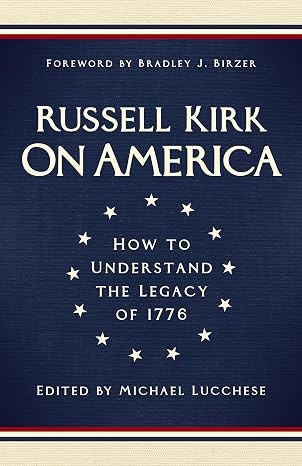
“On America: How to Understand the Legacy of 1776” is a new collection of essays by the late philosopher Russell Kirk. His classic 1953 book, “The Conservative Mind,” helped form the worldview of generations of conservatives, including President Ronald Reagan.
Kirk also was my teacher at Hillsdale College, then my mentor and friend. He died in 1994.
Kirk greatly admired Edmund Burke, the 18th-century British statesman and early conservative thinker. In his essay, “A Revolution Not Made, but Prevented,” Kirk engages with Burke’s contemporaneous observations of both the American and French revolutions.
In his March 1775 “Speech on Conciliation with America,” Burke called for peace, not war, because a “fierce spirit of liberty is stronger in the English colonies probably than in any other people of the earth.” In Kirk’s interpretation, the “patriots intended no radical break with the past,” but instead “thought of themselves as conservators rather than as innovators” of English liberties dating back to the Magna Carta of 1215.
By contrast, Burke, in his 1790 book “Reflections on the Revolution in France,” denounced the later revolt’s bloodshed based on abstract principles and Madame Guillotine. Those extremes, as Kirk put it, brought “the destruction of the fabric of society.”
Other essays by Kirk cover early American culture and how the founders sought to implement the values of our revolution.
While of course admiring Thomas Jefferson and the Declaration of Independence, Kirk also commended the political writings of John Adams as a counterweight to Jefferson’s tendency toward abstractions and pure democracy. Adams “entertained no exaggerated opinion of the wisdom and virtue possessed by the mass of mankind,” observed Kirk. “He taught the value of good and practical laws, transcending the passions of the hour.”
In another essay from 1989, Kirk warned that a potential American Caesar might arise from a combination of “monstrous debt,” a “second military defeat as serious” as the Vietnam War, and a “prolonged paralysis of the federal political structure.” A Caesar would “stride forward” and “be a vulgar autocrat, as Lyndon Johnson was.”
“Certain national difficulties and dangers exist today that, in unhappy circumstances, could cause the majority of the American people to turn to some potential Caesar—so long as that Caesar, like the original Julius, should wear an egalitarian mask,” he warned.
Also included in the book is a speech Kirk gave at the Heritage Foundation, which I happened to attend. Speaking of President Ronald Reagan, Kirk said the president’s “most remarkable quality” was, “at a time of life when nearly all men become timorous, Reagan’s gift of audacity seems undiminished.”
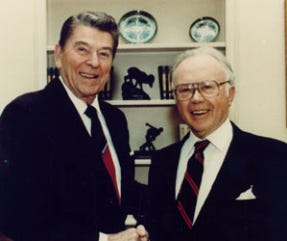
Kirk commended Reagan’s large tax cuts. And, in contrast to the “namby-pamby” approach and soft words of predecessor Jimmy Carter on communism, Kirk praised Reagan for confronting the menace of the Soviet Union at the height of the Cold War. The Gipper himself predicted “the march of freedom and democracy which will leave Marxism-Leninism on the ash heap of history.”
We know the results: Reaganomics produced the 1980s boom, as even Democrats now acknowledge. And just nine months after Reagan left office in January 1989, the Berlin Wall fell.
Reading this book, I can still hear my old friend’s voice. You can, too, in “On Revolution” and other lectures on YouTube and elsewhere. Also check out the Russell Kirk Center for Cultural Renewal, whose president emerita is his lovely wife, Annette.
Enjoy a Russell Kirk semiquincentennial.
No posts
Comments
Nothing yet. Say the first thing.
Sign in to join the conversation.