
“And these are the days when our work has come asunder / And these are the days when we look for something other”
(U2, “Lemon”)

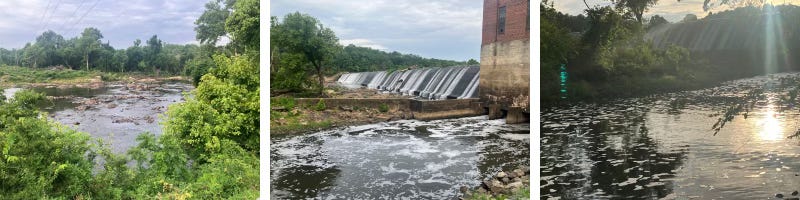
Last weekend, I took the kids on a semi-last minute, ultra fast trip to Saxapahaw, North Carolina.
For more than twenty years — roughly my tween years to mid-30s — my dad and stepmother lived just south of the old mill town at the top of Greenhill Road, a two lane country road that dipped down over a small creek enveloped in kudzu, slipped past farmhouses and barns and brick ranchers, and ended — for me, anyway — at Chatham Friends Meeting. I had memories here, and the gravesite where my dad, then my stepmother, were laid to rest.
It’s a good place to rest.
And it’s a good slice of America, one of many diverse slices I’ve found over the years. This one is generally more conservative, absolutely more rural, rooted in Quaker tradition, close-knit and neighborly. It was a good place to transition from awkward tween to punk rock teenager, and for a young man to say goodbye to his dad.
Since my stepmother died in 2003, I’d been back exactly three times. This time, I brought both my kids. Returning to a familiar place but creating new memories.
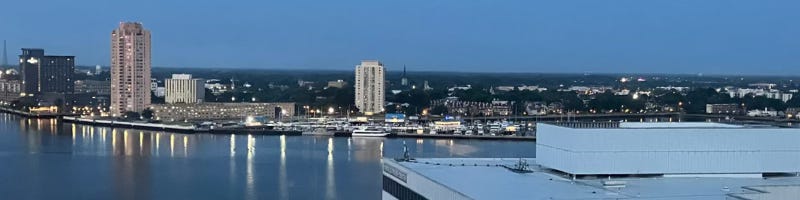
I recently made a commitment to find a space outside of my house to read actual books printed on paper.
Last week, I was in Norfolk for work, and took Fab 5 Freddy’s biography to dinner with me. I saw the waitress side eye me as she glanced down at the book I was carrying — a vibrant blue cover with a close up of a cool Black dude in a fedora and shades.
“You know him?” I asked, handing her the book. She shook her head, and skimmed the back blurbs.
“He was a graffiti artist in New York in the late 70s. From Brooklyn,” I said. “I remember when he used to host Yo! MTV Raps back when music videos were a thing.”
“I’m from the Bronx,” she said, handing the book back. “If you finish it during dinner, you can give it to me to read.”
I didn’t finish it. But I should probably mail it to the restaurant when I’m done.
This week’s a kids week so I’ll be reading closer to home. I’m still moving through “Everybody’s Fly” by Freddy, and starting “Gilead” by Marilynne Robinson. Next week, I’m going to hang out in Shafer Court after the Rachel Beanland book launch and get started on “Tomorrow, Tomorrow and Tomorrow” by Gabrielle Zevin. Bring a book of your own, and join me.
What started as an interesting article about a baker in New York who decided America needed a birthday cake — because the weirdo in the White House and his Freedom250 slush machine didn’t think about cake — took me down an America’s birthday rabbit hole.
Specifically, a what in the world was Baltimore thinking back in 1976 time tunnel. Or the Great 1976 American Cake Fail.
The headline on the 2016 Baltimore Magazine article was all I needed:
Forty years ago, rain and rats ruined a 35-ton cake and nearly wrecked Baltimore’s bicentennial. Then, the tall ships came.
The set up involved a 35 ton cake shipped in by barge. Two hundred candles. The sale of 153,000 slices of cake to a celebratory public would pay the bill.
It was a disaster.
The 69,000 pound cake was made by squeezing 153,000 small sheet cakes (made from boxed cake mix, because it was 1976, America) into a plywood map of America. Before it was even completed, a rainstorm washed 3,000 pounds of icing into the Baltimore Harbor, and by July 7 a combination of citizens, rain, rats and summer heat had completely wrecked it. It ended up in a landfill.
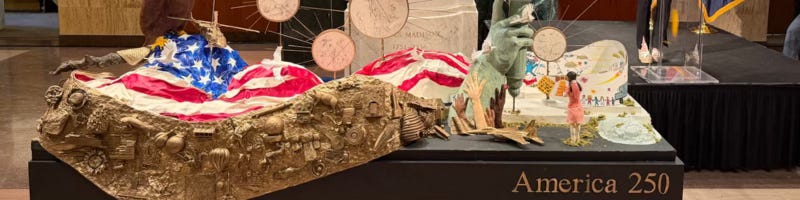
Fast forward to 2026. The Freedom250 committee bought a commercial swimming pool for a baptismal font — the traditional Fourth of July Baptism is not to be missed, y’all — and the congressionally established American250 organization had only received ~15% of its funding. New York cake artist Grace Pak, fresh off a 250th birthday cake for the U.S. Marine Corps, was determined that America would have its cake, and eat it, too.
The NYTimes deconstructs the whole amazing journey, but the cake uses flour from the grist mill at Mount Vernon, currants soaked in Kentucky bourbon, Granny Smith apple slices. A ribbon around the base of the cake holds 56 squares of chocolate — one for each state and territory (and the District of Columbia). Virginia’s features tiny ships and naval aircraft that Rep. Jen Kiggans (a former naval helicopter pilot) helped sculpt.
Maybe we’d be a little less nationally sour right now if we’d gathered together with people we didn’t know well to bake a semiquincentennial anniversary cake for whatever version of America we could agree on. Something lemon, definitely.
NOTE: The America250 cake was unveiled at the Library of Congress yesterday. Indoors. Well-protected from rain and rats.
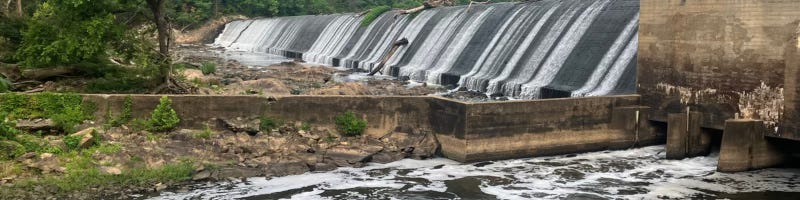
In case you think social media is a door to nowhere, I give you — courtesy of a random tweet on the cursed site — Visdeurbel, the fish doorbell.
And while the doorbell is closed for the season, it’s a fascinating collision of man, nature and technology.
The bones of it: Fish in the Netherlands migrate. The historic locks in many cities aren’t always open, which can block migrating fish. An underwater camera allows viewers anywhere in the world to ring an actual doorbell when there are fish waiting at the lock.
This past season — March through June — brought 900,000 people to the site, and the doorbell rang 263,331 times. Twelve different species, thousands of fish.
“Thanks to you, thousands of fish were able to continue their journey,” a canal spokesperson told NL Times. “The fish migration season has now come to an end, so the Fish Doorbell is taking a break. The camera is off, the doorbell is silent, and the fish have reached their spawning grounds.”
The doorbell returns to duty next March.

I don’t remember what I was promised in 1976, but I’ve been waiting for my friggin’ personal jetpack most of my life.
And now — just as jetpacks are an actual thing — science writer Joel Achenbach comes along to pull a bait and switch, and kick the future down the road.
That’s just how the future rolls, he says: “It’s sneaky, disorderly and can’t be tamed.”
But then he places some bets anyway. After reminding us that the “digital age” that has dominated the past 50 years wasn’t even a phrase in 1976, Achenbach throws down a gauntlet: the rise of the robots. His loose predictions? AI may solve climate change, make working for pay optional, and turbocharge the surveillance state. Then he shrugs, reminds us again about the futility of predictions, and hands the mic to Robert Wright, who gives us roughly a decade to figure out global governance before the whole thing dissolves into chaos. Or not.
Thanks, Bob.
Achenbach’s been writing about the future for about as long as I’ve been reading the Washington Post, and he hits some solid notes — AI, the science of not dying, telescopes hunting for Earth 2.0, either a climate fix or decades of catastrophe, all on the near horizon.
But the detail I keep coming back to is the one he saves for last. Maybe it’s because I spend my life on a laptop and a phone. And my handwriting has become complete garbage.
He ends with a Silicon Valley historian who makes her students take notes by hand. No laptops, no phones. She follows her own rule, and she’s noticed her handwriting is improving.
Fifty years of the future, and smart people are putting their money on a pencil.
Attention must be paid. And then neatly transcribed.
At the end of May, I wrote that perhaps I’d hit a wall. Written myself into exhaustion. Was, impossibly, at a loss for words.
Which is why I look at the intersection of a holiday weekend and wretchedly hot weather as a gift. For the past several days, I’ve been clearing the cobwebs. Email inbox cleared (ish). Bills paid (ish). Chores, sort of done.
And on America’s national day of freedom, I sat down and got back to it. In addition to some serious editing work on Revolution Summer, and some line editing on Lagrange, I began chipping away at a new novel. A stranger one than the others, but essentially a love story.
What would it be like to have vivid dreams, and to build a career — as a greeting card writer, a ghostwriter for Nashville musicians — only to discover that the dreams you have built a career around are the last conscious thoughts of people who love you? And that there’s a cost. If you don’t trace the dream back to the person who left it, pieces of your world literally vanish. Buildings blur. Streets go soft. The people you loved fade from photographs. The city you inhabit is slowly filled with metaphorical dead zones, places you can — literally — no longer see.
It’s a deadpan, quietly surreal portrait of a man who has spent his life unknowingly harvesting love while it erased his world. And suddenly realizes the cost.
It’s complicated, and may break my brain before it’s done.
Comments
Nothing yet. Say the first thing.
Sign in to join the conversation.