
Homer never explicitly called Achilles and Patroclus lovers. Yet modern audiences seem unable to imagine profound love between men without reducing it to sex. That may reveal a deeper crisis in modern culture itself.
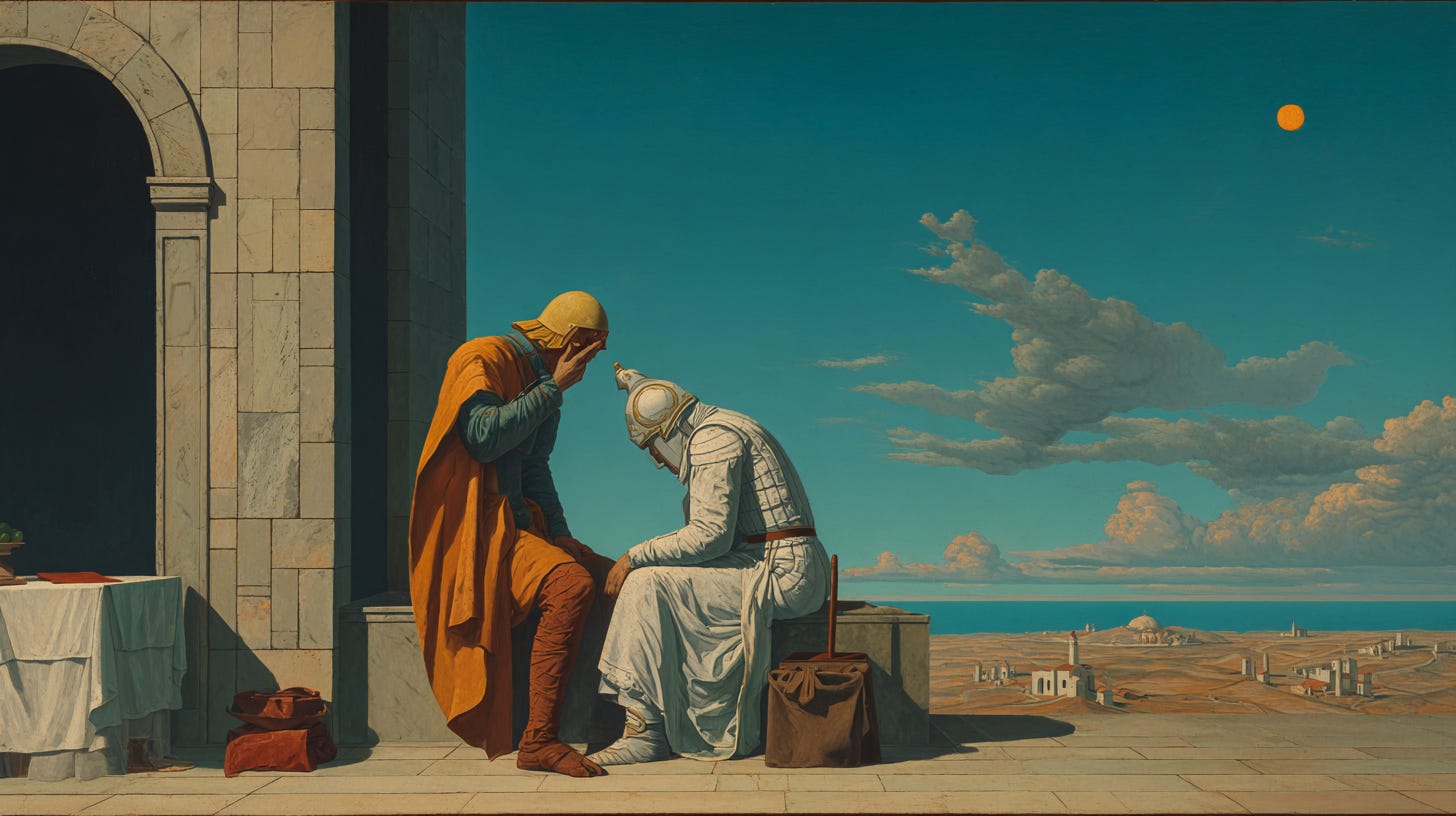
There has been much discussion lately surrounding Homer’s ancient epic maritime tale, The Odyssey. Suddenly, a renewed interest in the Homeric epics, and especially the relationship between Achilles and Patroclus, has emerged. Much of this conversation has been shaped by modern works such as Madeline Miller’s The Song of Achilles, which presents the relationship explicitly through a romantic and sexual lens. Yet what is striking is not merely that modern authors reinterpret ancient texts — that has always happened — but rather the assumption that deep emotional intimacy between men must ultimately be sexual in nature.
This assumption reveals something significant about modernity itself.
One of the most important points often overlooked in these discussions is that Homer never explicitly presents Achilles and Patroclus as sexual lovers in the Iliad. The central theme of the poem is stated clearly in the very first word: Μῆνιν — wrath:
Μῆνιν ἄειδε, θεά, Πηληϊάδεω Ἀχιλῆος – “Sing, goddess, the wrath of Achilles, son of Peleus”
The Iliad is fundamentally concerned with rage, pride, shame, mortality, and the destructive consequences of wounded honor within a heroic society. Achilles’ argument with Agamemnon leads him to withdraw from battle out of injured pride, and this withdrawal results in catastrophic suffering for the Greeks and ultimately in the death of Patroclus himself. The tragedy of Patroclus is therefore inseparable from Achilles’ inability to govern his anger.
This is what makes the story enduringly human and morally profound. Achilles is not destroyed by forbidden love; he is destroyed by disordered passion, pride, and wrath. The poem is deeply didactic. It is anti-war in many respects, but it is also an examination of shame culture, honor culture, masculine pride, and the catastrophic social consequences that occur when private rage supersedes communal duty.
Homer never depicts the relationship between Achilles and Patroclus as explicitly sexual.
The relationship, however, is undoubtedly one of profound emotional intimacy. Patroclus is clearly the person Achilles loves most deeply, and his death becomes the emotional and thematic turning point of the entire epic. When Patroclus dies, Achilles’ grief is catastrophic. The emotional intensity of Achilles’ mourning is extraordinary, even within the heightened emotional world of epic poetry.
This emotional intensity is precisely why the relationship has attracted our attention across centuries.
Homer presents Patroclus not merely as another warrior, but as Achilles’ closest companion — the one person capable of softening, mediating, or redirecting Achilles’ wrath. It was Patroclus who convinced Achilles to let him don his armor and rally the Greeks against the Trojans in the first place. It was Achilles’ withdrawal over his perceived slight by Agamemnon that led to this dangerous situation for the Greeks.
After ten years of besieging the powerful city of Troy, the Greek cause was on the brink of collapse. Achilles’ withdrawal has given the Trojans tremendous confidence and motivation; Hector rallied and killed many of the Greeks in this latest push. Patroclus pleads with Achilles to fulfill his obligation; Achilles’ emotional refusal compels Patroclus to negotiate with him and at least allow Patroclus to bear the legendary armor and make everyone think Achilles has returned to the fight. This indicates that Achilles and Patroclus were so very similar, even to their most intimate companions.
The death of Patroclus is the keystone to the whole tragedy of Achilles. He feels tremendous guilt over the loss and at the height of receiving the news, Achilles explicitly describes Patroclus as the companion dearest to him above all others. He laments:
“ἀλλὰ τί μοι τῶν ἦδος ἐπεὶ φίλος ὤλεθʼ ἑταῖρος
Πάτροκλος, τὸν ἐγὼ περὶ πάντων τῖον ἑταίρων
ἶσον ἐμῇ κεφαλῇ; τὸν ἀπώλεσα.”
“But what pleasure is this to me, since my dear companion (Patroclus) has perished
Patroclus, whom I honored above all companions,
equal to my own life? Him I have lost.”
(Iliad, 18.80-82)
Notice that the word Homer uses here, ἑταῖρος, does not imply sexuality at all. In fact, looking at this example, Achilles classifies Patroclus as someone whom he honors above all of his other companions (πάντων ἑταίρων). Achilles’ language here is not one of erotic conquest or appetite, but of honor, loyalty, and existential attachment. Reducing the relationship primarily to erotic desire risks narrowing the broader moral, martial, and existential dimensions through which Homer presents the pair. If that were the case, he would be an unrelatable figure or disingenuous, merely signaling a loss here for some social gain or standing. It would be a manipulation.
Yet, none is needed; the loss is real. It is tragic. It is felt deeply–otherwise, later commentary would have noted the facade and called it for what it is.
While Homeric poetry can certainly employ ambiguity and indirection, Homer does not use the more explicitly erotic vocabulary available within Greek traditions when describing Achilles and Patroclus. Instead, he has Achilles describe his companion as “dear” (φίλος). This points to affection, loyalty, closeness. This speaks to the nature of the warrior. Companionship was sacred. You fought alongside your companions; you relied on them to literally have your back. You traveled with them, you depended on each other. You trained together.
If Achilles was the greatest warrior of his day, indeed of all-time, he most certainly needed a training partner to push him to be his best. This denotes a dependency, if not a symbiotic relationship, something that is lost on the modern reader with no direct connection or experience in this matter. The only ones who will understand this are those who serve in the military or train in martial arts.
Homer’s use of ἑταῖρος situates the relationship primarily within the framework of companionship, loyalty, and warrior fraternity rather than explicitly erotic language. The emotional force of Achilles’ grief does not require eroticism to make sense.
Even the name Patroclus is revealing. The name Patroclus (Πάτροκλος / Pátroklos) is generally understood as being formed from πατήρ “father” and κλέος “glory” or “fame”.
The second element, κλέος, is one of the central concepts of Homeric epic. Warriors seek κλέος through heroic deeds. This is arguably why Achilles is so distraught after his dust-up with Agamemnon. His μῆνιν results from an insult he sustains, and that will affect his κλέος. Achilles is obsessed with this aspect of his identity; it is indeed the one decision he knowingly makes—to choose a short, but famous life over a long and obscure one. He chose fame over stability, and he knew that the price was his life.
This concept leads to the twin forces of τιμή and κλέος, which govern the Homeric hero’s life. In Homeric society, a warrior’s τιμή (“honor” or “recognized social worth”) was inseparable from identity itself. Agamemnon’s seizure of Briseis was not merely personal humiliation; it was a public diminishment of Achilles’ standing within the heroic order. Achilles’ wrath emerges from wounded honor within a society where reputation, hierarchy, and communal recognition structured the entire moral world.
Yet, Patroclus becomes the vehicle for this fate of Achilles; he is both the vehicle for his κλέος and at the same time the catalyst for his destruction. Achilles will reenter the battle to seek vengeance for his fallen friend against the indomitable Hector, thus embracing his own doom.
Returning to Patroclus’ etymology, even the first element of “father” is critical because in Homeric warrior society, lineage is everything. Identity is inherited; fate dictates the heights to which one can climb. This world is characterized by lineage, ancestry, inheritance, the relationship between fathers and sons, the preservation of family honor, and proper alignment with communities and society. You were identified according to a patronymic—not a coincedence. Almost quite literally, Patroclus is embedded in this world of κλέος and not the world of romantic self-expression.
It is the straying from one’s duty, one’s obligation to society and the community, that is the harbinger of doom. Achilles’ inability to control his emotions and desires is what dooms him. Yet the irony is that it is also what fuels his immortality.
To be sure, later Greek authors—especially in Classical Athens—did reinterpret Achilles and Patroclus through a more erotic framework. Figures such as Plato and Aeschines reflect cultural assumptions that emerged centuries after Homer. That is likely because the bonds of social networks were changed during those days. As one could expect, they changed significantly from the time of Homer, which preceded the classical period by about four centuries.
Plato and Xenophon, by extension, are not merely discussing Achilles and Patroclus — they are using them as vehicles for debating the nature of eros and friendship in Classical Athens.
In Plato’s Symposium (179e–180b), the character Phaedrus argues that Achilles and Patroclus were lovers, but he famously flips the traditional roles assigned to them by earlier writers like Aeschylus. (He argues that Patroclus is the elder and the ἐραστής while Achilles is the younger in the relationship and the ἐρώμενος.) Phaedrus explicitly calls Aeschylus’ view “nonsense”. In his lost play The Myrmidons, Aeschylus had portrayed Achilles as the older erastes, likely because of his superior status and power as a warrior. Phaedrus argues that the gods were especially impressed by Achilles because he, as the eromenos, was willing to die for his erastes (Patroclus). He claims the gods value the devotion of a “beloved” even more than that of a “lover,” which is why Achilles was granted a place in the Isles of the Blest.
Xenophon, on the other hand, explicitly rejected the erotic reading. He presents this argument in his Symposium (8.31) where he has Socrates assert that Homer depicts Achilles’ intense grief and vengeance for Patroclus not as the reaction of a lover, but as that of a devoted comrade (hetairos). Socrates argues that Homer never explicitly describes them as having a sexual relationship. He groups them with other famous pairs like Orestes and Pylades or Theseus and Peirithous, claiming their great deeds were performed out of mutual admiration rather than physical passion. This stands in direct opposition to Plato’s aforementioned Symposium, where Phaedrus made his assumptions.
Thus, the modern erotic interpretation is also a reinterpretation of an interpretation. Some Athenians were already working to impose their social orders onto Homer—and even they struggled because the Homeric details did not graft onto the later Athenian context. Patroclus is older; Achilles is younger, socially superior, and more beautiful. The relationship does not map cleanly. Phaedrus had to creatively reinterpret the pairing. The very fact that later Greeks debated the nature of the relationship demonstrates that Homer himself did not originally construct them according to erotic categories in the first place.
What modern readers often fail to recognize is that earlier civilizations possessed a richer vocabulary for deep friendship, loyalty, and brotherhood than modern society tends to allow.
Across history and literature, we repeatedly encounter profound male bonds that are not reducible to sexuality: Gilgamesh and Enkidu, David and Jonathan, Damon and Pythias, Alexander the Great and Hephaestion, Aeneas and Achates, even Frodo and Sam.
The friendship of David and Jonathan (1 Samuel 18–20) is one of the most famous examples of loyal male friendship grounded in covenant, honor, and mutual sacrifice. Throughout history and literature there are several comparable relationships that emphasize loyalty, respect, and shared mission rather than rivalry. Considering that Saul was persecuting David at the time, his deep friendship with Jonathan is even more striking and profound.
Gilgamesh and Enkidu, from the Epic of Gilgamesh, become a central relationship in the narrative. Both start as fierce rivals but become inseparable; each refining the character of the other. They fight monsters and challenge gods, but it is Enkidu’s death that has a profound impact on Gilgamesh and what would become his quest for immortality and understanding the purpose of life. Their relationship leads to personal transformation.
Pythias is condemned to death by Dionysius I of Syracuse, but before his execution he asks permission to return home briefly to settle his affairs and say farewell to his family. The tyrant laughs at the request, believing no condemned man would ever willingly return.
Damon, who accompanied Pythais, then offers himself as a hostage. He agrees to remain imprisoned and to be executed in Pythias’ place if his friend does not return on the appointed day. As the execution deadline approaches, Pythias is delayed, and everyone assumes he has fled to save his own life. Yet at the final moment, Pythias arrives back in Syracuse, exhausted but determined to keep his word and fulfill his sentence, thus relieving his friend.
The extraordinary loyalty between the two men astonishes Dionysius. According to the legend, the tyrant pardons Pythias and asks to become their friend himself.
This is not an outlier example, there is historical precedent, too. The relationship between Alexander the Great and Hephaestion is one of the most famous male friendships of the ancient world and became deeply associated with the Homeric model of Achilles and Patroclus. Arrian even described their relationship in such terms.
Both men were educated under Aristotle, and ancient sources repeatedly emphasize the unusual closeness of their bond. According to later traditions, when Alexander visited Troy, he honored the tomb of Achilles while Hephaestion honored the tomb of Patroclus.
Hephaestion even occupied an extraordinarily privileged position in Alexander’s inner circle. He was one of the few individuals permitted to speak candidly with Alexander and often acted as a mediator between Alexander and others. When Hephaestion died suddenly in 324 BC at Ecbatana, Alexander’s grief was immense and in some ways recalls Achilles’ mourning for Patroclus in the Iliad.
We hear similar examples of these bonds of brotherhood from soldiers in war, monks in religious communities, philosophers, explorers, and lifelong companions joined by shared sacrifice and mutual formation.
The ancient world not only preserved examples of profound friendship in literature and history; it also reflected deeply on friendship philosophically. Aristotle, in the Nicomachean Ethics, distinguished between friendships of utility, friendships of pleasure, and the highest form: friendships grounded in mutual virtue and shared pursuit of the good. The first two are conditional; friendships based on utility are transactional while friendships of pleasure only occur so long as the good times roll. Yet, friendships based on mutual virtue are rooted in formation and personal growth. Modernity increasingly collapses friendship into the first two categories (either into utility or pleasure) while losing sight of friendship as a formative vehicle for a moral relationship and mutual development.
Modern culture increasingly struggles to comprehend these relationships because modernity tends to flatten intimacy into eroticism. If two men deeply admire one another, sacrifice for one another, or love one another in a non-sexual sense, contemporary audiences often assume that sexuality must be the hidden “truth” behind the relationship.
This assumption reveals less about Homer and more about ourselves.
The ancient world possessed categories for profound same-sex loyalty and emotional intimacy that do not map neatly onto modern identity categories. Alexander himself consciously modeled aspects of his life on Homeric heroism, especially Achilles. Thus the relationship with Hephaestion was understood through this cultural lens.
Modern readers often feel compelled to definitively classify the relationship sexually because contemporary culture tends to interpret intense intimacy primarily through erotic frameworks. Yet ancient evidence does not reduce the relationship so simply. Premodern societies could recognize profound love, loyalty, and emotional dependence between men without necessarily collapsing those relationships into exclusively sexual categories.
This flattening of human relationships has broader social consequences. A culture that loses the category of brotherhood increasingly leaves young men isolated, emotionally stunted, and unable to form meaningful bonds outside the framework of sexuality, status, or consumption. Intimacy becomes commodified. Women become objects of validation rather than persons to be loved. Pornography becomes a substitute for authentic human connection. Loneliness becomes eroticized instead of healed through friendship, fraternity, mentorship, and communal life.
The tragedy of the modern “incel” phenomenon is not merely sexual frustration but social fragmentation. Many young men have inherited a culture that tells them their value is measured primarily through romantic or sexual success while simultaneously depriving them of the structures that once formed healthy male identity: friendship, discipline, mentorship, ritual, shared labor, and communal responsibility.
Seen in this light, the Iliad becomes startlingly relevant once again. Achilles isolates himself from his community because of wounded pride. His rage cuts him off from his obligations, his companions, and ultimately from his own humanity.
Patroclus dies because Achilles withdraws from the communal order and allows anger to dominate him. The catastrophe is not merely personal; it is civilizational.
Homer gives us more. If this was the end of the episode, Achilles at best would avenge the death of Patroclus. His treatment of Hector after their battle was horrifying; Achilles desecrates Hector’s corpse in an act of rage that borders on dehumanizing. Indeed, many readers ultimately sympathize more with Hector than Achilles and see in him the true moral center of the epic.
Yet Homer does not end the story there.
It is Priam’s grief that ultimately saves Achilles. The aged king, driven by unbearable loss, enters the camp of the man who killed his son and humbles himself before him. Exposed, Priam kneels before Achilles, kisses the hands that killed Hector, and begs for his son’s body so that he may properly bury him.
The scene is among the most profound in all of ancient literature because it forces Achilles—and the audience—to confront the shared reality of human suffering and mortality. Achilles sees not merely Priam before him, but his own father, Peleus, and the inevitable grief that awaits him as well. Achilles is finally moved to tears, not simply for Patroclus, but for the tragic condition shared by all mortals.
In this moment, Achilles’ wrath finally gives way to pity, empathy, and restored humanity. The Iliad does not conclude with triumphant vengeance, but with mourning, reconciliation, and burial. Homer’s epic ultimately reveals that ungoverned rage destroys both self and society, while shared recognition of human suffering restores the possibility of civilization itself.
This is why reducing Achilles and Patroclus to a modern romantic archetype ultimately diminishes the scope of Homer’s tragedy. It narrows a profound meditation on wrath, honor, friendship, mortality, and social collapse into the language of contemporary identity politics and erotic projection.
Increasingly, human identity is interpreted through categories of consumption, desire, and self-expression rather than duty, fraternity, or communal belonging.
Perhaps the deeper question modern readers should ask is not whether Achilles and Patroclus were lovers, but whether modern society still possesses the ability to recognize profound love between men without reducing it to sex.
Perhaps the survival of civilization depends not merely upon technological advancement or political systems, but upon whether human beings still possess the capacity for loyalty, sacrifice, fraternity, and love that transcends consumption.
A civilization incapable of recognizing brotherhood and fellowship, except through the language of desire may, in the end, no longer fully understand friendship itself.
Share this post with someone who’s seeking depth in their faith life.
Thanks for reading Timeless Wisdom! This post is public so feel free to share it.
No posts
Comments
Nothing yet. Say the first thing.
Sign in to join the conversation.