
This is the second part of a post broken up into multiple parts, because of its length. This is my eighth post on geoheliocentrism, and the fourth post specifically focusing on Simon Shack’s TYCHOS model.1 The previous posts were:
In this post, we will focus on the Great Inequality, in which seemingly, in the span of a single human lifetime, it was observed that the orbits of Jupiter and Saturn had sped up or slowed down.
In The Great Inequality of Jupiter and Saturn, Part 1: The English Astronomers, I wrote that this problem was first noted by Johannes Kepler (1571-1630) after the publishing in 1627 of his Rudolphine Tables, and that the English astronomers of the 17th century attempted, without much success, to reconcile the observed movements of Jupiter and Saturn with Kepler’s tables. Ultimately, Edmond Halley (1656-1742) printed in 1719—but only published posthumously in 1752—revised astronomical tables, with “an anomalous acceleration in the mean motion of Jupiter and an anomalous deceleration in the mean motion of Saturn”.
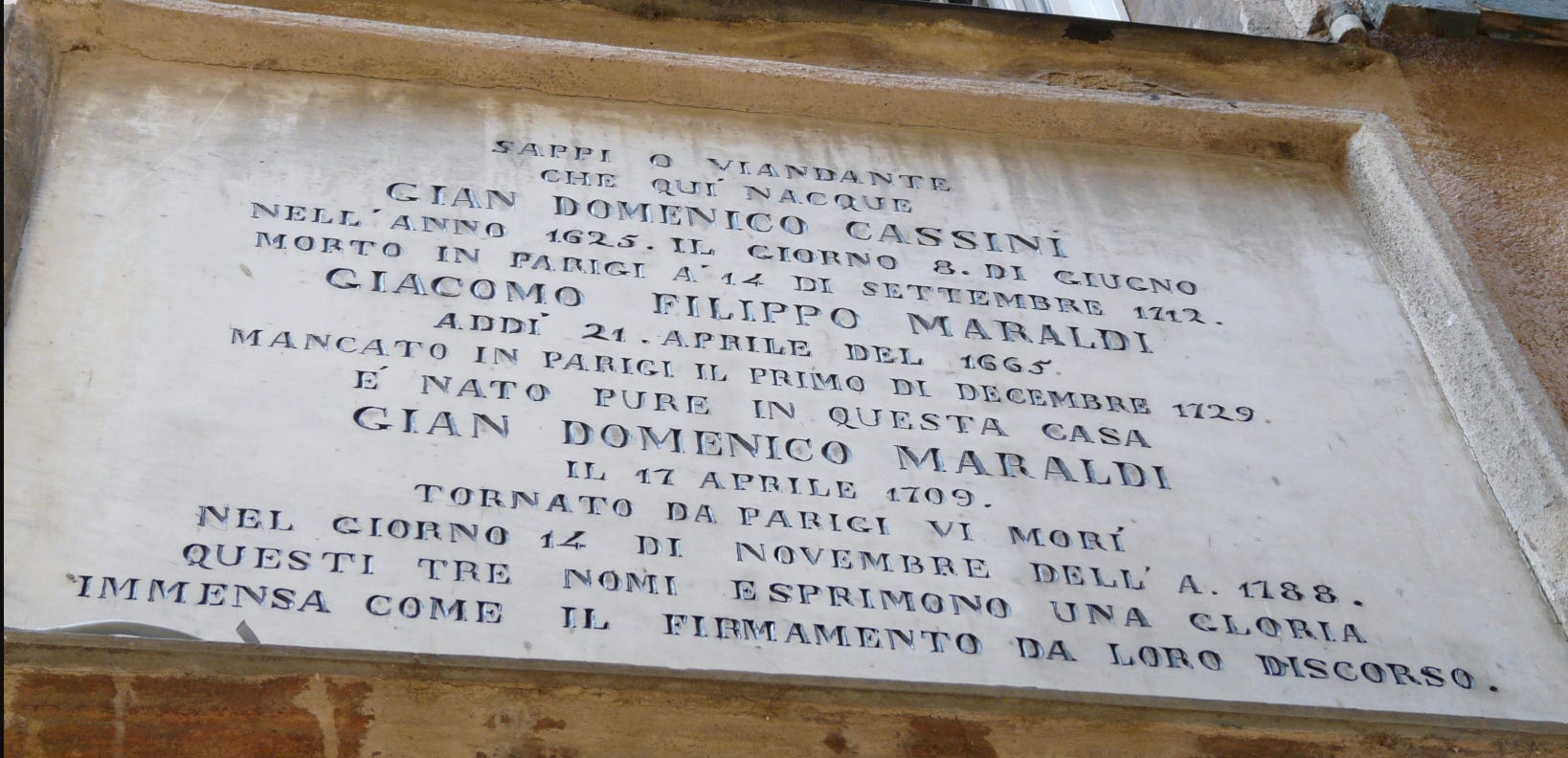
Focus on the Great Inequality moved across the English Channel in the early 18th century. Key players in French astronomy at the time were the Cassinis and the Maraldis, who originally hailed from Perinaldo in Liguria:
Giovanni Domenico Cassini (1625-1712), known as Cassini I.
Giacomo Filippo Maraldi (1665-1729), nephew of Cassini I, known as Maraldi I.
Jacques Cassini (1677-1756), son of Cassini I, known as Cassini II.
Giovanni Domenico Maraldi (1709-1788), nephew of Maraldi I, known as Maraldi II.
César-François Cassini de Thury (1714-1784), son of Cassini II, known as Cassini III.
Jean-Dominique, comte de Cassini (1748-1845), son of Cassini III, known as Cassini IV.
It is important to remember that the French and English scientific environments were quite different. For example, as I wrote in my post Johannes Kepler “Disappears” Tycho Brahe’s Principal Critique of Copernicanism, Cassini I and Ole Christensen Rømer (1644-1710), both working in Paris, were, in the words of Cristiaan Huygens (1629-1695), complete dunces, “whose Dulness can’t comprehend it” («d’une intelligence tardive»), as they did not believe the Copernican system to be true. And even after Cassini I, when the Copernican system was accepted in France, there were still holdouts, such as Cassini II when he was young, supporting the idea of Cartesian vortices—as opposed to Newtonian gravity—as a cause of the motion of the planets. The vortices had also been supported by Huygens, as I wrote in my post Christiaan Huygens Accepts the Inverse-Square Law But Not Action-at-a-Distance. For more on vortices, see my post Descartes’s Vortices Keep Resurfacing.
I perused through the proceedings of the Académie Royale des Sciences, which were published during the years 1733-1788, for the years 1666-1786. After the French Revolution, the Académie Royale was shut and replaced by a series of other institutions, ultimately leading to the creation of the modern Académie des Sciences. Each of the proceedings of the Académie Royale, sometimes published several years after the nominal year, consisted of two parts. The Histoire part consisted of summary papers with no attributed author, each of which reported on the importance of one or more authored papers appearing in the second part. The Mémoires part consisted of authored papers. Below are the papers that I found that are relevant to the Great Inequality.
Maraldi I’s 1704 and 1706 papers presented attempts to reconcile observations of the motions of Jupiter and Saturn over a period of several decades, initially by Cassini I, then jointly with Maraldi I, with the predictions in the Keplerian tables.
The 1704 paper, along with the accompanying Histoire paper [reference 2], outlines the difficulty of constructing astronomical tables. Initially, a mean or average motion for a planet’s entire orbit around the Sun was computed. Then, given an epoch, i.e., a designated point in time for which the observations were certain, the tables for the entire orbit could be computed, by supposing that for about half of the orbit, the calculated motion was computed by adding to the mean motion, while for the other half of the orbit, the calculated motion was computed by subtracting from the mean motion. From there, the aphelion (furthest point from the Sun), perihelion (closest to the Sun), apogee (furthest from the Earth), perigee (closest to the Earth) and nodes (crossings of the ecliptic) of the orbit could be determined.
Any error in observations of a planet’s position in the sky, or subsequent calculations of its orbit, could lead to significant errors in the tables, for the entire orbit of that planet. Therefore, trying to determine if there were anomalies in the Keplerian trajectory of a planet was no easy task, as it have been that the predictions as appearing in a set of tables were simply the result of errors in observations and calculations, as opposed to the planet not moving according to Keplerian principles.
In the 1704 paper, Maraldi I proposed some adjustments to the orbit of Saturn, and in the 1706 paper, to that of Jupiter.
To establish the hypotheses concerning Saturn, we first calculated a large number of observations made during the planet’s opposition to the Sun at various points along the planet’s orbit, and we compared these observations with Kepler’s Tables. This comparison revealed that in the years 1672 and 1673, these Tables gave Saturn’s position as being further advanced in the Zodiac than the observations by 20 to 21 minutes; that in the years 1686 and 1687, the difference between the observations and the Tables there was a difference of only 10 to 12 minutes, with the Tables being more advanced; and that finally, in the years 1700, 1701 and 1702, this difference was approximately 21 minutes, as it had been thirty years earlier. [1704, pp.314-315]
This has shown us that we must increase the greatest equation of Saturn determined by Kepler—which he sets at 6° 31' 30''—by half of this difference, which is 5 minutes, making it 6° 36' 30'', which is within one minute of that determined by Mr Bouillaud. In addition to this correction, a second must be made to the Epoch, by subtracting 16 minutes from the mean motion of 1607, which Kepler gives as 6 28° 3' 52'', and setting it at 6 27° 47' 52''. [1704, pp.315-316]
To determine the greatest inequality of Jupiter, we compared the calculation derived from the same Tables with the observations made near the mean distances, & we found that to properly represent these different observations, the greatest equation of Jupiter had to be set at times to 5° 34' 55'', sometimes 5° 35' 25'' and sometimes 5° 35' 15'', on which we have settled, as it is the mean between the extremes with which it agrees to the minute; thus, in accordance with this determination, it will be necessary to increase by three and a half minutes the greatest equation of Jupiter determined by Kepler, and by one minute that determined by Mr Boüillaud. [1706, pp.62-63]
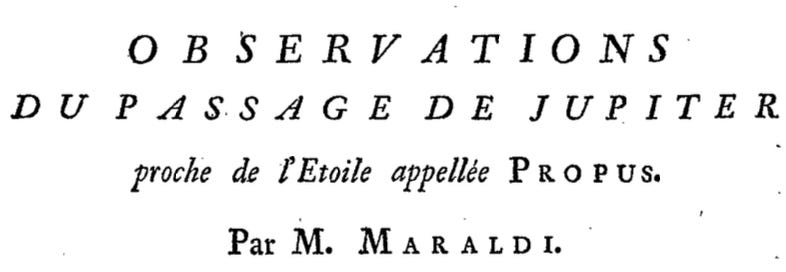
But it would be in the 1718 paper that Maraldi I proposed that there was some serious problem to be resolved. It was known that seven orbits of Jupiter take place in just over 83 years. Maraldi I compared the lengths of seven-Jupiter-orbit periods of his time with that of Tycho Brahe and also that of medieval, Ptolemaic and Babylonian astronomers. His conclusion was that these periods were not of the same length, and apparently the orbit of Jupiter had accelerated, although not uniformly, over a period of some two millennia, and that the greatest acceleration had taken place in the most recent centuries:
It is clear from all that we have just reported, 1. That the four earlier observations, when compared with one another in the order in which they were made, all yield a smaller value for the motion than that obtained by comparing the earlier observations with the modern ones, and even smaller than that found by comparing the modern observations with one another. 2. That the difference in motion resulting from the comparison of one ancient observation with two others made by Walterus within an interval of eight months is not what it ought to be, which shows how little reliance can be placed on it. 3. That this acceleration, as indicated by the ancient observations, amounts to less than one minute in 83 years, whereas from the modern observations it amounts to at least 9 to 10 minutes over a similar period. Thus, although this acceleration appears certain when observations made over the past century are compared with one another, it is not so when based on the ancient observations. The small differences found therein may be attributed partly to the hypotheses one is obliged to employ to reduce the true motions to their mean values, and partly to certain minor errors to which the observations are subject, chiefly the older ones which lack the degree of precision required by this research, having been made by the naked eye, and being, moreover, too few in number. [1718, pp.326-327]
As for Saturn’s orbit, referring to his 1704 paper, he concluded that it has been decelerating:
Thus, if one were to accurately represent the most precise ancient and modern observations of Saturn, one would have to assume that the average motion of this planet has been slower in recent times than it was in the past, contrary to what appears to follow from the observations of Jupiter that we have just compared. [1718, p.327]
The accompanying Histoire paper [reference 6] concludes that there is clearly a problem to be resolved:
Mr Maraldi even admits that, by investigating in the same way he had previously done whether there is any variation in Saturn’s motion, he found that it would be opposite to that of Jupiter; that is to say, that Saturn’s motion would be retarded; yet if there were any slow and gradual variation in the motion of a planet, it seems quite likely that not only would there be such a variation for all of them, but that it would be of the same kind for all, that is to say, accelerated or delayed, unless, however, the acceleration of some caused the delay of others, or vice versa, which would be quite possible, since the total quantity of motion would always have to remain the same. Be that as it may, a mere suspicion on this matter is quite enough for the present, and had physics not made such great progress, one would not have the audacity to entertain it. [Histoire, 1718, pp.69-70]
The articles of Cassini II and Le Monnier continued on from the work of Maraldi I. They consisted of very detailed discussions of astronomical observations of the motions of both Jupiter and Saturn, made both in ancient and modern times, and confirmed what Maraldi I had observed: over the centuries, the orbit of Jupiter had accelerated and that of Saturn had decelerated.
What differentiates the work of Cassini II and Le Monnier from that of Maraldi I is their attempts to provide physical explanations for these anomalies in the orbits of Jupiter and Saturn.
For Cassini II, what is fascinating is how he initially supported Descartes’s vortices and then later accepted the Newtonian model of gravity. Compare the following passages from 1723:
It therefore remains to be examined whether some other cause can be attributed to them which is subject to some law.
It is known that some modern physicists have supposed that the planets may undergo some alteration in their motion due to the various positions they occupy in relation to one another. This hypothesis in no way contradicts the most generally accepted principles of physics; for since everything is full, the vortices of these planets cannot approach or move away from one another without the bodies contained within them receiving some impression from the combination of these movements. But the question is whether these effects are sufficiently noticeable for us to perceive them. [1723, p.86, my emphasis]
and from 1746:
However, as one might be reluctant to accept this hypothesis if it were not supported by arguments that had at least some semblance of plausibility, I have examined whether this variation in the motion of these planets could be explained by the laws of gravity, which, as Mr Newton has shown, are consistent with the motions of the planets, whatever the cause of that gravity may be. [1746, pp.474-475, my emphasis]
As for Le Monnier’s article, its most lasting legacy is a footnote found at the bottom of its first page, in which it was announced that after he presented the results of this article to the Académie Royale, it was decided that the subject for the next Académie prize would be the theory of Saturn and Jupiter.
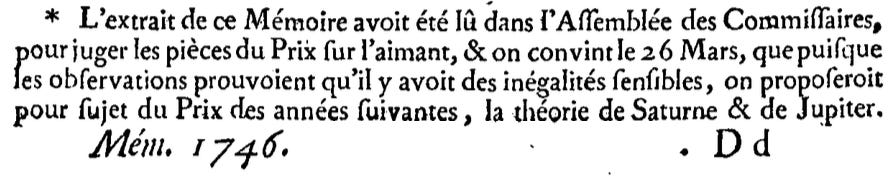
Henceforth, it would be the mathematicians who would take up the baton in trying to resolve the Great Inequality. That will be the topic of the third part of this post.
If you wish to donate to support my work, please use the Buy Me a Coffee app.
Sur les planètes en général, et sur Saturne en particulier. Histoire de l’Académie Royale des Sciences, pp.65-72. In Histoire de l’Académie Royale des Sciences, Année 1704. Paris, 1745.
M. Maraldi. Considérations sur la théorie des planètes. Mémoires de Mathématique et de Physique, pp.306-322. In Histoire de l’Académie Royale des Sciences, Année 1704. Paris, 1745.
Sur les mouvements de Jupiter et de Mars. Histoire de l’Académie Royale des Sciences, pp.95-101. In Histoire de l’Académie Royale des Sciences, Année 1706. Paris, 1731.
M. Maraldi. Les hypothèses du mouvement de Jupiter. Mémoires de Mathématique et de Physique, pp.61-78. In Histoire de l’Académie Royale des Sciences, Année 1706. Paris, 1731.
Sur le mouvement de Jupiter. Histoire de l’Académie Royale des Sciences, pp.66-70. In Histoire de l’Académie Royale des Sciences, Année 1718. Paris, 1741.
M. Maraldi. Observations du passage de Jupiter proche de l’Étoile appelée Propus. Mémoires de Mathématique et de Physique, pp.313-327. In Histoire de l’Académie Royale des Sciences, Année 1718. Paris, 1741.
Sur le mouvement de Saturne. Histoire de l’Académie Royale des Sciences, pp.69-72. In Histoire de l’Académie Royale des Sciences, Année 1728. Paris, 1753.
M. Cassini. Du mouvement de Saturne. Mémoires de Mathématique et de Physique, pp.67-88. In Histoire de l’Académie Royale des Sciences, Année 1728. Paris, 1753.
Sur la conjonction de Mars avec Saturne et Jupiter. Histoire de l’Académie Royale des Sciences, pp.129-131, 1728. In Histoire de l’Académie Royale des Sciences, Année 1743. Paris, 1746.
M. Cassini. De la conjonction de Mars avec Saturne et Jupiter. Mémoires de Mathématique et de Physique, pp.318-334. In Histoire de l’Académie Royale des Sciences, Année 1743. Paris, 1746.
Sur la cause des inégalités observées dans les mouvemens de Saturne et de Jupiter. Histoire de l’Académie Royale des Sciences, pp.95-101. In Histoire de l’Académie Royale des Sciences, Année 1746. Paris, 1751.
M. Cassini. Des deux conjonctions de Mars avec Saturne, Qui sont arrivés en 1745, avec quelques conjectures sur la cause des inégalités que l’on a remarquées dans les mouvemens de Saturne & de Jupiter. Mémoires de Mathématique et de Physique, pp.465-482. In Histoire de l’Académie Royale des Sciences, Année 1746. Paris, 1751.
M. le Monnier le Fils. Sur le mouvement de Saturne, Et sur l’inégalité de ses révolutions périodiques, qui dépendent de ses diverses configurations à l’égard de Jupiter. Première partie. Mémoires de Mathématique et de Physique, pp.209-222. In Histoire de l’Académie Royale des Sciences, Année 1746. Paris, 1751.
M. le Monnier le Fils. Sur le mouvement de Saturne. Seconde partie. Mémoires de Mathématique et de Physique, pp.689-710. In Histoire de l’Académie Royale des Sciences, Année 1746. Paris, 1751.
No posts
Comments
Nothing yet. Say the first thing.
Sign in to join the conversation.