
This is the fourth and final part of a post broken up into multiple parts, because of its length. This is my eighth post on geoheliocentrism, and the fourth post specifically focusing on Simon Shack’s TYCHOS model.1 The previous posts were:
In this post, we are focusing on the Great Inequality, in which seemingly, in the span of a single human lifetime, it was observed that the orbits of Jupiter and Saturn had sped up or slowed down. The first three parts of this post were:
The Great Inequality of Jupiter and Saturn, Part 1: The English Astronomers
This problem was first noted by Johannes Kepler (1571-1630) after the publishing in 1627 of his Rudolphine Tables, and the English astronomers of the 17th century attempted, without much success, to reconcile the observed movements of Jupiter and Saturn with Kepler’s tables. Ultimately, Edmond Halley (1656-1742) printed in 1719—but only published posthumously in 1752—revised astronomical tables, with “an anomalous acceleration in the mean motion of Jupiter and an anomalous deceleration in the mean motion of Saturn”.
The Great Inequality of Jupiter and Saturn, Part 2: The French Astronomers
This problem was picked up by Maraldi I (Giacomo Filippo Maraldi, 1665-1729), who first began looking at this problem in 1704. In his 1718 paper, he stated clearly that, since ancient times, Jupiter has been accelerating and Saturn decelerating, but not uniformly. In 1746, both Cassini II (Jacques Cassini, 1677-1756) and Pierre Charles Le Monnier (1715-1799) published papers attempting to explain the anomalies. After the reading of Le Monnier’s papers, the Académie Royale announced a prize for a mathematician resolving the anomaly.
The Great Inequality of Jupiter and Saturn, Part 3: The Mathematicians
The resolution of the Great Inequality from the perspective of Newtonian gravitation was taken up by the foremost mathematicians of the 18th century, including Leonhard Euler (1707-1783), Joseph-Louis Lagrange (1736-1813) and Pierre-Simon Laplace (1749-1827). Over a period of several decades, new mathematical techniques needed to be developed, ultimately providing an infrastructure—published in 1785 by Laplace—allowing the known anomalies in the orbit of the Moon, as well as those of Jupiter, Saturn and their moons, to be solved, leading to the publication of much more accurate astronomical tables. However, the solution is a set of mathematical equations that is as complicated as the epicycle-and-deferent Ptolemaic system that Copernicanism supposedly replaced.
In this fourth and final part of the post, we leave the Copernican model, as mathematized by Laplace, and go back to Simon Shack’s neo-Tychonian model, the TYCHOS. In this model, the Sun and Mars form a binary system, rotating around the Earth, which is close to—but not exactly—the barycentre of the system. The Earth plods along at a pace of 1.6 km/h (one mile an hour), in a slow orbit—called the PVP orbit—of 25'344 years, which explains, as was written in my post Hamlet’s Mill Advances at 1.6 km/h, the precession of the equinoxes.
So what does this have to do with the Great Inequality? The answer is simple:
In the TYCHOS, the Great Inequality Does Not Exist!
The published orbital periods of Jupiter and Saturn are respectively 11.862 and 29.4571 years, i.e., close to 12 and 30 years. This means that after 60 years, Jupiter will have completed just over 5 orbits and Saturn just over 2 orbits. Meanwhile, the Earth will have plodded along its slow orbit, advancing some 840 thousand kilometres. Earth’s advance during this period will have changed our perspective of the orbits of Jupiter and Saturn. And, as can be seen in the diagram below, depending on the current position of the Earth along the PVP orbit, we will have gotten the impression that Jupiter was accelerating and Saturn decelerating, or the reverse.
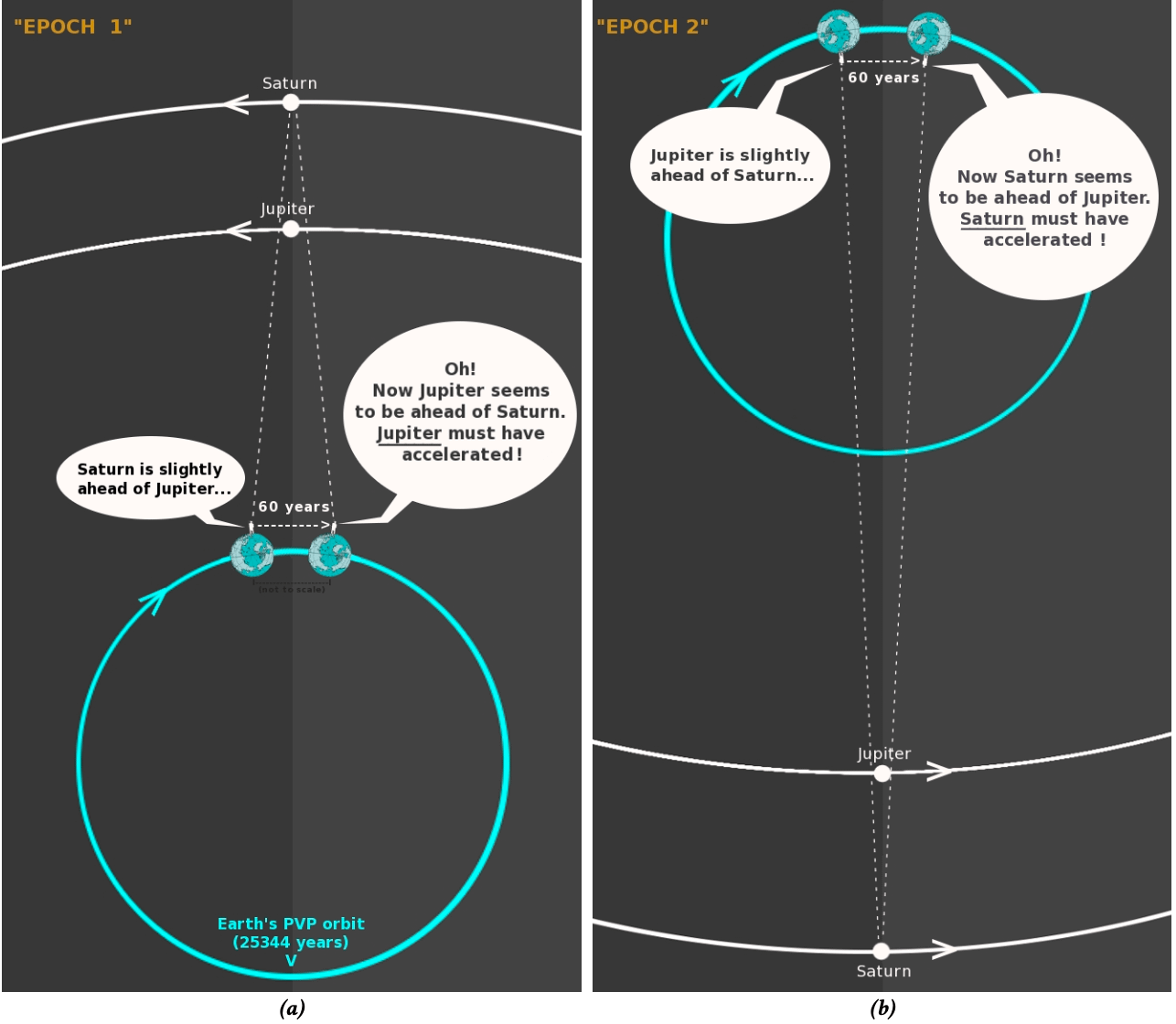
Shack’s explanation of the diagram is given below:
As viewed from Earth, Jupiter and Saturn will appear to alternately “accelerate and decelerate” depending on the timeframe chosen to measure their “60-year” conjunctions. This, due to Earth’s 1.6 km/h orbital motion. Two successive Jupiter-Saturn “60-year” conjunctions: in (a) the “upper” and (b) the “lower” quadrant of our celestial sphere. The so-called “Great Inequality” is nothing more than an illusion of perspective. [p.156, my emphasis]
In other words, a problem that vexed Europe’s leading astronomers and mathematicians for most of the 17th and 18th centuries can be explained using the most basic mathematics, which has been programmed into the Tychosium simulator (https://ts.tychos.space).
The slow advance along the PVP orbit explains a number of the anomalies that arise by presupposing the Copernican model: variations in the Moon’s orbit, the analemma, stellar aberration, Earth’s nutation, and so on. For each of these, simply taking into account the motion of the Earth along the PVP changes our perspective and makes these anomalies disappear.
It should be said that it took me months to prepare the three previous parts of this post, perusing through a century of articles published by the Académie Royale des Sciences, and working through Curtis Wilson’s lengthy article2 on the topic. As for this (fourth) part of the post, it took me two hours to prepare. The simplicity of the TYCHOS model is impressive.
If you wish to donate to support my work, please use the Buy Me a Coffee app.
Curtis Wilson. The great inequality of Jupiter and Saturn: from Kepler to Laplace. Archive for History of Exact Sciences 33(1-3):15-290, 1985.
No posts
Comments
Nothing yet. Say the first thing.
Sign in to join the conversation.