
This post follows on from two previous posts:
The objective of this series was to first understand, in my own terms, what are exactly Gottfried Wilhelm Leibniz’s (1646-1716) monads, and then to follow their evolution through the thinking of successive researchers.
After reading several of Leibniz’s works on this question, my conclusion was that his monads could be considered to be “infinitesimals of consciousness”, i.e., they were ideal concepts, which could help us understand the basis for life and consciousness, but not the material world. In fact, this topic was the subject of extensive correspondence—with no result—with the Jesuit Bartholomaeus Des Basses, who translated Leibniz’s Theodicy from French into Latin. The Theodicy covered such difficult topics as the existence of evil in Leibniz’s “best of all possible worlds”. For my take on the latter, see my post The Best of All Possible Worlds.
Christian Wolff (1679-1754), the most important German philosopher after Leibniz and before Immanuel Kant (1724-1804), moved away from Leibniz’s monads, and came up with his corpuscles, made up of elements. When I looked at the elements, I found them to be “infinitesimals of physicality”, i.e., they tried to explain the basis for the material world. But since they were infinitesimals, they did not have any extent. And, just as Leibniz could not use his monads to explain the material world, Wolff had to hand-wave to try to explain how real objects, which all have extent, could ultimately be made up from his elements, which had none.
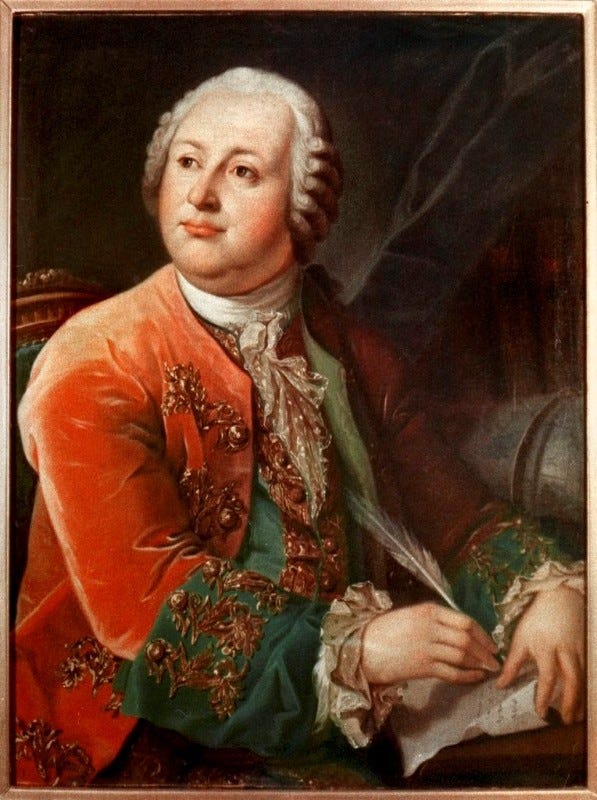
One of Wolff’s students in Marburg was Mikhail Vasilyevich Lomonosov (Михайл Васильевич Ломоносов, 1711-1765), the first Russian-born to be a member of the Saint Petersburg Academy of Sciences, and the founder of Moscow State University, now named after him. Lomonosov’s primary scientific interest was chemistry, and he was the first to propose that there is what we now call “conservation of mass” during combustion, although at the time he still believed in the phlogiston theory.
The most readily-available source in English on Lomonosov is the book Russia’s Lomonosov: Chemist, Courtier, Physicist, Poet,1 written by the chemist Boris Nikolaevich Menshutkin (Борис Николаевич Меншуткин, 1874-1938). Lomonosov’s collected works, which cover a wide variety of subjects, including a Russian grammar and poetry, consist of nine volumes, the first four covering scientific subjects. I will be looking at two articles appearing in Volume 12, both referred to by Menshutkin:
Elementa chimiae mathematicae (Elements of mathematical chemistry, 1741, pp.65-83)
De particulis physicis insensibilibus corpora naturalia constituentibus, in quibus qualitatum particularium ratio sufficiens continetur (Of the imperceptible physical particles that constitute natural bodies, in which a sufficient account of the particular qualities is contained, pp.279-313)
In the collected works, these articles appear as side-by-side Latin-Russian bilingual editions. I chose to work with the Latin, as I find it easier to read than the Russian.
In the Elements of mathematical chemistry, Lomonosov uses the same terminology as does Wolff:3
38) An element is a part of a body which consists of no other smaller bodies that are different from itself.
39) A corpuscle is a collection of elements into one mass. [my emphasis]
From these definitions, he moved on to define further concepts, such as homogeneous, heterogeneous and mixed bodies. But what is clear is that he had in mind preparing the groundwork, not for general philosophical arguments but, rather, for discussing Chemistry:4
Since in Chemistry things must be demonstrated, they are demonstrated from distinct notions of the thing itself. A distinct notion must be sought in the enumeration of the notes, that is, in the parts of the whole, and thus the parts of the mixture must be known, which since they cannot be known in any way better than if they were viewed separately, which since they are so minute cannot be distinguished in the mixture, and therefore in order to know the mixture they must be separated. But separation supposes that the parts change place and are thus moved. Therefore, to know and demonstrate the truths of Chemistry and Mechanics, there is need of knowledge. [my emphasis]
In the second work, it becomes clear that Lomonosov is focussing on the actual, real, material world, and he clearly differentiates between mathematics and the physical world, and that mathematical and physical division should not be conflated:5
Bodies can be divided into the smallest parts because of the matter of which they are composed. This division can be considered in two ways, namely mathematically and physically. I say that a body is mathematically divided when, in its given extension, parts are assigned at will by calculation. Physically a body is divided when its parts are actually separated from one another. But since the purely mathematical division is determined by arbitrary choice and cannot be demonstrated, that the mathematically assigned parts exist in bodies that are actually separable from one another; for this reason, we will be less concerned with it and will attempt to investigate only the physical division of bodies; nevertheless, where it is permissible, we will mathematically determine the universal qualities of the physical parts. [his emphasis]
The essence of Lomonosov’s approach can be understood by focussing on the passages that he himself emphasized:6
Physically, bodies are divided into particles of astonishing fineness.
[T]here are minute, insensible, physically separable particles in bodies.
The individual particles of physical bodies are extended.
Individual physical particles are impenetrable, endowed with the force of inertia, capable of motion and rest.
Therefore, since physical particles, even insensible ones, are extended, impenetrable, endowed with the force of inertia, capable of motion and rest, they are consequently bodies, and therefore all that proceeds from the universal qualities in them can be explained by mechanical rules.
In other words, Lomonosov is stating that studying chemistry must be undertaken by using all of the knowledge we have from mechanics; we have clearly left the world of alchemy. Furthermore, his ultimate particles are physical, and extended. The inherent philosophical problems inherent in the work of Leibniz and Wolff in trying to explain the physical world have been left behind.
The ideas of atomism were always most readily accepted by those—such as Lomonosov—working in chemistry. As we will see in posts over the coming months, there was strong resistance throughout the 19th century to the idea of physical atoms among physicists.
If you wish to donate to support my work, please use the Buy Me a Coffee app.
Boris N. Menshutkin. Russia’s Lomonosov: Chemist, Courtier, Physicist, Poet. Translated from the Russian by Jeannette Eyre Thal and Edward J. Webster under the direction of W. Chapin Huntington. Princeton University Press, 1952.
М. В. Ломоносов. Полное Собрание Сочинений. Том первый: Труды по физике и химии 1738-1746 гг. Москва, Ленинград: Издательство Акадамии Наук СССР, 1950.
38) Elementum est pars corporis, quae ex nullis aliis corporibus minoribus et a se diversis constat.
39) Corpusculum est elementorum in unam massulam congeries.
Quoniam in Chymia dicenda demonstrari debent, demonstrantur vero ex rei ipsius distinctis notionibus. Notio distincta in enumeratione notarum, id est partibus totius quaerenda, adeoque partes mixti cognoscendae sunt, quae quoniam nullo modo melius cognosci possunt, ac si seorsum spectentur, quae quoniam adeo minutae sunt in mixtione dignosci non possunt adeoque ad cognoscenda mixta eadem separari debent. Verum separatio supponit, ut partes locum mutent adeoque moveantur. Igitur ad cognoscendas et demonstrandas veritates Chymicas Mechanicae opus est cognitione.
Corpora ob materiam ex qua constant dividi possunt in partes minutissimas. Divisio haec duplici ratione considerari potest, nimirum mathematice et physice. Corpus mathematice dividi dico, quando in data ejus extensione partes pro lubitu per calculum assignantur. Physice corpus dividitur, quando partes ejus actu a se invicem sejunguntur. Quoniam autem pura mathematica divisio arbitrio determinatur, neque demonstrari potest, partes mathematice assignatas dari in corporibus actu a se invicem separabiles; quamobrem de ea minus solliciti, solam physicam corporum divisionem pervestigare tentabimus; verum tamen, ubi licebit, qualitates partium physicarum catholicas mathematice determinabimus.
Physice corpora dividuntur in particulas stupendae exilitatis
dari in corporibus particulas minutissimas insensibiles physice separabiles
Particulae corporum physicae singulae sunt extensae.
Particulae physicae singulae sunt incompenetrabiles, vi inertiae praeditae, motus et quietis capaces.
Itaque, quoniam particulae physicae etiam insensibiles sunt extensae (§~9), incompenetrabiles, vi inertiae praeditae, motus et quietis capaces (§~10), consequenter sunt corpora (§~1), atque adeo omnia ea, quae a qualitatibus catholicis in illis proficiscuntur per regulas mechanicas explicari possunt (§~4).
No posts
Comments
Nothing yet. Say the first thing.
Sign in to join the conversation.