
This is my tenth post on geoheliocentrism, and the sixth post specifically focusing on Simon Shack’s TYCHOS model.1 The previous posts were:
Resonances in TYCHOS, Simon Shack’s Neo-Tychonian Model of Our Stellar System
The Great Inequality of Jupiter and Saturn (four parts):
Part 1: The English Astronomers
Accurately Retrodicting 3000 Years of Passages of Halley’s Comet
As we have seen in the previous posts, the TYCHOS defines a remarkably simple geometry describing the motions of the celestial bodies in our stellar system. There is one problem, however: there is no associated physics, explaining why these bodies move as they do, following their trajectories of circles on circles.
This is a valid criticism, which I intend to address in this post. However, I think two points need to be made about mainstream astronomy.
First, it should be remembered just how long it took to develop the Copernican system into a coherent scientific theory, based on the principle of gravitation, providing accurate predictions:
1543: De revolutionibus (Nicolaus Copernicus, 1473-1543)
1619: Harmonices mundi (Johannes Kepler, 1571-1630)
1687: Principia, first edition (Isaac Newton, 1643-1727)
1785: Solution of Great Inequality (Pierre-Simon Laplace, 1749-1827)
1798-1825: Traité de mécanique céleste (Laplace)
Second, it is not so clear to me that today’s mainstream astronomy is itself actually based on a clear physics. Consider, for example, the following statement in Wikipedia about lunar theory:2
The analysts of the mid-18th century expressed the perturbations of the Moon’s position in longitude using about 25-30 trigonometrical terms. However, work in the nineteenth and twentieth century led to very different formulations of the theory so these terms are no longer current. The number of terms needed to express the Moon’s position with the accuracy sought at the beginning of the twentieth century was over 1400; and the number of terms needed to emulate the accuracy of modern numerical integrations based on laser-ranging observations is in the tens of thousands: there is no limit to the increase in number of terms needed as requirements of accuracy increase. [my emphasis]
So, for the Moon alone, tens of thousands of parameters are needed to accurately describe its motion. Is there a physical explanation for each of these parameters? The answer is a clear no, they are calculated using large computers using statistical analysis. They are the result of curve-fitting. And how many parameters are needed for the motions of the other major celestial bodies in our stellar system? We are a long way from the geometrical arguments used by Newton when writing his Principia.
So, yes, a physics for the TYCHOS would be welcome, and a search therefore is a completely valid exercise. However, it might take time. What does give us hope is that the Tychosium simulator developed by Patrik Holmqvist gives reliable predictive capability using only a few kB of initial data, while the best standard simulators need GB of initial data.
In the meantime, here are my thoughts on this question.
First, it seems to me that a proper physics for our stellar system—and others as well—should presuppose electricity as the dominant force of the universe. Here are some of my initial thoughts on this topic:
Second, if we accept the idea that the universe is self-similar at different scales, then one possible research direction is to consider our stellar system to be akin to an atom, in which the Sun-Earth-Mars core, along with the satellites Venus, Mercury, Moon, Phobos and Deimos, together can be considered to be equivalent to the nucleus of an atom.
For me, the planetary model of the atom of Wilhelm Eduard Weber (1804-1891) holds promise. I first presented this model in my post How Does a Positively-Charged Body or an Atomic Nucleus Hold Together?, in the section entitled Does Weber’s Electric Force Law Provide a Solution?
In Weber’s atom, the charges inside the nucleus are held together by his force law: when identical charges are sufficiently close together (approximately 10-15 m, which is the typical diameter of an atomic nucleus), and with non-zero relative velocity and relative acceleration, then they will attract each other. Is something similar holding together the components of the core of our stellar system?
Third, when I discussed with Simon Shack recently, he pointed out to me that binary systems also seem to occur at many different scales. Consider, for example, this image of neighboring spiral galaxy M31, located in the constellation Andromeda.34
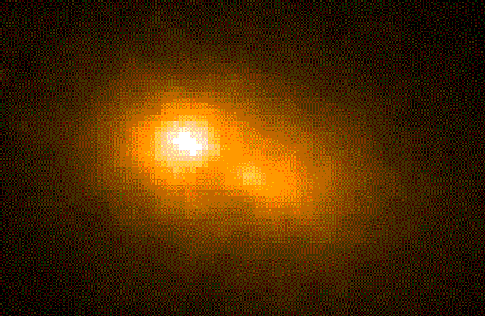
If this is correct, then a proper physics would cover not only the Sun-Mars binary system, but also how binary systems develop in general.
Finally, Shack and Holmqvist have recently discovered that the speeds of a number of celestial bodies in our stellar system are all very similar:5
In summary, here are the respective (approximate) translational speeds of the Sun, Mars, Halley’s comet, Jupiter, Saturn, Uranus and Neptune—according to the TYCHOS model:
Sun: ≈107'226 km/h or 29.79 km/s
Mars: ≈107'192 km/h or 29.78 km/s
Halley: ≈107'226 km/h or 29.79 km/s
Jupiter: ≈112'465 km/h or 31.24 km/s
Saturn: ≈109'953 km/h or 30.54 km/s
Uranus: ≈109'076 km/h or 30.30 km/s
Neptune: ≈108'988 km/h or 30.28 km/s
Needless to say, these (slightly different) speed values are probably not quite exact. Thus, it is not entirely inconceivable to think that they may possibly all be identical. [Shack’s emphasis]
Once again, a coherent physics for the TYCHOS would be able to explain why these numbers are so similar, or even possibly identical. This could be very interesting.
If you wish to donate to support my work, please use the Buy Me a Coffee app.
No posts
Comments
Nothing yet. Say the first thing.
Sign in to join the conversation.