

You talk about 90s comics, you’re usually talking about the art.
Some 90s comic book art is fantastic.
Some is raw, but has an energy to it, unique to that decade.
Some of it is little better than cave drawings.
I think the coloring process had something to do with how sloppy some 90s art ending up looking. They seemed to be experimenting with new tech, probably to make things cheaper.
Well, it worked, it made the comics look cheap.
Even when the art was good, everything either looked like day-go diarrhea, or had a strange faded and/or smeared look, like they’d run out of colored ink cartridges at the copy shop. A lot of it looks bleary and fuzzy, even in reprints.
And everything was busy. Not just the lines, pouches, guns, and hair, but an obscene level of detail that did little to focus the eye, everything everywhere all at once in the frame.
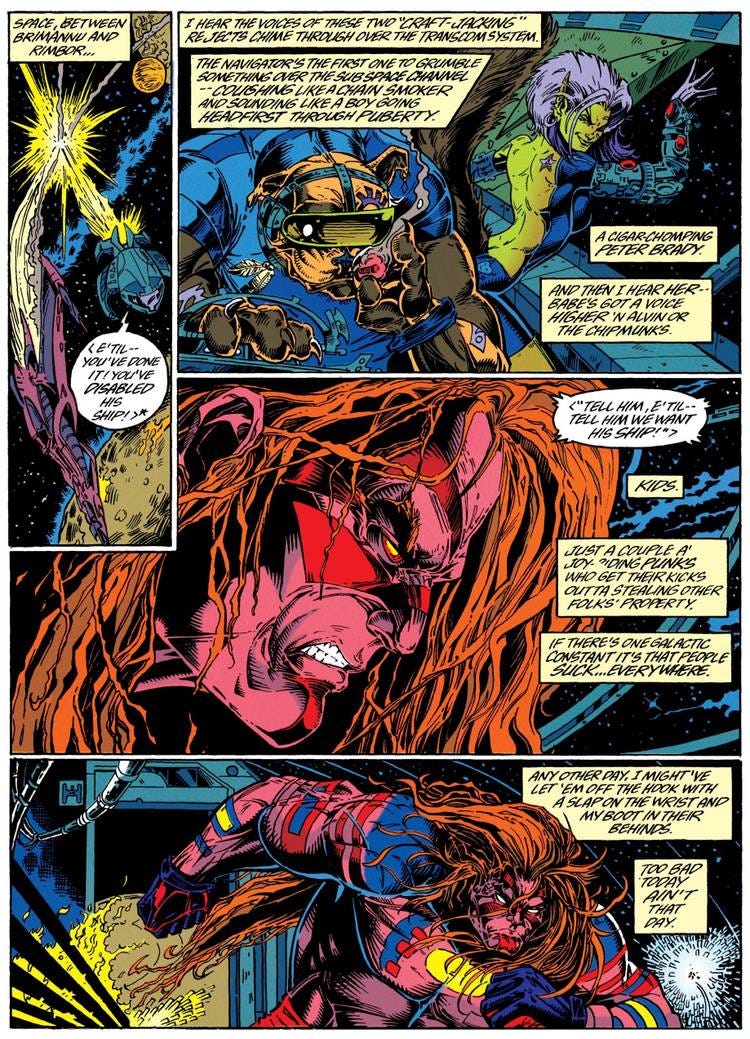
For artists like Todd McFarlane, who knew when to add enough detail to focus an image, you’d have others, who’d just crowd everything into the damn panel. And if you weren’t Jim Lee, or George Perez, who knew how to handle that explosion of detail and still make a stunning image, it just looked overstuffed.
But the art wasn’t the real problem.
No, while 90s comic art is a big point of contention, to me, the 90s had a way bigger issue.
The writing.
Or lack thereof.
(Yes, there was some great writing in 90s comics. Some of my favorites. Starman, Preacher, Astro City, Stray Bullets, Sin City, the list goes on. These tended to not be mainstream big sellers.)
You read a lot of comics from that time, they feel like they’re missing something.
I mean, you’re not missing dialogue, them shits was crammed to the gills. In the Tarantino, Mamet and Claremont era, everyone was trying to prove that they too had the gift of magical fake talk.
Uncanny X-Men and its many, many offshoots were the worst offenders.
Everybody loved Claremont, nobody could write like Claremont.
Like Tarantino, he made it look easy. And like Tarantino, he was oft imitated, never duplicated.1
So pages were stuffed hard with word balloons, making the cramped art even more awkward.
Didn’t seem to hurt sales any.
But worse than the faux-Tarantino/Claremont was the lack of story and character. Most times, “character” was “oh shit, my friend/husband/baby was killed by a villain! I AM CONSUMED BY RAGE YAAAARR.”
Guns, guns, fisticuffs, murder, fire, unh.2
Some of it was because the “hot” artists were trying to write their own books without having written much before, but even a lot of veteran writers were writing weird. Like they were trying to create some “neo-90s” style to differentiate them.
(Or, more likely, ride the wave of the Image artists.)
But a lot of the stories don’t click. They skip important details or transition material in their zeal to keep things pumping, and in so doing, it feels incomplete.
And everything is about “change!” and “taking it to the next level!” with little consideration of letting us live in the status quo. We don’t get any grounding. Most stories seemed written from the notion that their readers were already following the story, and had been for years.
Though it’s easy to pick on Image comics, I think the worst offenders were probably Marvel and DC. Because they knew better.
Even skipping over the Claremont-less X-Men, the Spider-Man “Clone Saga,” “The Death of Superman,” and “Batman: Knightfall” (all of which have some good stuff in-betwixt the soap opera monotony), the Big Two made some obnoxious comics.
They just seemed to be constantly dipping the bottom of the barrel, making every female into a Playboy pinup, every male into a longhaired, roided out nightmare.
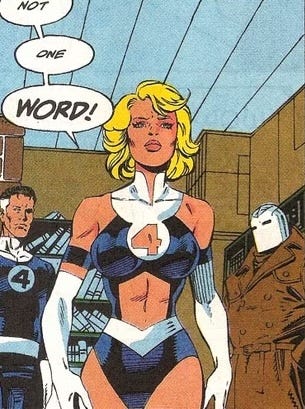
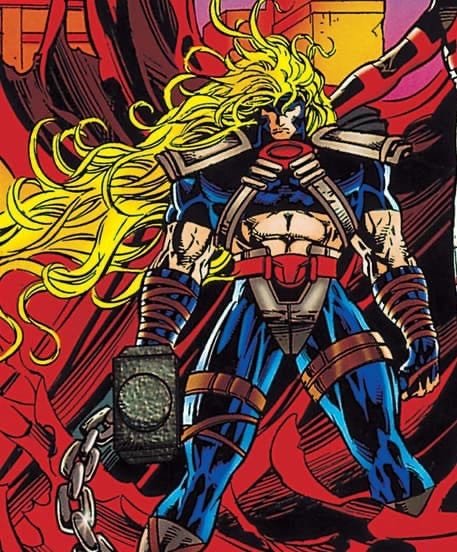
And you might say, well, that’s an art thing, and I’d return with, yeah, but to quote Gene Hackman in Unforgiven, “the writing’s not that much different than the picture.”
The women became hyper-sexualized and their IQs dropped about sixty points apiece, and the dudes just shot everything with their big guns and gritted their teeth. Nuance went out the window.
I know, I know, it’s comics, but we had JUST come out of the 80s, with Watchmen and Dark Knight and Miracleman and Animal Man and Daredevil, and all these great stories that showed us a new way.
One example sticks in my craw is The Avengers big “event” story: “The Crossing.”
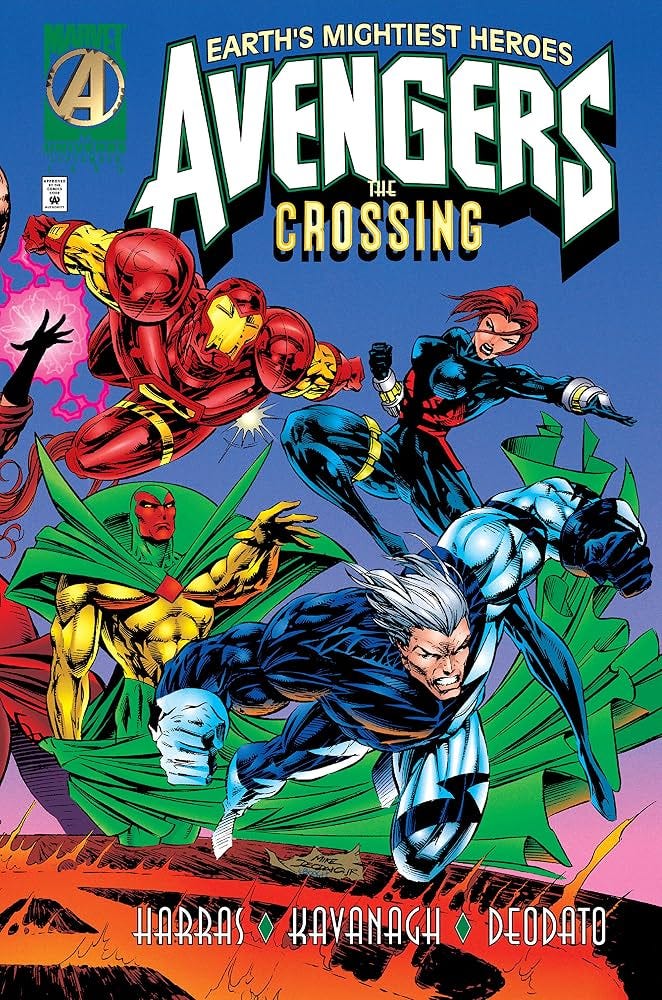
The elevator pitch? Stop me if you’ve heard this one: Oh, shit! The Avengers are hit with a force so hard, it breaks them up again!
Hey, I love a good “The Old Order Changeth!” story. But this one was truly missing something.
I tried to reread it a couple weeks back, to make sure memory wasn’t betraying me.
But, no, I remembered correctly. It’s a mess.
I mean, I’d been reading comics for decades by this point, so as a longtime reader, you’d think I would know who was who.
But the characters I’d “known” for years were acting completely different. And not in new, interesting ways.
Like, the Wasp, the character depicted (wholey differently than the comics, it must be noted) by Evangaline Lily in the “Ant-Man” movies. A lady character with a very troublesome publishing history. In the 60s, she was established as a rich airhead socialite, who lived only for her (Ant-)man.
The 80s gave her, if not a perfect revision, much more to do, making her airheadedness a put-on, showing she was a shrewd businesswoman, and had the stuff of leadership, making her independent of her abusive man. For a long while, she was the assumed leader of the Avengers.
So, it surprised me that in re-reading the Crossing, she’s back to being an airhead with nothing to do. The story seemed much more interested in her metamorphosis into a humanoid wasp-thing.
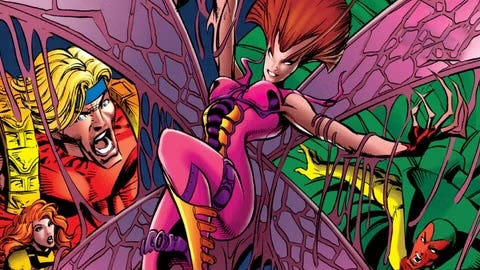
This version of the Wasp didn’t stick.
There would be times that weird writing style would almost work, but then the book would disappear.
Like, say, The Regulators, written by Kurt Busiek. Something with a genuinely different take on comics, that would take that weird 90s writing style, and make it work. It would run a couple of sporadically-distributed issues.
Then, the book would suddenly just… stop. No warning, no announcement that I knew of, just, whoops, over.
It was odd.
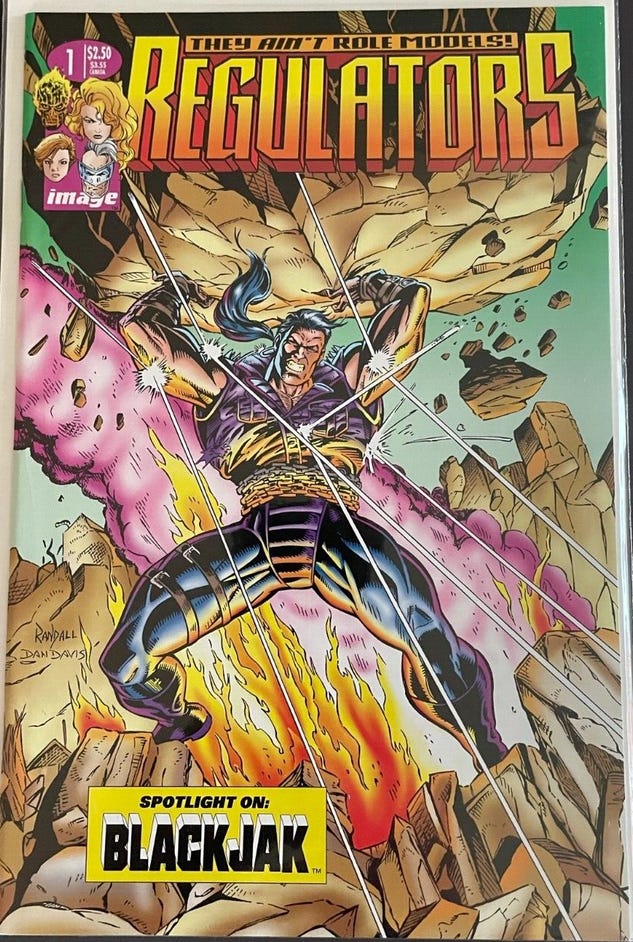
And that happened with stunning regularity, even with the big comic companies. Skrull Kill Krew was one of those weirdo books from Marvel, written by Grant Morrison and Mark Millar, with batshit ideas and goofy humor. It ran a few issues, then just stopped.
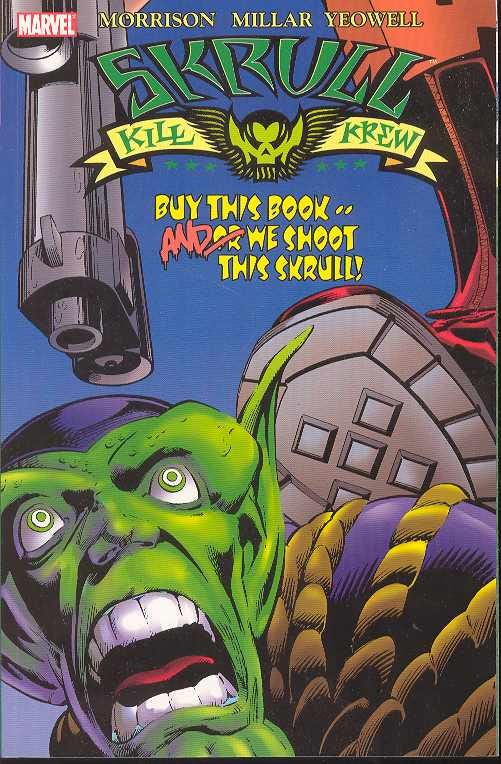
This book is kinda the epitome of that 90s writing style I’m talking about. Machine-gun stutter action and obscure dialogue. Mostly shooting, not much deeper. Characterization is mostly a shot at satire or deconstructing tropes.
Morrison, who’s already the kinda writer who’ll skip transitions and go for an avant-garde feel, really goes oblique with this one.3
That said, at least all of the weirdness and 90s style feels deliberate. And it’s clever and fun.
Most of the 90s comics eschewed “fun” in favor of “Yeargh!” and “Nooooo!” Mistaking grim & gritty for “good,” and joy for “lame.”
And maybe that was the flaw in the writing: the writers had seen what the 80s had wrought, and thought, ahhh, I too can make characters dark and complex.
It probably came from good intention.
Or to make money. They certainly nailed that part. All the books I’m complaining about were the best-sellers.
Shows what I know.
Click the titles to get at muh stories:
or you c’n find alla this right chere:
© MMXXVI
According to Joe Casey’s substack, a lot of that chatty X-dialogue might’ve been the editors. He said he tried to use minimal dialogue in his X-Men run, only to open the book and see it packed with words he never wrote.
Like a warm up to “The Invisibles” and “The Filth”
No posts
Comments
Nothing yet. Say the first thing.
Sign in to join the conversation.