
That may be changing.
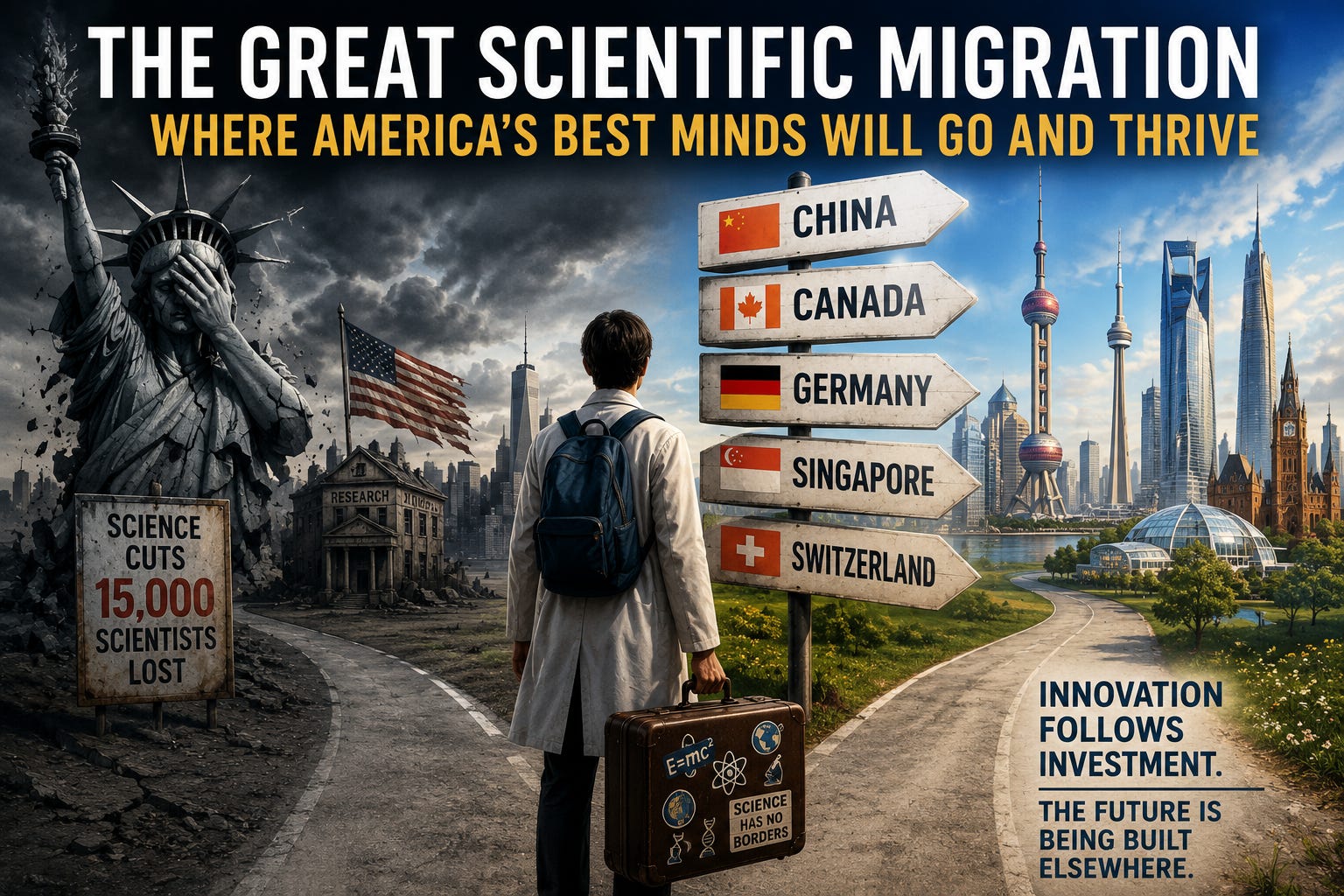
Astrophysicist Neil deGrasse Tyson recently warned that America is risking a historic brain drain as research funding is slashed and thousands of scientists are losing their positions. His question is simple:
What happens when the world’s smartest people stop choosing America?
History already provides the answer. Scientists don’t stop discovering. They simply move somewhere else.

China has spent decades building world-class universities, research parks, AI laboratories, semiconductor programs, biotechnology centers, and an ambitious space program.
Unlike the United States, China is dramatically increasing long-term investment in science and engineering.
If American researchers continue leaving, China is positioned to absorb elite talent in:
Artificial Intelligence
Quantum Computing
Biotechnology
Clean Energy
Space Exploration
Advanced Manufacturing
Innovation follows investment.
China understands that.

Canada offers something increasingly valuable:
Political stability.
Strong universities.
Universal healthcare.
A high quality of life.
Easy cultural transition for Americans.
For decades, Canada lost researchers to higher-paying U.S. universities.
Now that pipeline may reverse.
Several Canadian institutions are already actively recruiting scientists leaving the United States.

Germany has always believed that research is an investment—not an expense.
Its Max Planck Institutes, Fraunhofer Institutes, and leading universities remain among the most respected scientific organizations on Earth.
Germany excels in:
Engineering
Robotics
Chemistry
Green Technology
Automotive Innovation
Industrial Manufacturing
If America retreats from research, Germany gains.

Singapore has quietly become one of the world’s most attractive destinations for elite scientists.
Why?
Massive government research funding
Low bureaucracy
Modern laboratories
Competitive salaries
International talent visas
Despite its tiny size, Singapore has become one of Asia’s premier innovation hubs.
The government knows exactly what it’s buying:
Brains.

Home to CERN, ETH Zurich, and some of the world’s highest-ranked research institutions, Switzerland consistently punches above its weight.
Scientists value:
Stable funding
Academic freedom
International collaboration
Outstanding infrastructure
Switzerland has long attracted Nobel Prize winners.
It is likely to attract even more if American instability continues.
Scientific discovery isn’t patriotic. Scientists simply go where they can do their work. When governments invest, innovation flourishes.
When governments cut research, innovation emigrates.
History has demonstrated this repeatedly—from Europe before World War II to the Cold War era, when the United States benefited enormously from attracting scientists trained abroad.
Today, the flow could be reversing.
When a scientist leaves, America doesn’t just lose one job.
It may lose:
The next life-saving medicine.
The next semiconductor breakthrough.
The next Nobel Prize.
The next clean-energy revolution.
The next trillion-dollar technology company.
Basic research often produces breakthroughs decades later in ways nobody can predict. Tyson argues that this unpredictability is exactly why sustained public investment matters.
The United States became the world’s economic leader because it invested heavily in universities, laboratories, NASA, the NIH, the NSF, and countless public-private research partnerships.
The internet.
GPS.
MRI technology.
Modern aerospace.
Many medical breakthroughs.
Much of today’s digital economy traces back to publicly funded research.
If that investment continues to shrink while competitors expand theirs, leadership in science and technology could gradually shift elsewhere. Whether that happens depends on future policy choices, not destiny.
As Neil deGrasse Tyson warns, the question isn’t whether scientists will innovate.
The question is where they will innovate.
PS: To be frank, in my view, it’s already too late. The table has been set. USrael sux. It’s being hollowed out, pillaged and the fools who voted for it will be the biggest losers.
No posts
Comments
Nothing yet. Say the first thing.
Sign in to join the conversation.