
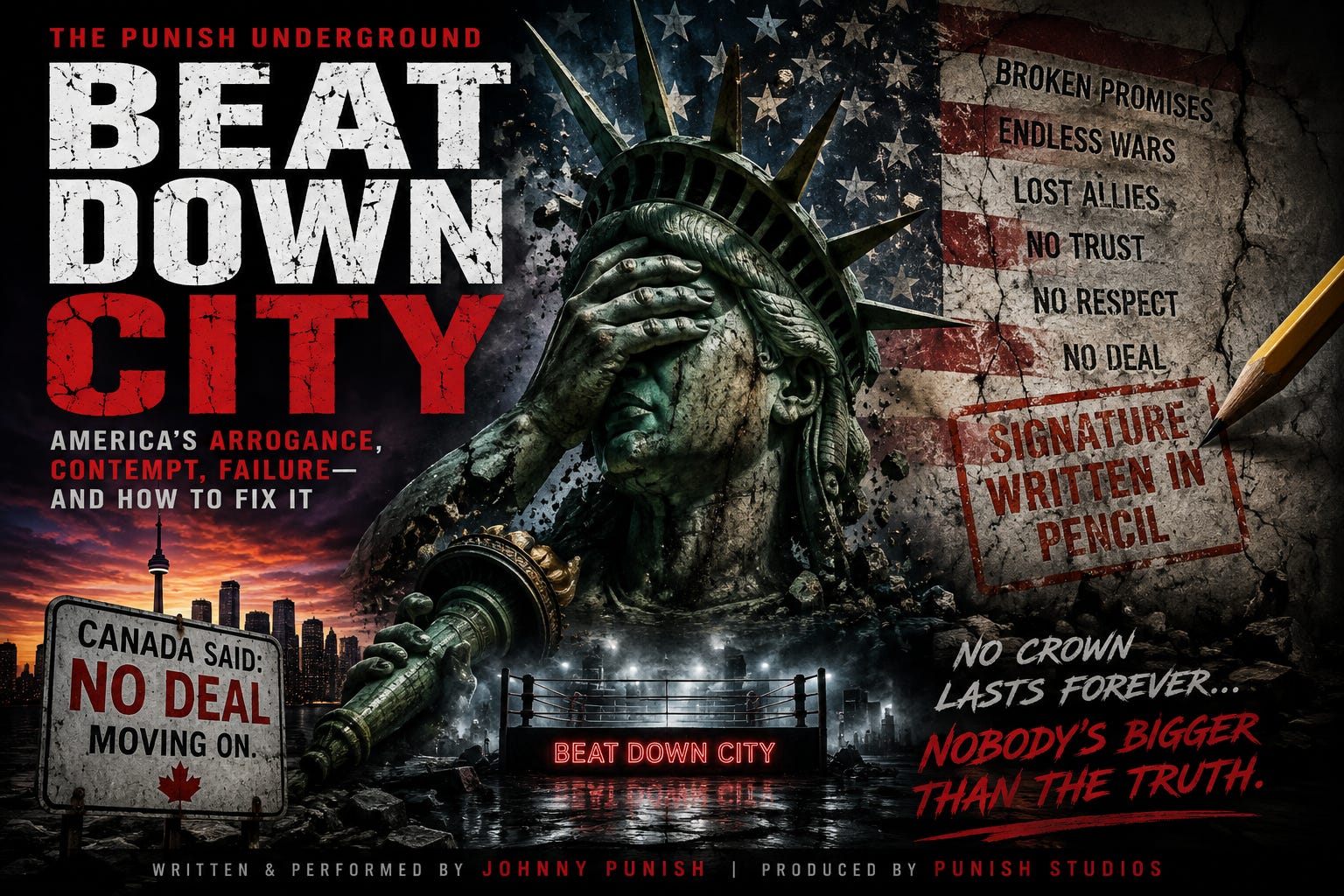
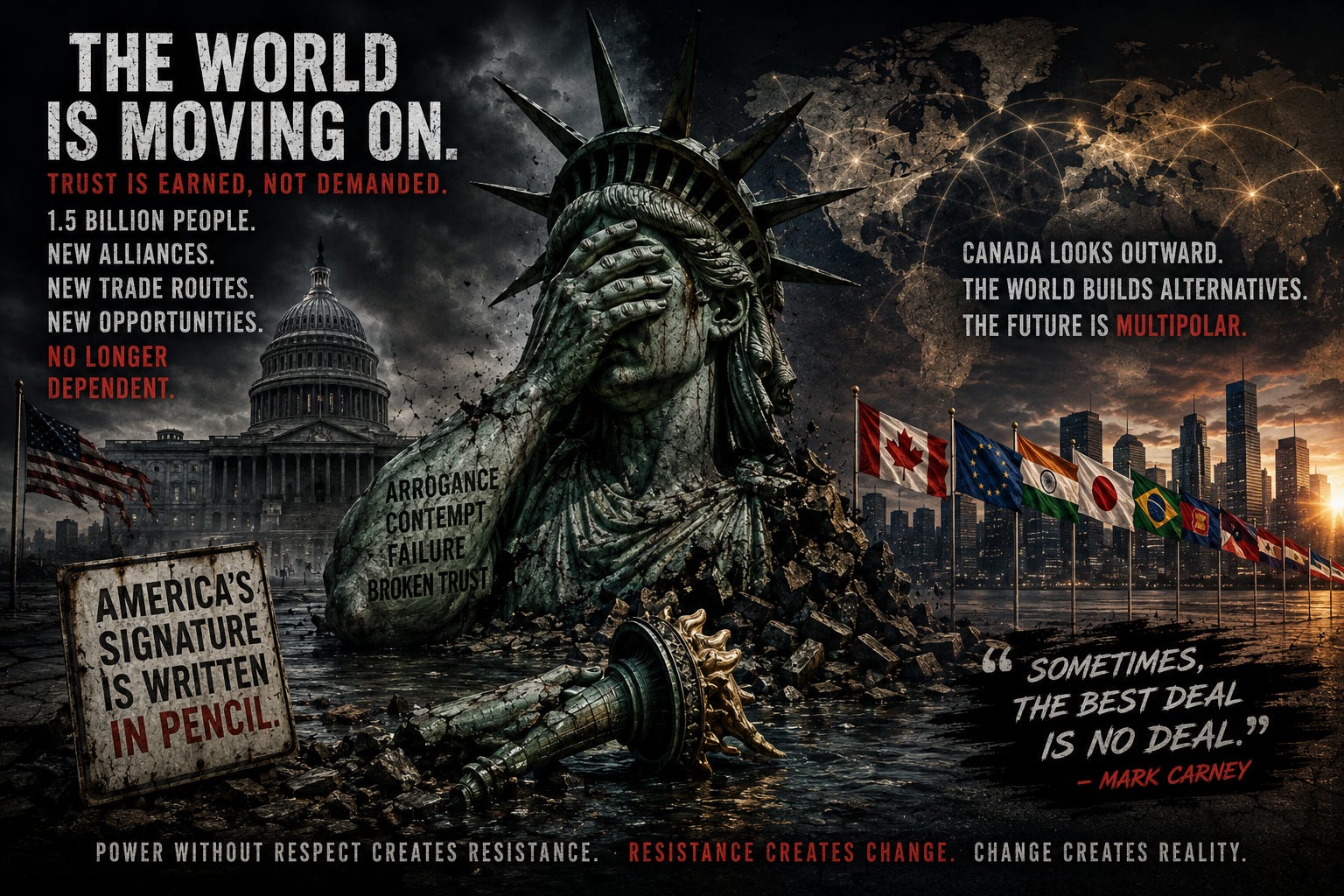
Canada, he explained, has already opened access to roughly 1.5 billion consumers around the world and intends to double that reach. Then came the line that should make Washington uncomfortable: America’s signature, he suggested, is now written in pencil.
The message was unmistakable: Canada can no longer assume that an agreement with the United States will remain reliable tomorrow. That is not simply a trade dispute. It is a crisis of credibility.
Canada PM Speaks Out as US Trade Deal Collapses - YouTube
After World War II, America helped construct an international system built around American economic power, American institutions, American alliances, and American security guarantees. From roughly 1945 through the end of the 20th century, the United States possessed something far more valuable than raw power. It possessed legitimacy.
Countries wanted access to American markets. They wanted American investment, technology, security, and leadership. They wanted to be America’s friends. But somewhere along the way, leadership began to look like entitlement. Partnership began to look like obedience. Diplomacy began to look like leverage. And disagreement began to look like disrespect.
That is where arrogance enters the story. The most dangerous stage of power is not when you become powerful. It is when you become so accustomed to being powerful that you can no longer imagine a world without your power. The rest of the world, however, did not stop evolving.
China rose. India rose. Europe became more integrated. The Gulf states accumulated enormous wealth. Southeast Asia expanded. Latin America diversified. Africa became increasingly important. Middle powers discovered something that great powers hate: they have choices. Canada has choices. Mexico has choices. Europe has choices. India has choices. The Gulf has choices. Even America’s traditional allies increasingly have choices. And when a country begins treating its friends like hostages, eventually those friends begin looking for the exits.
Canada appears to be doing exactly that. Rather than endlessly arguing with Washington, Canada is increasingly looking outward. Carney’s message was essentially that Canada cannot control what happens in Washington, but it can control how dependent Canada remains on Washington. That is an enormous strategic shift.
When coercion replaces cooperation, countries begin building alternatives. They diversify their trade. They develop new alliances. They seek new markets. They create new relationships. And eventually, the country that once believed everyone needed it discovers that everyone has been preparing for the possibility that they might not.
Perhaps the hardest thing for Americans to accept is that national decline rarely feels like decline while you are living through it. Rome did not wake up one morning and announce that it was declining. Britain did not hold a press conference and announce that America had become the new global power. Decline happens incrementally. It happens through lost influence, lost trust, lost competitiveness, lost alliances, and lost credibility.
Eventually, people begin making decisions without you. That is the real danger. It is not necessarily that everybody suddenly hates America. It is that they stop needing America. That is a much more profound form of defeat.
And then there is war. Nothing exposes arrogance faster than war because war eventually forces political narratives to collide with physical reality. The United States has demonstrated repeatedly that overwhelming military power does not automatically produce political victory. Afghanistan and Iraq should have taught that lesson.
Vietnam should have taught it decades earlier. Yet the temptation remains to believe that enough military force, enough sanctions, enough threats, and enough economic pressure can compel another nation to surrender to American demands. Sometimes it works temporarily. But history repeatedly demonstrates that military superiority and political wisdom are not the same thing. A country can win battles and still lose strategically. It can destroy infrastructure and still fail to achieve its political objectives. It can declare victory while the underlying problem remains.
That is why Beat Down City is not really about America. It is about consequences. The song is about what happens when leaders become so convinced of their own mythology that they stop listening. It is about what happens when every failure becomes somebody else’s fault, every criticism becomes an attack, every defeat becomes a victory, and propaganda becomes more important than reality.
It is about the moment when the bill finally comes due. Because history keeps receipts. Every broken promise. Every abandoned ally. Every unnecessary war. Every insult. Every threat. Every country pushed away. Every institution weakened. Every time a leader chooses political theater over reality. History remembers.
You cannot convince someone they are arrogant by telling them they are arrogant. You cannot convince someone trapped inside an echo chamber that they are trapped inside an echo chamber. Americans have been told for generations that America is exceptional, that America is the leader, that America is indispensable, and that America is the greatest.
There is nothing inherently wrong with believing in your country. Patriotism is not the problem. The problem begins when patriotism becomes an excuse for refusing to listen. There is a profound difference between confidence and contempt. Confidence says, “We believe we can compete.” Contempt says, “You have no choice but to follow us.” Confidence says, “Let’s build something together.” Contempt says, “Do what we say.” Confidence creates allies. Contempt creates alternatives.
Maybe the answer isn’t another speech. Maybe it isn’t another election. Maybe it isn’t another patriotic campaign designed to convince Americans that everything is fine. Perhaps the answer is much simpler: failure. Not because failure is desirable, but because failure is sometimes the only teacher powerful enough to reach people who refuse to listen.
Companies learn when customers leave. Athletes learn when they lose. Businesses learn when the market rejects them. Nations learn when their assumptions stop working. And powerful countries learn when the rest of the world simply says, No.
No, we won’t accept that deal. No, we won’t follow you into that war. No, we won’t depend exclusively on your market. No, we don’t trust your signature. No, we aren’t afraid of your threats. No. No. No. Eventually, the powerful discover something the powerless have always known: you cannot force everyone forever.
Perhaps America has not reached rock bottom. It remains extraordinarily powerful, wealthy, innovative, technologically advanced, militarily formidable, and culturally influential. But power can erode surprisingly quickly when credibility disappears.
What happened?
Where did our allies go?
Why don’t they trust us?
Why are countries trading around us?
Why are they building new alliances?
Why are they creating alternatives to American systems?
Why doesn’t our word carry the weight it once did?
Why does everyone seem to be moving on?
That moment could be painful. But it could also be the beginning of recovery, because you cannot repair a problem you refuse to acknowledge. The United States may eventually have to look into the mirror and recognize that the world has changed. The old American leadership model—where Washington could set the rules and expect everyone else to follow—may already be gone.
Even if America eventually wakes up, it cannot simply rewind history. The world will not necessarily say, “Welcome back. We’ve been waiting.” Too much has changed. New powers have emerged. New trade routes have been built. New alliances have formed. New institutions have developed. New generations have grown up in a multipolar world.
That does not mean America has no future. Quite the opposite. America can still be one of the world’s great nations. It can still lead. It can still innovate. It can still create. It can still inspire. But perhaps it will have to learn something it has not practiced very well lately: how to be one leader among many. Not the boss. Not the empire. Not the world’s policeman. A partner.
The America the world once believed in was powerful, but it was also capable of building coalitions, creating institutions, negotiating agreements, and making people want to stand beside it. That America could still exist. But it cannot be rebuilt through arrogance. It can only be rebuilt through humility, accountability, competence, and trust.
And that is why I keep coming back to the phrase Beat Down City. Not because I want America to suffer. Not because I want ordinary Americans to lose their jobs, their homes, or their futures. And certainly not because political disagreement should become hatred. Quite the opposite. I want America to survive its own arrogance. I want America to become capable of looking into the mirror.
I want Americans to understand that criticism isn’t hatred, disagreement isn’t betrayal, allies aren’t subjects, and strength isn’t measured by how many people you can intimidate. Leadership isn’t about standing on top of everyone else. Leadership is about making people want to stand beside you.
Perhaps the road back begins only after the road down has been traveled far enough. Perhaps the country must experience enough consequences that the mythology finally breaks apart and reality becomes impossible to ignore. The lights go out. The crowd goes home. The scoreboard stays on.
Eventually, someone has to look at it. Because history doesn’t care how loud you were. It doesn’t care how many flags you waved. It doesn’t care how many times you declared victory. It asks only one question: What did you leave behind?
That is what Beat Down City is about. It is a dark, cinematic trip-hop anthem about propaganda, political theater, accountability, and the inevitable collision between mythology and reality. It isn’t about fists. It is about consequences. It is about the moment the excuses stop working, the spin doctors go home, the television cameras turn off, and history opens the book.
No crown lasts forever. No empire lasts forever. No politician lasts forever. No lie lasts forever. And nobody—nobody—is bigger than the truth.
Welcome to Beat Down City.
Where the beat goes down.
💥
“BEAT DOWN CITY”
Written & Performed by Johnny Punish
Produced by Punish Studios
#TripHop #Darkwave #AlternativeRock #ElectronicRock #PoliticalRock #Industrial #1990s #Noir #Cinematic #ProtestMusic #Truth #Justice #Accountability #IndieMusic #JohnnyPunish #PunishStudios #BeatDownCity
No posts
Comments
Nothing yet. Say the first thing.
Sign in to join the conversation.