
It wasn’t four score and seven years ago - just twenty-one days by my count - that I more or less (mostly more) took on “The American Scholar” and author Ruth Franklin for her “Twain Town U.S.A.” in this very Substack.
What I interpreted in that article was a somewhat scurrilous attack on (A.) the rampant commercialism of Hannibal, Missouri, (B.) the town’s ‘who cares attitude about history, particularly regarding Black Americans” and especially, Franklin training her sights on Hannibal’s most famous citizen, Mark Twain or as he was known in non-writing circumstances, Samuel L. Clemens.
Going after Twain for what she saw as his failed “gender dynamics” in his masterwork, “Adventures Of Huckleberry Finn,” seemed as ludicrous to me as judging a novel written 141 years ago by today’s standards. And I said so.
To have Franklin write in “The American Scholar” that “his books inadequately represent the experience of Black people,” frosted my pumpkin. Hell, the book was written 141 years ago! “And it was no small thing to have the most popular writer in America take on racism just twenty years after the Civil War - and inarguably, that is the central topic of the book - didn’t that take considerable artistic courage? This was just 20 years after the Civil War, with veterans on both sides still alive and, we presume, reading.”
What in the name of Thomas Jefferson Snodgrass (one of Twain’s aliases) was Twain supposed to do in “Huck Finn,” have the kid grow dreads, invent hip hop and lead a slave rebellion to take over the town?
So imagine my surprise when I glance at today’s “Paper Of Record” - The New York Times - and the top story is about “Adventures Of Huckleberry Finn” and written by, you guessed it, folks, Ruth Franklin!
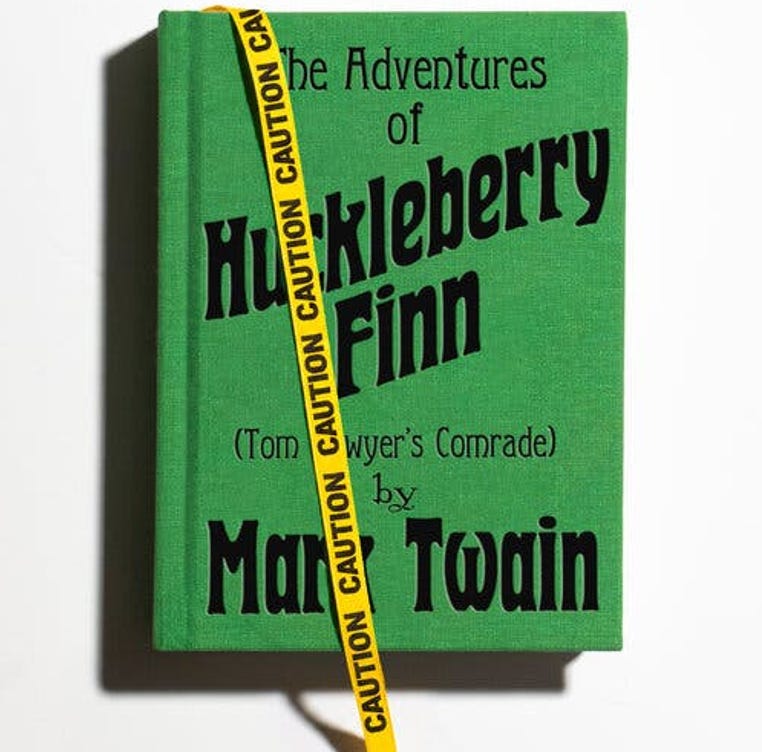
The New York Times’ illustration with Franklin’s article and essay.
Apparently, author Franklin has been talking to a number of classroom teachers, re-reading some Twain scholarship and, get this, actually re-reading “Adventures Of Huckleberry Finn” for the first time since she was a kid. (It doesn’t say whether she read it before she wrote “Twain Town U.S.A.” for “The American Scholar.”)
She gives us a major authorial hint of her initial attitude: “I could see this as soon as I opened the book. I was reading a used copy whose previous owner must have been a student. This person started out diligently highlighting and taking notes. But they clearly found the slur upsetting. “OMG stop using it,” they wrote in the margin at one point. Eventually, the highlights and notes petered out.
“I gulped down the novel in two sittings, disoriented and amazed. It felt genuinely shocking to be confronted by the slur so brazenly. But I was beguiled by Huck’s plain-spoken voice and by the way Twain uses it to point to the gap between the character’s limited understanding of the world and what is really taking place in the novel, which we must work out on our own. “It shows how a body can see and don’t see, at the same time,” Huck says at one point when he’s failed to notice something — a line that could be the novel’s motto.”
What was troubling to me and somewhat surprising, given Franklin’s impressive credentials, is that she seemed to fail to notice that Huck only uses the phrase “N-word Jim” once in the entire novel. That’s in the letter he writes to Miss Watson about Jim, which he ultimately tears up, deciding he will stick up for his friend in Chapter 31.
So while it’s true the N-word does appear in the novel over 200 times, it’s never from the mouth of Huckleberry Finn. That seems important, doesn’t it?
In talking via email to the late actor Hal Holbrook about Twain’s use of the N-word - Holbrook, of course, did his “Mark Twain Tonight” stage show over 2,300 times over 60 years - he insisted Twain used that word “like an anvil. To hit people over the head with it to make them see how wrong it was.”
A little known anecdote about Twain surfaced in Andrew Levy’s scholarly “Mark Twain And America” which came out in 2015 and recounts a moment where Twain, traveling by train, hears a young boy use the “N-word” “in easy hearing distance” of “a Negro woman,” and Twain corrects the youngster.
In Franklin’s New York Times essay, she recounts talking with various teachers and students about the book, including Samantha Goodwin, who she notes is white, has biracial children and teaches at Sidwell Friends School in Washington.
Sitting in her classroom, she writes “As the students debated where various scenes in the novel fall on the satirical spectrum, Goodwin, who is white, brought up Huck’s demeaning language about Black people. There was a pause in which I could see the discomfort on some students’ faces. Finally, a white student responded. “It’s supposed to anger you,” he said. “You feel like Huck has been taught that Black people aren’t human.”
“You’re speaking nicely to the power of Huck as narrator,” Goodwin responded. “He doesn’t have the ability to take the next step and say: ‘Wait a second. Why did I believe that?’ But we get angry.”
In a pedagogical culture that tends to shy away from unpleasantness, Goodwin’s approach felt like an honest — and valuable — way of dealing with one of the ugliest aspects of American literary history. Reading “Huck Finn” isn’t just an intellectual experience; it’s also an emotional journey. If the book produces strong feelings in its readers, it’s doing what it’s supposed to do. Still, I left Goodwin’s classroom wondering whether her strategy was replicable on a larger scale. She teaches in an elite private school where around 40 percent of students are white, and she is able to design her own curriculum.”
Had Franklin written this story a few years ago, she could have interviewed a white (now mostly gray) teacher who taught the novel at an all-Black school for a decade and found it a transformative experience for some, not-all, students.
“Mr. Nogo, Huck is the brother I never had,” wrote one 15-year-old African-American.
One lunchtime, there was a knock on my door from a young man, who had walked all the way across campus, missing his lunch - and he came to me Sixth Period that very day.
“Mr. Nogo,” Rashad said, sort of breathlessly. “I’ve gotta know. Does Jim get to Cairo today?”
That the N-word scared off most teachers at my school was evident in my first trip to the book room. There were 30 immaculate (i.e.: Never read) copies of “Huck” in a stack on a corner table. As one of maybe three white teachers at our school, it took some nerve/courage/defiance to decide to teach “Huck” and not all my colleagues were supportive.
“N-word, N-word, N-word,” one African-American female neighbor said when she saw the books in my room. Another just threw up her hands and walked out.
But I believed in the power of Twain’s words then. And still do. We spent two classroom periods discussing the “N-word,” which we still occasionally heard on campus in the halls and at lunch before we ever started the novel. And for some of my classes, they liked the idea “we were getting away with something.” Twain, I suspect, would have liked that, too.
While Franklin goes to great pains to present both sides of teaching the novel in these turbulent times, it was encouraging to read that, despite its flawed “gender dynamics” and “inadequate representation of Black people,” the book still worked.
“I was startled, too, to find that Twain relies on Jim as the novel’s moral fulcrum,” she wrote, “often leaving space in the narrative for a richer and more multilayered reading of the character than is commonly thought. Despite all its problems, the book felt fresh and relevant.”
Maybe I’m not objective on this, but I count that as a win for Twain. And in writing my book on my Huckleberry Finn experience, I think it was the single-most important thing I did in my dozen-plus years in the classroom.
As I wrote: “What now seems incredible to me – and I’ve done a fair amount of research on this – is that America did not get it,” I wrote, referring to Twain taking on the moral issue of slavery. “As Andrew Levy explains in his valuable “Huck Finn’s America”, we did not see what Twain was doing at all. The author’s purpose was hiding in plain sight.
“Virtually no surviving review of the book, and there are dozens, talks about the novel as if it were bringing anything new to the story of black and white in America,” Levy writes. “And those few references thought what Twain said on the subject was funny.
“Most amusing,” wrote the Hartford Courant, “is the struggle Huck has with his conscience in regard to slavery.” In the Southern newspapers, Huck was almost invisible.”
So while it seems obvious to us now what Twain was doing, America didn’t get it back then. While I’ve never met Ruth Franklin and objected to much of her “Twain Town U.S.A,” article, I found it encouraging that, re-reading the novel one more time, giving Twain a second chance, you might say, she found power and insight in his words. Good to have you on board, Ruth.
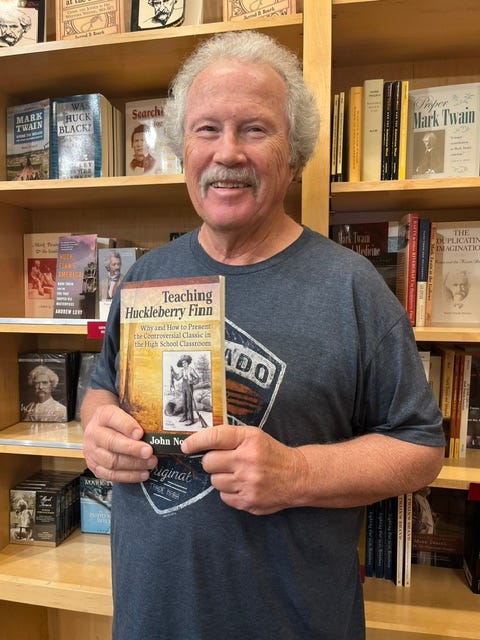
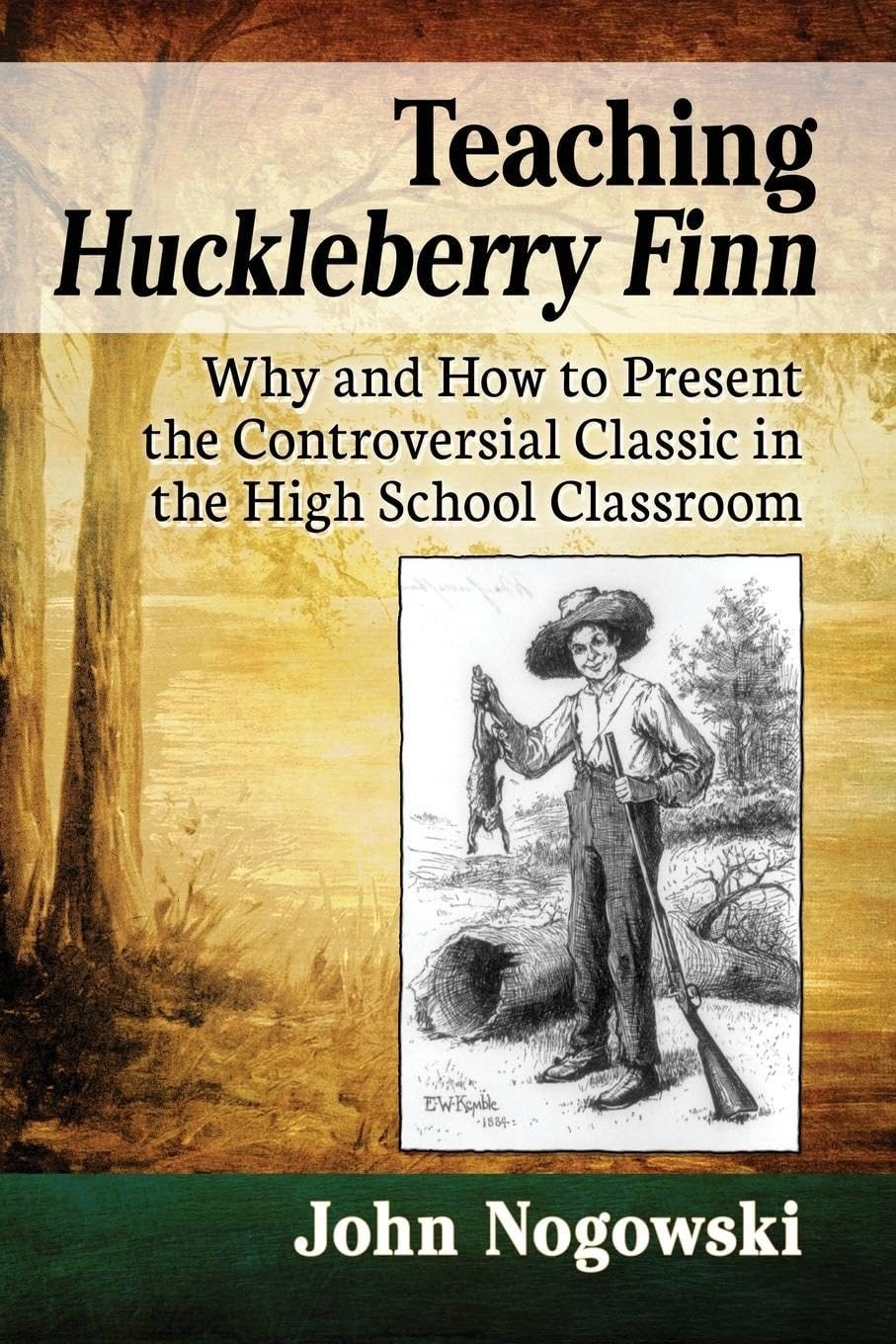
“Teaching Huckleberry Finn” is available on Amazon or by order at your bookstore.
“We got Twain when we got him, and thank goodness we did, and God help the culture that pretends that earlier stupidities never happened and tries to eradicate all evidence of them.” George Saunders, “The United States of Huck.”
It was a full quarter-century ago that the estimable George Saunders wrote “The United States Of Huck” as the Introduction to a new edition of Mark Twain’s “Adventures of Huckleberry Finn.” In full disclosure, Mr. Saunders was kind enough to allow me to reprint his superb Introduction in my own book, “Teaching Huckleberry Finn.” It was something I used in my classroom as part of our discussion of Twain’s book and a way to help my students, almost all African-American, examine the many sides of his controversial novel.
His words - “We got Twain when we got him” - rang in my reddening ears as I sat in Thomasville’s “The Bookshelf” the other day, reading Ruth Franklin’s “Twain Town U.S.A.”, an essay that appeared in the latest issue of “The American Scholar.” A day earlier, I’d read a lengthy - but fascinating -- story in Harper’s Magazine by John Jeremiah Sullivan called “Twain Dreams.” Mr. Clemens died in 1910 but his words haven’t.
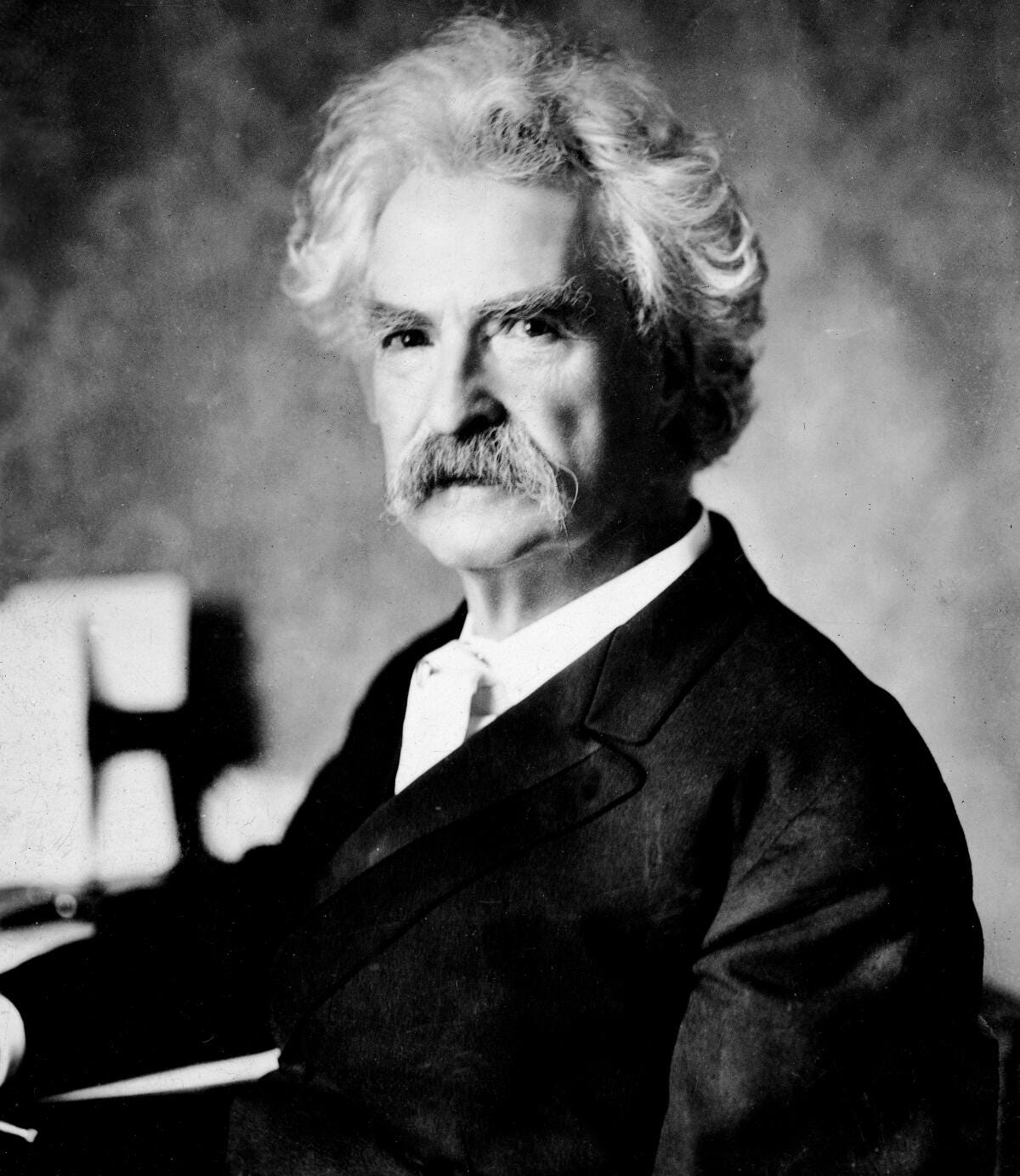

On Mark Twain: “We got Twain when we got him” says author George Saunders
Mark Twain certainly doesn’t need some cranky old retired teacher sitting in his den coming to his defense. But I want to do it anyway. Judging a 141-year-old book - and its author - by contemporary standards and values and prejudices seems, to me at least, wrong-headed and unfair. Now, I recognize Ms. Franklin certainly is an accomplished literary critic and “The American Scholar” always seems to have something worth thinking and talking about in every issue.
But her “Twain Town U.S.A.” seemed to take aim at Twain and the undeniable cultural impact of both the “Adventures Of Huckleberry Finn” and “The Adventures of Tom Sawyer,” as if some of the built-in wrongs of American society could be pinned to these novels. That’s how I read it, anyway.
Her story takes place in Hannibal, Missouri on the Fourth of July on National Tom Sawyer Day, now in its 70th year, where the town has what seems to be a fierce competition to name a “Tom Sawyer” and “Becky Thatcher,” after characters in Twain’s novel. And Twain, as Franklin notes, is big business in Hannibal.
There’s the Mark Twain Boyhood Home, The Mark Twain Cave, “the Mark Twain Casino, Becky’s Old Fashioned Ice Cream Parlor & Emporium, Clemens General Store, and more. Even a bottled-water vending machine bears a quote from Twain: “High and fine literature is wine, and mine is only water; but everybody likes water.””
Of course, this is way over the top but can we blame Twain for that? And how are we supposed to remember literature from that time? For what it brought us or what it didn’t?
Franklin notes Twain’s complex history. “A child of slave owners, he married into an abolitionist family and ultimately wrote “Adventures of Huckleberry Finn,” which is generally acknowledged as one of the greatest works of American literature, with a deeply antiracist message.
“At the same time, the book has been criticized and even banned for its frequent use of the n-word and perceived racial stereotyping. The runaway success of Percival Everett’s 2024 novel “James,” a retelling of the Huck Finn story from the perspective of Jim, the enslaved man who is Huck’s companion, shows that interest in Twain remains high even as contemporary readers increasingly acknowledge the ways in which his books inadequately represent the experience of Black people.”
I had to read that again. “his books inadequately represent the experience of Black people.” It was written 141 years ago. To have the most popular writer in America, just twenty years after the Civil War, take on racism - and let’s face it, that is the central topic of the book - didn’t that take considerable artistic courage? This was just 20 years after the Civil War, with veterans on both sides still alive and, we presume, reading.
Should we have expected Twain to be able to “adequately present the experience of Black people?” In 1885? Were there a lot of American authors at that time willing to take on the issue of race? I must have missed that chapter in American Lit.
Franklin’s assessment of Everett’s “James,” a re-telling of Huck Finn, this time from the perspective of Jim, the runaway slave, “shows that interest in Twain remains high.” That’s one way to look at it.
Another might be to suggest it’s literary revenge, of a sort. “I’m going to bring back Jim and, uh, I’ll make him an intellectual.” In other words, Twain was really selling Jim short, so Everett took the ball and really ran with it. As Sullivan notes in Harper’s “Twain Dreams,” that’s a bit much.
“The place where Everett has left himself open to the most obvious criticism is in his decision to make James an intellectual. The man is not merely intelligent, in other words, in the way that any healthy, alert person might be. He is instead a highly literate and systematic thinker, who, when he dreams, is visited by John Locke and Voltaire. They discuss such topics as the nature of civic equality and natural rights and the real-world responsibilities of philosophers. It’s absurd….”
Whatever your thoughts on Twain, his use of the “N-word” (for authenticity, in my view - that’s how people spoke then) he clearly and I think bravely depicted Jim as uneducated but nurturing, caring and loyal. Was it a perfect portrait? No. But does the reader, particularly then, come away from the book, thinking Jim is the hero, the best person in the novel? Let me say that again. Particularly then.
Maybe I’m naive, but I think that was Twain’s intent. In 1885! And in spending a dozen years in a classroom teaching the novel to an audience of young African-Americans, it worked for many of them. One student wrote me: “Mr. Nogo: Huck is the brother I never had.” Another student skipped his lunch, walked all the way across the campus to ask me one question. “I’ve gotta know, Mr. Nogo. Will Jim get to Cairo today?”
There are other issues with “Twain Town, U.S.A.” that seem wrong-headed. When Franklin describes the engagement scene between Tom and Becky, “During our conversations, I asked some of the Beckys whether they were troubled by the gender dynamics, but no one took the bait.” The “gender dynamics”? What would Twain have done with that phrase?
Franklin also discovers a one-room museum opened by G. Faye Dant called “Jim’s Journey: The Huck Finn Freedom Center” that explains Hannibal’s Black history, which, her “Twain Town, U.S.A.” makes clear isn’t something citizens spend much time with.
“People that like American literature … are some of our brightest people,” G. Faye Dant tells me. “But they go right over there to Huck Finn’s house and don’t walk across the street to Jim’s place. A lot of people don’t want to make that connection.”
Is that all that surprising? You’re in Hannibal and if you’re there, chances are you came to find out about Mark Twain, not America’s unforgivable sin, slavery. There is no getting around it, slavery happened. And I don’t know that we’ll ever get over it.
When I drove to the South from Michigan thirty-four years ago, I remember going around a corner in Georgia and coming upon an empty cotton field. And I choked up. “My God. Slavery happened here.” I had to pull over.
As Sullivan notes in closing “Twain Dreams” he quotes the American historian Arthur G. Petit: “Twain befriended Frederick Douglass, financed a black artist’s apprenticeship in Paris, and supported several black students through Yale Law School. As Mark Twain he lectured in all-black churches, championed the cause of Booker T. Washington, wrote blistering essays about atrocities committed against blacks, and gave large doses of dignity and power to three of the outstanding black characters in nineteenth-century literature. He began his career as a segregationist, turned himself into a champion of interracial brotherhood, and ended his life as a prophet of racial war.
“ “Having learned about the man’s protean personality,” Pettit writes, “we find that his feelings on race and region move in an intelligible direction . . . there is a clearly traceable movement away from the white South and toward the black race.”
In “Twain Town, U.S.A.” Ruth Franklin doesn’t seem to see that side of Mark Twain. Or that Hannibal is doing anything but perpetuating the Twain myth, which, to her, seems so wrong, so one-sided.
It’s as if, in 1885, Mark Twain had only been able to see into our future and tell the real story instead of fanciful tales like “Adventures of Huckleberry Finn” and “Adventures Of Tom Sawyer.”
As Saunders said in “The United States Of Huck,” “we got Twain when we got him and thank goodness we did…”
Author John Nogowski has written several books, two on baseball - “Last Time Out” and “Diamond Duels,” two on music “Bob Dylan: A Descriptive, Critical Discography and Filmography” and a similar volume on Neil Young due in 2027 and “Teaching Huckleberry Finn” on my classroom experiences. All are available on Amazon. Currently at work on a book about Bruce Springsteen, he’s a regular contributor to the Hartford Courant.
No posts
Comments
Nothing yet. Say the first thing.
Sign in to join the conversation.