
Warning:
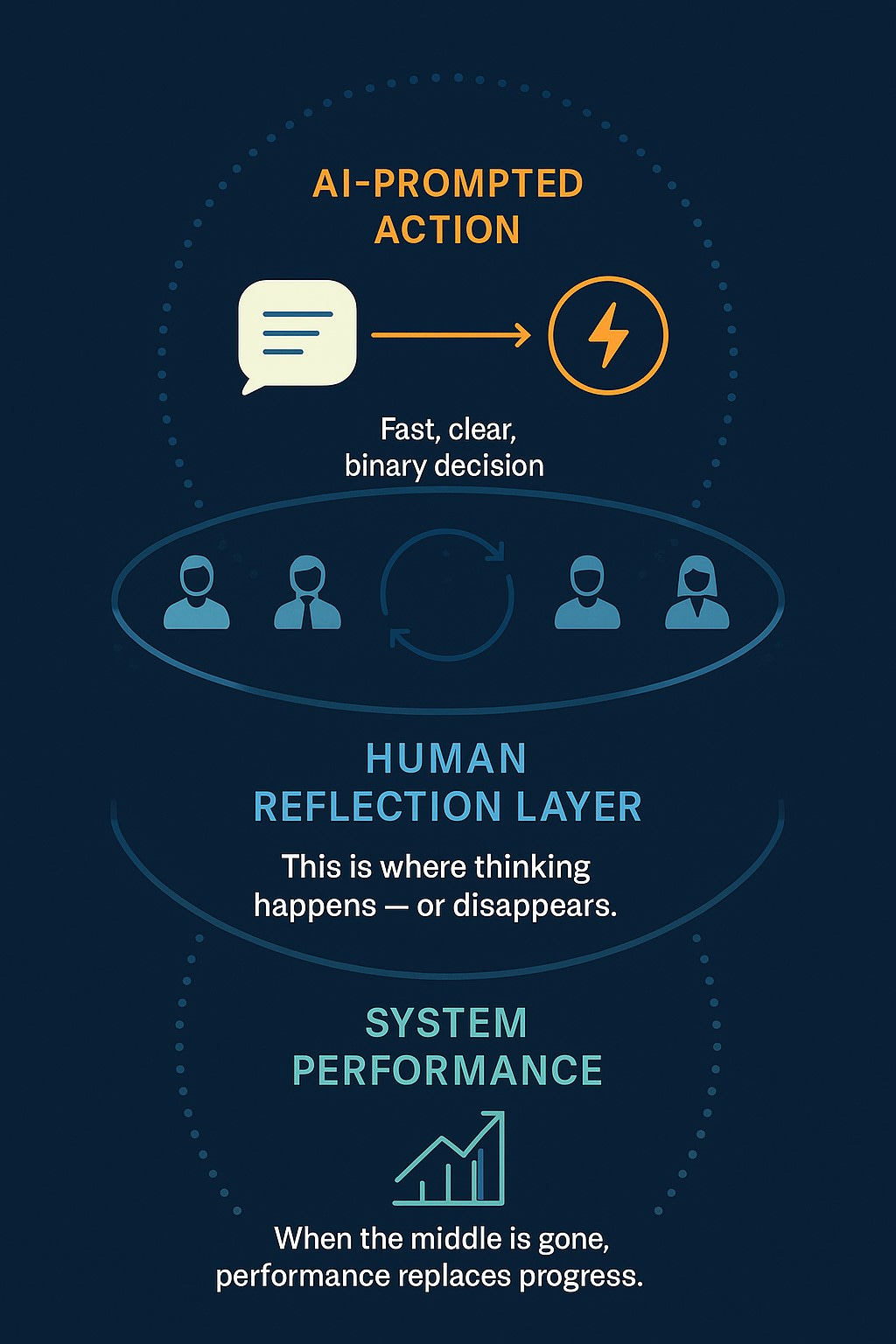
"If you allow AI to replace the middle layer of your organisation, you eliminate critical thinking capability forcing binary choices through digital solutions. In other words, digital silos."
Insight:
In every healthy system, organisations, governments, even families, there’s a middle. Not the most visible, not the most radical. But critical.
The middle makes meaning, sense-checks signals, and translates strategy into practice. It questions, ridicules and challenges thereby ensuring resilience in decision making.
But AI, in its current use, doesn’t reward that work. It amplifies the extremes:
Top-end strategic prompts
Bottom-end execution
No room for the integrators, analysts, translators, bridge-builders
This isn’t just about job roles. It’s a cognitive restructure.
AI tools simulate decisiveness by collapsing nuance.
They bypass the slow, necessary friction that keeps systems resilient. Yes, by removing this element we can speed decisions. But what are we accelerating? How will we know?
The irony? We adopted AI to unlock complexity and ended up forcing it into digital binary silos.
AI was meant to help us think more deeply. Instead, we now think more like the machines we built, prompt-response logic, false clarity, binary resolution.
And when we mistake that for intelligence, we don’t just cut costs,
we cut off feedback, learning loops and originality.
Klarna & the Algorithmic Edge
In 2023, Klarna reported that its AI assistant was handling two-thirds of customer service chats and had enabled a reduction of over 700 roles in its customer operations team. While the company highlighted gains in speed and efficiency, analysts and internal feedback suggest a more complex picture.
Employees raised concerns about morale, de-skilling, and the loss of contextual judgement i.e. the roles once filled by mid-level interpreters of nuance. Industry analysts noted that while the system now moves faster, its ability to listen, adapt, and handle edge-cases appears diminished.
Is this, in time, creating a skills void that will be a critical differentiator for competing organisations? Should we hold the middle ground?
F.I.X. Insight:
"Every system needs a reflective layer, the space for learning, sense-checking, and surfacing nuance. It’s where metrics are applied, trade-offs are examined, and unseen opportunities emerge. In the F.I.X. Framework, we prove empirically that failure does not exist, it's only unmeasured progress. Remove this layer, and AI’s binary lens frames all deviation as failure, eliminating the very signals that spark adaptation. Without it, we are unable to eXcel, we are unable to evolve."
When Insight is removed from the loop, systems breakdown and we risk optimising the wrong solution.
Best Practice for AI Leadership
How can we integrate AI without losing the middle ground?
Name the middle, what roles, voices, or bridge-functions are at risk of erasure?
Measure reflection, how will your system pause for reflection, not just perform?
Design in dissent, if AI closes decisions faster, who ultimately owns them, who re-opens them, who signs off on them?
Role Mapping Examples:
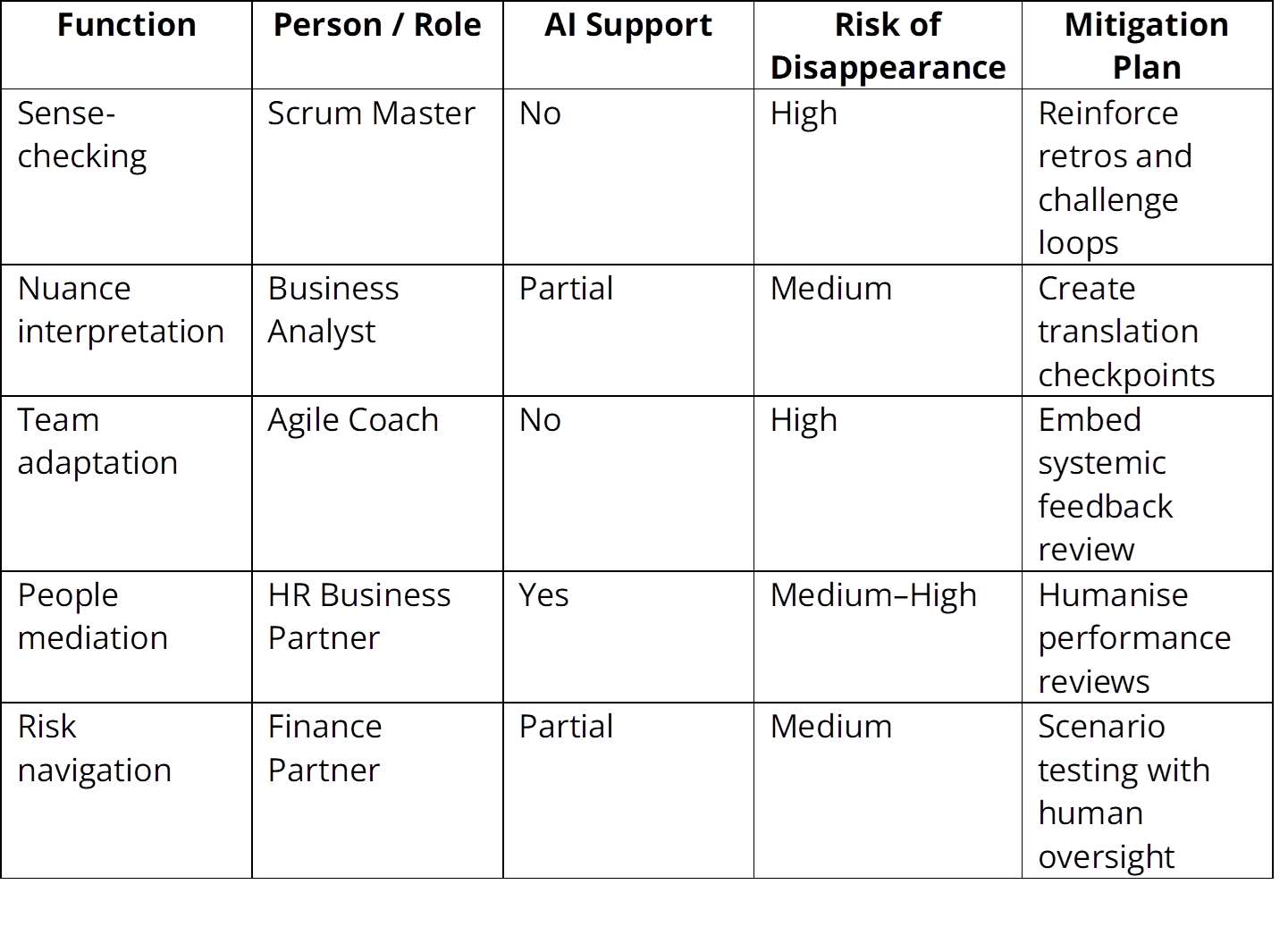
Don’t just deploy AI to move faster. Use it to think better, by designing it to work with, not against, your system’s reflective layer. That means preserving the middle: the roles that ask better questions, challenge assumptions, interpret signals, and hold ambiguity long enough to surface true opportunity, navigate the real risk, and crucially, bring others on the journey. The middle connects insight to action, not just through logic, but through language, trust, and shared understanding.
F.I.X. Reflective Layer Audit Tool
When the middle layer erodes, across Agile, HR, Finance, Ops, or delivery teams, organisations lose more than roles. They lose reflection, translation, dissent, and most importantly, resilience. These functions aren't optional; they are systemic safeguards.
Here’s what’s really at stake:
Agile Teams: Without Scrum Masters, Analysts, or Coaches, iterative loops collapse into delivery sprints with no learning.
HR: When AI automates “performance” tracking, but no one holds space for feedback, trust and development disappear.
Finance: Cost-efficiency becomes a blunt instrument. Long-term viability is overlooked in favour of short-term optimisation.
Team Leads / Middle Managers: Without context interpreters, strategy becomes disconnected from delivery, creating morale breakdowns and micro-failures that compound.
The Competency Collapse:
When reflective capacity is lost, core competencies like judgement, adaptability, trust-building, and systemic foresight decay. These don’t fail loudly, they fade quietly, until the system no longer sees around corners.
Prompt for Action:
Where are you still holding the middle?
Where have you accidentally optimised it out?
And what would it take to rebuild it, on purpose?
Reflection:
When was the last time your AI asked, “Are you sure you want to do that?”
The middle isn't just a management tier, it's where critical thinking lives. It's the zone of translation, tension, trust, and transformation. Without it, systems move fast but learn nothing. AI may handle delivery, but it cannot replicate the relational glue or reflective pause that the middle provides.
Where is your middle held, and where is it missing or being eroded?
Ask yourself:
Where do reflective roles still exist in your system, and where have they been quietly removed?
Which decisions are happening too quickly, with no space for debate or dissent?
Where has clarity been prioritised over context, or performance over progress?
Can you rebuild your middle layer, intentionally, using AI as a partner rather than a proxy?
This means:
Designing AI to support human insight, not replace it
Embedding roles that translate data into action and emotion into understanding
Protecting the cadence of feedback, interpretation, and sense making
And above all:
Who is architecting this middle?
Who is safeguarding learning, dissent, and adaptation?
Is your system sensing and evolving, or simply executing and optimising?
The middle is where leadership lives.
Rebuilding it is not a technical fix. It’s a strategic decision.
Is your AI strategy helping people come with you, or quietly replacing the ones who would have guided them?
Here’s a concise yet powerful summary of the F.I.X. Reflective Layer Audit Tool and why it matters:
What It Is
The F.I.X. Reflective Layer Audit is a strategic self-assessment tool designed to help organisations identify whether they are preserving or losing their critical “middle layer” the space where reflection, context, interpretation, and challenge live.
It guides you to evaluate how AI is impacting your system’s ability to:
Learn from tension
Pause for interpretation
Translate data into wisdom
Make decisions that evolve, not just execute
Why You Should Use It
1. To Detect Silent Erosion
Most systems don’t announce when they’ve lost critical thinking, they just move faster and miss more. This tool helps you find where reflective roles (Scrum Masters, Analysts, HR partners, Coaches) are disappearing without being replaced by design.
2. To Prevent Binary Blindness
Without a reflective layer, AI systems frame all outcomes as success or failure. This tool helps you spot where nuance, trade-offs, and adaptive signals are being ignored and helps you rebuild the space for learning.
3. To Make Reflection Measurable
Using a clear scoring model across three categories
Middle Function
AI Overlay Risk
Signals of System Fragility: the audit gives you a total score to assess the integrity of your reflective loop.
4. To Redesign the Middle, Not Just Observe Its Absence
You’ll map current and missing roles, interpret risk levels, and design intervention plans with guidance on how to embed or protect:
Sense-checking
Human interpretation
Feedback design
Trust and shared meaning
Core Message:
“The middle is not a management layer. It’s where your system learns, evolves, and avoids collapse.”
Comments
Nothing yet. Say the first thing.
Sign in to join the conversation.