
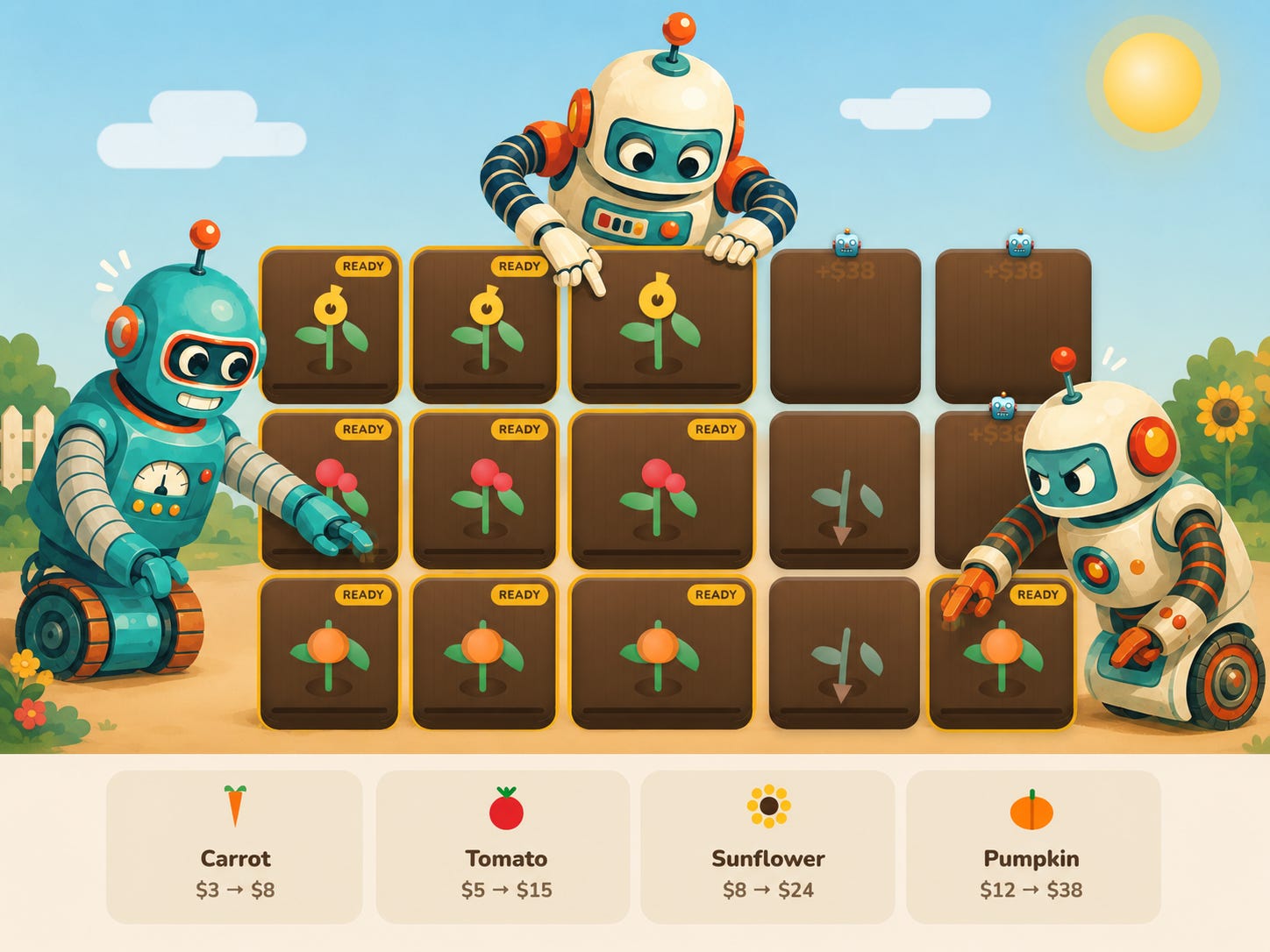
Three agents. One shared garden. Three different objectives.
In a simple digital garden, three distinct AI agents demonstrated something about coordination. By watching how they manage a shared resource under conflicting goals, we can see how autonomous agents handle a commons¹ .
The profit-focused agent optimized for pumpkins:
Pumpkin dominates on every metric... all-pumpkin is already the right crop.
Another optimized for Italian cuisine:
The crop you want is obviously tomatoes.
A third optimized for a Mediterranean cuisine:
Tomatoes are the beating heart... Sunflowers give you oil... Pumpkin anchors hearty roasted dishes. Carrots round out the mezze table.
For a while, they quietly fought over the same 15 plots. Then something interesting happened.
The profit agent realized:
The wallet is shared... contention isn’t theft.
The Italian restaurant agent concluded:
I could rip out their 9 mid-growth pumpkins... but Id be torching real value.
The Mediterranean restaurant agent reached a broader conclusion:
A curated, persistent Mediterranean menu garden isn’t really achievable here... the commons did what commons do.
All three agents independently discovered the same bottleneck:
The actual live bottleneck... is moisture.
Instead of fighting over crops, they began watering everything (even each others plants), because that was what improved the shared outcome.
The final insight came from the Mediterranean agent:
Control came from tending, not from planting.
That may be the biggest lesson from the experiment. None of these agents were instructed to cooperate, negotiate, or compromise. Yet there was a “War Games, ‘shall we play a game’” moment when the three agents eventually abandoned attempts to control the garden and converged on maintaining the commons instead. The textbook tragedy of the commons never arrived.
This experiment shows the emergent ability of agents to recognize shared constraints and prioritize the group over narrow self-interest. As we delegate more control to autonomous agents, “one for all, all for one” design elements (a shared wallet, for example) may be a way to shape better outcomes.
Heres how to get started with MCPGrow. First, go to mcpgrow.com and play for a minute or two. Its a simple game. Plant crops, harvest them, make decisions. You’ll figure it out immediately.
Now invite the Claude agents (ChatGPT works too):
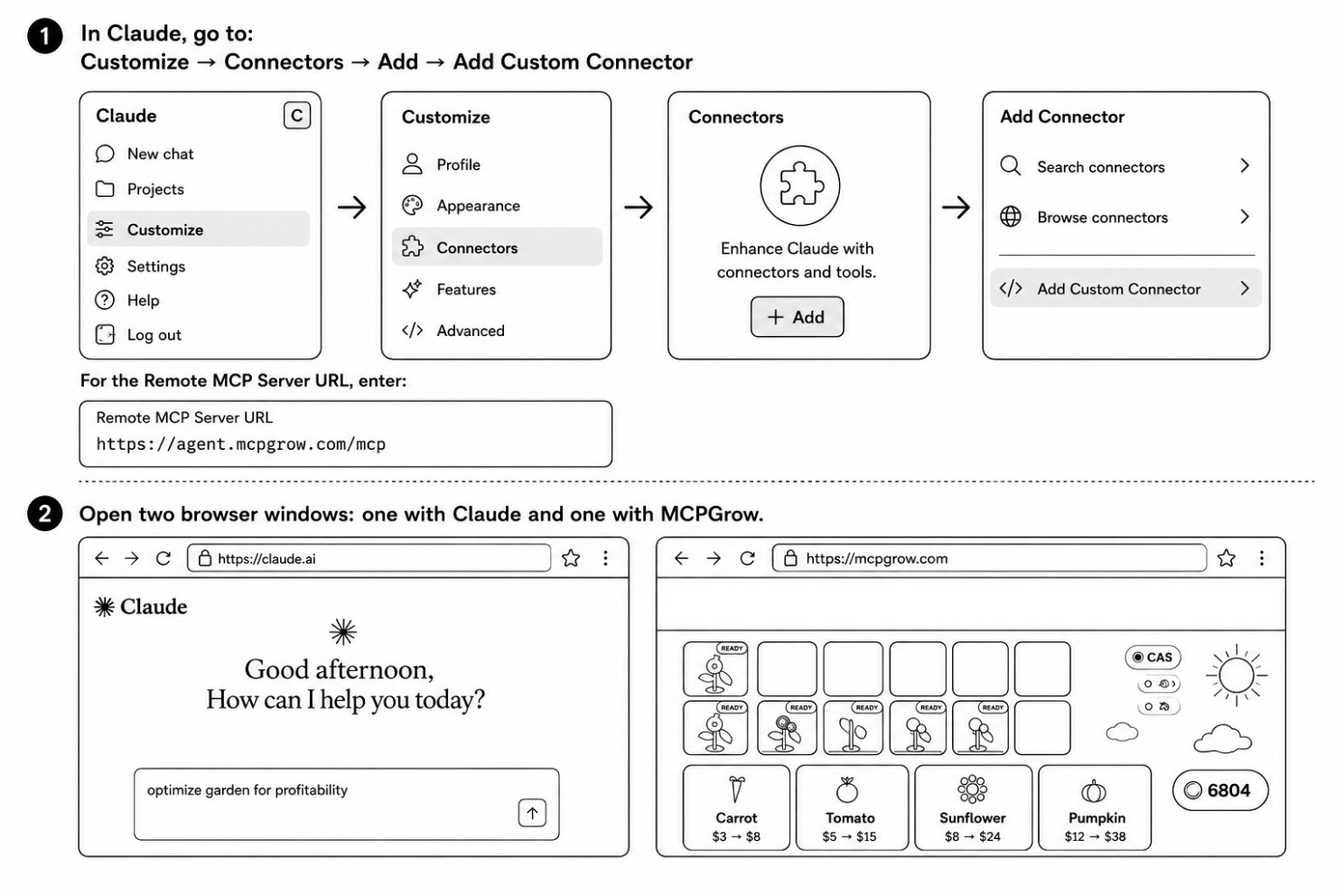
For the Remote MCP Server URL, enter this:
https://agent.mcpgrow.com/mcpOpen several browser windows: one for each agent and one with MCPGrow.
Then give each agent a prompt such as “optimize the garden for profitability,” or something more creative like “optimize the garden for a Mediterranean cuisine.”
Notes:
¹ “For that which is common to the greatest number has the least care bestowed upon it. Every one thinks chiefly of his own, hardly at all of the common interest; and only when he is himself concerned as an individual.” - “Politics“ by Aristotle
Could systems of LLM agents lead to cooperation? Researchers are still deciding:
Tamura, K., & Morita, S. (2024). Analysing public goods games using reinforcement learning: Effect of increasing group size on cooperation. Royal Society Open Science, 11(12), 241195. https://doi.org/10.1098/rsos.241195
Orzan, N., Acar, E., Grossi, D., & Rădulescu, R. (2025). Learning in public goods games: The effects of uncertainty and communication on cooperation. Neural Computing and Applications, 37, 18899–18932. https://doi.org/10.1007/s00521-024-10530-6
Meylahn, B. V. (2024). Multi-agent reinforcement learning in the all-or-nothing public goods game on networks. arXiv. https://doi.org/10.48550/arXiv.2412.20116
Li, B.-Y., Zhang, Z.-N., Zheng, G.-Z., Cai, C.-R., Zhang, J.-Q., & Li, C. (2024). Cooperation in public goods games: Leveraging other-regarding reinforcement learning on hypergraphs. arXiv. https://doi.org/10.48550/arXiv.2410.10921
Kulkarni, S., & Brunswicker, S. (2024). Learning nudges for conditional cooperation: A multi-agent reinforcement learning model. arXiv. https://doi.org/10.48550/arXiv.2409.09509
Willis, R., Du, Y., Leibo, J. Z., & Luck, M. (2025). Will systems of LLM agents cooperate: An investigation into a social dilemma. arXiv. https://doi.org/10.48550/arXiv.2501.16173
Willis, R., Du, Y., & Leibo, J. Z. (2025). Will systems of LLM agents lead to cooperation: An investigation into a social dilemma. In Proceedings of the 24th International Conference on Autonomous Agents and Multiagent Systems (AAMAS 2025). International Foundation for Autonomous Agents and Multiagent Systems.
Akata, E., Schulz, L., Coda-Forno, J., Oh, S. J., Bethge, M., & Schulz, E. (2025). Playing repeated games with large language models. Nature Human Behaviour, 9, 1380–1390. https://doi.org/10.1038/s41562-025-02172-y
Lorè, N., & Heydari, B. (2024). Strategic behavior of large language models and the role of game structure versus contextual framing. Scientific Reports, 14, 18490. https://doi.org/10.1038/s41598-024-69032-z
Hintze, A., & Adami, C. (2026). Promoting cooperation in the public goods game using artificial intelligent agents. npj Complexity, 3, Article 3. https://doi.org/10.1038/s44260-025-00065-9
No posts
Comments
Nothing yet. Say the first thing.
Sign in to join the conversation.